
Lewis Hamilton cost Ferrari victory and Ocon’s career-ending black eye
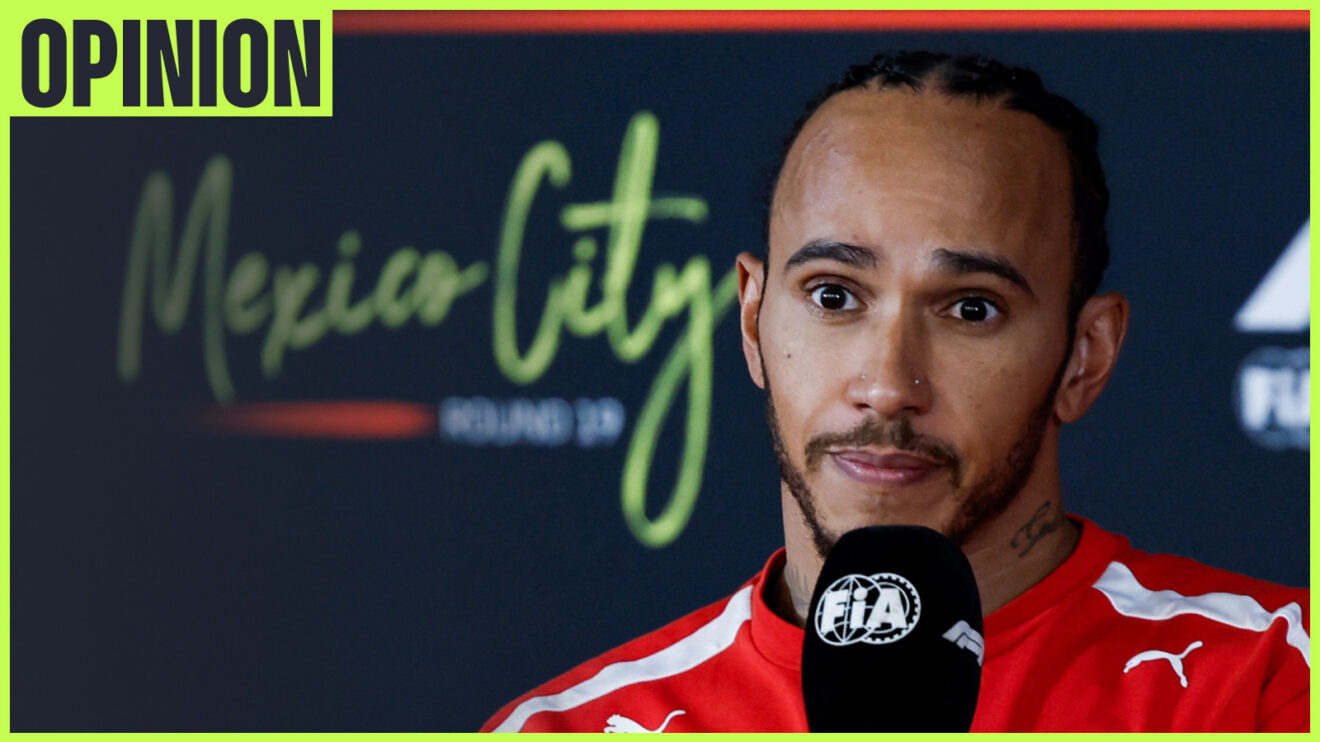
Lewis Hamilton cost Ferrari a chance at a one-two in the Mexican GP.
Nobody in Formula 1 can snatch defeat from the jaws of victory with the surgical precision of Ferrari.
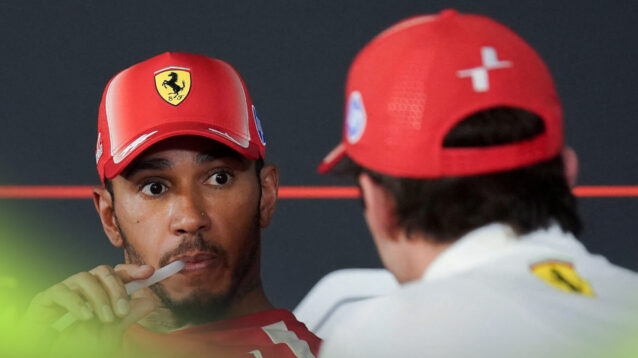
Immediately after the race-defining clash between Lewis Hamilton and Charles Leclerc, the former was already pointing fingers, but he should have been pointing them at himself.
Lewis Hamilton cost Ferrari Mexican GP 1-2
Lewis Hamilton led the Mexican Grand Prix from pole, challenged by his teammate through the first chicane. That is racing. Not especially smart racing, perhaps, but that is the fundamental point of the sport: to compete for victory.
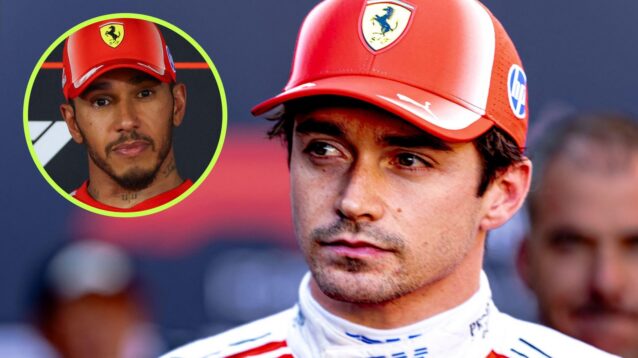
Applying that early pressure on Hamilton was the right thing for Leclerc to do, but it was disastrous for Ferrari. Where an opportunity existed to lock down the front of the race early, on a circuit where overtaking is more difficult than predicting the weather, the Monegasque driver pursued his own best interests. While F1 is often seen as an individual sport, in reality it is a team game, and it is the Scuderia which, in this instance, should have come first. And probably second.
Instead, Leclerc’s attempt to scythe up the inside of Hamilton at Turn 1 and squabble through Turn 2 planted the seeds of discontent that came to fruition in the run-off at Turn 4. It was utter stupidity on the part of both drivers. While Leclerc was within his rights to attack, was it the wisest move at the start of the race when his teammate was leading? Probably not.
But for Hamilton to escort Leclerc off the road was perhaps even more ridiculous. While Leclerc challenged within the limits of the regulations, his teammate defended by feeding him into the weeds in a move that saw Hamilton leave the road, too. In what world is that acceptable behaviour between teammates? Through their combined pig-headedness, Ferrari lost control of the race and handed Max Verstappen the win.
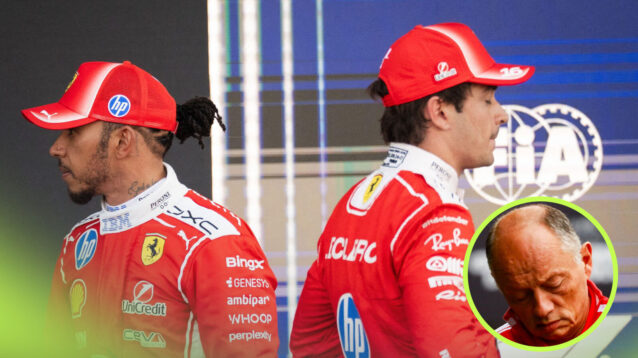
Fred should be furious. Lewis is.
That fury, though, is unfounded. While he has a point in feeling aggrieved that his teammate challenged him at a delicate point in the race, he would also do well to heed the advice one M. Masi once offered his employer: “It’s called a motor race.” Hamilton’s reaction, leaving Leclerc with no option but to leave the road, was inexcusable and deserves to be punished by Ferrari’s management.
You might argue that it was Leclerc who was in the wrong. His penalty proves as much, but that’s a separate issue, and one for which Ferrari also needs its knuckles rapped. Consider the entry into Turn 4: with Leclerc on the outside and his teammate to his left, how could he possibly have made the corner without driving into Hamilton? Hamilton was on the verge of losing control and clearly wasn’t going to make the corner. He forced the Ferrari pair into that position. What followed was a consequence of that. For Hamilton to then lay the blame at Leclerc’s feet is borderline delusional. He didn’t like being attacked, became overly aggressive in defence as a result, and cost Ferrari a one-two finish. That was a consequence of his actions, not Leclerc’s.
What followed, if we are to believe Leclerc, was a failing of the Ferrari pit wall.
Or, to put it more accurately, another failing of the Ferrari pit wall.
It was clear in the immediate aftermath that, by cutting through the grass, Leclerc had gained a lasting advantage. It was a point discussed in the drivers’ briefing and clarified by race director Rui Marques in his notes to teams ahead of the race.
“All cars will, by default, be considered as both attacking and defending,” he wrote in a communication issued to teams after qualifying. “Thus, in line with existing guidelines, any car leaving the track in these areas and maintaining a position to a car or cars within close proximity behind (as determined by the stewards) may be considered as gaining a lasting advantage, unless such position is yielded … by Turn 12.”
It was there, spelled out in black and white and agreed upon by the drivers, yet Ferrari seemingly chose to ignore it. According to Leclerc, at no point was he told to give up the place. His fate was therefore entirely predictable, a time penalty, and for that not to have been appropriately communicated such that it could have been mitigated is inexcusable. Of course, if only he hadn’t been put in that position in the first place, he might have won.
George Russell adds the salt to Kimi Antonelli’s tequila
Equally inexcusable was George Russell, who hightailed it from the circuit immediately after the race. Having climbed from his car and offered the obligatory congratulations to Kimi Antonelli (the youngest ever F1 world champion, in case that fact had miraculously escaped your attention), he buggered off without speaking to the media. While his hasty retreat was made with the team’s approval, Mercedes still copped a €5,000 fine for a move that came across as petulant. Unless he’s rushed off to see his dying grandmother, what possible excuse is there to explain away an act that otherwise looks, in equal measure, unsporting and salty?
Mercedes does attempt to bill itself as something of a family team, and Russell is a product of its upbringing. And so his act looks a lot like an older brother being given permission to eat dinner in his room instead of with the family at Christmas because he didn’t get the fire truck he wanted. Of course, it cannot be easy to watch the team celebrate a world championship win he no doubt began the year thinking was his, but he is also a professional sportsman and an employee of the team. That no excuse has been offered suggests no palatable excuse exists.
Contrast that with Felipe Massa, who had the world title ripped from his clutches on the final lap of the 2008 Brazilian Grand Prix. On home soil, the greatest and most painful defeat of his career played out in front of the world. And still he climbed the podium, stood proud and owned the moment. Hamilton won that year’s title, but Massa stood a foot taller because of the magnanimous and (until recently) gracious way he accepted defeat. Russell has had months to come to terms with his failure; Massa did better with just seconds to process his. As Niki Lauda so famously once said, you learn more from losing than winning. This, it seems, has been an especially painful lesson for Russell.
Of course, none of that takes the shine off Antonelli’s accomplishment. The young Italian has delivered consistently throughout the season and is a deserving world champion. As impressive as that is, what’s even more eye-catching is that this has come in only his second season, against a field that includes two titans of F1: Hamilton and Verstappen. His rise has been meteoric, and it’s only just begun. Where Andrea Kimi Antonelli ends his career is anyone’s guess, but the ingredients are there for his name to be whispered alongside the legends of the sport.
Esteban Ocon, master of his own demise
Esteban Ocon’s probably won’t. The Frenchman’s time in F1 is over. Not just for now, not just for this season, but for good.
His mid-event ejection from Haas was an incredible, borderline unprecedented development that spoke to a significant issue behind the scenes at the plucky American-owned operation. To its credit, the team has kept quiet, refusing to be drawn on speculation about what went on. And there has been a great deal of speculation. It even prompted Ocon to take to social media to deny that the situation had become ‘physical’, and that has to be taken at face value. Stories will emerge, and many different versions already have, but only those who experienced whatever transpired first-hand will know exactly what went on – everything else is speculation. The one undeniable truth, however, is that whatever happened has left Ocon with a self-inflicted and F1-career-ending metaphorical black eye.
In the process, he’s made himself difficult to employ. Let’s not forget, this is the second time in three years that Ocon has departed a team before the end of the season, having done the same at Alpine. The specifics might be different, an agreement there was reached to release Ocon so he could join Haas for post-season testing in 2024, but consistent in that on both occasions was his employer was willing to accelerate its separation from the Frenchman.
And it’s a shame. He is fast, and he has talent; you simply don’t win a grand prix if you don’t have those qualities. The question has to be whether he’s made the most of that ability and whether his actions have served his own best interests.
The silver lining is that Ryo Hirakawa was afforded an opportunity that perhaps would never have arisen otherwise. The Japanese driver put in a fine account of himself, too. Thrown in at the deep end, he kept it on the road and scored a point for Haas. It’s a sensational return for a driver upon whom there were no expectations and, quite probably, no further opportunities.
Lose the battle, win the war
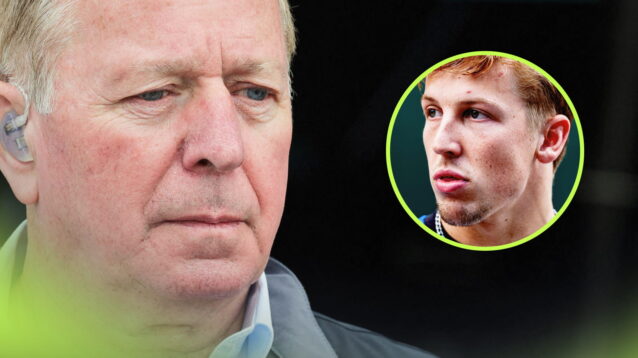
Also impressing was Liam Lawson. Not for the first time, the plucky New Zealander delivered a strong result to be classified seventh, having started at the rear of the grid. Of course, it was his mistake that left him at the back after he failed to lift off the throttle correctly following his Q2 lap. It was a tough pill to swallow, but such are the rules, and this deep into the season a driver like Lawson should know better.
The flip side of that is the ridiculous regulation that means a technical infringement results from the act of driving the car comparatively normally. While Lawson should have done better on Saturday, it’s another example that highlights the absurdity of the current regulations and the urgency with which every element of these power units needs to be unceremoniously dumped into a skip or, failing that, an active volcano.
Lawson’s Sunday result was important for another reason, too, as it highlighted his credentials and moved the narrative beyond his silly practice clash with Max Verstappen. Racing drivers are selfish and stubborn; they have to be. But those qualities are a double-edged sword. On Friday, it cut both Lawson and his former Red Bull teammate. It was all a bit unnecessary, and the one-place penalty each received was essentially the stewards banging their heads together and telling them both to behave.
The irony is that it’s the sort of thing Verstappen himself would have done, making the Dutchman’s reaction a bit over the top. And to cast aspersions about Lawson’s future on the back of it is to escalate the situation to a level it never needed to reach. Because, in reality, Verstappen was never going to clear both Lawson and the car ahead of the Racing Bulls before starting the lap. No matter what he might have been told over the radio, what Verstappen could see out of the front of his car should have prompted him to realise that backing off was the better option.
For Lawson, once Verstappen showed the nose, what was the point in fighting it? It was a practice session with no sheep stations to be won. Not that Verstappen warrants any special treatment. He might be the undisputed No. 1 within the Red Bull ranks, but what does that really mean for Lawson? Long-term, his future almost certainly has to take him away from Milton Keynes and Faenza, so standing up and showing that he wouldn’t be intimidated by Verstappen is a logical move. It’s also entirely in keeping with Lawson’s battling personality. Just ask Sergio Perez about that.
Read Next: Lewis Hamilton demands ‘serious talks’ at Ferrari after Leclerc Mexican GP clash