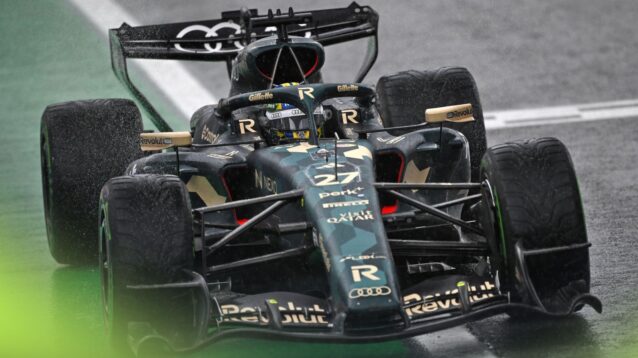

FIA makes announcement following investigation into Bahrain GP power loss
The FIA logo
The FIA has issued an update following an investigation into why cars lost power on the formation lap of the Bahrain Grand Prix in Malaysia.
Wet weather in Sepang triggered chaotic scenes with some cars experiencing a loss of power due to a software issue.
Why did F1 cars lose power before the Bahrain GP?
A hastily prepared software patch was distributed to teams at the Bahrain GP as some drivers experienced sudden power loss while on the formation lap.
It created a scenario where a number of cars had not yet completed the first of two planned formation laps behind the safety car as the leaders were poised to complete their second.
Race control elected to red flag the race to address the issue, which at the time was believed to stem from a combination of low RPM, slow speeds, the specific track configuration in Sepang, and wet track conditions.
In wet conditions, electrical power is reduced by the regulations, cutting the electrical output by around 250kW.
The FIA’s intervention resulted in the Bahrain GP in Sepang taking place without further incident, with the governing body confirming it would investigate the matter further.
“The FIA has completed a thorough review of the circumstances which necessitated the release of a Power Unit software configurations upgrade ahead of the race start of the Bahrain Grand Prix in Malaysia,” the FIA has now announced.
“The review concluded that some cars running on low engine RPM in certain circuit sectors where a 250kW power reduction was applied experienced a loss of power beyond the original intent and that could not be recovered in those sectors.
“As a result, the configuration established for the Sepang event will be reinstated for the Singapore Grand Prix should similar weather conditions be expected.
“Additionally, a further update to the wet weather software will be released for the United States Grand Prix on October 25.”
The Sepang situation saw criticism levied at the sport, with concerns the software had not been adequately tested, hence the bug manifested itself in a very public fashion.
The FIA responded to those claims, stating that testing had taken place, but that efforts would be ramped up in future.
More from PlanetF1
The Final Sector: Was Ferrari lucky in Sepang, and is the title race over?
FIA makes key decision for Singapore Grand Prix
“The review also recommended that measures would be implemented for testing of the software, recognising that opportunities for testing are limited, to make it robust as possible,” the FIA stated.
“The FIA, together with the teams and Power Unit Manufacturers (PUMs), will continue to strengthen Power Unit software testing and verification capabilities, enhancing the overall validation process through independent assessment and collaborative feedback, including input from the supplier of the standardised Electronics Control Unit (ECU).
“The FIA would like to address comments suggesting that the software had not been tested prior to its deployment.
“Before implementation, teams and Power Unit manufacturers conducted simulation exercises to validate the software package, which was subsequently tested in full-scale running during Free Practice 1 sessions at both the Belgian Grand Prix and the Dutch Grand Prix.”
Want to be the first to know exclusive information from the F1 paddock? Join our broadcast channel on WhatsApp to get the scoop on the latest developments from our team of accredited journalists.
You can also subscribe to the PlanetF1 YouTube channel for exclusive features, hear from our paddock journalists with stories from the heart of Formula 1 and much more!
Read Next: Singapore GP predictions: Verstappen win, Antonelli puts two fingers on the trophy, Perez scores