
Honda admits new turbocharger failed to solve Aston Martin’s Singapore struggles
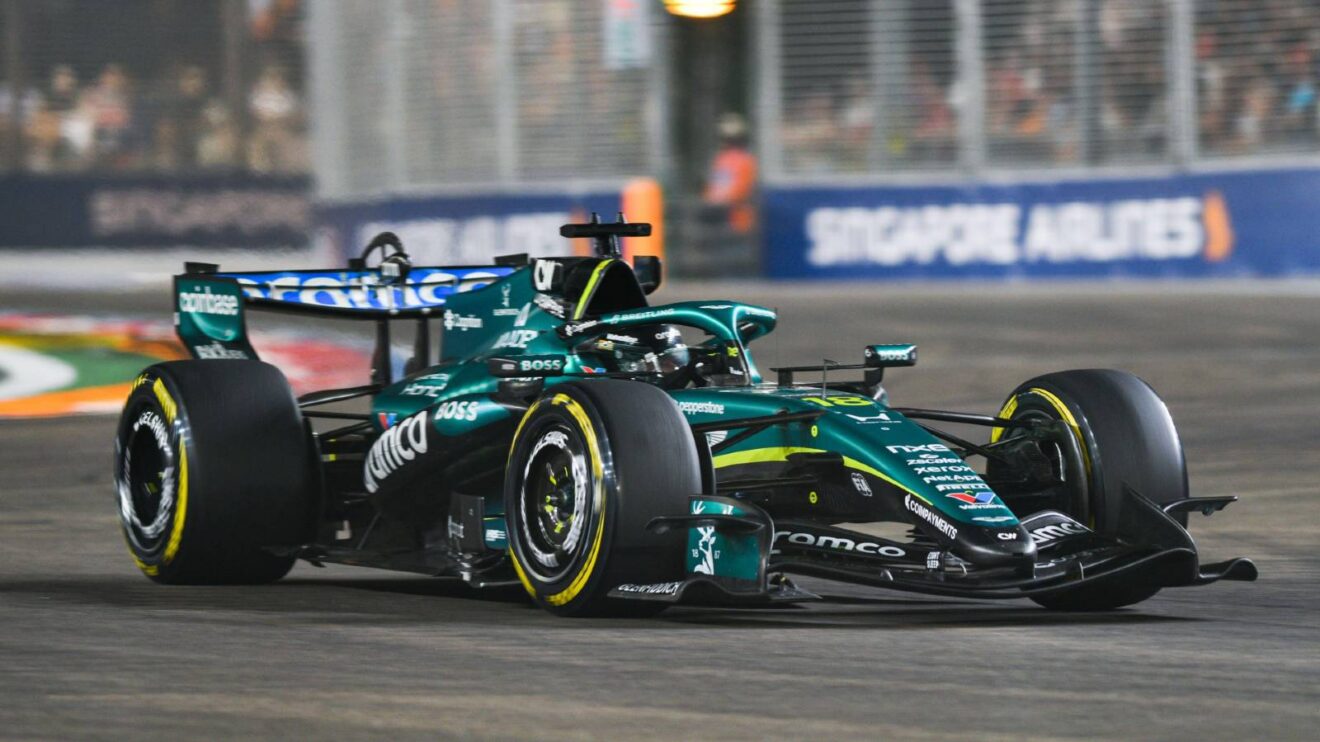
Honda introduced a new turbocharger on its power unit at the Singapore Grand Prix.
Honda has revealed that a new turbocharger, introduced in Singapore, didn’t mitigate lag issues due to the unique nature of the circuit layout.
Honda sent its power units back to Sakura in Japan after the Singapore Grand Prix, in order to carry out a full servicing and checkover before shipping the units to the United States.
Honda explains why Aston Martin continued to struggle with turbo lag in Singapore
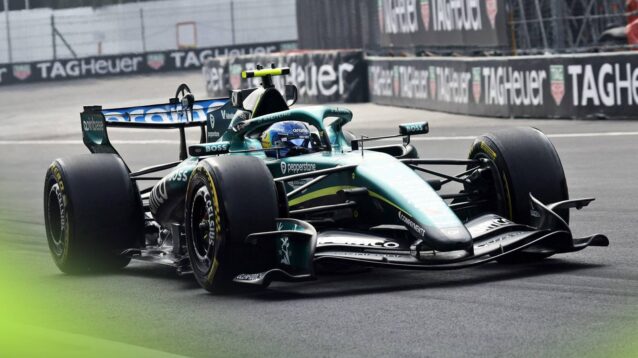
Coming off the high of a strong points finish with Fernando Alonso in Malaysia three weeks ago, Aston Martin was brought back down to earth with a bump in Singapore.
Despite it not being a particularly power-intensive circuit, a situation that meant there was some hope of another strong weekend, both drivers were knocked out in Q1 and complained about driveability issues that meant discomfort behind the wheel.
Aston Martin opted to make setup changes and break parc fermé protocol, resulting in pitlane starts for its two drivers, as well as fitting Alonso with a new turbocharger after encountering issues in the data on Saturday.
Alonso raced to 16th, while Stroll retired with a clutch issue, before Honda opted to ship its units back to headquarters in Japan for a closer look at how the power units had fared.
Speaking to the media on Thursday at the Circuit of the Americas ahead of the United States Grand Prix, Honda’s Shintaro Orihara revealed what had been uncovered as he revealed the new turbo had been introduced to try mitigating lag.
“In Singapore, we introduced a new turbocharger to manage turbo lag,” he said.
“Still, we struggled to manage turbo lag in Singapore because of the unique track layout and also the energy situation.
“Then we tried to manage turbo lag, but we still struggled to manage it, and that gave the driver an unstable acceleration feeling.
“Some good acceleration, some maybe not good acceleration coming from turbo lag. That gives some discomfort for the driver, so we expect drivers’ feedback after qualifying, and we decided to change the power unit if we see something different.
“Then [we sent the] engine back to Sakura, and we did a thorough inspection, and, at the moment, we haven’t seen major issues on our power unit, but I understand we struggled with turbo lag in Singapore, so I think it was uncomfortable for the drivers.”
With Singapore being an energy-rich circuit, meaning the drivers don’t struggle to recoup battery energy, Orihara explained that Honda has taken away some vital lessons for implementation at circuits of such characteristics.
“We have done some things from Singapore, so we are preparing countermeasures for the future,” he said.
“We understand we need to improve our control to manage turbo lag.
“At the moment, our control is not meeting driver demand. But we found something; we learned something from Singapore, and we applied some countermeasures.
“But again, we need to check how that works on our power unit.”
Asked whether there’s anything Honda can do in terms of ‘K’ deployment, ie., use of the MGU-K, to mitigate this lag issue, Orihara explained why the manufacturers’ options are limited.
“K deployment can help turbo lag, but not enough to compensate,” he said.
“So the difficulty is if we go to energy-rich tracks. Normally, we use MGU-K harvesting to compensate for turbo lag; if we have enough MGU-K harvest power, the engine can run at a high operating point in the oscillatory region.
“But if we go into an energy-rich circuit, sometimes it’s difficult to get enough MGU-K harvest value because of the energy-rich situation.
“Then, in that case, engine operation load is not enough to control turbo lag. That way, so at Singapore, and also on unique track layouts such as stop-and-go cornering, that combination gives us some struggle.”
More on Aston Martin and Honda
Honda contradicts Alonso claim after Singapore Grand Prix
Untelevised Alonso radio reveals ‘ridiculous’ engine comment
With the race in Sepang offering one of very few high points for Aston Martin this season, the failure to deliver in Singapore could be seen as very disappointing for the Silverstone-based squad, given the relative lack of circuits with ostensibly compatible characteristics for the AMR26, for which the power unit is the biggest weakness.
But chief trackside officer, Mike Krack, said the differing performance level relative to expectations simply provides more learning opportunities.
“I always call them emotional dynamics, and it came to the fact we spoke about it after the race in Singapore,” he said.
“I think Sepang probably surprised us in terms of outcome, and it raised the expectation level, maybe even beyond what was realistic.
“Then when you do not deliver it for various reasons, then everybody becomes disappointed, and it gets more difficult over the weekend. That is very clear.
“I think there are still opportunities on the circuits remaining; there will also be somewhere we will struggle.
“We know that, but you know that is part of why we do this: to really get the maximum out of it, and I think, in Sepang, we got more out of it than we were expecting, and in Singapore, it was less than we were expecting, and we need to understand that.
“Orihara-san already mentioned that drivability is something that, in our simulations, you cannot really have a clear picture of how much this will cost you, for example, if you have lag or if you have what he was mentioning on K stopping to harvest at one point, and how it affects the drivability, and this goes beyond simple sensitivity simulations.
“It’s important to regroup after such an event and try to understand why that was, in which areas we lost, and take the right learning from it, and manage your expectations a little bit better, or at least, when you manage expectations, that you have a set of risks that could affect it, which we didn’t.”
Read Next: Ferrari unveils special US GP livery with striking blueprint-inspired design