
How Antonelli outfoxed Leclerc in fascinating Belgian GP energy deployment duel


Spa data deployment battle
Charles Leclerc inherited the lead of the Belgian Grand Prix with a slice of luck, but he was ultimately unable to keep Kimi Antonelli’s visibly quicker Mercedes behind him. Although the Italian enjoyed a significant pace advantage, Leclerc put up a determined defence, producing a fascinating deployment battle between the two drivers.
How each driver tried to gain the upper hand, and how they adapted their strategies throughout the fight, can be analysed with the help of the telemetry data.
The deployment battle that decided the Belgian Grand Prix
Want more PlanetF1.com coverage? Add us as a preferred source on Google to your favourites list for news you can trust.
Leclerc made an excellent start to the race, gaining a position before benefiting from George Russell’s retirement to emerge as Antonelli’s main challenger for the lead.
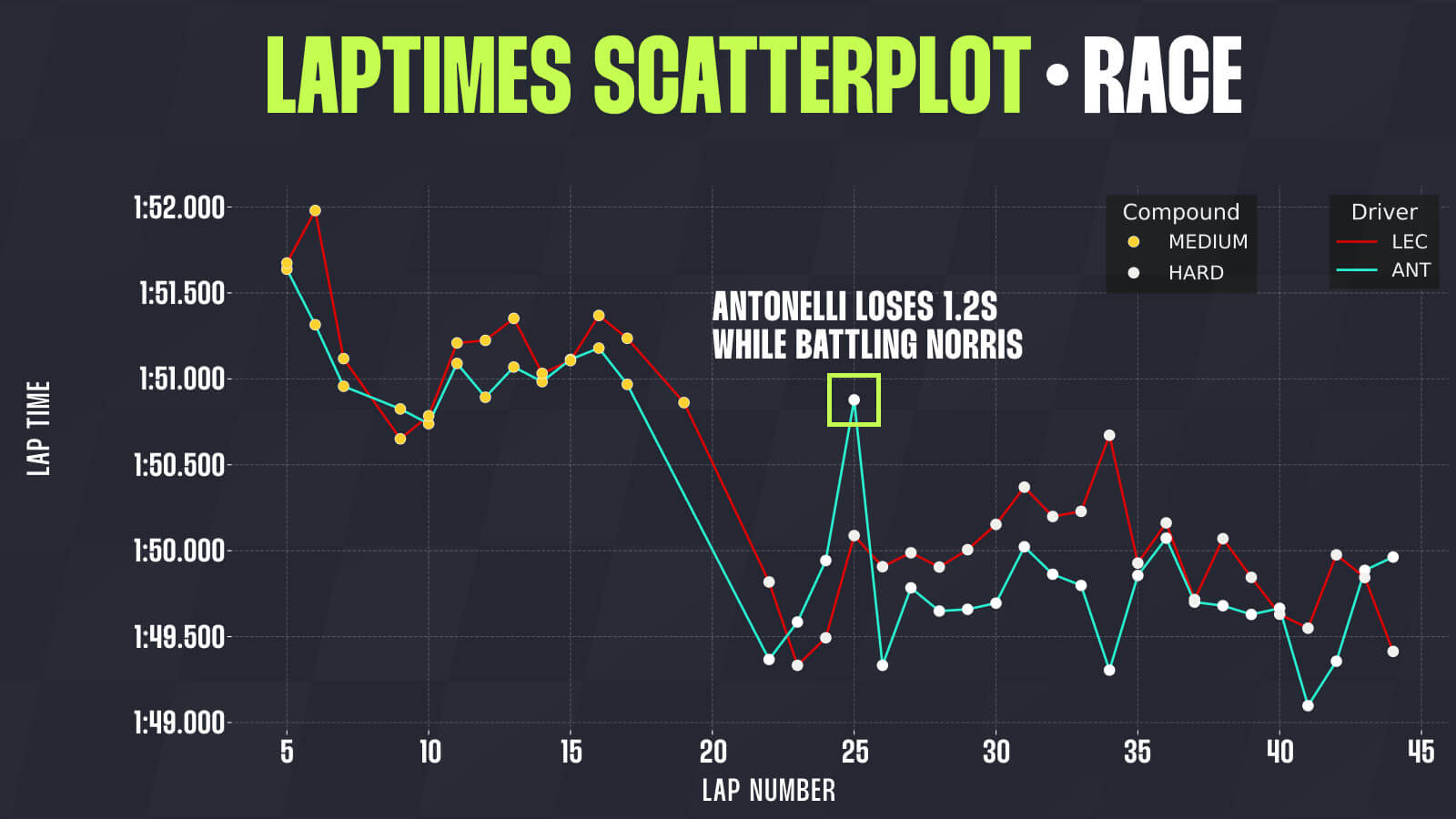
The Italian held the stronger pace, but the gap between the pair never stretched beyond 3.5 seconds, even after Antonelli lost a position to Max Verstappen and became embroiled in a battle with Oscar Piastri.
However, Leclerc truly found himself in contention after the first round of pit stops. The Ferrari driver benefitted from the timing of the Virtual Safety Car, taking advantage of a significantly cheaper pit stop.
Antonelli attempted to do the same, but the VSC ended just as he entered the pit lane, preventing him from extracting the full benefit of the neutralisation.
The graph below shows the duration of Antonelli’s and Leclerc’s pit stops, illustrating how the Monegasque regained track position over Antonelli, as well as Verstappen, who was the biggest loser from the timing of the pit-stop window.
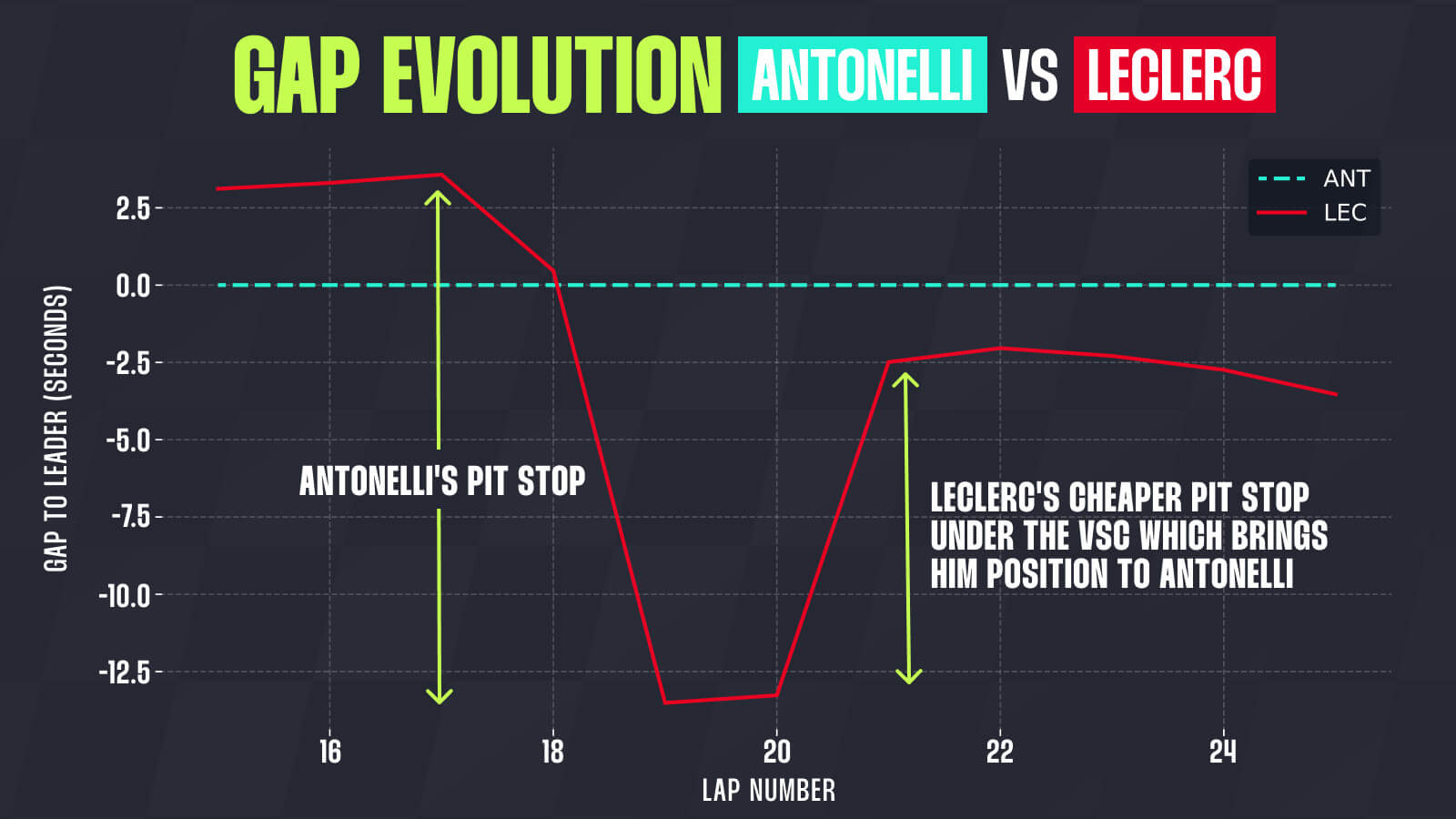
After overtaking Lando Norris, who was still completing a long stint on the hard tyres, Leclerc’s advantage over the Mercedes driver stood at just over two seconds.
Antonelli, however, took longer to pass the reigning World Champion, allowing Leclerc to extend his lead by approximately another 1.2 seconds.
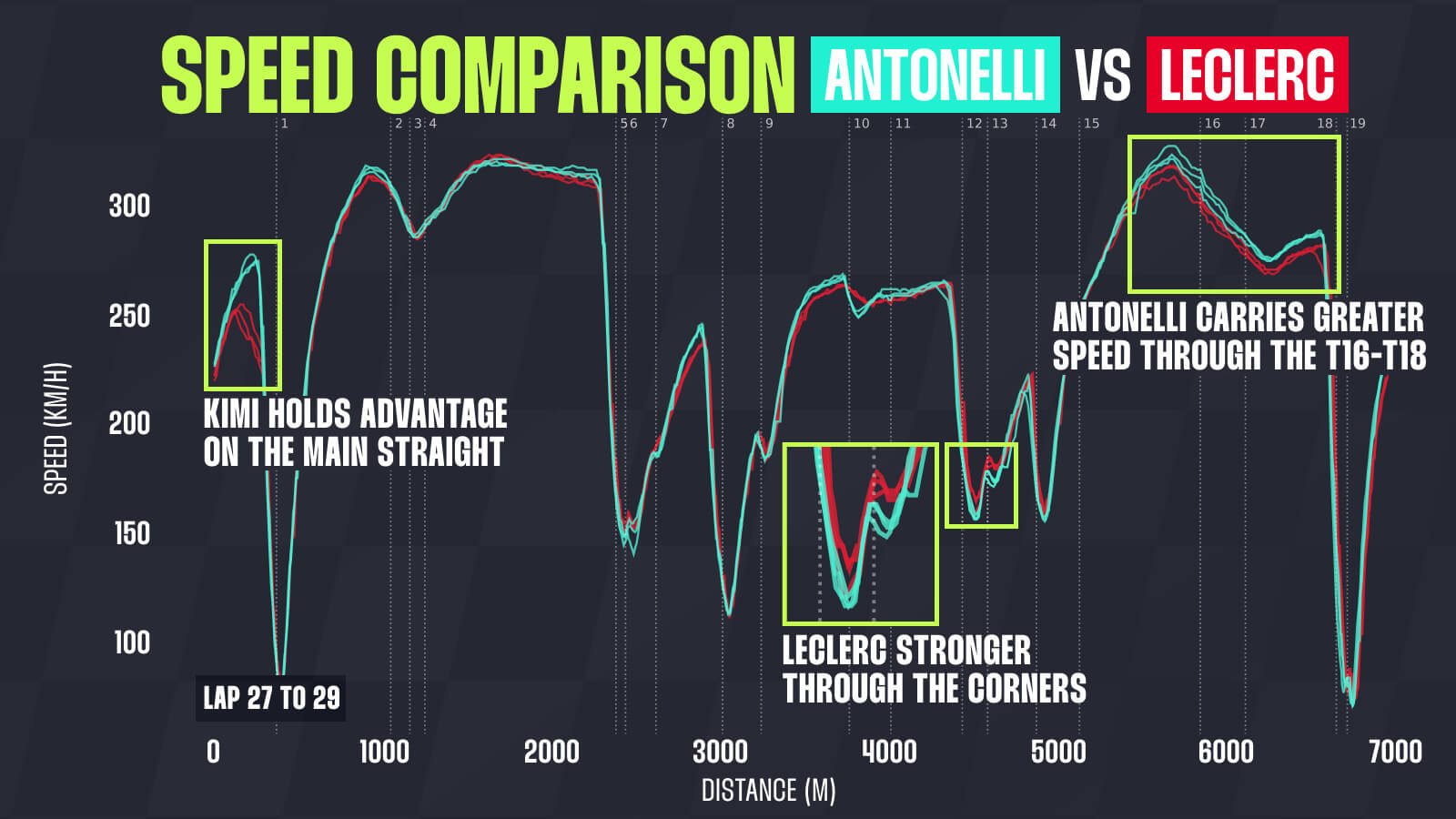
Once the Italian also cleared Norris, he began his charge towards victory, taking between two and three tenths of a second per lap out of Leclerc over the following seven laps before finally activating overtake mode on Lap 32.
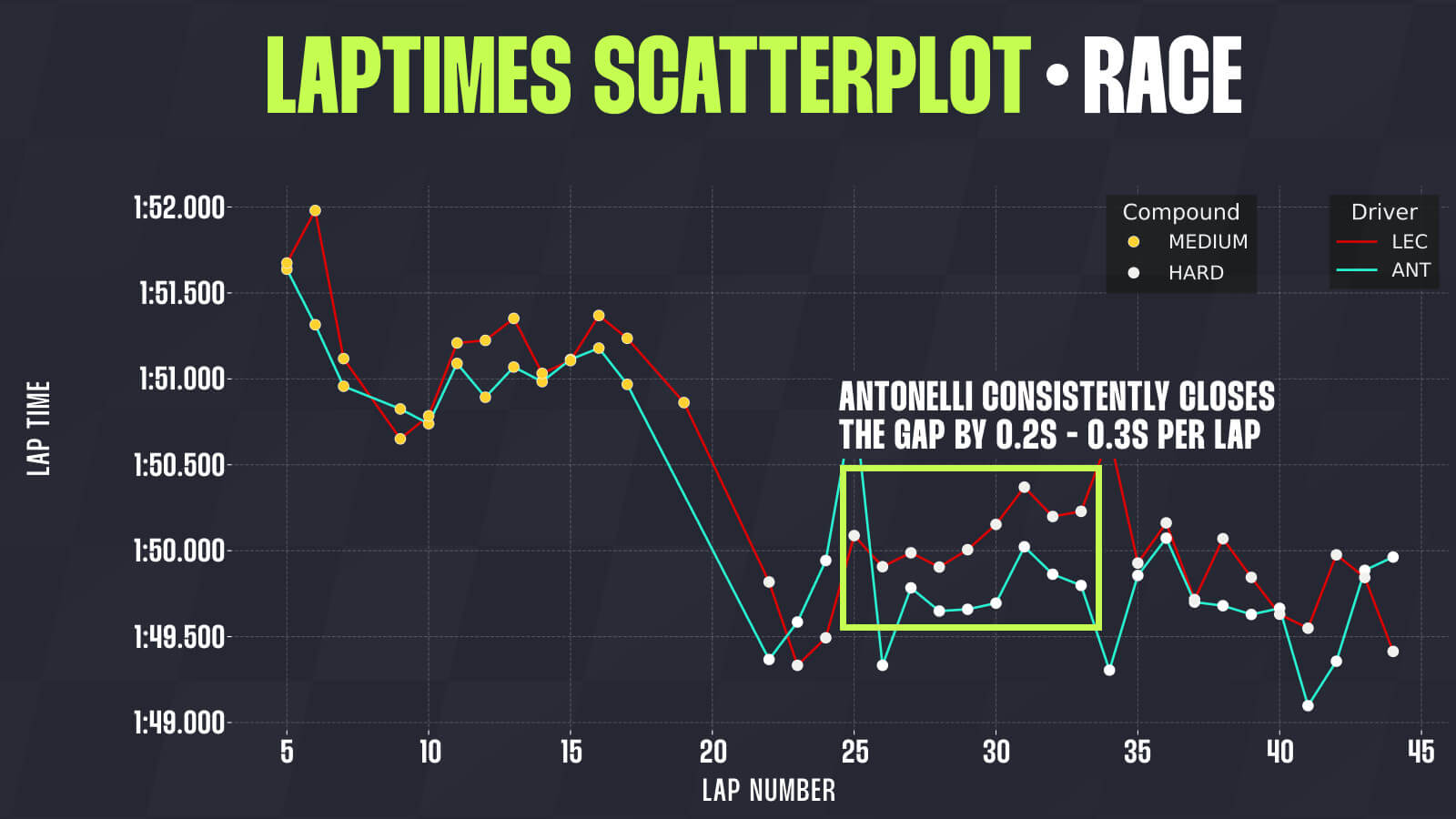
Analysing this sequence of laps, we can see Antonelli consistently gained time on the start-finish straight and through the section from Turn 16 to the Bus Stop chicane.
Leclerc, meanwhile, held the advantage through the corners, particularly Turns 5 and 6, as well as Turns 12 and 13. Antonelli appeared to harvest more energy through these sections before deploying it on Spa’s long, power-sensitive straights.
After the overtake, however, the picture changed completely, as shown in the graphs.
It was almost as though Leclerc began mirroring Antonelli’s deployment strategy. His speed on the start-finish straight increased to match the Mercedes, while he gained a substantial speed advantage along the Kemmel Straight thanks to the slipstream.
He also carried more speed through Pouhon, where he clawed back time, and reduced Antonelli’s advantage through the flat-out final sector.
The trade-off was that Leclerc sacrificed the cornering advantage he had enjoyed earlier in the race. Antonelli now became significantly quicker through Turns 5 and 6.
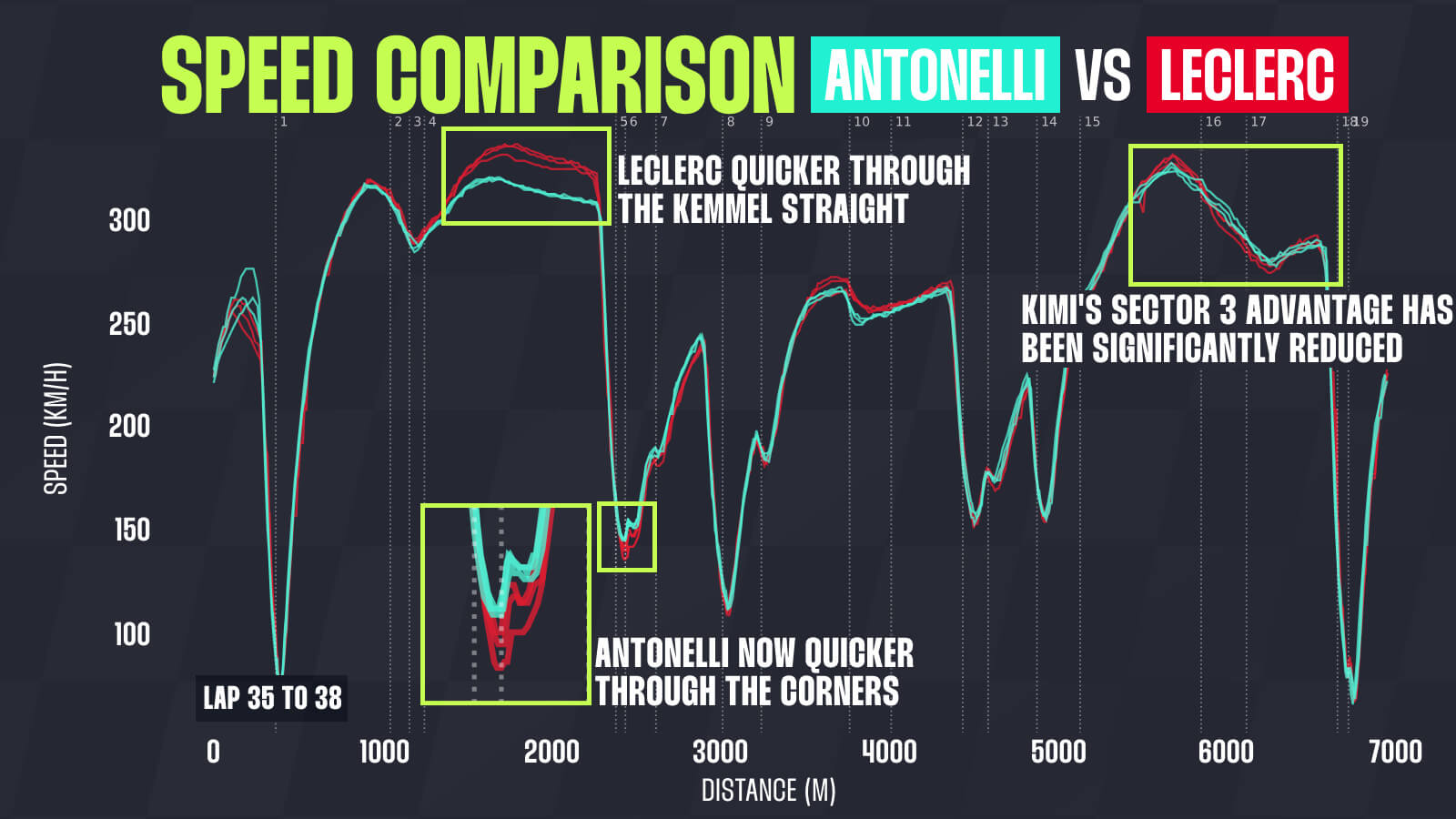
This pattern continued for four laps after Antonelli completed the overtake. During that period, Leclerc managed to remain within one second of the Mercedes, allowing him to benefit from the additional electrical deployment available while following closely.
Once Antonelli finally extended the gap beyond one second, Leclerc no longer had a realistic opportunity to fight back. Without the additional deployment advantage, and with the slipstream along the Kemmel Straight becoming less effective, Ferrari had no answer to the Mercedes’ superior pace.
Leclerc ultimately finished the race just two seconds behind the winner, an excellent result considering Ferrari’s struggles on circuits where power unit performance plays such a decisive role.
Perhaps most fascinating, however, was seeing how Formula 1’s new power unit regulations have introduced another strategic layer to racing. Drivers must now manage not only tyres and pace, but also energy deployment, creating an additional tactical battleground that can prove decisive in wheel-to-wheel combat.
Want to be the first to know exclusive information from the F1 paddock? Join our broadcast channel on WhatsApp to get the scoop on the latest developments from our team of accredited journalists.
You can also subscribe to the PlanetF1 YouTube channel for exclusive features, hear from our paddock journalists with stories from the heart of Formula 1 and much more!
Read Next: F1 2026 turned Spa into a different circuit – and the data exposes why