
How Ferrari suffered double qualifying blunder at Las Vegas GP
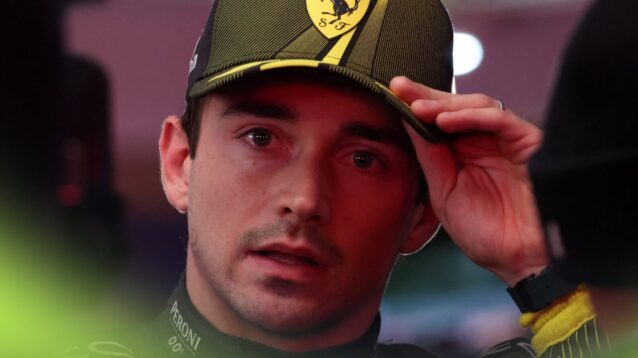
Both Lewis Hamilton and Charles Leclerc were knocked out in Q2 for Ferrari.
Both Ferrari drivers were eliminated in Q2—marking the Scuderia’s worst qualifying result since Imola in 2025.
The obvious suspect is power unit output down the long Las Vegas straights, yet telemetry data tells a different story, revealing that the issue is far more complex.
The main cause behind Ferrari’s disastrous qualifying in Las Vegas
Following two wet opening practice sessions and an FP3 where teams had severely limited time to dial in their dry setups, the first warning signs that Ferrari would struggle more than usual appeared right at the start of Q2.
Grip simply wasn’t there, forcing both Hamilton and Leclerc to work more on steering wheel just to keep their cars on track—and the root cause was the tyres.
Ferrari have battled tyre warm-up issues since the very start of the season. We have previously discussed their varied wheel rim designs aimed at controlling this thermal behaviour, which paid dividends at circuits like Barcelona where they preserved tyre life better than anyone else.
Las Vegas, however, is a completely different story. With track temperatures hovering around 12°C, significantly lower downforce levels, and long straights, generating heat in the soft compound is extraordinarily difficult. This creates problems not only mid-corner but also under braking—as we saw when Hamilton aborted a push lap after a heavy front lock-up at Turn 1, triggered directly by cold tyres lacking bite.
Driver frustration mounted rapidly, yet no immediate fix was available.
Comparing the initial push laps of Hamilton, Leclerc, and Russell from Q2 exposes the finer details behind their struggles.
First, it is worth noting that Ferrari’s top speed down the Strip straight actually matched Mercedes, meaning that specific section wasn’t the direct problem—though it certainly carried knock-on consequences elsewhere on the lap. To stay competitive on the main straight, Ferrari sacrificed electrical deployment through the middle sector, particularly through the fast sweeps of Turns 10 and 11, as well as Turn 6.
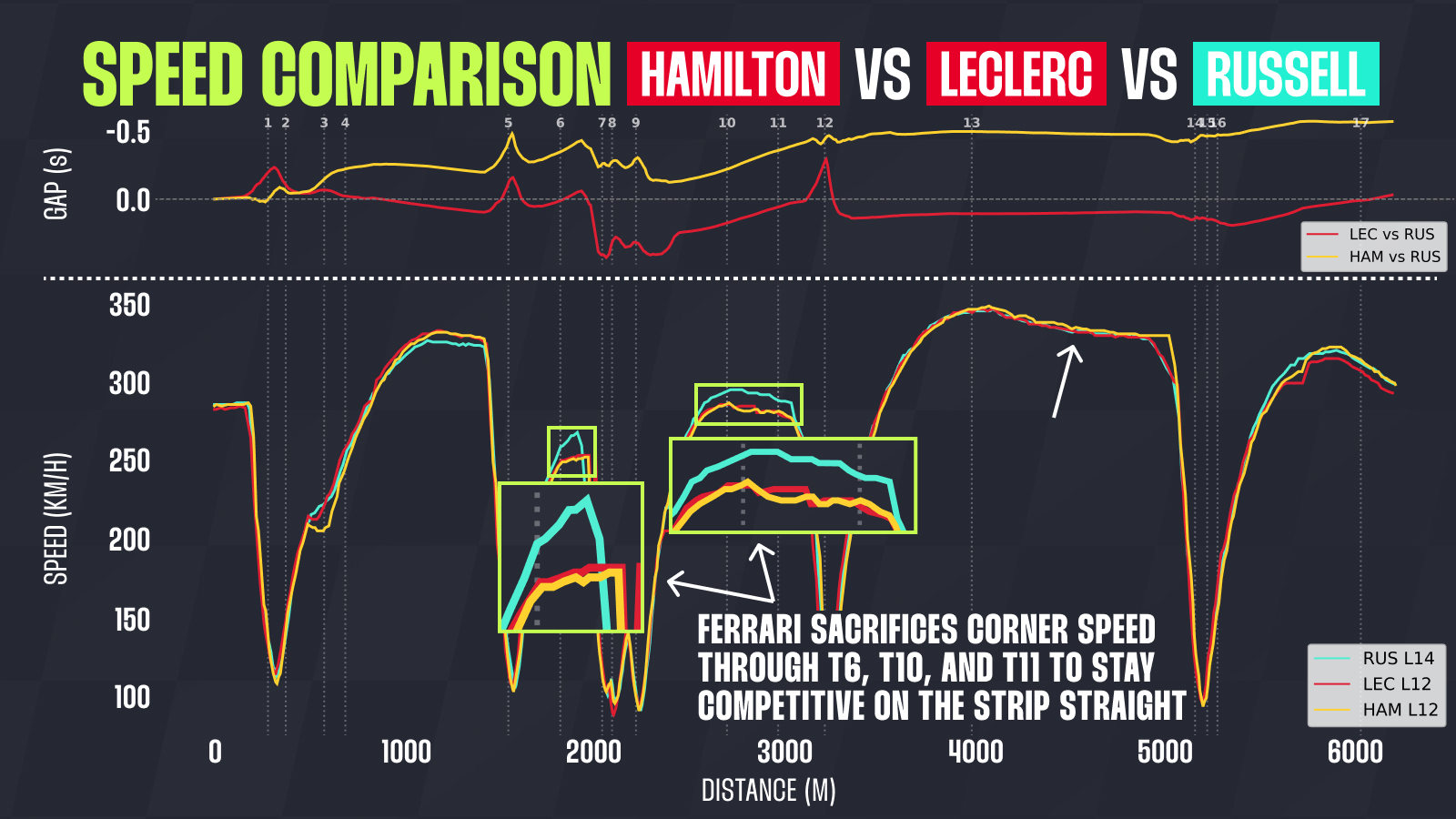
Through these sections—combined with the final straight—Ferrari bled the most time: roughly one tenth of a second for Leclerc and around 3.5 tenths for Hamilton.
However, the real issue is that the SF-26’s trademark cornering competitiveness vanished on this circuit. Look closely at Turn 3: Ferrari’s tyres were still cold, creating a clear deficit—especially for Hamilton, who lost roughly 0.15 seconds through that single corner alone.
Both red cars—and Leclerc in particular—also struggled heavily through the Turn 7 and Turn 8 complex, as highlighted in the graph below.
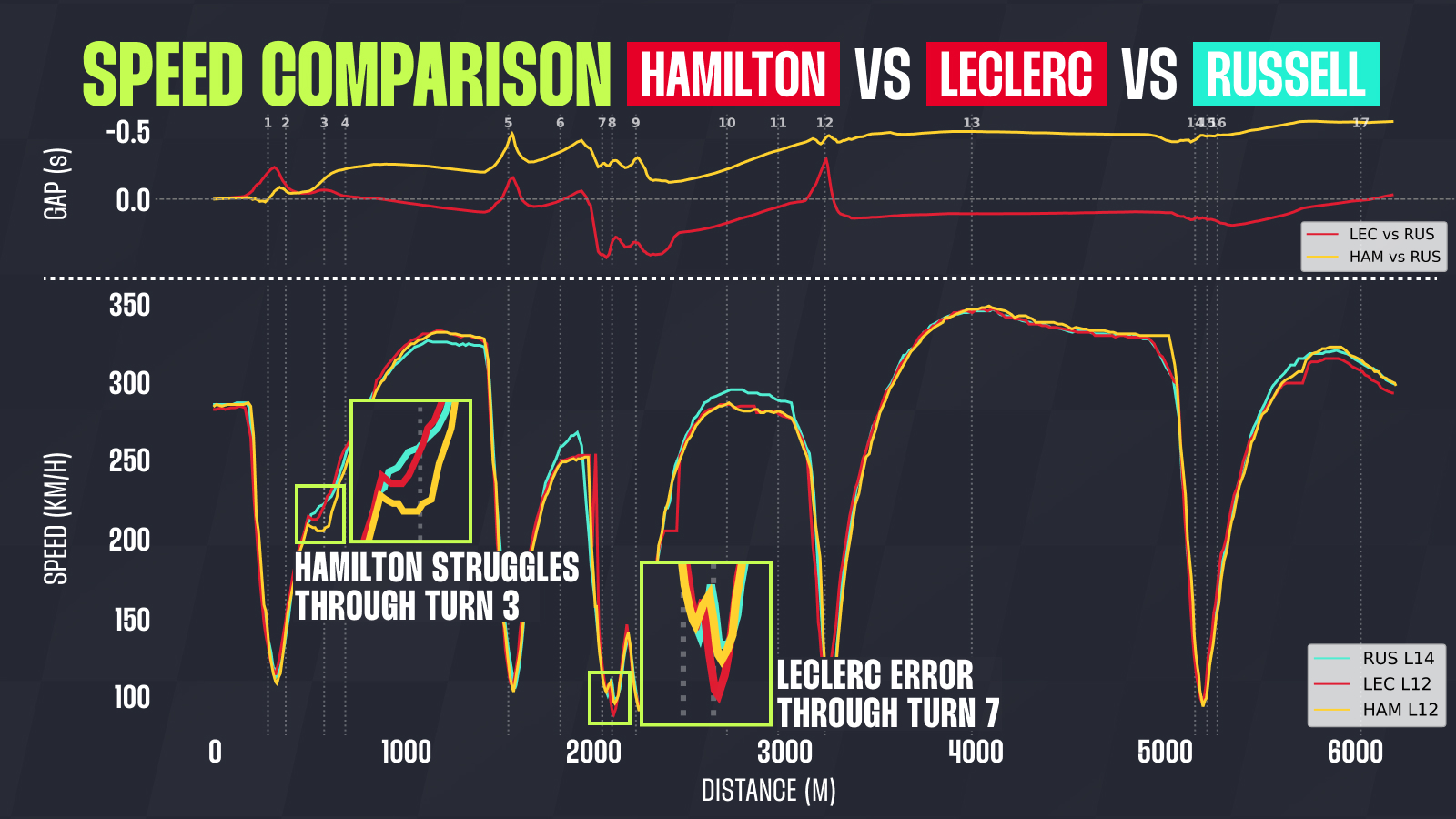
This exact section proved decisive for Leclerc. On his final flying lap, Leclerc made another error at Turn 7, only this time far more severe: he suffered massive understeer on entry to the chicane and ran straight on, forcing him to abort the lap.
With insufficient time left on the clock to complete the lap and start another push effort, the Monégasque driver was left with just a single timed lap across the entire Q2 session.
Prior to that error, Leclerc was two tenths up on his previous benchmark in Sector 1 and 0.166 seconds faster than Russell, who sat at the top of the timing sheets at that moment. Had he kept it clean and completed the lap, Charles stood a very strong chance of progressing.
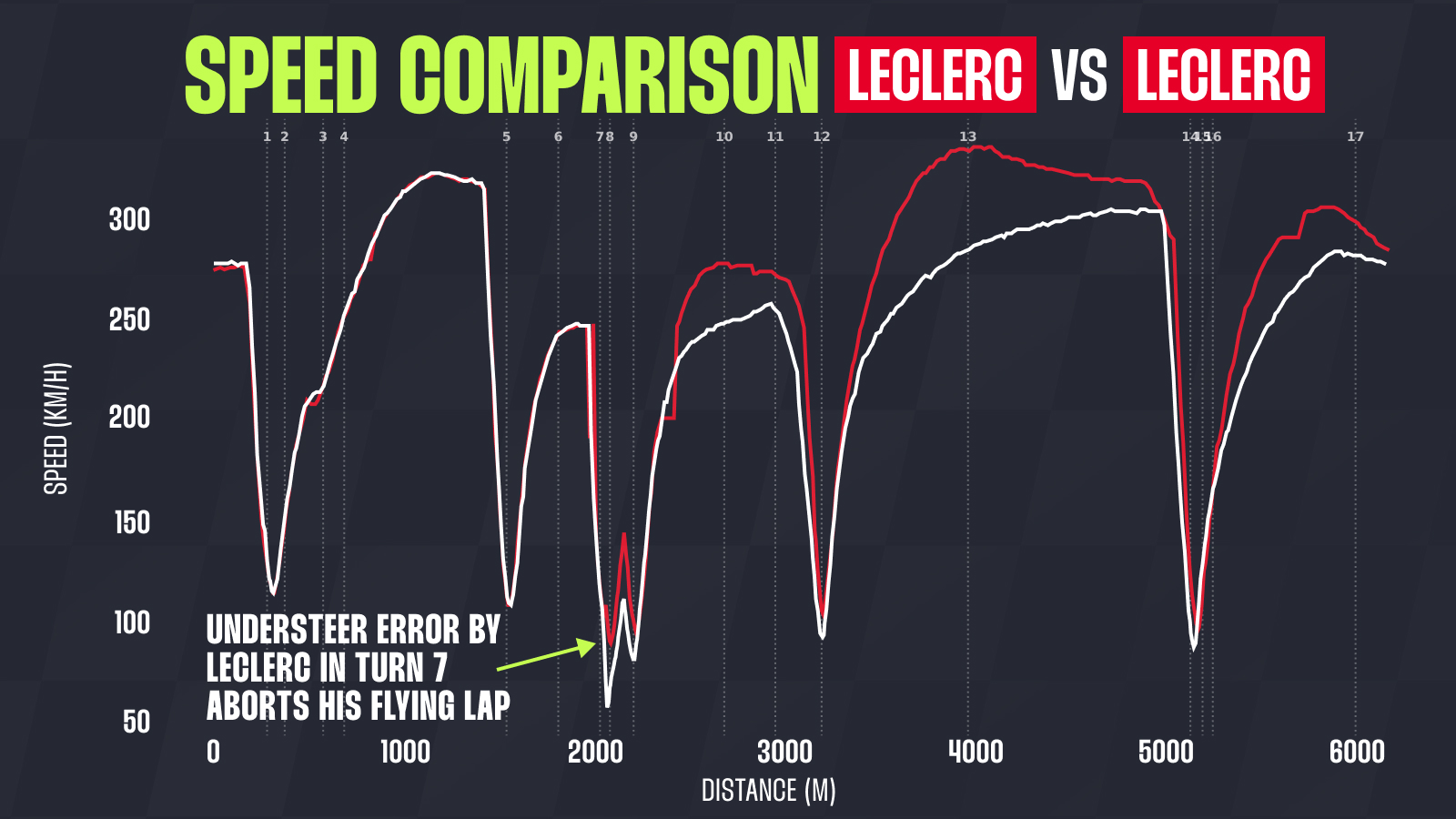
Even so, that does not mask the severe grip and tyre warm-up struggles Ferrari faced in Las Vegas. Hamilton logged three flying laps during Q2, yet none proved quick enough to reach Q3, though he and the team later confirmed he was also carrying floor damage through the session.
Can Ferrari recover in Sunday’s race?
Lining up P11 and P12 on the grid leaves both drivers with plenty of work to do, raising the question: can Ferrari salvage their weekend on Sunday?
Unfortunately, the outlook appears equally bleak.
FP3 offered a glimpse into expected race pace—though those numbers must be treated with caution, as they represented the drivers’ very first dry runs with minimal time to fine-tune car balance.
More from the Las Vegas Grand Prix
Winners and losers from the 2026 Las Vegas Grand Prix Qualifying
F1 Las Vegas GP grid 2026: The full starting order with penalties
The current data places Ferrari comfortably last among the front-runners on race pace, with Lando Norris setting the benchmark in the updated McLaren. Once again, telemetry shows Ferrari losing the bulk of their time in the middle sector: roughly 70% of their total deficit stems from that middle portion of the track—the exact opposite of what anyone would have predicted heading into the weekend.
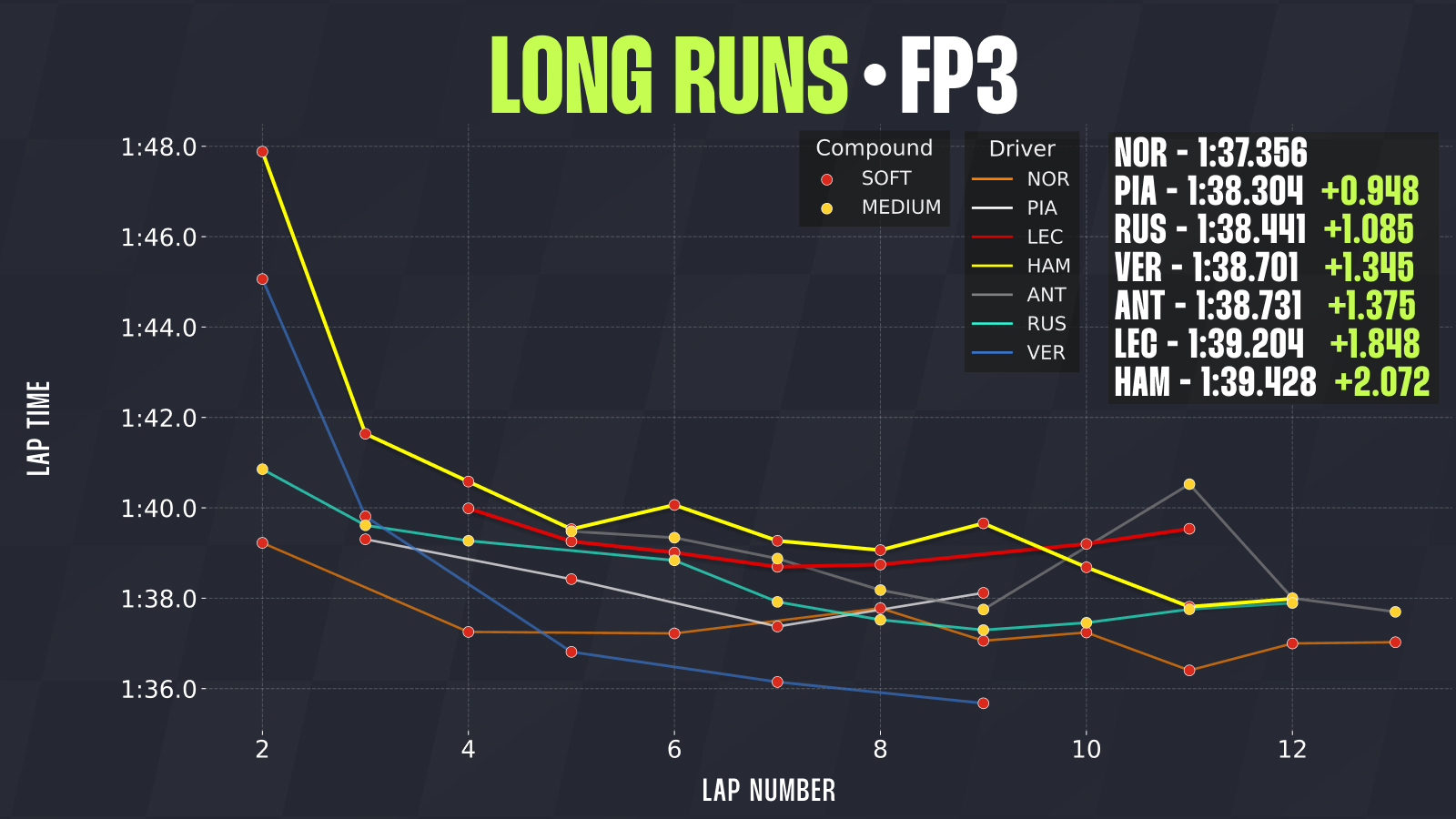
Compounding the SF-26’s headaches is the fact that the electrical deployment limit increases from 6 MJ to 8 MJ for the race, meaning we can expect an even wider gap in power unit efficiency between Ferrari and their rivals.
Las Vegas is certainly a track where overtaking is possible, particularly down its massive straight, yet right now it looks very difficult for Ferrari to avoid finishing as the lowest-placed top team.
Read next: Uncovering the slipstream gamble behind Antonelli’s Las Vegas P1 lap