
Max Verstappen data highlights deliberate action amid McLaren strategy blunder

Max Verstappen snatched victory from McLaren in Qatar
A catastrophic strategic mistake by the McLaren team complicated their race in Qatar and opened the door wide for Max Verstappen to secure his seventh season victory.
What the potential reasons were for McLaren’s decision to leave both of their drivers out on track during the Safety Car, and whether they could have improved the situation in the second half of the race in any meaningful way, we uncover with the help of telemetry data.
Why, McLaren?
After locking out the front row in qualifying, McLaren could not have asked for a better position to defend against Max Verstappen, who has unexpectedly emerged as a title threat over the last few races.
From Lando Norris’s point of view, however, this grid order was far from ideal, as he had his team-mate starting on pole ahead of him, and Verstappen directly behind.
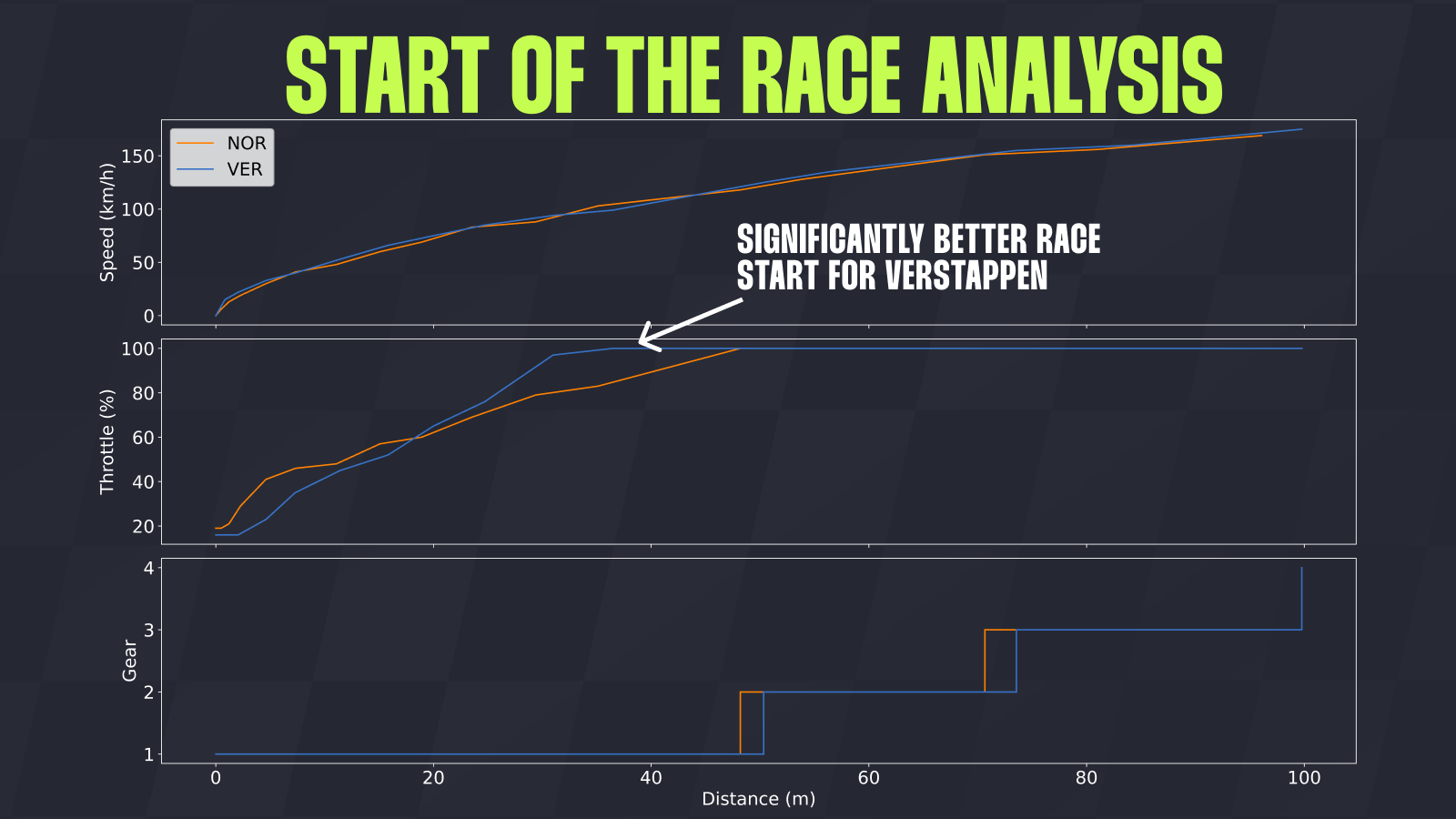
Verstappen held the advantage of the cleaner side of the grid and fully exploited it at the start, placing himself entirely ahead of Norris before Turn 1 and reclaiming the position without difficulty. Had the Qatar GP ended in that order, Norris would still have held a 22-point advantage over Verstappen, but only 12 over his team-mate.
However, on lap 7 the Safety Car was deployed after the Hülkenberg–Gasly incident, and McLaren then made arguably their biggest strategic error of the season. McLaren were the only team not to use the Safety Car window to change tyres, while the entire rest of the grid did so.
The Safety Car timing was crucial, as there were exactly 50 laps remaining – enough for two stints of 25 laps. A maximum stint length of 25 laps per tyre set was in place for safety reasons.
This meant every driver who stopped on lap 7 would need to pit again precisely on lap 32. McLaren, on the other hand, retained much greater flexibility regarding pit-stop timing – their only real positive at that moment.
What McLaren’s engineers likely did not expect at that moment was the fact that absolutely every other driver pitted, meaning Verstappen once again found himself directly behind Norris and effectively received a ‘free’ stop.
But the fact they kept flexibility simply was not a good enough reason for such a risky call. We cannot know what exactly happened behind the pit wall, but one possible reason could be that McLaren feared a double-stack stop, which could have compromised the second driver, in this case Lando Norris.
A slower stop (which McLaren have certainly had this season) could have cost Norris several positions at that moment and significantly shaken his title chances. Whether this thought influenced the engineers we cannot confirm, but it seems McLaren were choosing between a bad race for both drivers or potentially a bad race only for Norris.
Or perhaps the British team simply feared making a more aggressive strategic decision – which would not be the first time.
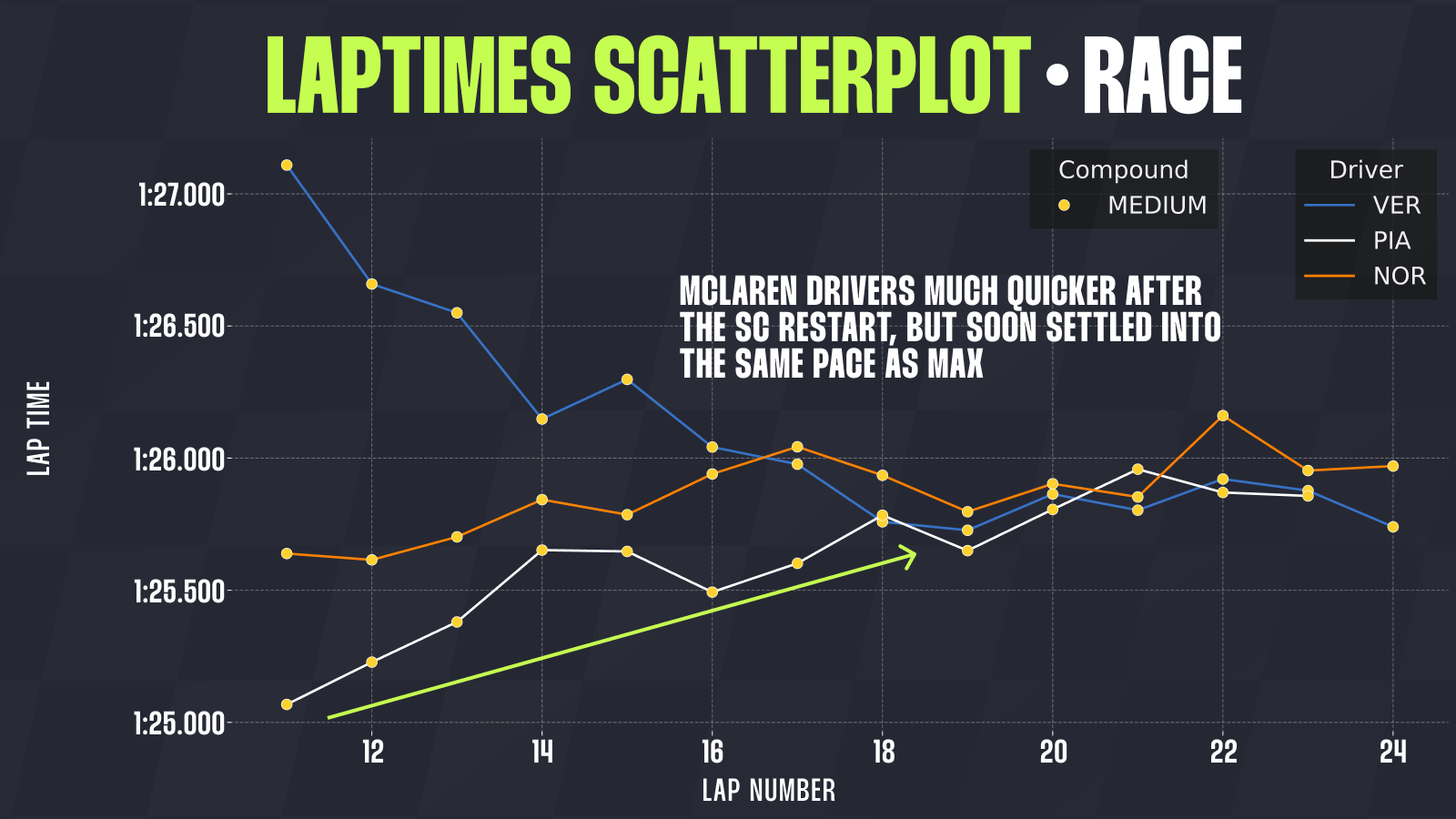
Either way, Verstappen was set on a clear path towards another win after McLaren’s strategic mistake. After the safety car restart, both McLaren drivers pushed aggressively, knowing they needed to open as big a gap as possible to recover the mistake.
In the first few laps they were around one second per lap quicker, but around lap 18 their pace dropped, and after that it stayed almost identical to Verstappen’s. After the first pit stops, both Piastri and Norris were fortunate to avoid traffic and the relative gap to Max remained the same in the following phase.
On lap 32, Max, along with 15 other drivers, pitted in the very same lap, an unusual sight. Most drivers opted for hard tyres for the final stint, which surprisingly delivered a stronger race pace than expected.
This was the crucial phase of the race: if McLaren wanted to recover the situation, this was their moment, as they were on faster tyres. But as already mentioned, the hard tyres surprised everyone, and Verstappen’s speed was equal to Piastri’s, while Norris was slightly slower.
Lando also made a significant mistake at Turn 14 on lap 36, which cost him around a second and later proved even more damaging.
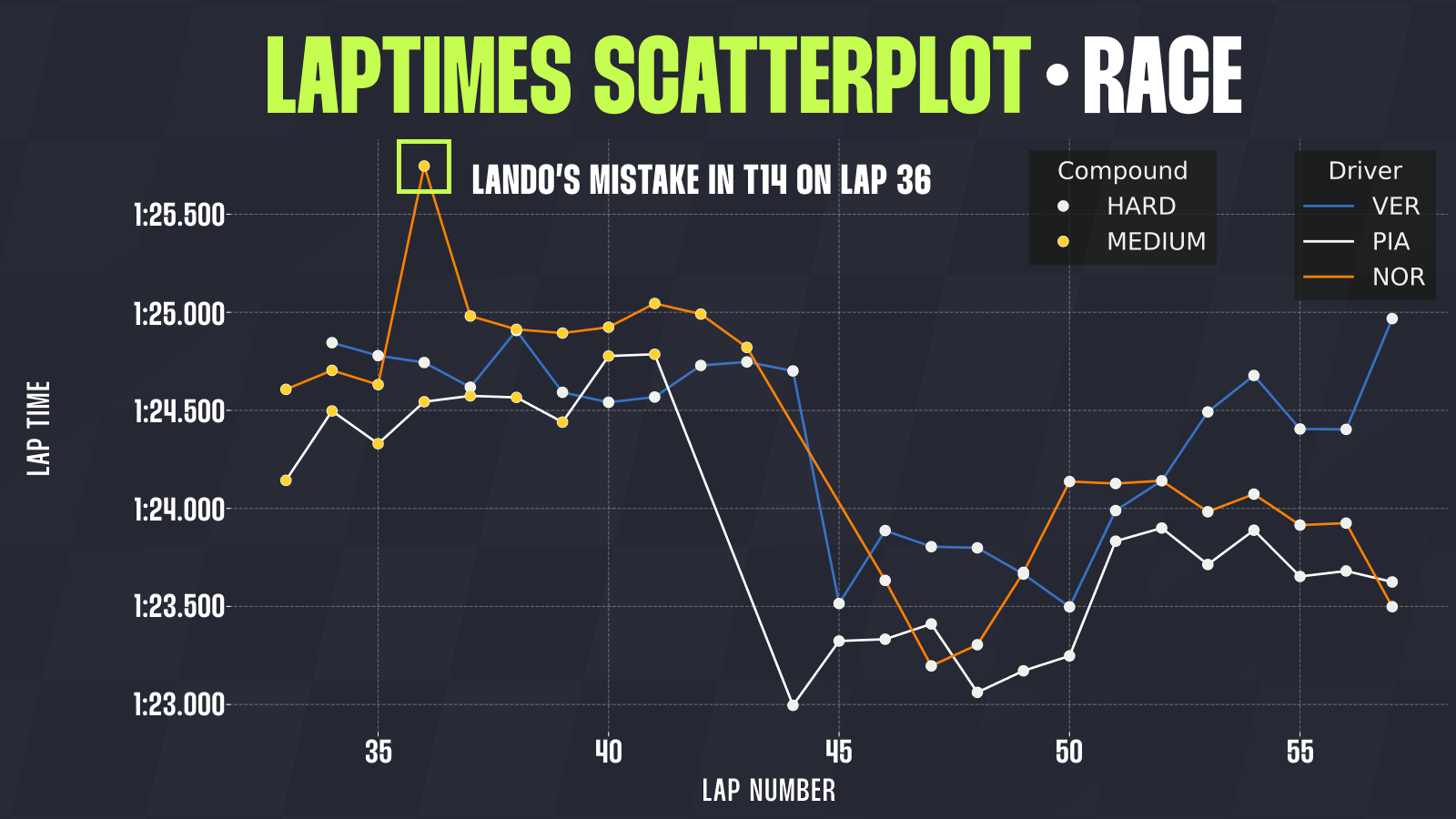
McLaren’s unexpected decision to pit Piastri earlier came on lap 43, giving him more time to attempt a potential attack on Verstappen. Was this a good idea?
In reality, the attempt did make sense given Verstappen’s better-than-expected pace on hard tyres. Had Piastri continued at the same level and stopped six laps earlier (the maximum possible because of the 25 laps rule). He would need to be 2.2 seconds per lap faster than Max if he wanted to even get a chance to overtake on the final lap of the race.
Even on soft tyres, that was nearly impossible so McLaren’s attempt was actually valid. Telemetry data also shows Verstappen deliberately matched Piastri’s pace until Oscar pitted, only then revealing his true pace.
The graph clearly shows how Max’s lap times suddenly dropped, as if he had just switched to fresh tyres.
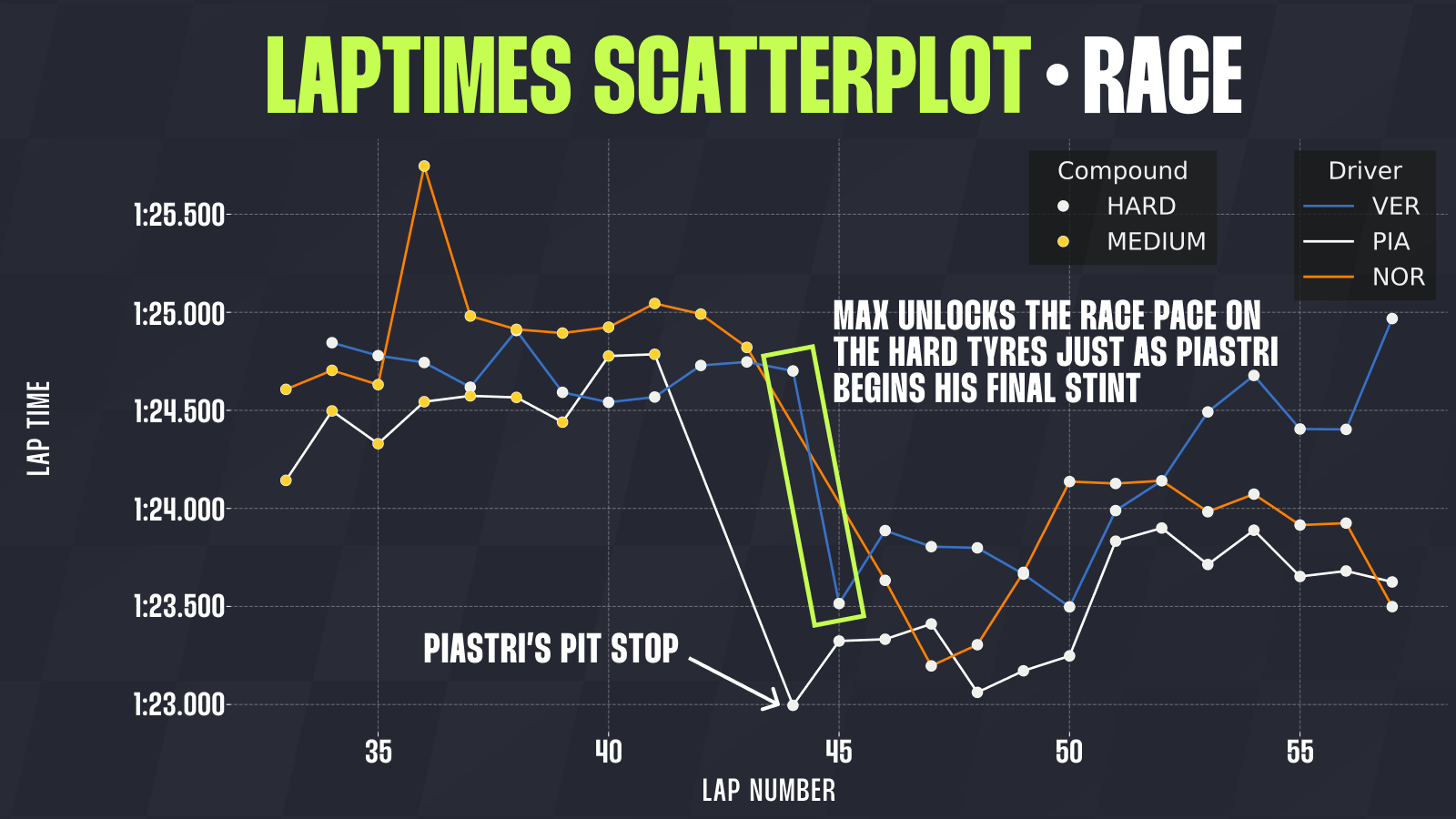
After his stop, Piastri was 18.4 seconds behind Max and attempted to close the gap, but even his 0.6-second-per-lap advantage was nowhere near enough.
More McLaren reaction from PlanetF1.com
👉 McLaren ‘gave away’ Piastri’s Qatar win as Zak Brown speaks out
👉 ‘Speechless’ Oscar Piastri fumes at McLaren tactical mistake in Qatar GP
And Verstappen was entirely correct: his involvement in the title fight was the product of others’ mistakes – mistakes he once again capitalised on perfectly in Qatar.
The biggest loser from the race was Norris, who finished fourth, losing an additional place to Sainz after the second pit stop.
Heading into the final race weekend of the 2025 season, Lando Norris remains the championship leader, but now only 12 points ahead of Verstappen. Everything is still open – but one thing is certain: we are in for an exciting finale in Abu Dhabi.
Read next: Lando Norris reacts to McLaren Qatar GP strategy error as Verstappen closes in