
F1 facts that sound fake: Schumacher gives Ferrari a fright, record McLaren grid penalty


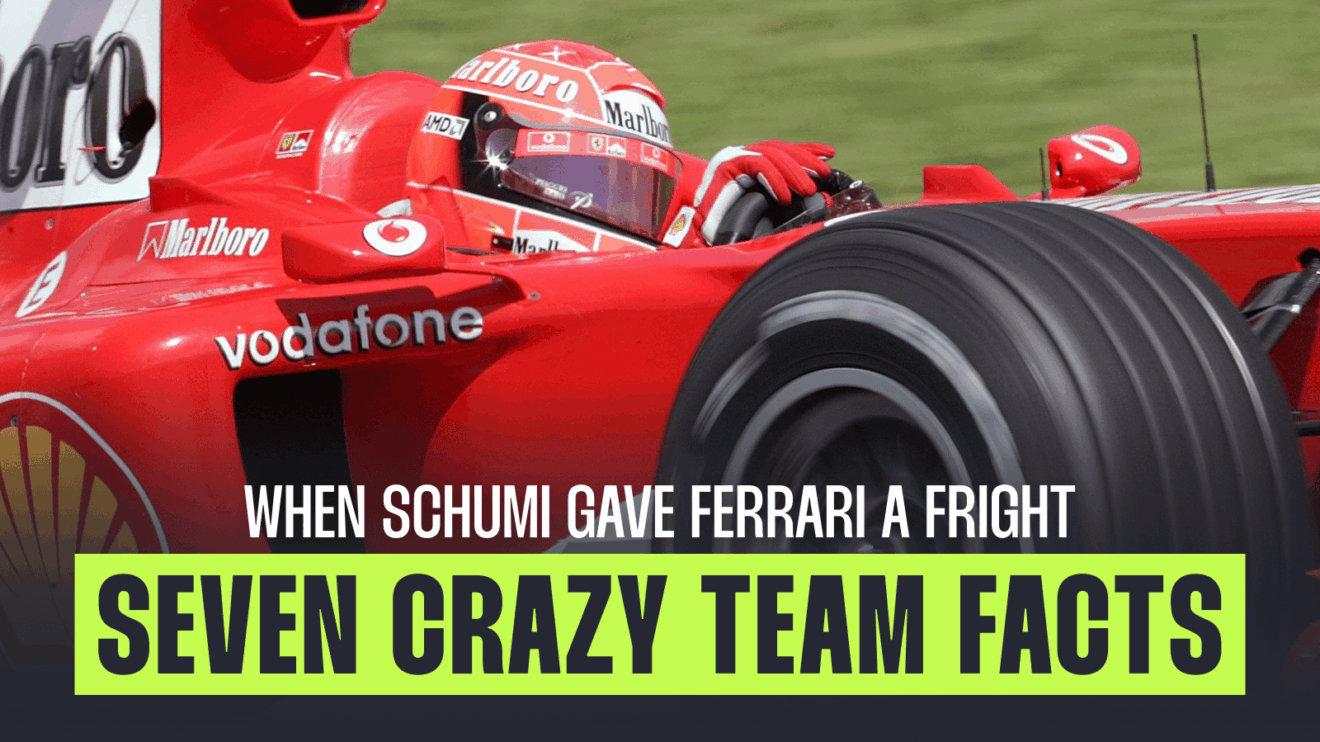
Michael Schumacher's terrifying pace in early 2004 left some at Ferrari wondering if the new F2004 was illegal
Formula 1 is full of quirky facts and stories through its history and that is no different for the teams racing within it.
From McLaren’s record grid penalty to Michael Schumacher’s scary Ferrari F2004 pace, here are seven F1 team facts that sound fake but are true.
How McLaren’s debut colour scheme was incorporated into Hollywood
Want more PlanetF1.com coverage? Add us as a preferred source on Google to your favourites list for news you can trust
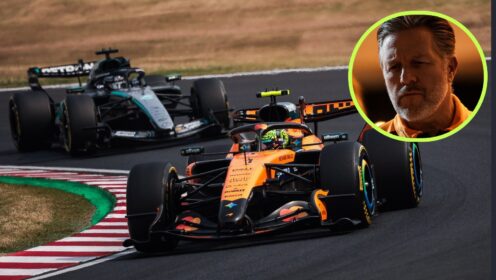
McLaren moved back to its ‘papaya’ livery colours several years ago in a move to honour its past, but at the team’s debut at the 1966 Monaco Grand Prix it was a different story altogether.
Bruce McLaren was due to drive an M2B chassis that weekend and a papaya colour scheme was not due to be on the menu either, with a silver-and-green livery having been proposed for the team’s grand prix debut, in honour of McLaren’s New Zealand roots.
However, with the seminal Formula 1 film of the time, Grand Prix, in the works and filming throughout the weekend in Monaco, the film’s producers struck a deal with the debutant team to run a white livery with a single stripe instead as that colour scheme was needed in order to represent fictional outfit, Yamura Motors.
Papaya would appear on a McLaren for the first time in 1968, through the car which would become its first-ever race winner, the M7A.
When Ferrari frightened itself with its own pace
The Ferrari F2004 proved to be one of the most dominant cars in Formula 1 history in the hands of Michael Schumacher.
So much so, that Schumacher’s pace during the car’s first test at Fiorano is believed to have been a full second quicker than the Scuderia’s own simulated predictions.
In fact, when Schumacher clocked a track-record 55.999-second lap at Ferrari’s in-house test track, team principal Jean Todt is said to have repeatedly asked Ross Brawn, the team’s technical director, to assure him that the F2004 was legal and within the regulations.
Upon confirmation that the car did in fact comply, it would become not just the car which would power Schumacher’s fifth and final world championship with the Scuderia, but with refuelling in play it would set a host of lap records which would not be challenged for around 15 years.
More historical stories from the world of Formula 1
F1 stats: Twelve times one driver would’ve single-handedly won the Constructors’ title
Eight times the Halo was a saviour: Grosjean, Leclerc and more scary incidents involved
Williams’ own take on the ‘six-wheeler’ in Formula 1
The Tyrrell P34 is widely held up as unique in its own right for being the ‘six-wheeler’ in Formula 1 in 1976 and ’77, but Williams looked to try its own solution several years later.
While the Tyrrell utilised two sets of smaller front wheels, Williams briefly tried to create a six-wheeler of its own with a radically different take.
With the rise of turbo engines leaving the team short on power compared to its rivals, and with the large rear tyres of the time being highlighted as a significant source of drag, Williams tried out the FW07D – carrying six evenly-sized wheels, with four at the rear and two at the front.
After just one test at Donington Park, the concept proved successful, prompting its design team to begin building the next year’s car, the FW08B, with that in mind.
However, the sport’s governing body would intervene and it would never race.
The four rear tyres provided drive, and with four-wheel drive cars already banned, FOCA would also swiftly place a ban on cars having more than four wheels to match, which ruled out the design on two separate fronts.
McLaren’s all-time record grid penalty
Amid power unit issues with its partnership with Honda in 2015, McLaren had been on the back foot for much of the year, going well over its power unit allocation for the season and suffering a general lack of pace within its machine.
This came to a peak at the Belgian Grand Prix as the team already came into the weekend knowing it would start at the back of the grid owing to new parts taken beyond its allocation.
With another power unit change on the Saturday, however, the nature of engine penalties mean a grid drop based on each component part of the PU, and with a full change, Fernando Alonso and Jenson Button’s penalties combined to create a 105-place grid penalty between the two.
There was method to it from Honda’s part, however, as in handing the McLaren duo two all-new engines for the weekend, it effectively meant serving its grid penalties at once while increasing its power unit pool for the remainder of the season.
There would be one final grain of salt in the wounds of both drivers, however.
As well as finishing a lap down on the leaders, Alonso and Button were also behind a non-finishing car in the classification following Sebastian Vettel’s last-lap tyre failure.
One team’s unsuccessful quest to make it onto grid after grid
Formula 1 has had 27 teams to either start one race or none at all despite lodging entries.
In the days of when the grid was congested enough to necessitate pre-qualifying, most often for privateer entries or teams looking to get off the ground, the 1990 season was one of frustration for the Life team.
Already listed as one of the six teams needing to pre-qualify at weekends, one-car entry Life tried on 14 occasions in 1990 to make its way through to grand prix qualifying, but failed to do so on each occasion.
Given the race team normally consisted of less than a dozen people, though, that they were able to compete in the paddock was no mean feat in itself.
Jaguar’s diamond of an idea backfires spectacularly
Formula 1 has rarely been short of an opportunity for a PR stunt and that was the case at the 2004 Monaco Grand Prix when Jaguar, the team taken over by Red Bull the following year, was sponsored by Steinmetz Diamonds for the weekend in honour of the movie sequel, Ocean’s Twelve, being released.
To accentuate the glitz and glamour of Monaco even further, two real – yes, real – $300,000 diamonds were embedded in the nose cones through the course of the weekend.
The only thing the drivers needed to do on their part, on the toughest circuit on the calendar to navigate, was stay out of the barriers.
However, Christian Klien was a first-lap retiree and lost his front wing in the process.
On top of that, the diamond disappeared and was never recovered.
Was it lost? Taken? Was it even a real diamond? These are still unknowns two decades later.
F1 newcomers’ simple but costly oversight
Formula 1 welcomed three new teams in 2010, none of which are on the grid now in HRT, Lotus and Virgin Racing.
Virgin, powered by company founder Richard Branson, had one of the smallest operating budgets on the grid, and took the unusual step of creating its first design entirely by CFD (computational fluid dynamics) rather than making use of a wind tunnel.
With refuelling outlawed in 2010, it was a journey into the unknown for many of the teams on the grid, not least the ones arriving for the first time.
In Virgin’s case, rumours were rife that its fuel tank was too small to complete a race distance and this was later confirmed when the FIA granted permission for a change to its construction to allow for a larger tank.
Even still, it took until the European season for the changes to take effect, meaning the sport’s newbies will have had races to navigate with plenty of fuel saving going on.
“It has become clear during pre-season testing and our debut race in Bahrain that our fuel tank capacity is marginal and if not addressed there is the possibility that fuel pick-up could become an issue in certain circumstances,” Virgin’s technical director, Nick Wirth, said at the time.
“At the time the design of the tank was locked down in June 2009, its capacity was determined by a number of factors, some of which have since changed, and the tank capacity now needs to be increased accordingly.
“We thank the FIA for permitting this change, which we expect to introduce in the early part of the European season.”
Want to be the first to know exclusive information from the F1 paddock? Join our broadcast channel on WhatsApp to get the scoop on the latest developments from our team of accredited journalists.
You can also subscribe to the PlanetF1 YouTube channel for exclusive features, hear from our paddock journalists with stories from the heart of Formula 1 and much more!
Read next: Michael Schumacher accident: Separating facts from fiction