
Meet Mercedes’ quiet owner: The billionaire racing driver involved in the team’s latest success
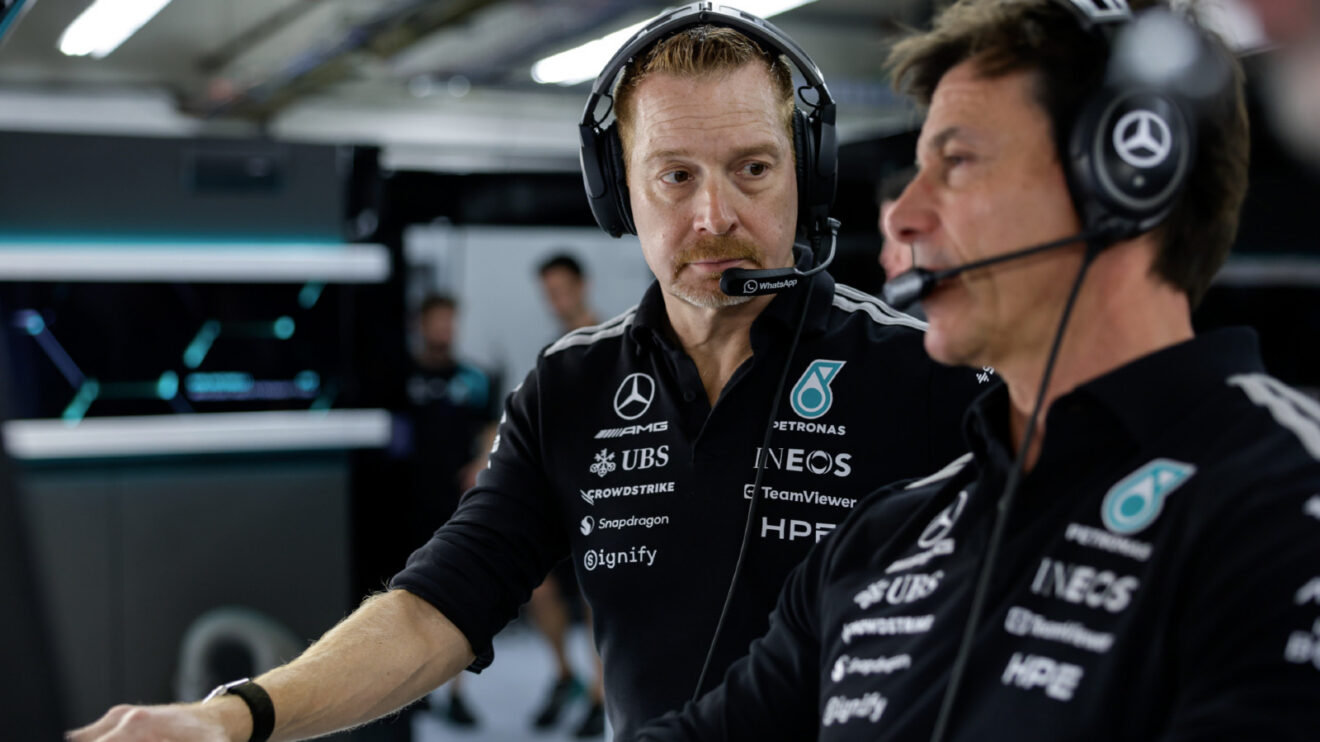
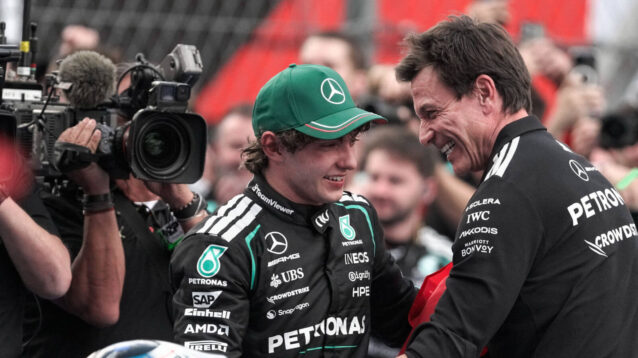
Mercedes' George Kurtz alongside Toto Wolff at the 2026 United States Grand Prix.
The long-standing ownership structure at Mercedes changed in November 2025 when billionaire businessman George Kurtz bought a 15 per cent stake in Toto Wolff’s holding company.
But the CrowdStrike CEO is much more than a wealthy investor. A successful endurance racer, Kurtz has won at Le Mans and Daytona, claimed the GT World Challenge America title and built a racing career that stretches from club-level competition to some of the sport’s biggest events.
A year after joining Mercedes’ ownership structure, the 56-year-old has spoken to PlanetF1.com about his passion for motorsport, his experience driving a championship-winning F1 car and the relationship with Wolff that eventually brought him into the team.
Meet George Kurtz: Mercedes’ billionaire owner and Le Mans winner
It’s been a year of monumental success for Mercedes, with the Brackley-based squad wrapping up both the Drivers’ and Constructors’ Championships after a controlled season in which Wolff’s protege, the precocious Kimi Antonelli, emerged as the new star of the sport.
Fresh off the back of this success, it’s perhaps no surprise that there was a sense of jubilation and celebration in the air as PlanetF1.com arrived at the Paul Ricard circuit in the south of France, two days after the Brazil success, to join a small contingent of the Mercedes squad at the former French GP venue.
Ahead of the season opener for the Asian Le Mans Series, LMP2 cars were scattered throughout the paddock, and our host eagerly pointed out one particularly striking car being unloaded from a truck. Emblazoned with the CrowdStrike logo on the fin, it wasn’t difficult to spot George Kurtz’s name above the door: the American driver was there to take part in the endurance event, with the 56-year-old’s involvement in motorsport going much deeper than mere sponsorship.
Last year, Kurtz added F1 team ownership to his already vast portfolio of responsibilities by going into business with Toto Wolff. He purchased a 15 per cent stake in Wolff’s holding company, Motorsport Investment Ltd, which adds his name to the list of owners, alongside Wolff, Mercedes AG, and INEOS’ Sir Jim Ratcliffe.
Kurtz was already out on track, but his concentration wasn’t yet on the Oreca car that was being assembled out in the paddock.
Instead, it was on a Mercedes W12 from 2021, the car with which Lewis Hamilton almost (and, in many eyes, did) won the championship. As we pulled up behind the pit building and climbed out of the CrowdStrike minibus in an enclosed and private section of the paddock, Kurtz is pounding around on track, with the V6 hybrid barking and echoing off the empty concrete as the American driver zips through the gears down the main straight.
There were two units sitting quietly in the middle of this restricted area: one a luxurious hospitality unit housing Kurtz’s own racing efforts, and a full Mercedes hospitality unit just like the one that the team uses when navigating its way through the European season of the F1 calendar.
Inside was a hubbub of activity, with guests being fed (it was lunchtime when we arrived), and there were some recognisable faces meandering through the building. Mercedes ambassador Esteban Gutierrez was in attendance, while 2016 F1 World Champion Nico Rosberg was also finishing up his lunch.
Resplendent in Mercedes regalia, Rosberg’s appearance was jarring: he looked fit and ready to jump back in the car 10 years after his abrupt departure from the sport, and it’s as if the last decade simply hasn’t happened. Meandering his way over to our table for a quick chat and a hello with familiar faces, Rosberg was clearly enjoying himself, but shrugged off my suggestion that doing some work in Mercedes uniform might reignite some of his racing driver hunger.
We were informed that George Russell was running late, en route to Paul Ricard after getting back from Brazil, and the atmosphere in the hospitality unit was relaxed and carefree, but mixed with a twinge of excitement.
But why, exactly, was Mercedes at Paul Ricard? Why were George Russell, Esteban Gutierrez, and Nico Rosberg all hanging out in the south of France on a random Tuesday afternoon, while a five-year Mercedes F1 car flew around the circuit?
The answer came shortly after silence descended over the circuit in the mid-afternoon, and George Kurtz strode back into the hospitality unit, Mercedes race suit undone and around his hips as he grabbed a drink.
George Kurtz’s F1 driving lessons with Nico Rosberg and George Russell
Kurtz was here for a filming day for the Driving Ambition documentary series, produced by CrowdStrike, with the ‘Marginal Gains’ episode showing how the American is working closely with the driving talents of Rosberg and Russell to identify marginal gains on track, with incremental improvements at any given corner translating into significant laptime gain.
He is already a highly accomplished racing driver in his own right. This year, he won in the LMP2 Pro-Am class of the Rolex 24 at Daytona, as well as being part of the defending line-up for the Asian Le Mans Series title – a crown he’s won twice.
He’s also a Le Mans 24 Hours winner, taking the LMP2 Pro-Am class in 2023, alongside winning the GT World Challenge America championship in 2023.
But, as good as he’s proven to be, lessons from race- and championship-winning F1 drivers not only help with finding lap time, but underpin a critical mindset: one of the relentless pursuit of how to refine, improve, and stay hungry.
The car from which Kurtz emerged was not ‘just’ a W12, either: the exact chassis he’s driving won multiple races in Lewis Hamilton’s hands, and was also the machine involved in the two biggest flashpoints of the season. It was the car that tagged Max Verstappen to pitch the Red Bull off at Copse at Silverstone in 2021, and, while I looked carefully, I couldn’t spot any tyre marks left on the halo from when Verstappen’s tyre almost ended up on Hamilton’s head.
Having completed his day of filming and lessons, Kurtz sat down with PlanetF1.com and select media to chat about the experience, as well as looking back over how he has expanded from cybersecurity software development into a pro racing driver and part-team owner.
Fresh from climbing out of the W12, a clearly awed Kurtz said, “The car is absolutely incredible. To drive a modern Formula 1 car, the W12, one of the best cars probably in F1 history, is just that can’t put it into words.
“But I think one of the most amazing things is the braking. Of course, the speed, the cornering, those sorts of things combined are incredible.
“But when you actually realise that you can be 300 kph and brake at the 70 board in Turn 1, and how much the car slows down is just mind-blowing. That’s the biggest surprise in driving these cars.”
George Kurtz explains the difference between F1 and endurance racing
Just how much of a jump is an F1 car, even one that’s not running at ‘full blood’, so to speak, compared to an LMP2 machine?
“The P2 car and the Oreca car, in particular, is a great chassis. It’s a proper race car. Sadly, they turn down the power in some of the series that we run, but it’s been a great car, and it really teaches you to use the downforce.
“And you certainly don’t have as much downforce as a Formula 1 car, so you’re always on the edge of using the downforce there. So, I think being able, particularly at this track at Paul Ricard, you have to roll the speed, so you just can’t over-brake like in Turn 1 or Turn 11.
“Even without the power in the LMP2 to make speed, you’ve got to really just roll it without over-braking. So I think that really helps. And because it’s a downforce car, at least you have an idea of what it really means to use the downforce and get the most out of the car.”
What’s evident is that Kurtz is no mere ‘gentleman racer’, the polite term for the dentists and solicitors whose money can buy cars and track time for their hobbies, but perhaps not the talent to ever turn it into a career.
Watching from the roof of the pit building, Kurtz’s car control was evident: he was able to dance the car around from apex to apex through the third sector, and his positioning and throttle application even earned a nod of approval from Russell as the British driver watched on from trackside following his arrival in the afternoon.
“It’s absolutely surreal,” Kurtz said of being mentored by such names as Russell, Gutierrez, and Rosberg.
“I mean, you think about the triple threat of coaching there. You’ve got a world champion and two just incredibly accomplished Formula 1 drivers. It’s just crazy to have them as your coach.
“Each one brings a different vantage point of what to focus on and how much mental preparation is needed, and where to focus on the lines and what not to focus on.
“Every little inch matters. There’s more into just using the car and carrying the speed, and then the last bit is just tiny, tiny changes in the line maybe.
“Everyone brings a different skill set and a different approach, and I think that’s been invaluable to have three coaches like that. I’m not sure who’s been able to do that. That’s about the best coaching lineup you can find.
“I think there were two pieces of advice. Turn 1, basically Turn 1s and 2. You have to think of Turn 2 not as a turn; I had overslowed it and then treated it as a turn.
“And when I came through Turn 1, I got back and then just accelerated out of 2, and I was losing massive lap time.
“So just by changing the mindset of it’s not really a turn, just make Turn 1 and then accelerate out and bend the car, that really helped.
“And then we were going back and forth into strat modes to charge the battery. You only get so many laps. So to maximise the number of laps and just to get into rhythm, we went into a different strat mode that didn’t give us full power, but didn’t deplete the battery over the whole lap. So rather than having nothing at the end, we had something, but it wasn’t as fast as a quali lap.”
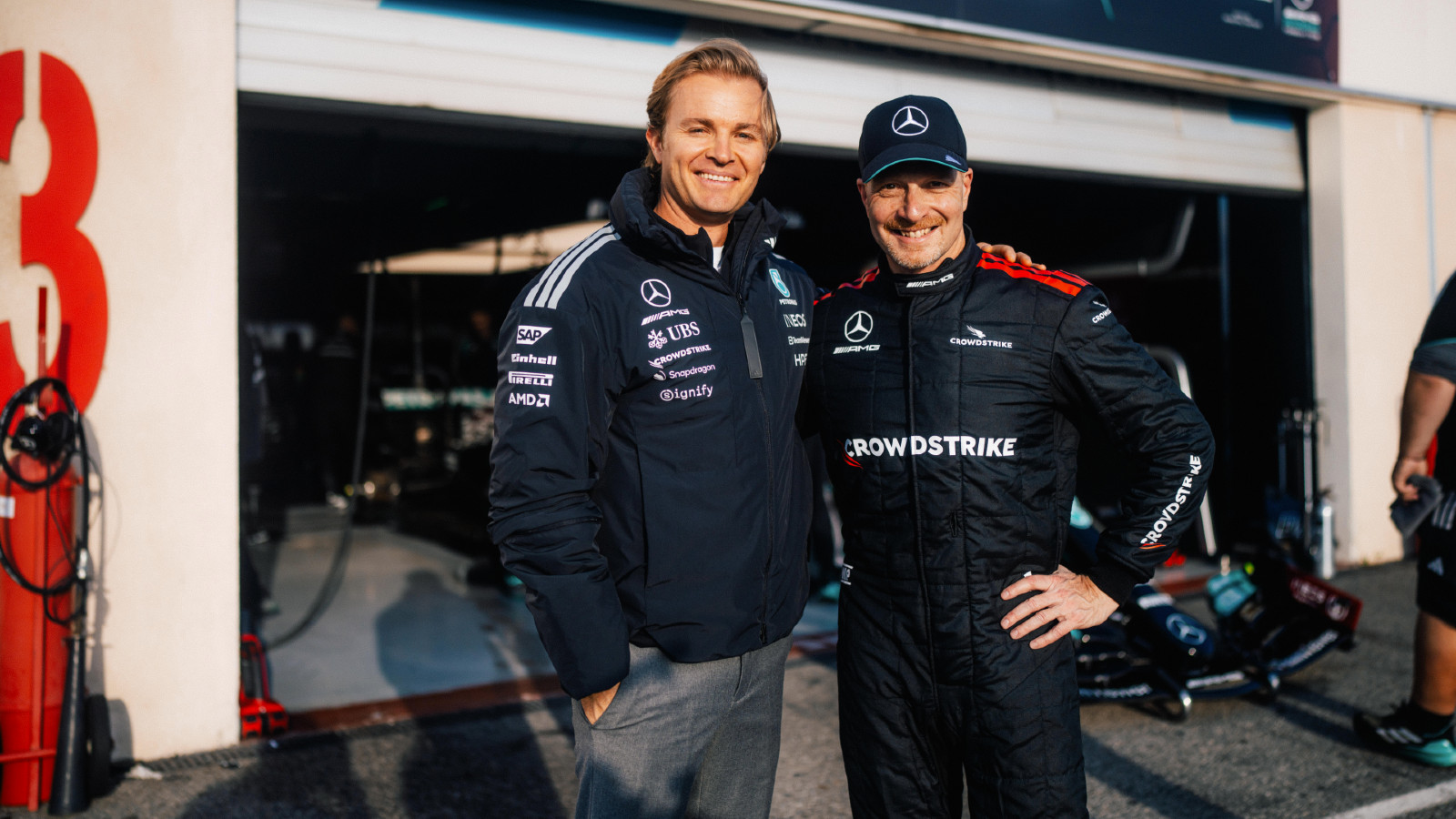
George Kurtz opens up on his 15 per cent Mercedes investment
CrowdStrike first appeared on the Mercedes F1 car in 2018, initially as a cybersecurity partner, before becoming a principal partner the following year.
Over the intervening years, the relationship between Kurtz and Wolff has strengthened, to the point where Kurtz wanted to personally invest in the team alongside the Austrian.
“I think he’s the best principal in the business. The results speak for themselves. Mercedes is obviously a great brand, and there are shared values,” Kurtz explained about the investment.
“It starts with the people, it starts with the team, and there’s a great aspect to be involved in Formula 1. There’s business to it, right?
“In my opinion, it became a much more viable business once the cost cap came into place.
“So you put those together, and I think it was just serendipity because nobody really wanted to sell. I sort of pestered them for a couple of years, and we put it all together, and it all worked out.
“It’s certainly a great brand and one of the most valuable franchises in the world.
“It was really interesting because in 2018, before our IPO, we got a call from the Mercedes team, and they wanted to use our technology. They were switching providers, and they said, ‘Hey, we want the best. We want CrowdStrike.’
“That kind of goes with the Mercedes brand. It’s the best or nothing, which is the old Mercedes saying. So they became a customer, and then just through the channels, Toto figured out, ‘Hey, this guy likes racing.’ He raced in GT4 at the time, I think.
“So we had dinner, and it was like, ‘Well, what do you think about becoming part of the team?’
“We put together a small sponsorship because we wanted visibility outside the US. We’re a B2B company, and a lot of people know us now, but in 2018, not a lot of people knew us around the world.
“So that’s how we got into it, and then it blossomed over time, and we became bigger sponsors. And then last year, I had the opportunity to buy into the team, which is pretty cool. So it’s like-minded people, and the relationship grew over time.
“They want to be associated with marquee brands, and we certainly consider ourselves a marquee brand. It was great to be part of the family.
“We weren’t just a number. It’s only a handful of sponsors that they have, so they look after us pretty well. I think that’s been a relationship that we’ve grown over time.”
With Kurtz getting involved on the steering committee alongside Mercedes’ chairman Ola Kallenius, as well as Ratcliffe and Wolff, he’s also the team’s technology advisor.
It’s clear, then, that this is no mere passive investment, where those hoping to make a quick buck throw in some money, sit on the sidelines while waiting for valuations to climb, before cashing out at a (hopefully large) profit.
With F1 team ownership now a very valuable and increasingly difficult commodity to get a hold of, Kurtz pointed to how it took years of developing a solid foundation with Wolff before the option even became a tangible prospect.
“In my particular case, as a technical advisor for them, given the importance of AI, given the importance of reducing cost and driving performance, how can we make sure that we use AI as part of the team to drive performance where we can?” he said.
“That was part of the appeal. And obviously, like-minded. I’m not an in-and-out, like, get in and sell a couple of years later.
“For me, it was a good opportunity, and I think that was appealing to Toto.
“We built a relationship. I think it’s important. He’s not just selling, letting anybody buy into the team. So it really took trust over the years of knowing him and having like-minded philosophies.
“Obviously, my full-time job is CrowdStrike, but interacting with the team and the technical folks, and then thinking about how we can agentically help and accelerate what they’re doing.
“They have a lot of smart people. They have incredible engineers, and you just have to ease into where you can help, and where maybe you’re not helping.
“I think it’s always like, ‘Hey, what are things that we’re thinking about?’ Just providing some ideas as opposed to trying to jam ideas and bringing people along into the art of the possible.”
While the governance structure of the team hasn’t changed in light of Kurtz’s investment, he confirmed that his voice is one of those guiding the team forward.
“Toto and I are together, so I think he’s got everybody’s best interest at heart, and I provide my input to him,” he said.
“That’s been part of the overall view. I think it’s all worked out pretty well, and I’m not shy in giving my opinions!”
Very enjoyable few days at Paul Ricard to speak with Mercedes-AMG PETRONAS F1 team shareholder and CrowdStrike CEO George Kurtz, as he drove the W12 for his Driving Ambition documentary.
The interview will be on PlanetF1 shortly, in which he outlines why he’s got involved in the team alongside his own racing career.
Fun fact: the W12 he drove is the exact chassis that Lewis Hamilton was driving at the 2021 British and Italian Grands Prix… A slice of racing history! #F1
— Thomas Maher (@thomasmaheronf1) November 17, 2026
George Kurtz’s journey from cybersecurity billionaire to racing driver
The world of motorsport appears very different from the arena in which Kurtz made his $13 billion fortune, with the American starting his career at Price Waterhouse as an accountant in 1993, having majored in accounting at university.
But, with cybersecurity in its infancy, he joined the company’s security division to begin catching vulnerabilities in network systems, a role he continued at Ernst & Young up to 1999.
That year, Kurtz established his own company, Foundstone, to offer cybersecurity solutions and products, before selling to McAfee in 2004. As chief technology officer by 2009, he left the company when it was bought by Intel in 2011, going on to establish CrowdStrike that same year; an enterprise that quickly established significant momentum in the space.
But it was while at McAfee that Kurtz first had the idea that he, one day, wanted to end up in the F1 ecosystem in some shape or form.
“It actually goes back to probably 2010 because I had a company that I sold to McAfee,” he said.
“Gerhard [Watzinger, now chairman of CrowdStrike] and I put together a deal with Zak Brown; Zak was at JMI [Just Marketing International] at the time, and we were going to be on the Mercedes car with Nico and Michael Schumacher.
“Then, when we got acquired, Intel acquired us. They cancelled the sponsorship, and it never came to fruition.
“It was always in the back of my mind, like, ‘Hey, if we get CrowdStrike big enough, it’d be great to be on the Mercedes car.’
“So it actually started before 2018. It was a twinkle in my eye in 2010, so we were able to put it together for our own company.
“And it’s not just a logo that is on the car. There’s so much that we do with our customers and so many events, and we integrate motorsports into CrowdStrike in many different areas.
“People know us for that. It’s a bit of an ethos of the company, and it’s different from going to a football game or basketball or cricket or whatever it might be. That’s just part of the way we operate.”
How George Kurtz went from a track day to winning at Le Mans
The bug of motorsport had bitten Kurtz in 2007, sending him down the path that would see him start to diversify into the racing world over the following years, leading to him making his GT4 debut in 2016.
“I did a track day, and I did it in a Radical, which was a high-downforce car. It was a lot of fun, and I was pretty good at it,” he said.
“I had breakfast with the guy who owned the track, and he said, ‘Hey, I want to show you something.’
“So, in the clubhouse, he basically brought me over to this Radical and had velvet ropes around it. He said, ‘Hey, George, let me show you this thing.’ I looked down and saw my name on the car, and I said, ‘I’ll take it. Where do I sign?’
“I bought the car, and that was it. Then raced the Radicals through the club level, won a national championship at Radical, and then moved into GT4, GT3, LMP3 and LMP2 over the 20 years.”
Racing, in his eyes, might require some different skills, but Kurtz said he can see plenty of similarities and overlap in terms of how to get the most out of his two chosen professions.
“It’s very analytical. When you look at the data that you have to study, when you look at the approach, when you look at the preparation, there’s nothing like it in work,” he said.
“I have to prepare. I have to have the data. I have to understand the risk, and it’s the same way in the car where you have to understand what to prioritise, what to focus on. Can’t focus on everything.
“I’m a rule of three guy, so even out there, when I was asking my world championship coaches, I basically said, ‘What are the three things I’ve got to work on?’ Because I can’t think of three, and I really prioritise those.
“And then in car racing, even just trying to put fast laps in Lewis Hamilton’s historic car, I don’t want to bin it. So how much risk do you take? Same in business. It’s always a matter of managing risk and how much you push in business versus how much you push on the track.
“I think there are a lot of similarities, and, just like in business, the small details really matter. If you take care of the little details, the lap time will come, and the wins will come.”
George Kurtz explains why cybersecurity is so important to Mercedes and F1
While our foray at Paul Ricard was with George Kurtz, the racing driver, rather than the cybersecurity technology leader, it’s the efforts of companies like his that have ensured that the F1 teams aren’t continuously falling prey to bad actors, keen to get their hands on the priceless data and intellectual property that is constantly zipping through the air and their networks, whether that’s trackside or back at base.
Cybersecurity partners aren’t just a luxury, blue-chip consideration to have on a team’s sponsorship portfolio: they are essential to maintaining that wall of privacy and security, and it’s no surprise that the teams are signing up with other players in the same space.
“We see what happens when IP gets spread between teams, years ago, right? And you certainly don’t want that IP to be stolen,” Kurtz said of the industry’s importance to Formula 1.
“The way eCrime works today, they’re going to steal it, they’re going to encrypt it, and they’re going to basically, even if you have a backup, they’re going to extort you.
‘We’re going to take your latest 2027 car and put it on the internet.’ That would be a disaster. So we’re a big part of it. We take that responsibility seriously, and there’s a lot at stake for a Formula 1 team.
“Performance, it’s all about performance, and you want to keep that obviously secret until you get the car on track.”
It’s a hidden and secret war, a never-ending effort to stay a step ahead of vulnerabilities, and the rise of artificial intelligence has obvious implications, not only in terms of the breadth of the veracity of an attack, but the volume of attempts that AI makes possible.
“We work very closely with Michael Taylor, who’s the CIO [Mercedes’ chief information officer], and obviously there’s a lot of data.
“The computer, the car is a rolling computer, hundreds of computers in it, and lots of data that goes back every weekend.
“Given the products we have, we have that integrated into the Mercedes team, and we’re protecting a big part of their estate.
“It’s the relationship that we built over time. They trust us, and we’re always trying to figure out how do we make sure we protect them, and how do we also drive down the cost because everything comes in the cost cap.
“I think we were certainly in the early days of cybersecurity partners. Now there are a lot of companies that are out there, but we started a trend. I think it became fashionable. Any of the Formula 1 teams are going to have to have good cybersecurity partners.
“[With AI] what you have is you’ve got more volume of attacks, because AI can just generate more of them and find more vulnerabilities, and they come at you faster.
“So you have a shorter amount of time to deal with patching and being able to protect yourself, and a much greater number of attacks that happen in an automated way.
“A big thing for us and for our customers is to use AI, defensive AI, blue models as opposed to red models. Red is offence, blue is defence, and to be able to take really world-class, frontier-calibre models that we’ve built and be able to protect our customers, along with all the other technology that we’ve built over the last 15 years.
“We like to think that we let people sleep better, and we’re a big part of their security strategy.
“Again, it’s a team effort. It’s not us. They’ve got a great team internally, and you just have to be vigilant because the bad guys are so good.
“I think the latest stat right now is that this eCrime is about a $20 billion business, and there’s a lot of money being made by the bad guys.
“What we find now with AI is that it used to be a pyramid of threat actors. You’d have hacktivists at the bottom, a lot of them, not as sophisticated.
“In the middle, you have eCrime, a little bit fewer of them, but more sophisticated. And at the top, you’d have a nation-state: China, Russia, Iran, those sort of things. They had the greatest capabilities, the smallest number, but the greatest capabilities.
“Really, now it’s the agent state because that pyramid has collapsed. The hacktivists have the same capabilities as a nation-state because they’ve got access to agents and models. It’s only going to get worse.”
With our time coming to an end, it’s time to say goodbye: Krtz is heading off to debrief from his F1 run, as well as start looking ahead to the ALMS race at the weekend.
As he departs with a cheerful goodbye, it’s clear that his declaration of activism as an investor is not lip service: this is a driven, headstrong, and highly intelligent leader who has come on board. And, most importantly, one who cares, deeply, about racing.
With a different perspective on the challenges facing a modern F1 team, particularly as data, AI, and technology become increasingly important to performance, his story is indicative of how a commercial partnership can evolve into something far deeper and beneficial for everyone involved.
Read Next: Aston Martin makes new Fernando Alonso announcement ahead of Las Vegas GP