
Red Bull’s 2026 struggles explained: Why Max Verstappen’s RB22 is losing nearly two seconds


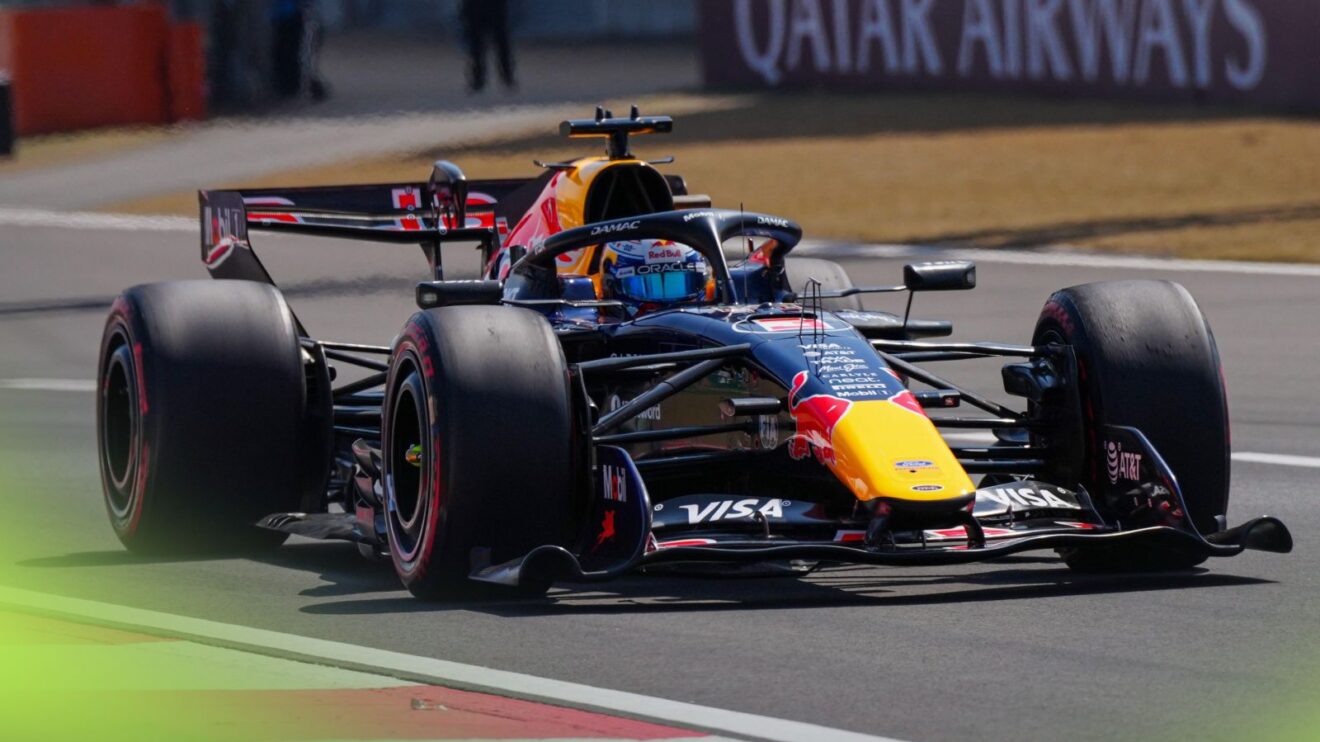
Max Verstappen driving the Red Bull RB22
Red Bull Racing have certainly not had the start to the 2026 season they envisioned. Max Verstappen has been one of the most vocal critics of the new regulations, and the results on track are currently far from what we’ve come to expect from the Milton Keynes team.
What is the root cause of this poor form, and can Red Bull find a way back to the front? Let’s dig a little deeper.
Why Max Verstappen and Red Bull are struggling under the 2026 regulations
Want more PlanetF1.com coverage? Add us as a preferred source on Google to your favourites list for news you can trust.
Red Bull were among the favourites heading into the season, even after pre-season testing in Bahrain. When you finish one era of Formula 1 with the fastest car on the grid, you generally remain the team to beat, regardless of how drastic the 2026 rule changes are.
However, those expectations have quickly fallen flat. After just two race weekends, it is clear that Red Bull are in serious trouble – not just in terms of outright performance, but also reliability.
In Australia, it was Isack Hadjar who suffered the most, and the story repeated itself at the Chinese Grand Prix with Max. After 45 laps, Verstappen was forced to retire the car due to a technical failure.
The situation in qualifying is equally concerning. In Australia, Max missed out on a Q1 run due to technical gremlins, and even when both drivers manage to finish a lap, the gap to the front remains stark.
By looking at the telemetry, we can try to find the answer: where exactly is Red Bull losing out?
Analysing the qualifying pace in China, Verstappen was nearly a second off pole position, while Hadjar was over a second adrift. These times left them in P8 and P9, positions that the team will certainly not be happy with.
You only need to watch Max’s onboard footage during his Q3 flying lap to see how difficult the new Red Bull is to handle.
The rear-end stability is very poor. Right from the entry to Turn 1, you can see the Dutchman making several steering corrections just to keep the car on the track. In high-speed corners, this issue is even more obvious. Both Red Bull drivers are recording much lower apex speeds, and it appears their energy recovery system is significantly less efficient in these sections. Essentially, they are forced to slow down more in the corners just to stay competitive on the straights.
In fact, their straight-line speed is one of the few bright spots; in this department, they are actually matching Mercedes, which suggests the raw power unit grunt is there.
However, things arguably look even worse when we look at race pace.
A poor start for Max cost him dearly, as he found himself down in P17 at the entry to Turn 1. Later in the race, this allowed us to see just how much Red Bull is struggling as their pace was not significantly better than the midfield teams.
Looking at the race data, high-speed corners remain the primary headache.
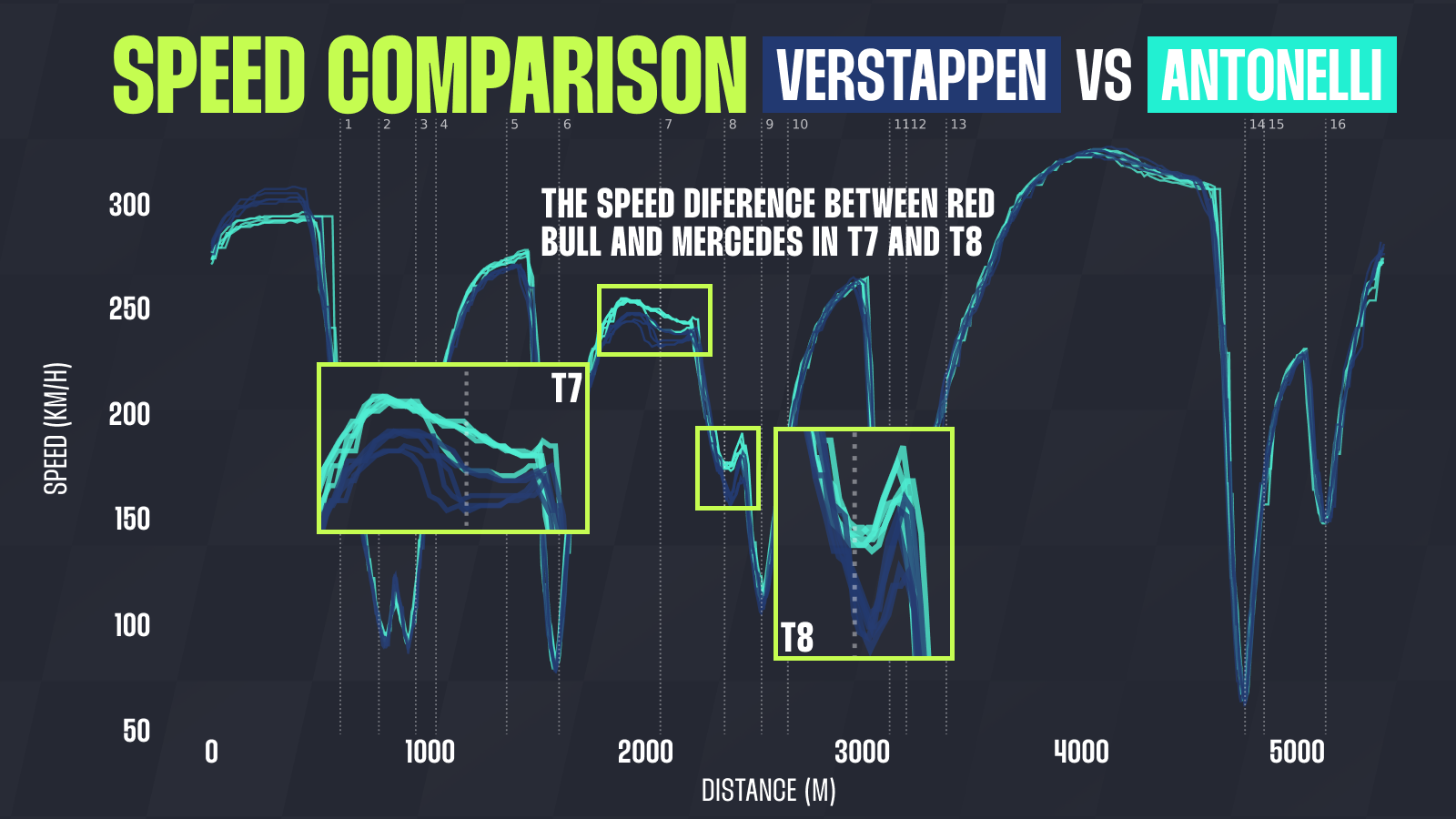
The graph above compares Verstappen’s and Antonelli’s laps from the middle of the race, when both were in clear air.
The biggest delta is visible in Turns 7 and 8. This is where teams usually harvest energy, and just like in qualifying, Red Bull is doing this at much lower speeds compared to the Mercedes. A very similar pattern repeats in Turns 9, 11, and 12.
Latest F1 2026 talking points via PlanetF1.com
Max Verstappen brands F1 2026 racing ‘a joke’ as he launches fiercest attack yet
How Lewis Hamilton overcame thrilling Leclerc battle for first Ferrari podium
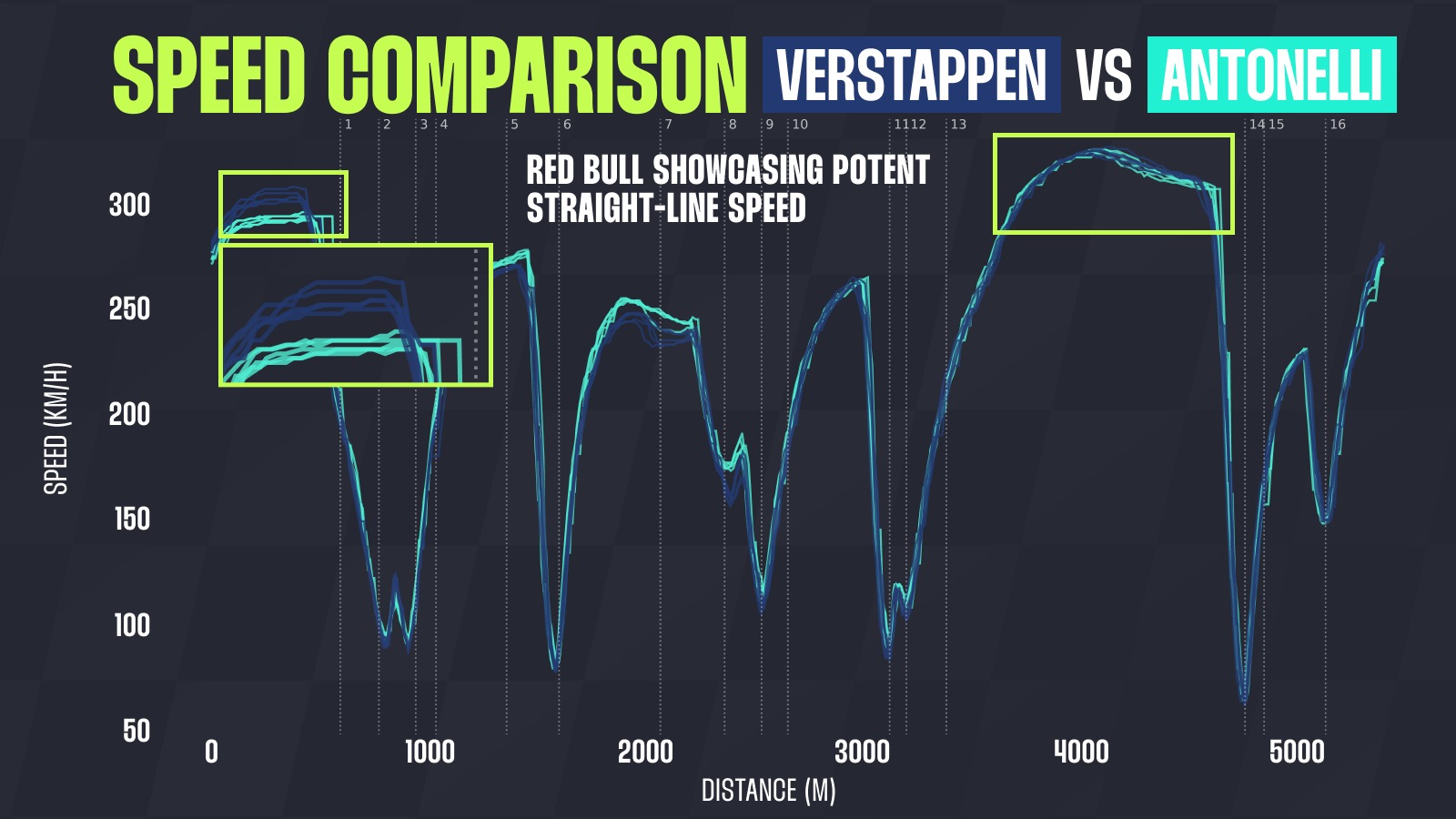
The top-speed figures are much better, with Max matching Antonelli on the T13–T14 straight and even beating him on the start-finish straight, as can be seen on the graph below.
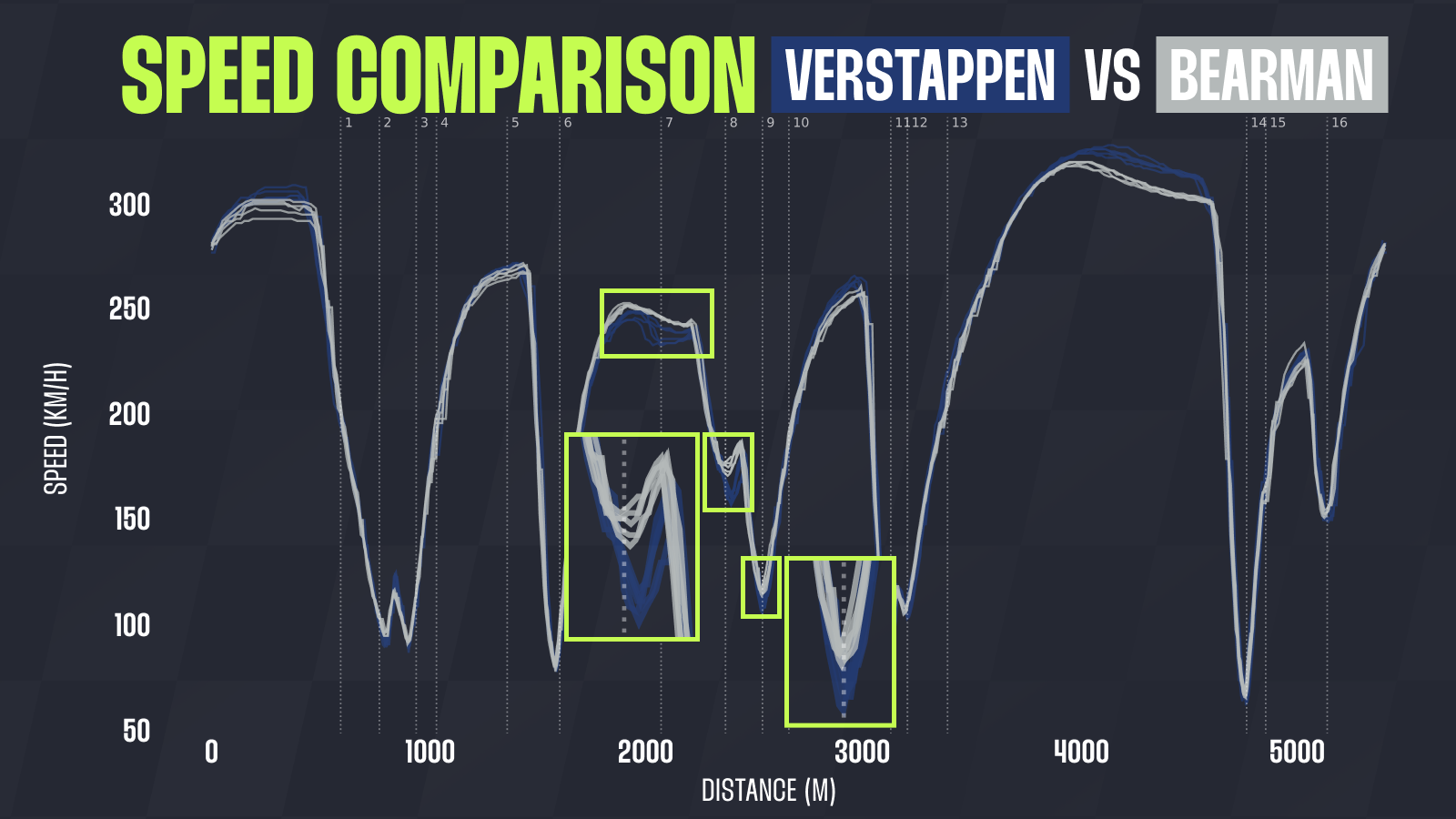
While the Mercedes is clearly the class of the field, the situation doesn’t improve much when we compare Max to Oliver Bearman, whom he was stuck behind for a large part of the race.
Despite Haas being slower on the straights, the deficit Red Bull loses in Turns 7 and 8 is more than enough to prevent them from using their straight-line advantage to make a move.
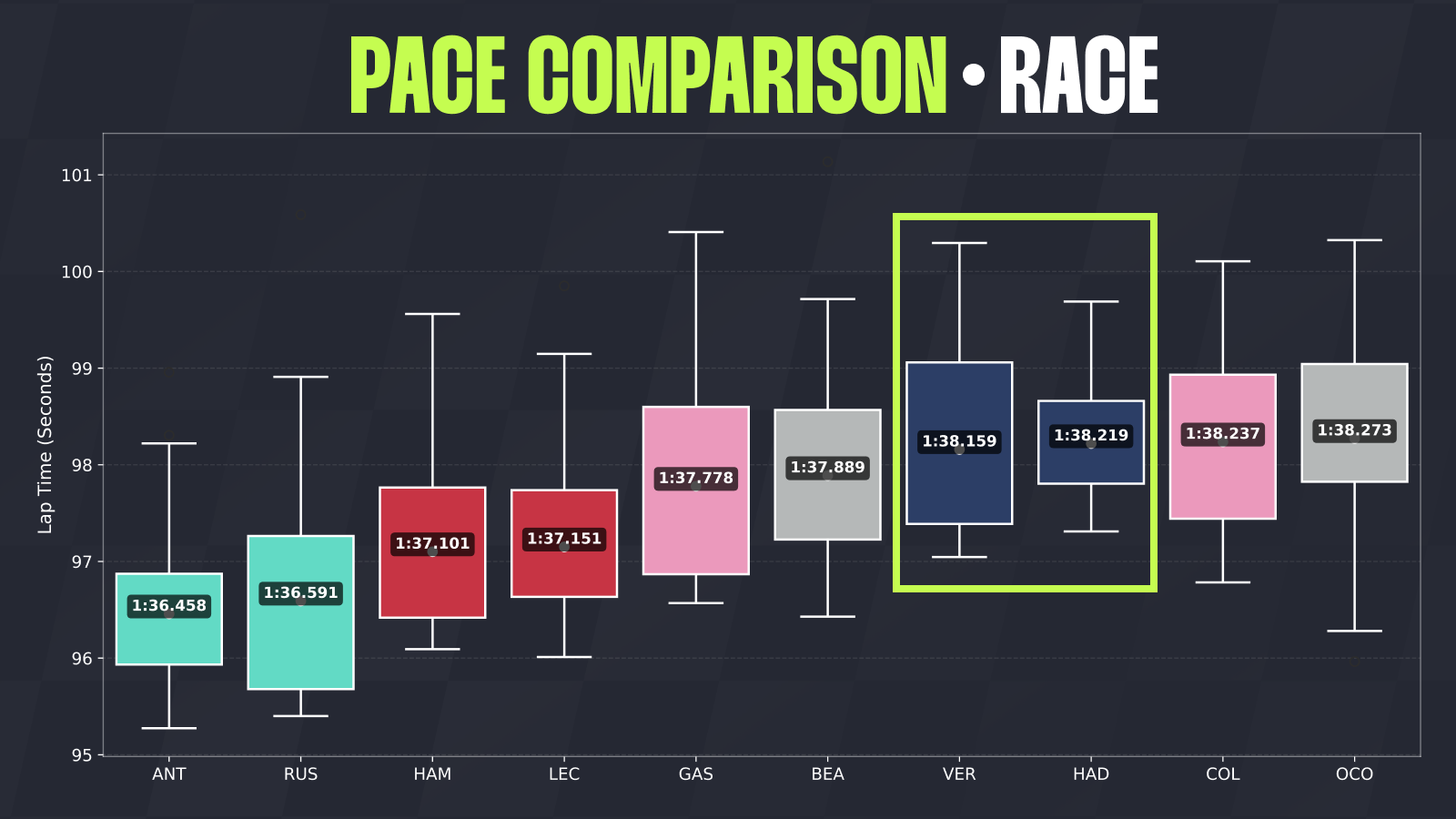
During his 45 laps in China, Max Verstappen was, on average, 1.7 seconds per lap slower than the race winner. In reality, the true gap might have been even larger, as this doesn’t account for the fact that Verstappen would have slowed down further had he stayed on track due to tyre degradation – which leads us to the next problem.
In an attempt to recover positions quickly, Max started the race on the soft compound, but the tyres were effectively “dead” after just seven laps. Even later, during his stint on the hards, his tyre wear was much higher than expected, adding another layer of difficulty to an already tough situation.
The conclusion is clear: Red Bull needs to make significant steps forward with their chassis and aerodynamics. The power unit has the speed, but that means very little when reliability is an issue.
The four-time world champion has been very direct, stating that he doesn’t enjoy racing this new generation of cars at all. Whether these comments are influenced by Red Bull’s current performance is hard to say, but fans will be hoping the team finds a solution soon. The sport needs a fast Max Verstappen back in the thick of the action.
Want to be the first to know exclusive information from the F1 paddock? Join our broadcast channel on WhatsApp to get the scoop on the latest developments from our team of accredited journalists.
You can also subscribe to the PlanetF1 YouTube channel for exclusive features, hear from our paddock journalists with stories from the heart of Formula 1 and much more!
Read next – Chinese GP driver ratings: Antonelli shines, Hamilton impresses and Ocon falters