

How big is Mercedes’ advantage? Data breaks down imposing Aus GP qualifying gap
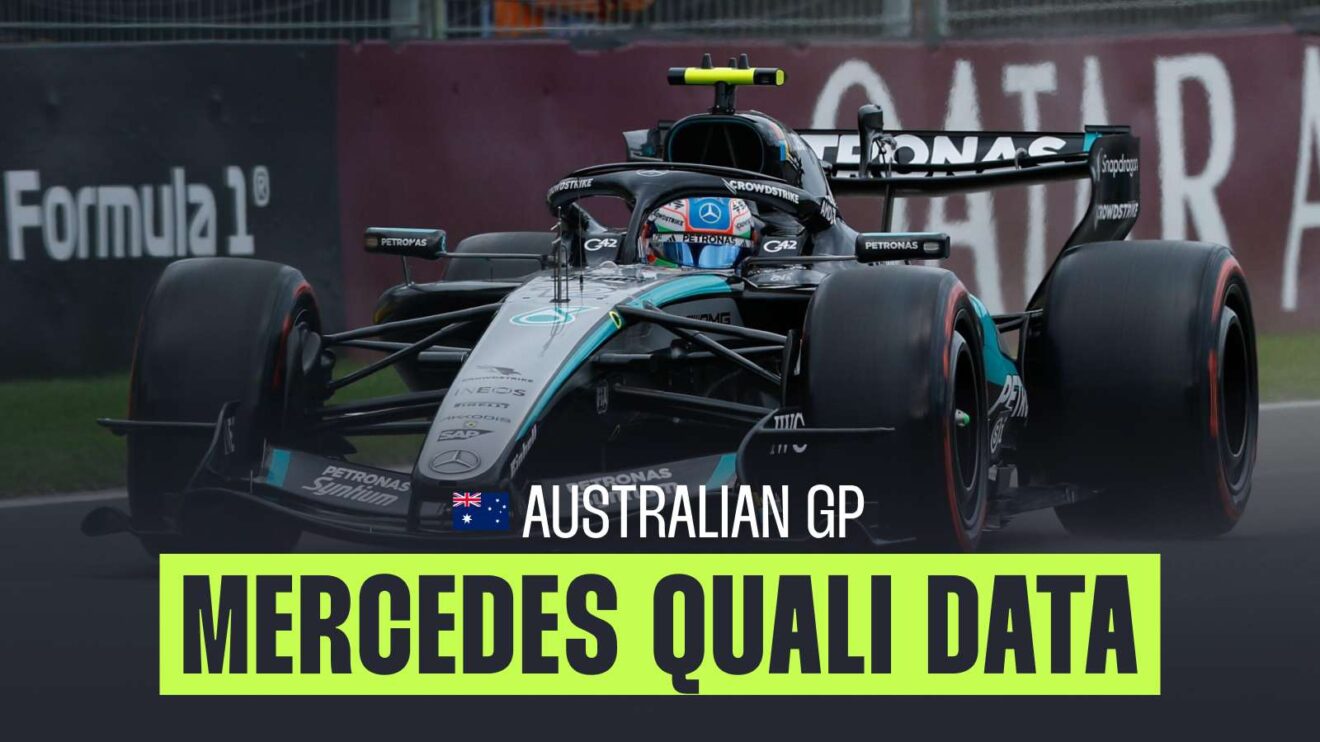
Mercedes proved dominant in Australia qualifying, but how much do rivals have to catch up?
Qualifying for the 2026 season opener in Australia was simultaneously captivating and cause for concern. We witnessed a blistering Mercedes, but also much wider gaps in the lap times of the chasing pack.
Where and why did such a disparity emerge, and exactly how much do the other teams trail? The telemetry data reveals the answers.
What is the actual gap to Mercedes?
Want more PlanetF1.com coverage? Add us as a preferred source on Google to your favourites list for news you can trust.
Mercedes is undoubtedly the primary talking point in Formula 1 following a truly dominant display of qualifying performance at the Albert Park circuit. George Russell secured pole position, with his teammate, driving a car without a finalised setup, slotting in right behind him.
Isack Hadjar in the Red Bull claimed third with a deficit of 0.785 seconds, followed by Leclerc at 0.809 seconds, while the McLaren pair finished qualifying in fifth and sixth, trailing the pole time by 0.862 and 0.961 seconds respectively.
In other words, Mercedes was between 0.8 to 1 second per lap faster than the rest of the field – a terrifying prospect, especially considering that Albert Park is one of the shorter circuits on the calendar.
More from qualifying at the Australian Grand Prix
F1 starting grid: What is the grid order for the 2026 Australian Grand Prix?
Max Verstappen Melbourne crash explained as Red Bull driver blasts ‘not correct’ F1 regulations
So, where does this massive delta come from?
If we examine the graph below, we can see that Turn 4 is actually the point where Mercedes breaks away, building a consistent advantage all the way to Turn 11. From Turn 11 through to the end of the lap, Mercedes is actually the slowest when considering the top four teams, but those differences are negligibly small.
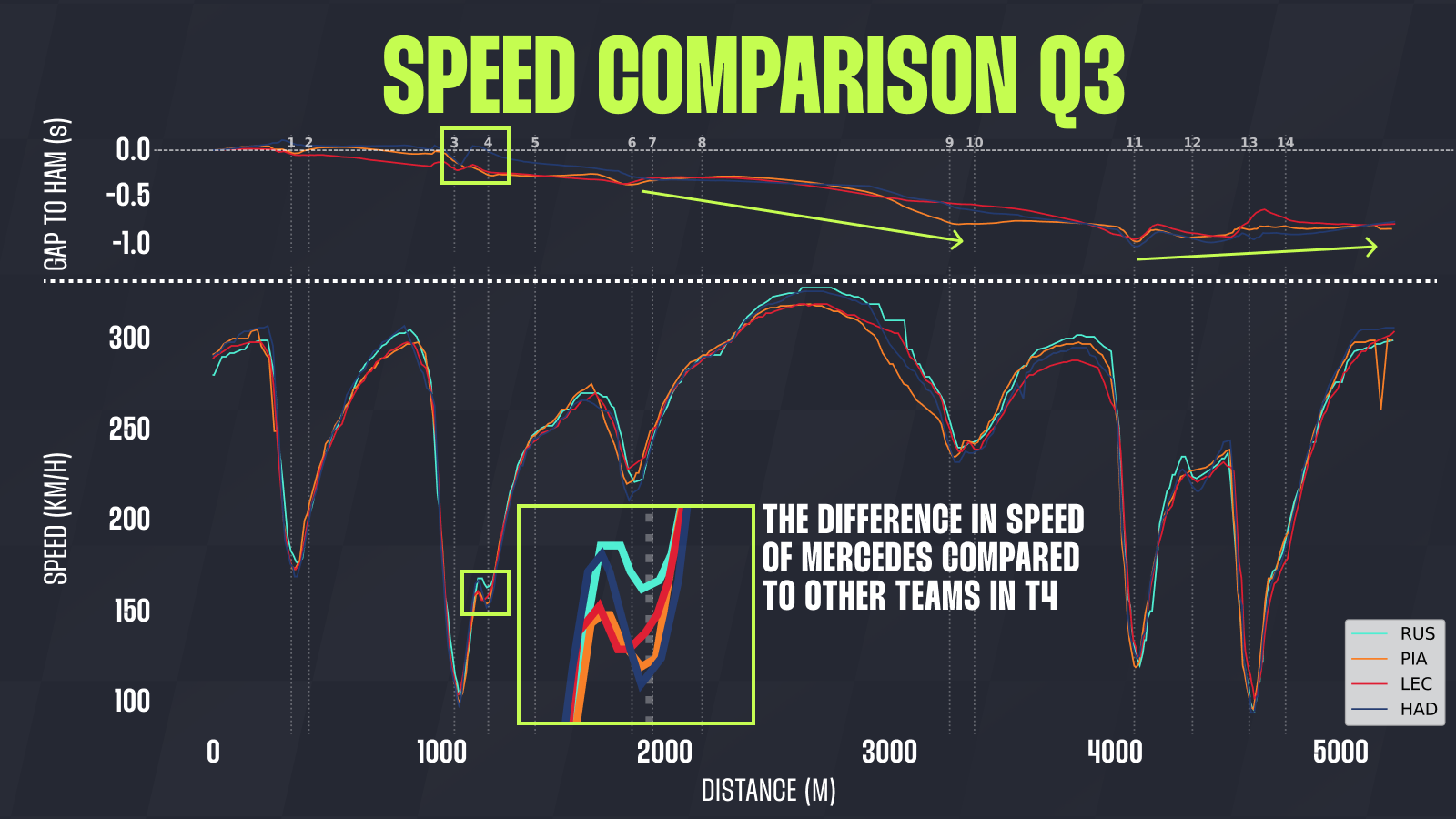
What we can also observe is that energy deployment strategies vary significantly from team to team, as was to be expected. For instance, top speeds on the start-finish straight are completely different from those seen on the T8–T9 straight.
However, as mentioned, T4 is the corner where relatively small time deltas begin to balloon. From the graph above, we can see how much more speed Russell manages to carry through T4. This grants him an immediate advantage of roughly two-tenths over Leclerc and Piastri.
What is particularly interesting is the period from T11 where the most significant difference was made. Russell was actually one of the slower drivers through T6 and T7, but that picture shifts rapidly. Just look at the difference between his top speed on the ensuing straight compared to the others. Red Bull isn’t actually that far off, but Ferrari and McLaren are on a lower tier entirely.
In the graph below, you can see a magnified section of T8-T9, which better illustrates the effect of “super clipping.”
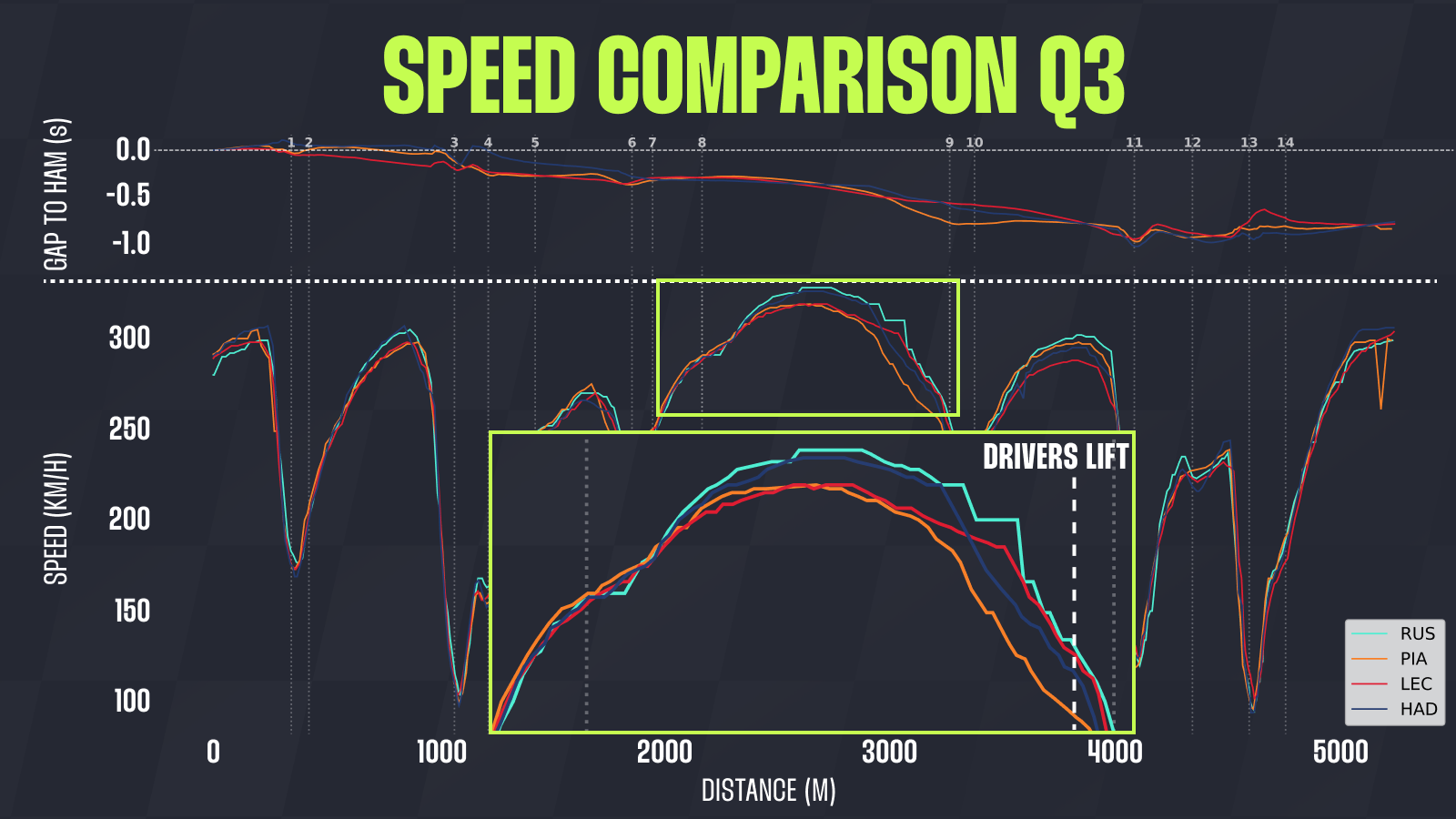
Crucially, Mercedes maintains the highest speed both at the midpoint of the straight and just before the entry to T9 when drivers lift off. In their case, clipping has the least impact on speed, whereas for other teams, it drops far more sharply. In this segment, McLaren is undoubtedly the weakest, as their speed falls off incredibly fast.
The explanation for this may lie in the straight that follows immediately after, where we see McLaren now rivalling Mercedes most effectively. Different teams are currently employing different energy optimisation strategies, giving them an edge in certain sectors while they lose out in others.
We should also mention that Ferrari suffered some form of technical glitch during Q2 and Q3, which certainly hindered their top speed on the straights (see the top speed charts below). On a more positive note for the Maranello squad, they were the fastest through T6 – hinting at an excellent level of downforce produced by the car.


This data firmly points towards all those pre-season predictions that Mercedes has produced the class-leading power unit. This fact is likely true; Mercedes does indeed have the best power unit, but their early dominance is surely not the result of a single factor alone.
McLaren, Williams, and Alpine also run the Mercedes power unit, yet the manner in which it is utilised is certainly not identical.
This brings us to perhaps the greatest issue with this new generation of cars: the inability of us, the viewers, to actually see what is happening. When you have these odd occurrences where cars lose up to 50 km/h on straights just to charge the battery, providing precise reasons for why a team is fast or slow (beyond battery harvesting) becomes incredibly difficult.
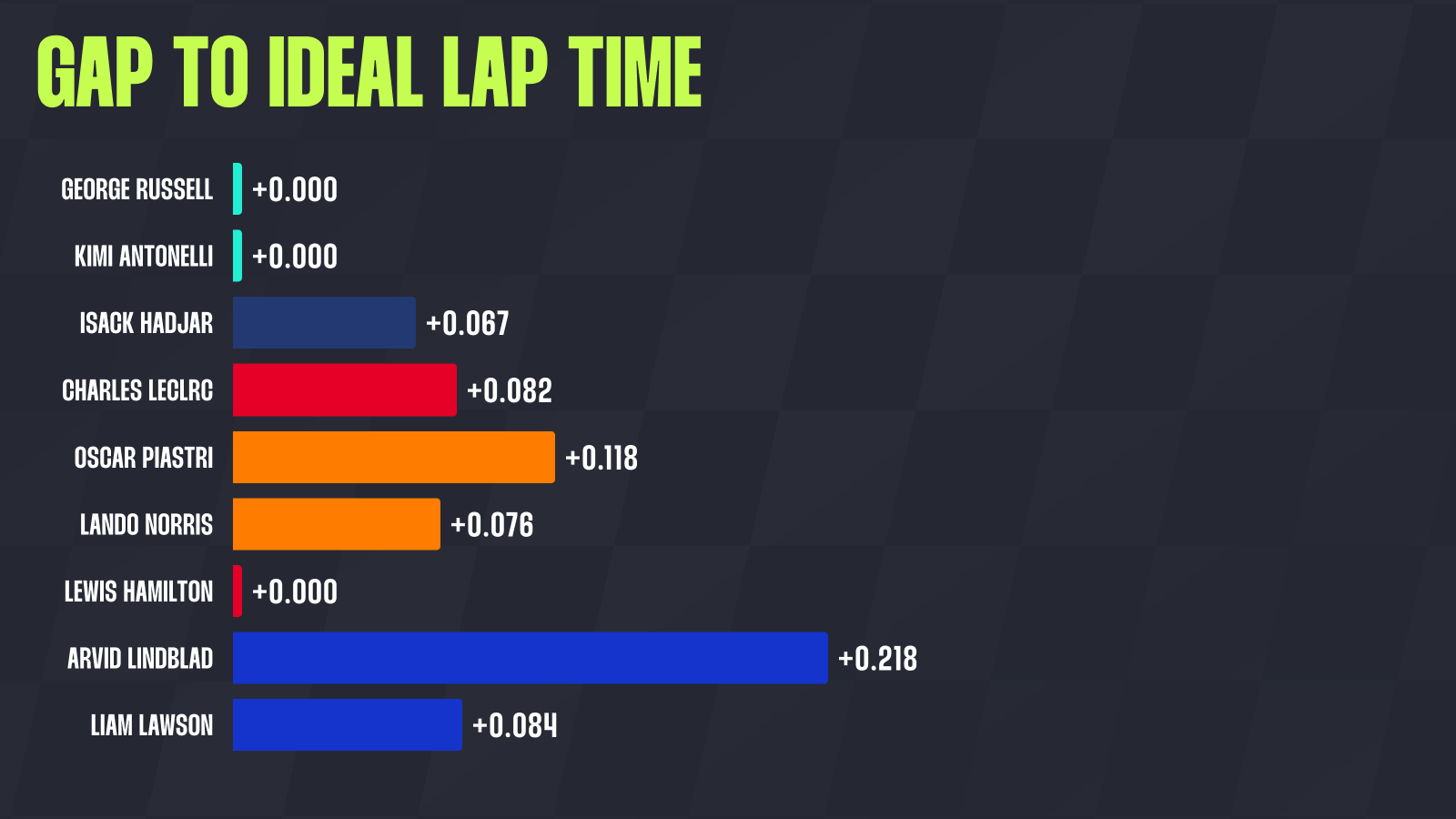
However, we can confirm that the gap Mercedes established in qualifying is more than genuine. Looking at the data regarding how much each driver trailed their theoretical “ideal lap,” it is clear that most drivers extracted their full potential.
Oscar Piastri and Lando Norris could have found about another tenth, but unfortunately for them, that wouldn’t have drastically altered the standings.
To make the situation even more worrying, we must remember that the limit for electrical energy recovery during qualifying is capped at 7MJ, whereas this figure rises to 8MJ for Sunday’s race. This rule was introduced specifically to bridge the gap between fast and slow teams – or rather, those who harvest energy more or less efficiently.
In other words, if Mercedes is this dominant in qualifying, the gap between them and the rest will likely only increase during the race.
However, this equation isn’t quite so simple, as we must factor in variables such as aerodynamics, tyre wear (which is directly linked to aero), strategy, the driver factor, and so on.
As onlookers, we can only hope that these factors will create a better balance on the grid, and that we will, in the end, have an engaging battle for the victory.
Want to be the first to know exclusive information from the F1 paddock? Join our broadcast channel on WhatsApp to get the scoop on the latest developments from our team of accredited journalists.
You can also subscribe to the PlanetF1 YouTube channel for exclusive features, hear from our paddock journalists with stories from the heart of Formula 1 and much more!
Read next: Adrian Newey claims AMR26 is ‘fifth-best’ chassis despite Melbourne woes