
Mercedes telemetry reveals how George Russell secured dominant Australian GP pole
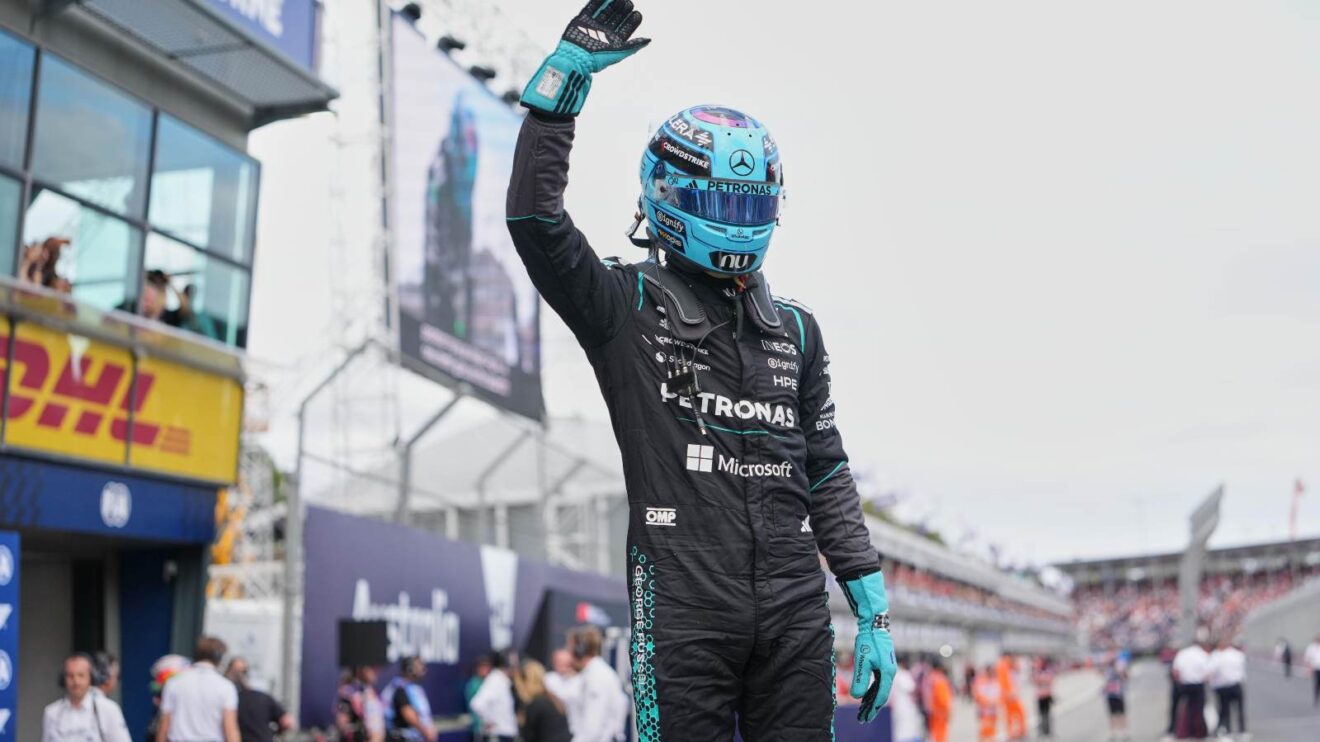
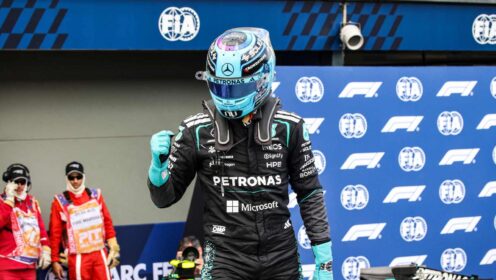
George Russell salutes the fans after taking pole in Melbourne.
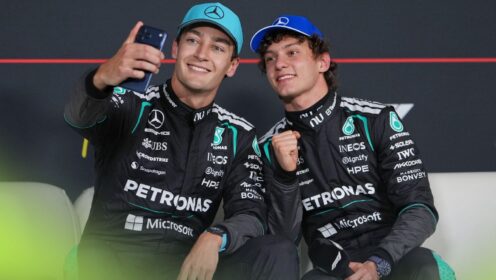
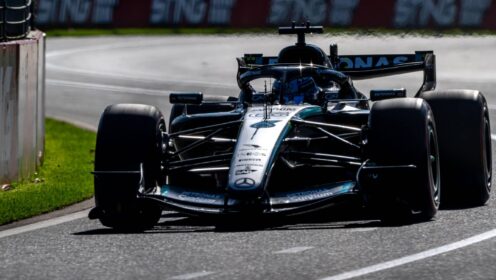
The first qualifying session of the 2026 season is in the books and, undeniably, Mercedes has built an absolute rocket ship. George Russell and Kimi Antonelli have locked out the front row, while Isack Hadjar finds himself in third, trailing the pole position by a significant 0.78 seconds.
How did Russell secure his pole position, and is it all down to the Mercedes PU? We reveal the answers through a deep dive into the telemetry data.
George Russell telemetry analysis explains Mercedes Australian GP pole
Want more PlanetF1.com coverage? Add us as a preferred source on Google to your favourites list for news you can trust.
Pre-season whispers have swiftly been vindicated. Although Mercedes engineers and drivers alike played down any talk of an advantage, the opening qualifying of this new era has told a very different story.
Mercedes has indeed produced an exceptionally fast car, and the fact that the fastest non-Mercedes driver is nearly eight-tenths off pole is cause for serious concern. To find the last time such a delta existed during qualifying in Australia, one would have to go back to 2018 when Hamilton – again in a Mercedes – was in a league of his own.
It appears Mercedes truly knows how to master the machinery when major technical shifts occur.
However, the question remains: just how much credit for this dominant start to the season belongs to the allegedly superior power unit?
More from qualifying at the Australian Grand Prix
F1 starting grid: What is the grid order for the 2026 Australian Grand Prix?
Max Verstappen Melbourne crash explained as Red Bull driver blasts ‘not correct’ F1 regulations
Comparing Russell’s and Hadjar’s laps from the Q3 shootout, several glaring differences come to light.
At the start of the lap, it was actually Hadjar who held a higher top speed and an initial lead even after T1, through which Russell had a much cleaner exit. Overall, George enjoyed a great start to his lap, with a very tidy and precise flow through the first three corners, avoiding any aggressive runs over kerbs.
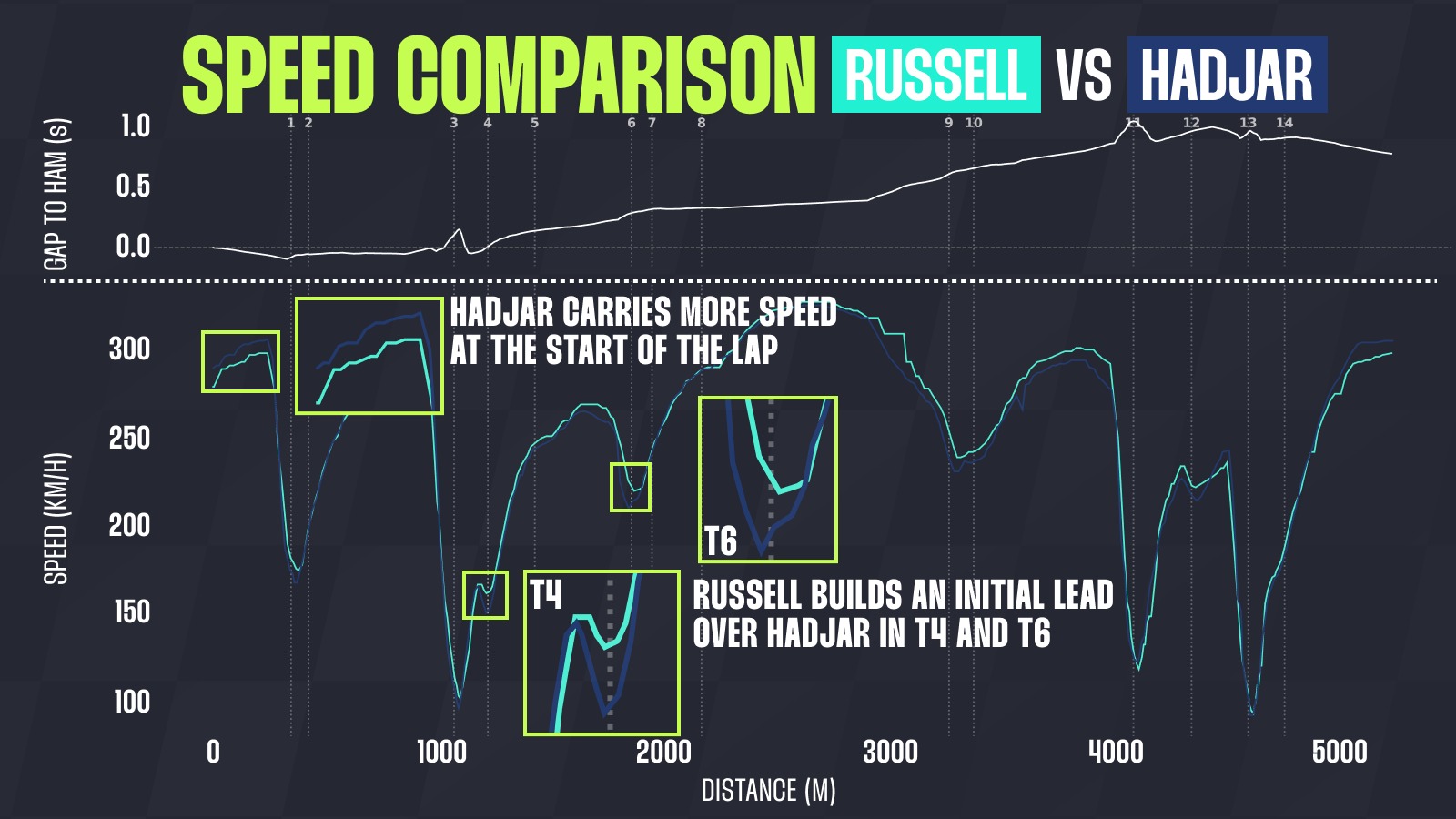
The point where a major disparity emerges is T4, where the Mercedes was simply fantastic during this qualifying, not just compared to the Red Bull but against the entire grid. Superior speed through T4 allowed Russell to carry that momentum through the rapid T5 and into T6, where a difference in apex speed is also evident.
The following section of the track is perhaps the most intriguing from a data perspective, as we see a variety of team strategies through the T8-T9 straight and subsequently T9 and T10. Hadjar, in the Red Bull, matched the apex speed through T8 and held his own halfway down the straight.
However, in the second half of the straight, when the battery drains and the MGU-K switches into energy recovery mode, the delta between Russell and Hadjar begins to open up.
While almost certainly both teams are harvesting energy in this section, Mercedes manages to do so far more efficiently, granting Russell and Antonelli a clear speed advantage, as illustrated in the graph below.
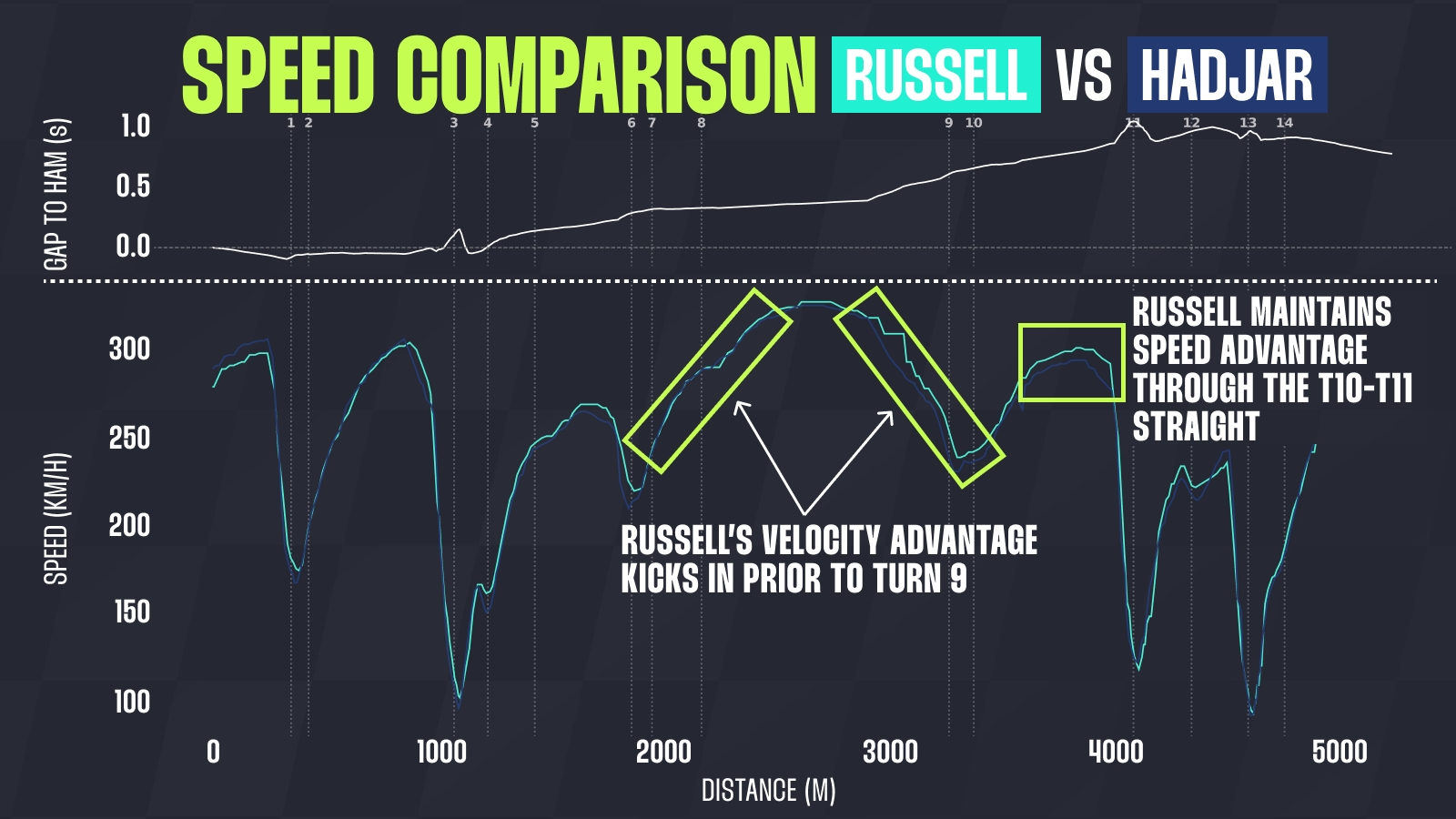
Furthermore, it’s worth noting that the throttle application between these two drivers is remarkably similar in this section, leading us to conclude that the advantage Russell gains here is truly down to the excellent work of the engineers back at the factory.
However, we must differentiate between raw power unit output and energy optimisation. We cannot know for certain if the Mercedes unit is fundamentally more powerful than the rest, but the data clearly shows their engineers have done a better job regarding energy deployment.
Quite simply, they have found a more effective method and location on the track to charge the batteries; exactly how much of that is due to the ICE itself is something we may never know for sure.
From T10 until the end of the lap, Hadjar drove exceptionally well, losing no further time to the Briton. In the final corner, he appeared to have more electrical energy in reserve, granting him an extra boost for the final sprint and clawing back a fraction of a tenth.
To ensure the fantastic W17 doesn’t take all the credit, a comparison between Russell and his teammate is telling.
Kimi had a slightly scruffier run through the first corner, losing roughly 1.5 tenths immediately. The next section of the lap looks hauntingly identical between the two drivers, until we reach that notorious Turn 9 once again.
Despite being behind the wheel of identical machinery, Russell managed to extract better entry speed into T9, finding another 0.15 seconds in the process.
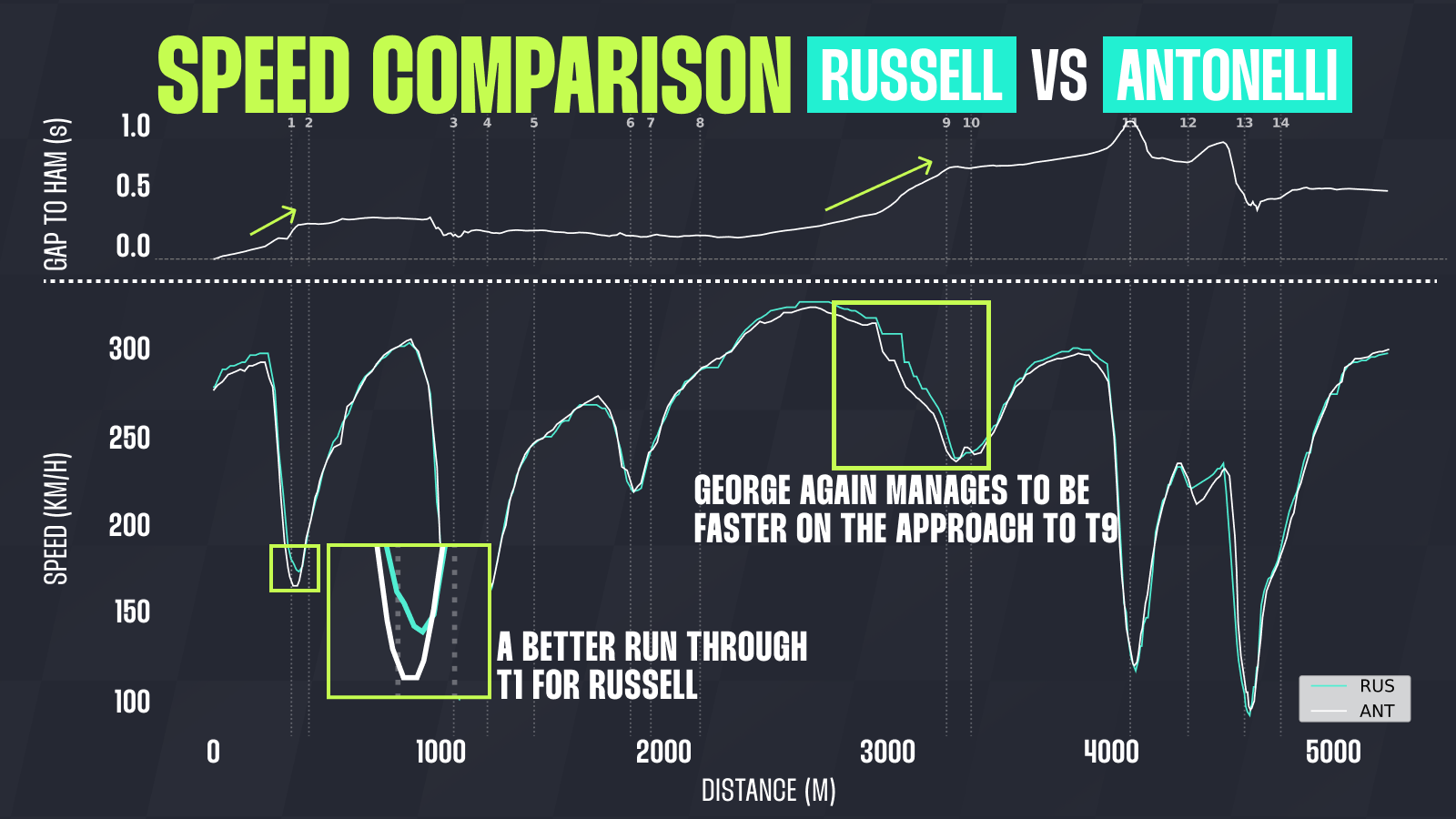
This proves that even in these high-tech scenarios, the driver still can make a contribution, whether through a better setup, superior energy management, or simply a different driving style.
It should also be highlighted that Antonelli suffered a heavy shunt during FP3, leaving his qualifying participation under a massive cloud of doubt. As we learned later, Antonelli had no time for any meaningful setup work, which undoubtedly hampered his final result.
Despite this, Antonelli managed to snatch back some of that lost time with later braking into T13, ending his lap just under three-tenths behind his teammate.
Mercedes certainly couldn’t have asked for a better start to the new era of Formula 1. Whether they can convert this raw pace into a victory tomorrow, and what kind of racing the drivers will provide, remains to be seen.
Want to be the first to know exclusive information from the F1 paddock? Join our broadcast channel on WhatsApp to get the scoop on the latest developments from our team of accredited journalists.
You can also subscribe to the PlanetF1 YouTube channel for exclusive features, hear from our paddock journalists with stories from the heart of Formula 1 and much more!
Read next: Adrian Newey claims AMR26 is ‘fifth-best’ chassis despite Melbourne woes