

Bahrain telemetry suggests Red Bull engine edge after Wolff claim

Max Verstappen in action during the third day of testing in Bahrain.
The 2026 season has not even officially begun, yet the political skirmish between teams is already well underway. This time, the spotlight fell on a statement from Mercedes boss Toto Wolff, who labelled the Red Bull engine as the “benchmark,” suggesting its drivers hold a staggering advantage of up to one second per lap.
While testing is still in full swing and all data must be taken with a pinch of salt, the telemetry reveals some rather fascinating insights.
2026: A battle of energy optimisation
Want more PlanetF1.com coverage? Add us as a preferred source on Google for news you can trust.
The new generation of 2026 cars, arguably the most significant technical shift in Formula 1 history, will fundamentally alter the racing landscape as we know it.
With electrical systems now nearly three times more powerful than last season (350kW, up from 120kW), the power split between electric motors and the traditional V6 will be almost 50/50. However, the even more vital change directly impacting fans is the introduction of the so-called Boost and Overtake modes.
For F1 2026, instead of the Drag Reduction System (DRS) to aid overtaking, drivers will have these two tactical tools at their disposal to assist when hunting down the car ahead.
Boost mode allows every driver to deploy 8.5MJ of electrical energy per lap on any part of the circuit. Overtake mode is only available when a driver is within one second of the car in front, granting an additional 0.5MJ of electrical energy.
Crucially, however, the main catch is that the battery state-of-charge swing remains capped at 4MJ. This means you can only deploy 4MJ of energy in one go before the battery must be recharged.
Translated into simpler terms, 4MJ of energy grants you roughly 11 seconds of full electrical deployment.
This forces teams into a constant cycle of charging and discharging their batteries throughout the lap, meaning there are several strategic ways to manage this. In theory, this should introduce yet another variable into the strategy and a fresh dimension to the on-track action.
It is precisely these new regulations that have placed the power unit systems at the heart of the first official test in Bahrain. It is highly likely that the team which best solves the energy optimisation puzzle will also be the fastest on the grid.
Is Red Bull ahead?
If we look at the data from the opening day of testing, Toto Wolff’s claims do seem to carry some weight.
When comparing the long runs of Verstappen and Norris, it is clear that Red Bull holds a genuine advantage in top speed on the straights – and that was consistent across every single lap of their long-run simulations.
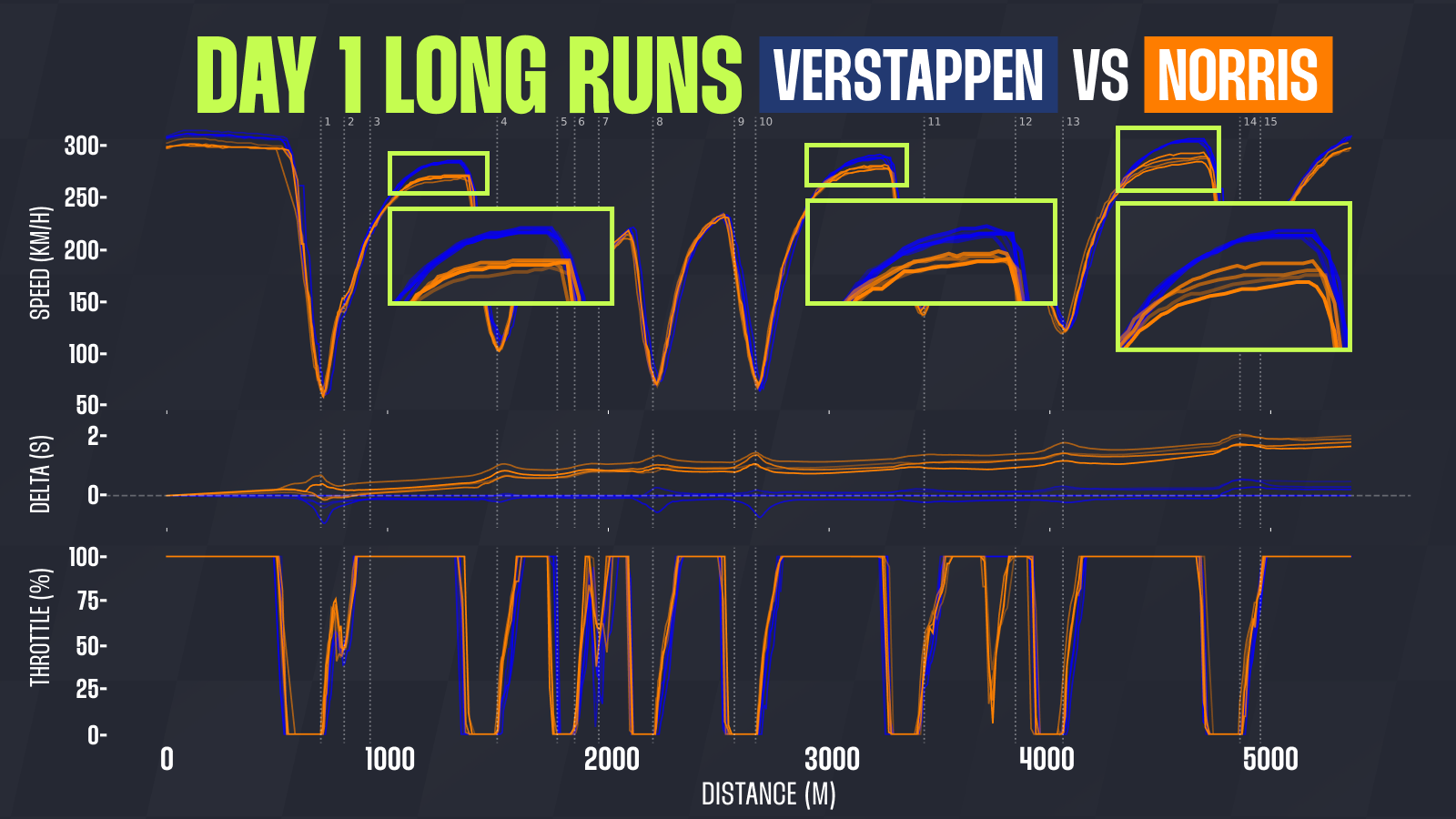
This disparity is most visible on the straights between T3 and T4, as well as between T13 and T14. From the graph above, you can see that both drivers are at full throttle in all straight-line situations, which clearly indicates the difference lies in the power delivered by the power unit.
A deeper dive into the graphs also reveals some nuances in throttle application: Verstappen lifts significantly more at the apex of T7, while his throttle application is a fraction later when exiting the slower corners.
Conversely, it is Norris who lifts off the pedal before entering T12, whereas Max remains flat-out here.
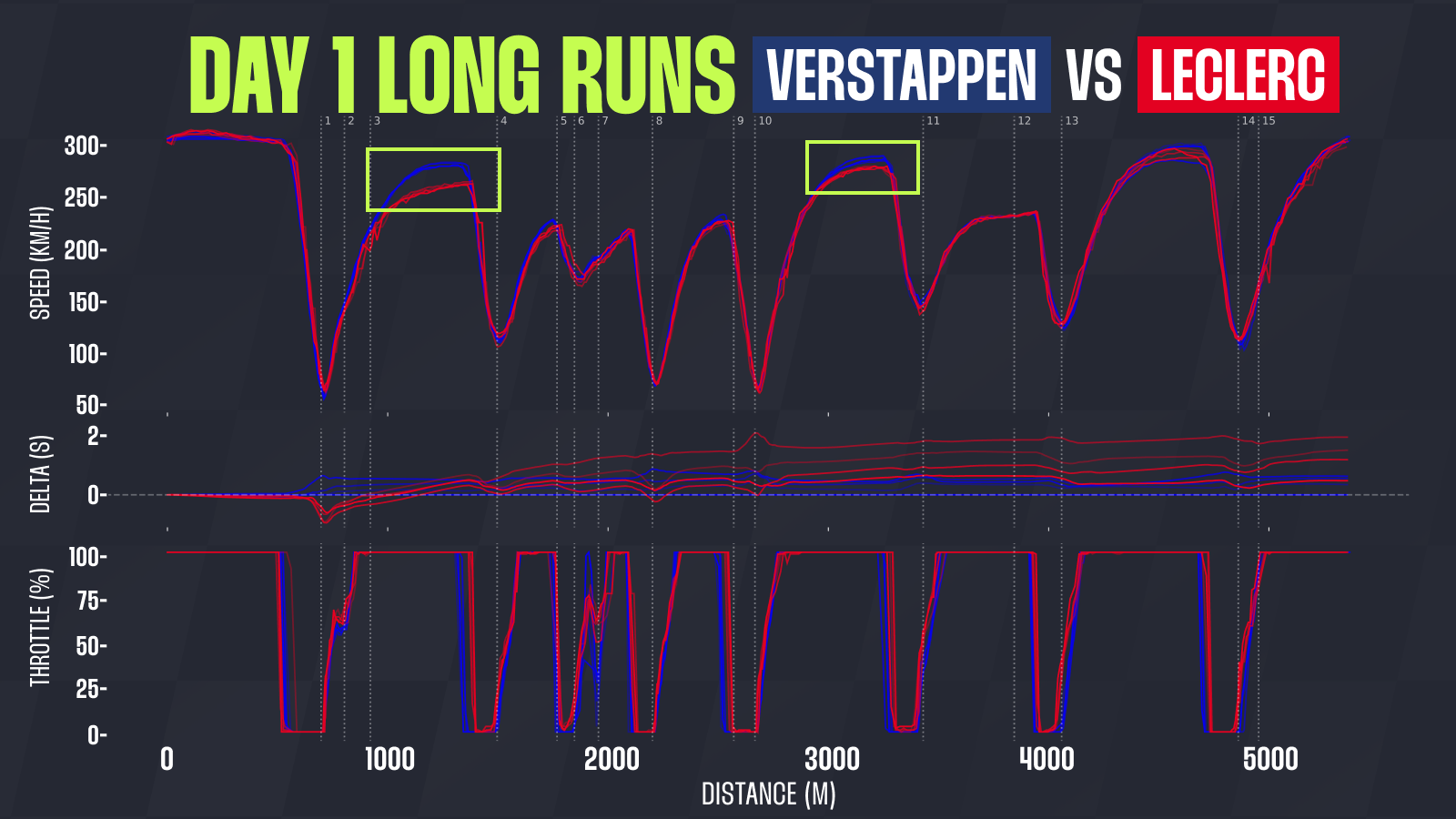
These recurring details suggest that teams are running vastly different strategies regarding where and when they charge the battery. Taking the long runs from this session into account, Verstappen was noticeably quicker than Norris, as well as Leclerc in the Ferrari, where a significant gap in maximum speed was also evident.
On the other hand, the Mercedes squad completed a significant number of laps on Day 1, but Russell’s long-run times do not look quite so promising. He averaged roughly two seconds slower than the four-time champion.
However, it is vital that we don’t take this data as gospel; although certain patterns are visible, we can never know how much engine power a team is actually deploying (it’s almost certain that no one is at 100 percent capacity).
An interesting nugget of data can be found by comparing Max’s and Lando’s fastest laps from the first day. In this instance, Norris is the one with the significantly higher top speed between T12 and T13, while Verstappen remained faster on the start-finish straight.
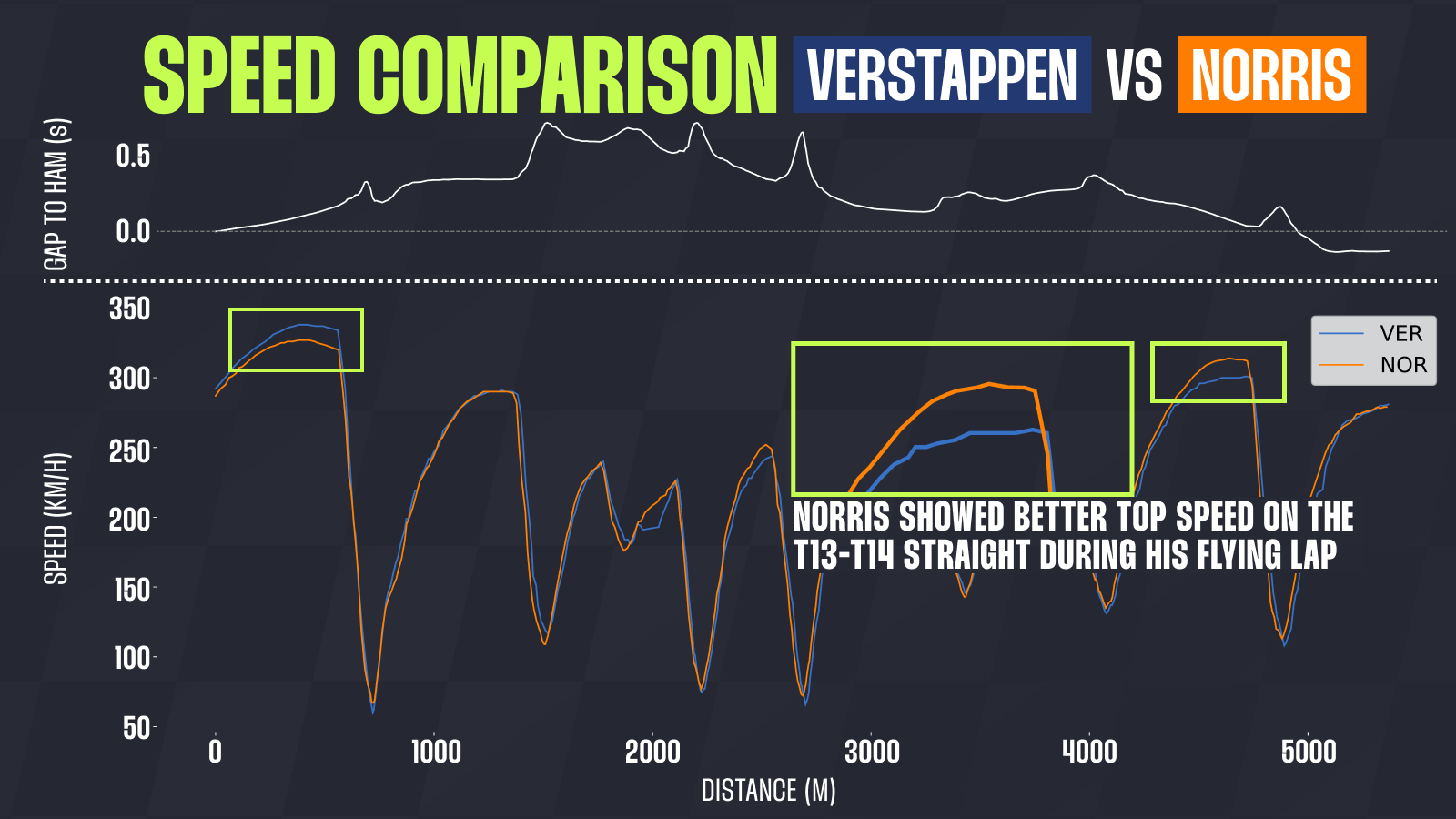
All of this tells us that the initial concept of a “new level of racing” is definitely working. Teams are using the Bahrain tests to figure out which strategies suit their car best.
Energy recovery is achieved solely via the rear axle, but there are several ways to execute this. One example is under braking, where instead of brake discs, the electric generator does the heavy lifting, essentially harvesting energy that would otherwise be lost to heat and sending it back to the battery.
Another method is harvesting during full throttle on the straights – which is precisely why we see drivers reaching peak speeds around the mid-point of a straight, after which their speed slightly drops (a phenomenon we didn’t see last year).
In truth, we can expect that teams won’t solve this puzzle easily; rather, we will see various methods and energy deployment strategies evolving throughout the season.
In the graph below, we can see a comparison of two different laps from the same session by the new champion, Lando Norris. We can observe how McLaren is trialling different strategies and how top speeds on the straights fluctuate lap by lap.
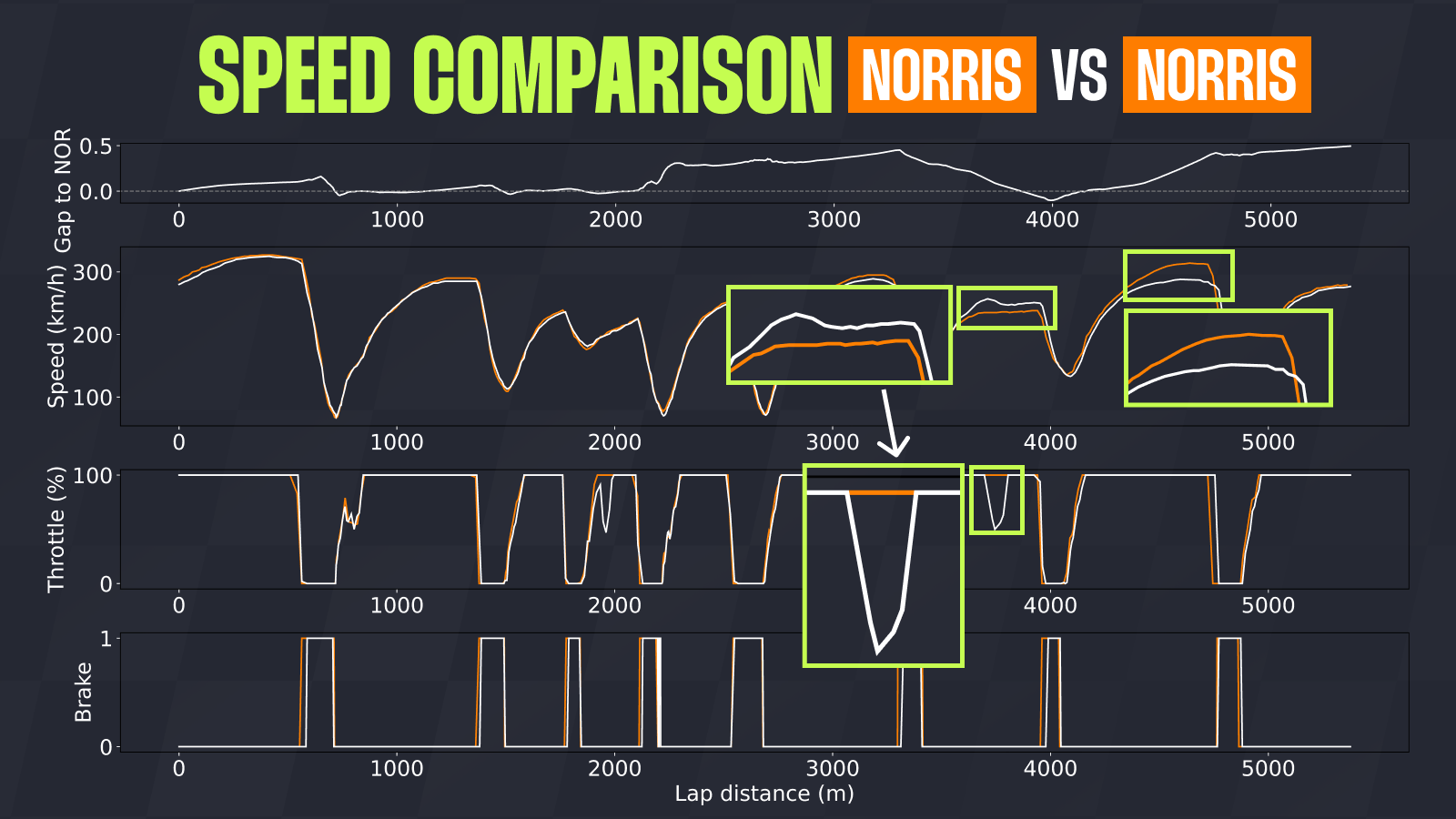
A curious detail on the graph above is Turn 12, where Norris’s lap (marked in white) shows a higher speed through the apex despite a lift off the throttle, whereas the lap where he was slower at the apex was taken at full throttle.
Telemetry data from the second day of official testing also provides some useful insights regarding the Red Bull engine and its electrical usage.
Even though Isack Hadjar was behind the steering wheel this time, the top-speed differences on the straights remained, albeit with a smaller margin compared to Day 1.
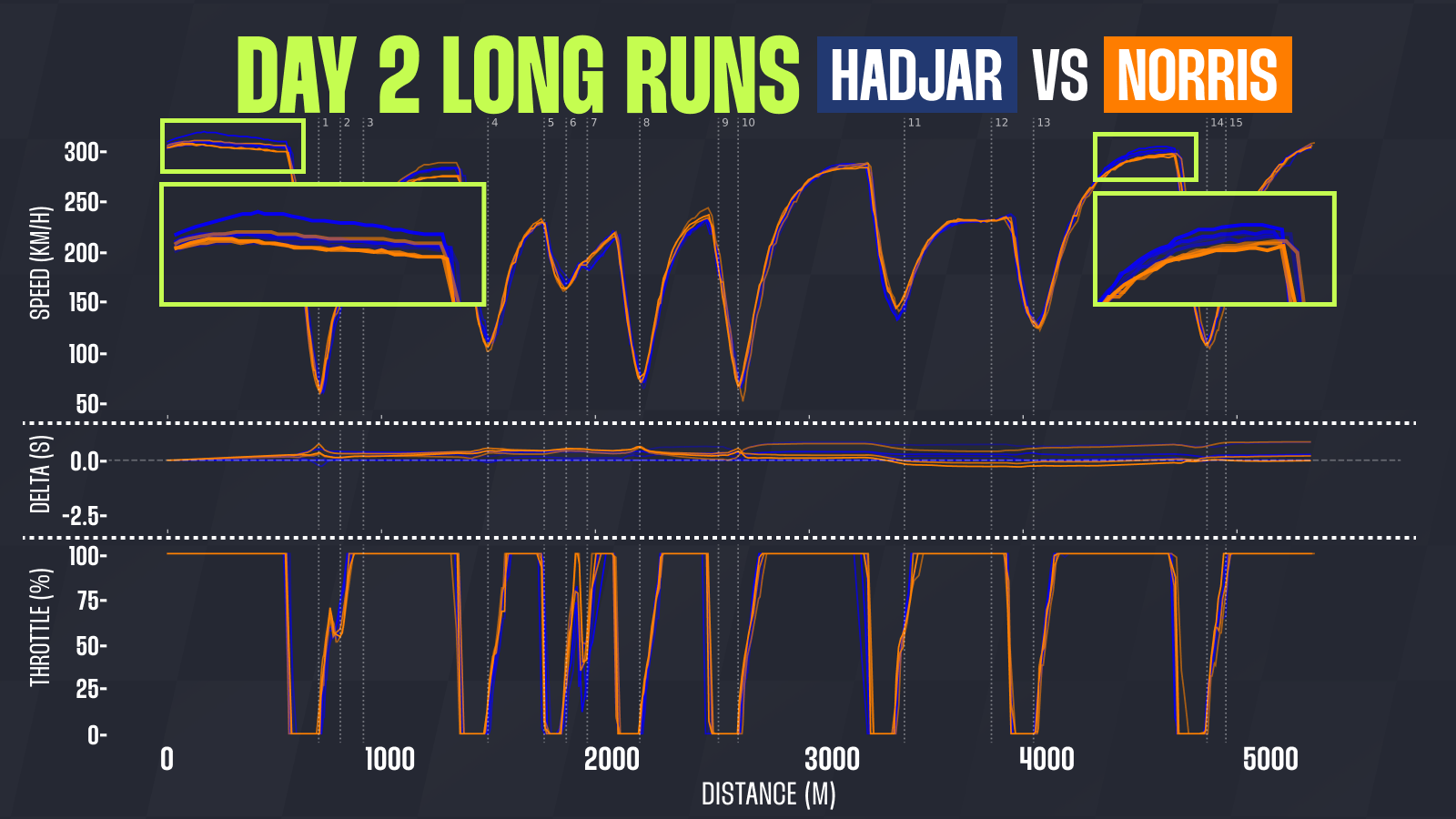
One potential reason for this reduced gap could be that, with the exception of T7 where throttle application varied, the rest of the lap comparison between Hadjar and Norris was practically identical.
The only thing for certain is that teams still have plenty of track time before the official season opener in Australia, and we will surely see more shifts in both telemetry data and car looks. The final moment of truth, when teams finally show their hand, will be qualifying in Melbourne.
Want to be the first to know exclusive information from the F1 paddock? Join our broadcast channel on WhatsApp to get the scoop on the latest developments from our team of accredited journalists.
You can also subscribe to the PlanetF1 YouTube channel for exclusive features, hear from our paddock journalists with stories from the heart of Formula 1 and much more!
Read Next: Williams FW48 makes debut in Bahrain with bold aerodynamic innovations


