

Why Max Verstappen’s criticisms of energy-starved F1 is premature
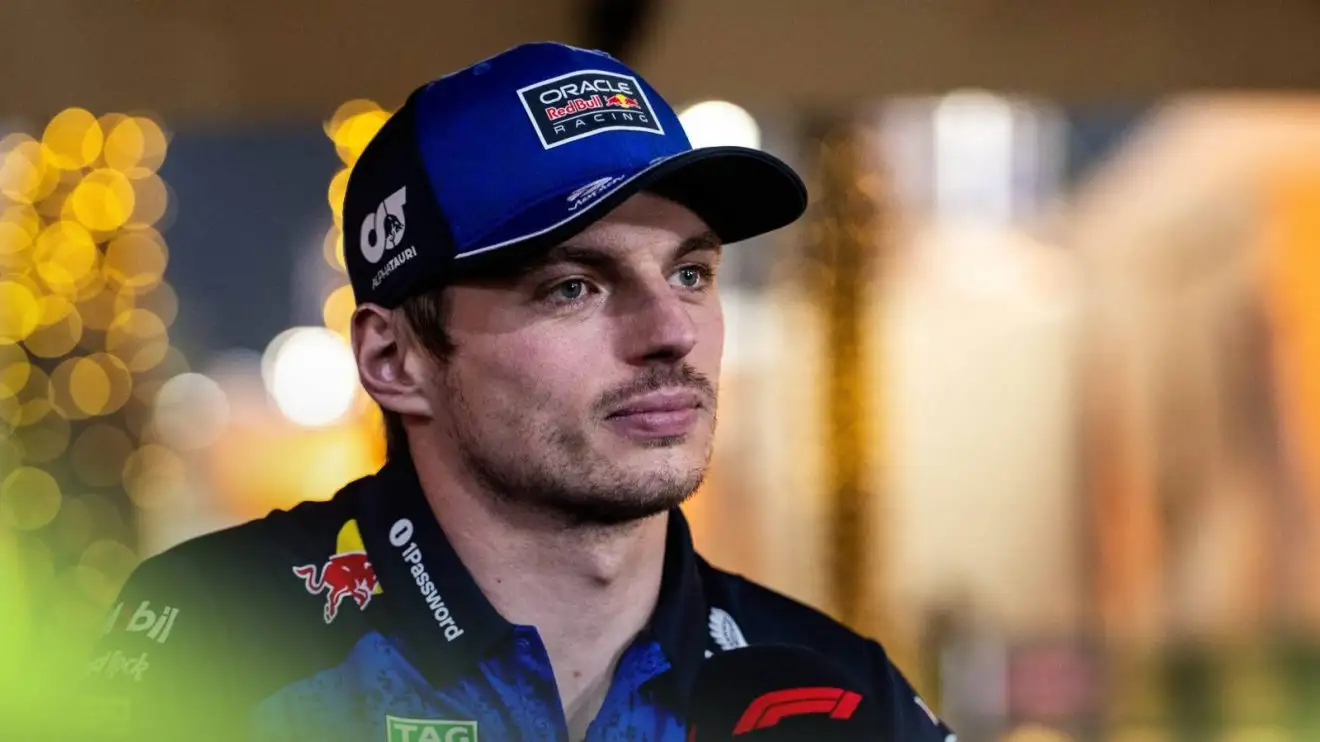
Red Bull's Max Verstappen during Bahrain testing.
Max Verstappen set the F1 paddock ablaze on Thursday evening as he revealed his true feelings on the driving dynamics required for the new F1 2026 regulations.
The Dutch driver did not hold back as he spoke about his dislike for the way the new cars will require the drivers to accumulate energy and unlock performance.
Max Verstappen’s F1 2026 criticism ignores early development reality
It’s been notable that not many of the F1 drivers have spoken with abundant enthusiasm about the new driving dynamics required from the new regulations.
The majority of them will speak about the intrinsic challenge of them, that of unlocking the pace potential via relentless energy management through the harvesting and deployment phases – but that is a very different topic than that of the pleasure that the drivers get from their chosen profession.
With many of the F1 drivers facing the media for the first time since the new cars have become a reality, the first two days in Bahrain have seen many of them take cagey positions.
They’ve also revealed some of the idiosyncrasies in driving demanded of them to perform the ultimate laptime: unusual behaviours such as a greater level of lift-and-coast, and downshifting on the straights.
“From the power unit side, there was obviously lots of chat around potentially having a downshift in the straights in some circumstances,” George Russell said after the Barcelona shakedown. “That will probably continue to be the case, but it doesn’t feel that abnormal, to be honest.”
“The way I would describe it is like if you’re driving your car up a hill, you’re still going flat out, but you’re losing a bit of speed.
“You may just downshift to give you a bit of extra revs to get up that hill. That’s how it sometimes feels when the engine is harvesting and you’re regenerating the battery.”
But that messaging hasn’t been unanimous and, given the perception of Mercedes’ status as favourites at the start of this new regulation cycle, Russell’s positive comments could be seen through the lens of coming from a hungry driver with success and glory tantalisingly within reach, begging the question of whether the British driver’s true feelings are being masked.
Other comments have also come from the likes of Fernando Alonso, who, while saying he has preferences in how he’d like to be able to drive, appeared to be keeping an open mind.
“I prefer to drive with not too many systems interacting with your driving style or with your approach to the corners, and it seems that you need to overthink a little bit while driving, and that’s always a risk of having less joy behind the wheel,” he said earlier this week.
“The initial feeling is that you will like to drive flat out, and have a different car. But F1 went into this direction, and these hybrid power units that requires this energy management… I think we will get used to, but, yeah, I think we will never go back to the late 1990s or early 2000s where the cars were light and fast, with the noise of the engine.
“Everything was probably at the peak of the Formula 1 DNA. Now we are moving more into a different Formula 1.
“I don’t know if it’s better or worse, but it’s different for sure.”
Lewis Hamilton labelled the rules as “ridiculously complex” and said drivers will “need a degree to understand it all”, but said there’s still a lot of room for understanding and growth with what he deemed “straightforward” management.
These above comments could be viewed as negative, despite their guardedness, but fall short of being explicitly critical.
But that changed on Thursday night, as Max Verstappen spoke to the media for the first time in a press conference that was eye-openingly honest, even by his standards.
Declaring the cars as “not a lot of fun”, Verstappen didn’t deliver his criticism with any hint of aggression, anger, or frustration; in fact, he was quite the opposite, smiling and warmly discussing the topic with his usual directness.
“So it’s not always the nicest thing to say, but I also want to be realistic as far as a driver, the feeling is not very F1-like. It feels a bit more like Formula E on steroids.
“But the rules are the same for everyone, so you have to deal with that. That’s also not my problem, because I’m all for that and equal chances.
“I don’t mind that, but, as a pure driver, I enjoy driving flat out, and, at the moment, you cannot drive like that.”
Labelling the regulations as “anti-racing”, Verstappen didn’t shut down the possibility of the regulations perhaps hastening his mind if leaving F1 is something he’d consider, saying that his primary concern is in enjoyment of his racing. With the RB22 and Red Bull Powertrains off to a strong start in testing, the competitive aspect is irrelevant to him, he claimed, and said that it might be better to drive in Formula E if energy management and efficiency is the goal.
The comments are a major slap in the face for the FIA. Verstappen’s position of being a four-time F1 World Champion means his characteristic honesty means he’s not likely to get into much trouble, but it’s understood that a dim view of his criticism is being taken behind closed doors at the FIA and FOM.
The Dutch driver was perhaps putting into words what more junior drivers, such as Liam Lawson, was thinking as a wry grin spread across his face when asked by PlanetF1.com about his enjoyment of the new rules.
Verstappen’s lack of enjoyment of the new driving dynamics might not be in isolation on the grid but reigning World Champion Lando Norris was quick to scoff at his rival’s opinions.
He matter-of-factly exclaimed that he’s “loving” driving the new cars as he suggested the Dutch driver could always “retire if he wants to retire” and that the new driving requirements represent a “good, fun challenge for the engineers and the drivers”.
The Red Bull driver’s detractors may take Verstappen’s misgivings as perhaps him not being on top of the regulations at this point, but there’s little evidence of that and, certainly, his excellence across every discipline of racing he’s ever entered suggests that the Dutchman is still likely to be at, or near, the head of the field in 2026 if the car is good enough.
But, for the sport itself, it’s not a great look for its most talismanic driver, the most prized of its luminaries, to be so negative, perhaps rashly so, about the regulations at this point.
“Probably people will not be happy with me saying this right now, but I am outspoken, and why am I not allowed to say what I think of my race car?” Verstappen said.
“I can’t help that. I mean, I didn’t write the regulation. If it was up to non-political aspects of making a regulation, the car would have probably very different origins. But yeah, that’s how it is.”
It’s a fair comment – Verstappen doesn’t need to kowtow to anyone, and is correct in his assessment that, had the power unit regulations been drafted to match the chassis, rather than the other way around, the new formula would quite likely look very different.
But, in an engineering-led sport, it’s worth remembering that the cars literally only have real-world on-track data of a duration that can be measured in double-digit hours.
The biggest weakness of the new regulations appears to be in that the duration of full-energy deployment simply isn’t long enough, due to the energy-starved nature of the cars – an issue that could see highly unnatural driving tactics at trickier energy-generation venues, such as Jeddah, Monza, or Spa.
But, at full chat, the cars are unleashing incredible amounts of power – the acceleration is “brutal”, as Kimi Antonelli labelled it – and Lawson conceded that “it’s pretty fast, to be fair” about the same phase of power delivery.
F1 2026 rules debate
Max Verstappen fails to rule out quitting F1 over 2026 ‘anti-racing’ regulations
Hamilton joins Verstappen in criticising F1 2026 regulations
With the cars being trickier to drive around the corners due to the reduced downforce, the driver’s skill can make a real difference once again – these cars aren’t glued to the road in the way they have been in recent years. Between that and the difficulty in transferring the power to the road, the cars are ballistic missiles. Albeit ballistic missiles that run out of puff halfway down the straight.
In this regard, the cars may prove to be damp squibs. But it’s just one characteristic of many, with this limitation brought about by the inherent limitations of the drivetrain – a drivetrain that has only just become a reality.
It’s worth remembering that, in the very early stages of any regulation cycle, the drivers are shaking off the muscle memory of cars that have been at the very end of their development potential for a long time – including the last generation of power units. Are the new cars a step back? Undoubtedly, they will be. They will feel sloppy and less highly-strung, lacking the finesse of the final products the drivers have just stepped out of.
But, given the intense development that awaits over the coming years, the potential for huge performance gains is huge.
After all, thinking back to when the hybrid engines were first introduced in 2014, doomsayers decried the regulations endlessly. It was a shaky start, not helped by only one power unit manufacturer nailing the regulations first time, but the performance gains came quickly.
It will be the same with these new regulations. Energy starvation will be an issue that means some races could see soul-destroying levels of conservation but, as the technology improves and the manufacturers get better and better at efficiently harvesting energy, this point in time should mark the very worst of the potential these regulations have to offer.
One area that could perhaps be reconsidered is that of relaxing the engine upgrade rules to speed up that process, which has prescribed windows of time during which manufacturers can introduce upgrades.
This could be a similar solution to the scrapping of the engine token system a decade ago, allowing for a greater rate of development and convergence.
An Additional Development and Upgrade Opportunities [ADUO] safety net has been defined by the FIA, offering trailing manufacturers more windows on shorter timescales. But, given the roll-out of a power unit manufacturers budget cap, these prescriptions seem excessive.
When asked about this by PlanetF1.com, Red Bull Powertrains [RBPT] technical director Ben Hodgkinson said removing these time allocations under the budget cap would speed up the development battle.
“I would personally love just to get rid of homologation and have a gloves-off fight. That’s what I’d really like,” he said.
“But we are where we are. We have a cost cap, and we have a dyno hours limit, so I think there’s enough limits in place without this.”
This development battle, however it unfolds, suggests it would seem too early for Verstappen to be completely writing off his enjoyment of the new cars. For a no-nonsense driver like he is, one who savours the thrill of unleashing his prodigious pace without restraint, the complexity of the rules are unsurprisingly unappealing.
But, in a year or two, will he still feel the same if the potential efficiency gains found mean energy deployment doesn’t have to be so meagrely meted out, and the full capacity of the huge output of these new power units is much more “on tap”? Given the diminishing restraint that would allow, you’d have to think so.
The concerns around just what kind of Formula 1 we will all witness in 2026 are valid and justified, and there’s always the possibility that the new regulations prove disastrous – perhaps hastening the departure of the world’s greatest driver from the grid. Verstappen citing the regulations as being a catalyst would be highly damaging for F1’s popularity globally, but this is very much worst-case scenario stuff.
But the likely outcome is somewhere in the middle, to start – the regulations will work brilliantly at some circuits, and terribly at others. It’s in the refinement and evolution of any given ruleset that Formula 1 teams and manufacturers are at their best and, given his global popularity, Verstappen’s brutal honesty and directness, for once, could have been tempered in favour of recognition of that expected progress.
After all, there has always been elements of resource management – whether that be physical constraints brought about by a requirement for mechanical sympathy, or the drivers being required to sip away at the tools available. For instance, even in the rose-tinted glory days of Ayrton Senna thrashing a McLaren-Honda turbo V6, the components required a delicate touch, and the tyres needed cosseting just to make it around a single qualifying lap.
Of course, in time, if it becomes obvious that there is no more efficiency to be found and the cars remain just as energy-starved as they are at the start of this regulation cycle, then there may be a time – sooner than the rules cycle of 2030 – to call a halt and admit that the sport pursued the wrong direction and hasten the return of a simpler engine.
But that moment hasn’t arrived yet.
Read Next: Max Verstappen accuses Toto Wolff of ‘diversion tactics’ over Red Bull RB22 speed


