

Can Adrian Newey and ADUO save Aston Martin’s F1 2026 season?
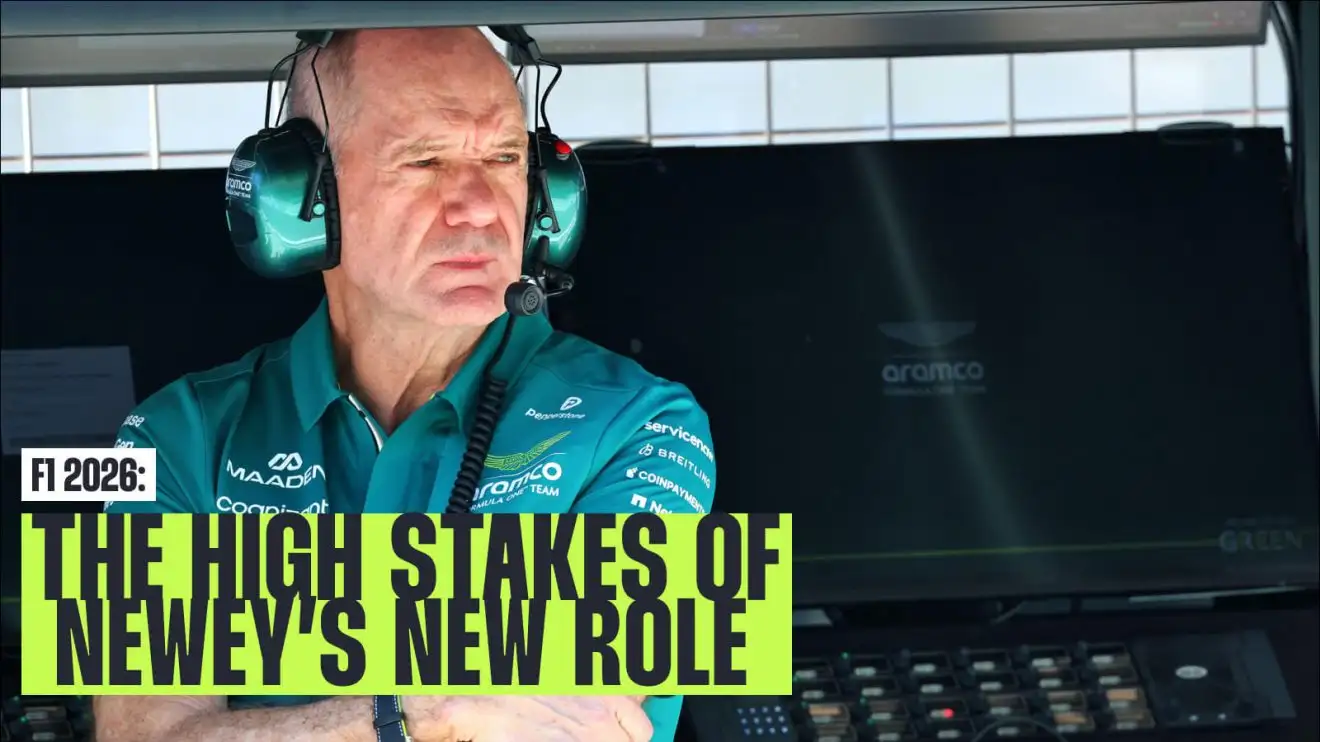
Adrian Newey's tenure as Aston Martin team boss has started in difficult fashion.
Aston Martin’s season has started in ignominious fashion, leaving Adrian Newey’s squad facing an uphill battle in the coming months.
The Silverstone-based squad completed 128 laps during the second Bahrain test, adding to its 206-lap tally from the first Bahrain event, and the 66 laps it completed in the Barcelona shakedown.
400 Laps vs. 4100: The massive data chasm facing Aston Martin
Want more PlanetF1.com coverage? Add us as a preferred source on Google to your favourites list for news you can trust
The marketing department that came up with the By Design theme for the Aston Martin AMR26 must have been despairing by the end of pre-season testing, given the juxtaposition of the imagery of clinical precision and perfection the team’s launch event had, against the reality of Alonso climbing out to all but end Aston Martin’s testing programme on Thursday after something in the back of the car let go and turned into a bag of cats.
Hopping on a plane to fly home from Bahrain, you’d have to hope that Adrian Newey had his copy of Yazz and the Plastic Population’s 1980’s hit, ‘The Only Way Is Up,’ on repeat as some motivational listening.
Fresh off the back of that classy launch event in Saudi Arabia two weeks ago, which was, perhaps prophetically, overshadowed by technical issues on the public video stream later that day, Bahrain testing couldn’t have been much more difficult for Newey and his drivers, Fernando Alonso and Lance Stroll.
The second test was even more gruelling than the first: Aston Martin’s lapcount across the three days was less than what Mercedes managed on the first day alone.
Once you bring engine manufacturers into the equation, Honda’s learning on the first day (54 laps), which was only possible with an Aston Martin on track, was just over 11 per cent of what Mercedes High-Performance Powertrains managed on the first day across the four Merc-powered teams (500 laps).
Across the three test weeks as a whole, Aston Martin completed 400 laps, half the distance of what Williams achieved (790 laps), despite the Grove-based squad sitting out Barcelona entirely. Cadillac, as a brand-new team, achieved 750.
At the top of the tree, Mercedes, Haas, Ferrari, and McLaren achieved almost three times the number of laps Aston Martin could manage. Looking at it from a PU perspective, Honda has 400 laps of data: Mercedes had over 4100, Ferrari over 3100, Red Bull Powertrains just over 2000, and Audi just under 1000.
It’s not a pretty picture: not only was the package unreliable but, when on track, the car looked clumsy and difficult to handle. A dramatic off-track moment for Stroll brought out the red flag on Wednesday as he ended up beached in the gravel at Turn 11, with the Canadian appearing to be caught out by a gearbox malady that destabilised the rear.
This was after power unit-related issues had curtailed Alonso’s programme earlier in the day, and similar was to happen to the Spaniard on Thursday as he stopped on track to bring out the red flags after a particularly ugly-sounding breakdown in the afternoon.
This breakdown had ramifications for Friday’s running, with Stroll only completing just six laps in total on the final day, due to a lack of spare parts.
As for pace, Stroll gloomily suggested a four-and-a-half-second pace deficit, which Alonso believes to be far more extreme than the reality.
Sources from other teams have suggested that, based on GPS data, Aston Martin’s AMR26 is ultimately faster than the Cadillac at the back of the grid, but a clearer picture of that is difficult to shape.
As for hopes of scoring points, or even finishing races, in the first handful of races of 2026, hopes aren’t high; the mentality being taken to Australia and China surely is that they are little more than public weekend tests.
Japan hosting the third round of the championship means Honda returns home with a negligible chance of repeating the glory of its 2025 race win with Red Bull, and, indeed, just finishing the race would mark a step forward at present.
Aston Martin’s Honda switch feels familiar as McLaren ghosts re-emerge
Since 2009, the team has run with Mercedes power units and gearboxes, stemming back to the days of Vijay Mallya’s ownership of the squad as Force India.
For 16 years, throughout its evolution into the Aston Martin squad, this has been the status quo, but this came to a very sudden stop at the end of 2025, as Lawrence Stroll had agreed a factory supply deal with Honda back in 2023.
The Japanese manufacturer had chosen to walk away from Formula 1 at the end of 2021, just as the sport introduced an engine freeze and Honda came good in its partnership with Red Bull.
Multiple consecutive titles ensued, but Honda was tempted back by the new regulations for ’26, aligning with its new mission in the automotive industry. Having opted to leave F1 in order to funnel its resources into future power unit and energy technologies, at a time when the ’26 regulations had not yet been decided, the confirmation of increased electrification tempted Honda back.
But this was in mid-2023. By that time, Audi was already a year into their programme of recruitment and R&D, while then-RBPT boss Christian Horner had already ramped up operations at Red Bull’s Milton Keynes base and was in advanced negotiations with Ford to bolster its programme.
For Honda, this meant it was already at least a year behind its fellow ’26 newcomers, whilst also going up against the established Mercedes and Ferrari powertrain departments.
A decade ago, Honda was a year behind when it entered F1 in 2015 with McLaren, resulting in years of misery for the Woking-based squad as the two sides never figured out how to work with each other. Honda had decided to re-enter the sport during 2013, putting it some two to three years behind in development compared to the likes of Mercedes HPP and Ferrari.
In what must feel like a cosmic joke of deja vu, it was Alonso who drove for McLaren for those years, leading to infamous quotes such as “GP2 engine” and “the engine feels good, much slower than before”, which did little for harmony between him and Honda.
McLaren infamously leaned on Honda’s subpar performance as being the primary party at fault, although the team’s later switch to Renault proved that not all the issues were on Honda’s side.
The Japanese manufacturer, licking its wounds, was picked up by Red Bull’s Toro Rosso squad, which saw enough potential for progress to convince the senior team to go all-in with Honda – a move that paid off with incredible rapidity.
Honda’s success ramped up immediately, with the first victories in 2019 and ’20 in Adrian Newey-overseen Red Bulls turning into multiple titles for Max Verstappen, starting in ’21.
Getting the chance to drive a car with some of these ingredients for Verstappen’s success may have given Alonso some hope of finally scoring that elusive 33rd victory this year, but, at present, this goal seems little more than a pipe dream.
What is evident is that Honda did not appear fully ready for 2026. Not only does the engine seem to be down on outright power, but reliability has been far worse than anticipated.
This led to the stuttering end to the Bahrain test: the Honda power unit had been consuming components (“destroying them” was one glum assessment offered by a source) at such a rate that there simply weren’t enough components left to run on track properly on the final day.
The ERS-related issue Alonso had suffered on Thursday is believed to have compromised the final battery Honda had available, explaining why just six laps were possible on Friday.
It’s led to some tensions, with sources not denying that senior management isn’t happy with the situation – TV cameras captured moments of Newey sitting with chief technical officer Enrico Cardile and team owner Lawrence Stroll, with the team boss running his hands over his face with visible weariness.
The majority of the team’s problems at present appear to stem from the lack of reliability of the power unit, but there’s also the question mark of just how good the chassis is.
Added to that, Aston Martin has also had to design and manufacture its own gearbox for the first time. Given its relative lack of experience in this area, it’s therefore not surprising that a fragile power unit mated to a gearbox, which the team itself is getting to grips with, might not provide a stable platform to start working on the ‘easier’ aspects of the chassis.
More on Aston Martin from PlanetF1
Stroll not waving white flag after Aston Martin and Honda setbacks
F1 testing conclusions: Bring back V10s, fresh Aston Martin hope, secret Ferrari weapon
How quickly can Aston Martin turn the ship around?
As the team with the most state-of-the-art facilities in Formula 1, following Stroll’s long-term investment in his Silverstone base – investment that helped secure Newey in the first place – to start the new regulation cycle even behind the likes of a brand-new team such as Cadillac is hugely demoralising, particularly after the years of pointing towards building for the great ’26 reset.
Aston Martin was the only team not to put its team principal figure out for media sessions during Bahrain testing, a conspicuous absence following on from Newey not speaking to attending media at the team’s launch two weeks ago, when there was still an opportunity to pre-empt the difficulties and lay the cards on the table.
Instead, Aston Martin put forward Mike Krack and Pedro de la Rosa to address the media, both assuming some of the usual team principal duties as part of the senior leadership supporting Newey, with both offering little beyond acknowledgements that the team is not where it should be and that there is a long road ahead.
Given their relative lack of authority compared to Newey, it’s disappointing that the legendary designer didn’t face the problem head-on with the media. While his focus, understandably, is on the issues with the car and power unit, the team principal’s role is a more expansive one than the senior technical roles he has long held – engaging with the media and being a public face of the team through thick and thin is part of that.
In stark contrast, James Vowles did not shirk these responsibilities when he held a specific press call during the Barcelona shakedown week, nor did Williams put forward people of lesser authority and responsibility to serve as a buffer, when the Grove-based squad wasn’t ready in sufficient time for the first test.
Newey may view responsibilities such as being the team’s figurehead as being an unnecessary distraction from what really matters to him, the car’s performance, but will he be similarly evasive in times of triumph?
De La Rosa did offer some crucial insight, though, revealing that there is no concern within Aston Martin due to the strength of Newey’s leadership.
“All the team knows exactly what they have to do,” he said.
“This is very different from previous years. Where everyone could have their own theory about things, or Adrian is very clear about what has to be done, and no one raises their hand to question him. Therefore, you have this massive amount of resources working in one single direction.
“I know it might not sound convincing to you, but believe me, sitting there and listening to these moments was very, very inspiring for all of us, especially when things go wrong.
“When things go right, we don’t need a leader. It’s when things go wrong.
“A critical turning point is having Adrian in the team.
“We’re not happy. I mean, let’s be honest, no one is happy when you are a second slower than what you were expecting.
“But it’s true as well to say that no one is worried. It’s different. We’re not happy, but we are not like, ‘Oh, this is it.’ No, no way.”
Where Newey’s greatest strengths are already proven is in the technical arena, which is why there has to be considerable optimism that things can be turned around.
After all, there are quite a few factors that explain why Aston Martin is in the position it’s in. Its brand-new facilities, such as the wind tunnel, only came online in March 2025, the same month as Newey’s arrival.
In August 2025, Enrico Cardile began work as chief technical officer, and both have been re-shaping and tweaking the organisation, with Newey’s recruitment drive seeing personnel joining across the design and manufacturing departments.
The biggest issue is undoubtedly the synergy between the team and its power unit supplier, with the two sides very much in the infancy of their relationship.
“This is a formula that all the parties need to work very well together. I think the better you integrate, the quicker we can make progress,” Krack said last week.
“We are in a situation where we have a new partner that we have to learn how to work with, but we have made very good steps already.
“We speak the same language, we have the same objective, and then the timeline is always something that is difficult to say. I think we take it step by step in the moment.
“The partnership or package that we have, you need to develop. It is not something that you turn the knob, and it works.
“There are humans involved, there are different cultures, there are different philosophies. But I think we are at a very good level, and we share our issues, we share our priorities. There is no magic in Formula 1. You really have to work hard.”
As revealed by PlanetF1.com, former team boss Andy Cowell is set to leave the team later this year after being usurped from his position by Newey, although he continues to work for the team on assignment in Japan at Honda’s Sakura base.
Given his experience of leading Mercedes’ HPP even before the hybrid era began, Cowell is likely to have a very good understanding of just how far behind Honda really is, and may yet be able to play a pivotal role in the turnaround over the coming months.
After all, it’s worth remembering that, despite the difficulties at present, Honda is likely to benefit greatly from a safety net introduced by the FIA for struggling PU manufacturers.
This is known as Additional Developments and Upgrade Opportunities [ADUO], which assesses the performance levels of the power units based on percentages.
This is known as the ICE Performance Index, and will be used to benchmark the five power unit manufacturers against each other.
The specifics of ADUO can be read about here.
Assuming Honda is the power unit that starts the new regulation cycle in the worst shape, it will thus have the ability to introduce upgrades sooner and more frequently than its rivals.
It’s not been a good start for Aston Martin-Honda, or for Newey. His own reveal that the concept for the AMR26 was only introduced to the team when he began work in March 2025, together with being several months behind on starting wind tunnel work, begs the question of whether a more conservative approach for ’26 may have been more beneficial, at least in the short-term.
After all, Newey’s ambitious McLaren MP4/18 in 2003 proved so radical and troubled that it never actually started a race, with its aggressive chassis design and uncompromising packaging resulting in engine and gearbox overheating, as well as triggering side effects such as floor delamination.
Fortunately, such a failure stands out simply due to its uniqueness and, in the here and now, what’s done is done, and conservatism would likely only lead to another nice and safe P5 or P6, something that Aston Martin can say it’s been there and done that.
This is a team that, from an infrastructure perspective, has even greater resources than what Red Bull has had at Milton Keynes, but, unlike Red Bull, has not yet learned how to be a winner.
Getting to grips with a more aggressive approach to the sport may be what Aston Martin needs to climb from its usual midfield position and become a championship-contending team. It’s worth remembering McLaren was still occasionally getting knocked out in Q1 at the end of 2023…
Addressing Honda’s reliability and performance is the first priority, and there is a clear path forward in that regard. As the new personnel and departments within Aston Martin start to mature in their positions, stability should emerge, and the availability of world-class equipment and technology means progress should be swift.
This is not a team that has much winning experience, and Newey is one of the best-positioned people in the paddock to be able to help that transition.
The fact that Aston Martin’s 2026 season has started so badly, clearly indicating drastic changes have been made, could ultimately prove to be the moment at which the team begins its rise, although this will likely need copious amounts of patience, as Honda will need time to close the gap.
If improvement doesn’t come, then the awkward question of whether Newey’s brilliance always needed tempering will arise. Can a design genius intent on not allowing that focus to be diluted really thrive in management?
There’s no doubt that Newey, just a few months after taking over at Aston Martin, is facing a baptism of fire in this new career challenge, and keeping up the spirits of an exhausted team that thought ’26 was supposed to be a step forward is going to be a big challenge if he is to succeed.
If Newey can convince those under him that success awaits under his leadership, this trying period could end up being a prelude (excuse the pun, Honda fans) for far greater things. But not every team dynamic succeeds, and not every great mind can be successful in every area. If he can’t rally the troops to give their all, will Stroll look elsewhere sooner rather than later?
Want to be the first to know exclusive information from the F1 paddock? Join our broadcast channel on WhatsApp to get the scoop on the latest developments from our team of accredited journalists.
You can also subscribe to the PlanetF1 YouTube channel for exclusive features, hear from our paddock journalists with stories from the heart of Formula 1 and much more!
Read Next: F1 2026 explained: why ‘super clipping’ could reshape racing


