

Jeremy Clarkson warns F1 2026 risks ‘Don’t Break Down To Survive’
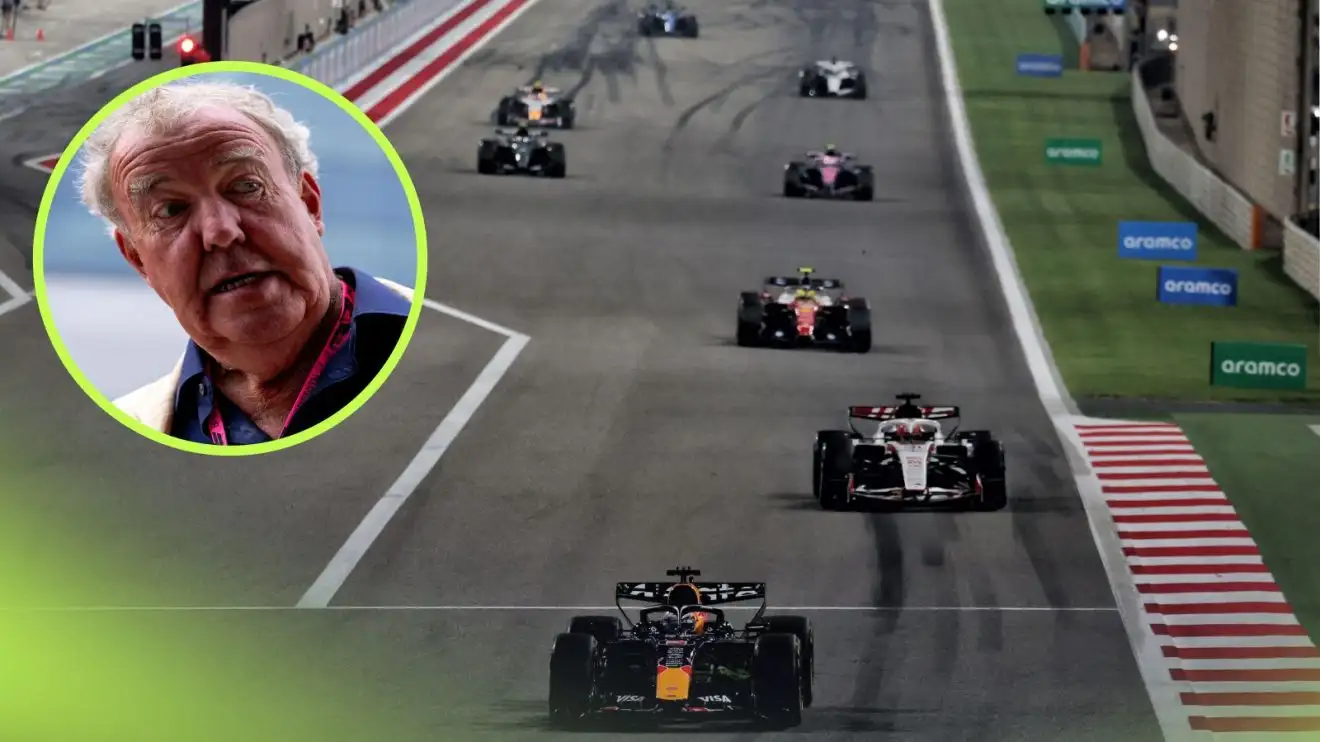
Race starts, power loss and reliability feature in Jeremy Clarkson's F1 2026 concerns
Celebrity F1 fan Jeremy Clarkson believes that Bahrain testing flagged up “some issues” with the sport’s new regulations.
Following those six days in Bahrain, Clarkson fears that cars will “run out of electrical power” down the straights at tracks such as Monza and China, while he also expressed his concerns over race start difficulties, performance disparities and reliability.
Jeremy Clarkson questions F1 2026 starts, reliability and energy concerns
Want more PlanetF1.com coverage? Add us as a preferred source on Google to your favourites list for news you can trust.
F1 2026 marks a genuine reset for the sport. We have smaller, lighter cars, active aerodynamics, and new engines, which produce triple the electrical power, peaking at 350 kilowatts.
The drivers took to the track in these new machines at testing in Barcelona and Bahrain, with the next stop Albert Park for the season-opening Australian Grand Prix.
It is clear that energy management will be far more critical in F1 2026 as a performance factor. That has not gone down too well with most drivers.
Bahrain also revealed that these cars are much harder to prepare to launch, due to the removal of the MGU-H engine element.
The MGU-H helped cover up the turbo lag across the lower rev range. Without it, the cars are taking longer to prepare for launch than they did in the MGU-H era.
The response was to trial a new start procedure in Bahrain, where a blue flashing light indicated to drivers that the start procedure was about to begin, allowing them extra time to ready the car for launch.
This system went a long way to addressing safety concerns, expressed by the likes of McLaren team principal Andrea Stella and driver Oscar Piastri. Meanwhile, the Ferrari engine emerged as a potential strong contender for the ideal launch.
All in all, Clarkson has his concerns for F1 2026, also throwing performance and reliability into the mix.
In a play on the hit F1 docuseries ‘Drive to Survive’, he quipped that F1 2026 will be more ‘Don’t Break Down To Survive.’
“Rule changes mean that this year’s Formula One cars are completely new,” Clarkson writes in his column for The Sun.
“Half the power now comes from batteries that must be recharged every lap. The cars are smaller too and have narrower tyres, which means less grip.
“And there’s no DRS on the rear wing.
“On paper, it all sounds very skiddy and exciting, but after three days of testing in Bahrain this week, it’s clear that there are some issues.
“At tracks such as Monza and China, the cars will run out of electrical power before they reach the end of the straight, which will cause them to suddenly and dramatically slow down. That is going to be a problem for the car behind.
“On the start line, they need to be at full revs for ten seconds for the turbocharger to wake up or the car will stall when the race begins.
“Then there’s the disparity in performance. Some are claiming that the Aston Martin is four seconds a lap slower than the Mercedes. And on top of all this, there’s the big question of reliability.
“It’s accepted that with so many new and untried parts, it’s inevitable there will be failures. So it won’t be Drive To Survive any more. It’ll be Don’t Break Down To Survive.”
Latest Bahrain F1 testing reaction via PlanetF1.com
F1 testing conclusions: Bring back V10s, fresh Aston Martin hope, secret Ferrari weapon
F1 2026 vs 2025: Bahrain lap-time data delivers rule change verdict
F1 2026: Early days in the new era
Bahrain did flag up early teething issues with the new regulations, yes. That was inevitable. But, this is as bad as it will get.
Technology, innovation, and adaptation moves at a rapid pace in Formula 1. Soon enough, the drivers will learn how to make that ideal start, and how/where to use the batteries for one-lap performance, overtaking and defending.
The engine manufacturers will improve and optimise the batteries over time. Just look at (yes, I’m going there), Formula E. Once upon a time, drivers had to swap cars mid-race when the battery ran out, but they have long since been fine for a full race distance.
Moral of the story, development and optimisation will polish these new F1 regulations up nicely. It will be strange for the drivers and fans at first, but it will all soon become normal and second nature, whether you are a driver at the wheel, or a fan watching all the action unfold.
Want to be the first to know exclusive information from the F1 paddock? Join our broadcast channel on WhatsApp to get the scoop on the latest developments from our team of accredited journalists.
You can also subscribe to the PlanetF1 YouTube channel for exclusive features, hear from our paddock journalists with stories from the heart of Formula 1 and much more!
Read next – F1 2026 explained: why ‘super clipping’ could reshape racing


