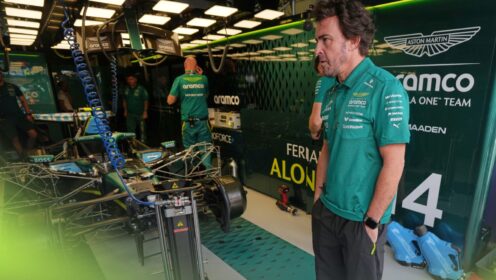

Albert Park exposes F1 2026 energy crisis as teams battle battery limits

Albert Park holds one of the biggest challenges for F1's new PUs, which was shown in free practice.
Following the long-awaited dawn of the 2026 season, the cars have already clocked a significant number of laps during the opening day of the Australian Grand Prix.
However, as many of us predicted well before the season opener, the Australian GP is proving to be a particular nightmare for F1 teams from the perspective of energy optimisation – which has now firmly become the talking point of the paddock.
Why Albert Park exposes Formula 1’s 2026 energy management challenge
Want more PlanetF1.com coverage? Add us as a preferred source on Google for news you can trust.
The question on a lot of people’s minds will be this: Why is the Albert Park circuit so uniquely demanding, and how will this energy headache impact qualifying and Sunday’s race?
As is now common knowledge, the 2026 technical regulations have ushered in seismic changes to Formula 1. With the goal of making the racing more interesting, the FIA has placed energy optimisation at the forefront – making it the primary weapon with which teams will wage war on track.
This has been achieved by tripling the power of the car’s electrical system compared to the previous generation. Furthermore, the overall dimensions of the cars have been trimmed down, rendering aerodynamics slightly less dominant than before, which once again serves to highlight the critical role of the electrical powertrain.
In short, all these shifts mean that throughout this season, our focus will be glued to how drivers charge their batteries, where they choose to do so, and precisely where they deploy the electrical “boost” at their disposal.
We already caught a glimpse of the massive impact this has on car speeds during the Bahrain tests. One only has to recall Fernando Alonso’s dry remark that even their team’s chef could drive an F1 car this way, alluding to the staggering speed difference in T12 between this generation and the last.
Essentially, teams have several methods for battery replenishment, the most effective being under heavy braking – ideally following a long straight. Other less efficient but necessary methods include “clipping” on the straights and partial throttle through high-speed bends, which brings us directly to the predicament in Melbourne.
This circuit is uniquely challenging precisely because it lacks significant heavy braking zones; the primary points are at Turn 3, following a relatively short straight, and at Turn 11. However, these instances aren’t still near the level of braking zones required for peak recovery.
More from the Australian Grand Prix
Why Valtteri Bottas’ Australian GP grid penalty has disappeared with FIA tweak
Adrian Newey feels ‘powerless’ as Aston Martin left with two Honda batteries
Furthermore, while the Melbourne circuit features sections where cars can exceed 300 km/h, these straights almost always terminate in high-speed corners, with the exception of the aforementioned Turn 3.
In fact, if we compare this track to others on the calendar, only the Saudi Arabian circuit ranks lower in terms of the percentage of time drivers spend on the brakes during a single lap. This figure stands at 11% in Australia and 10.6% in Saudi Arabia, while for comparison, the figure in Bahrain is 17.1% – which can be considered the Formula 1 average.
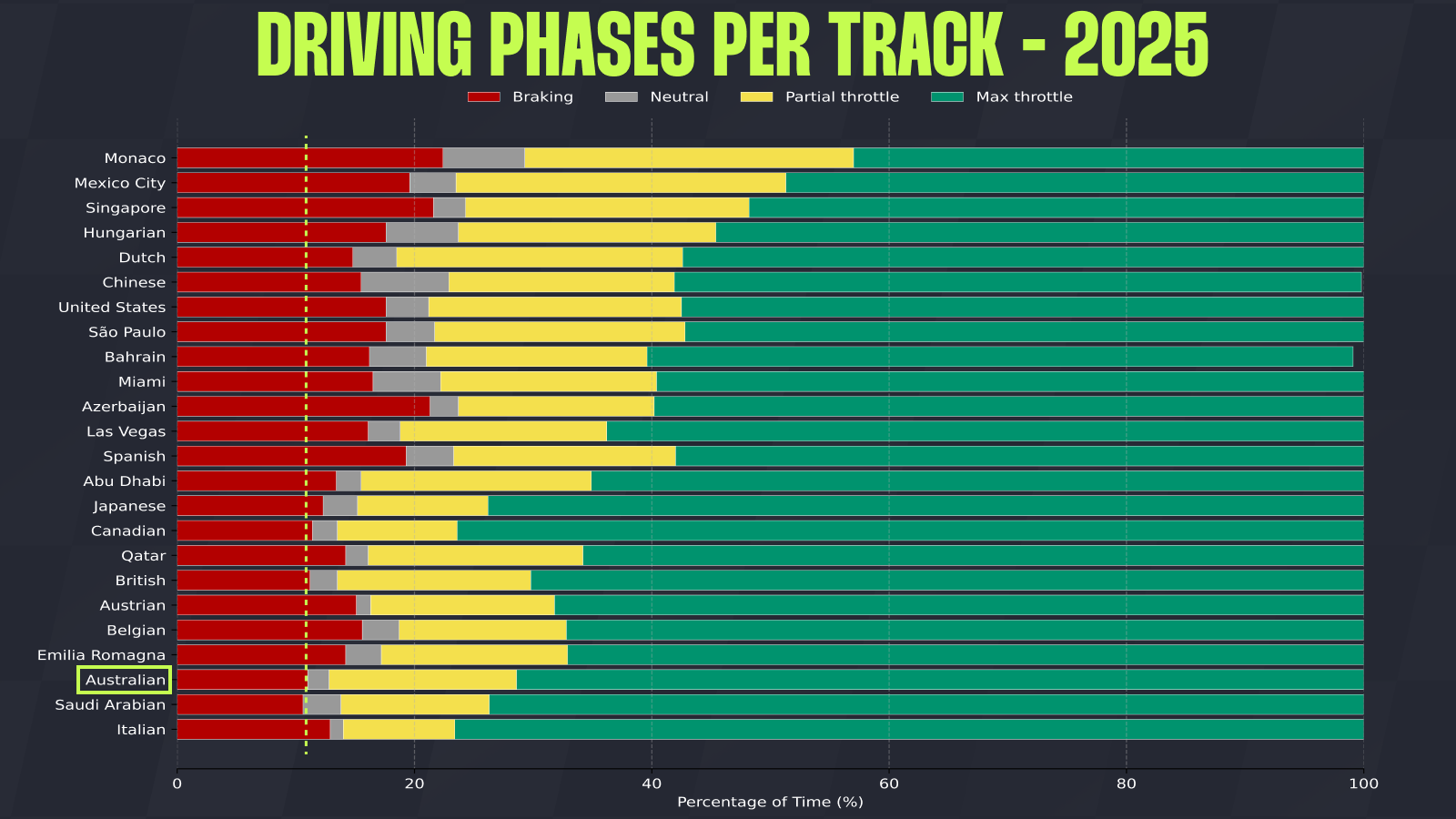
In other words, drivers simply don’t have the real estate on track to effectively top up their batteries. This means we are set to see some truly peculiar car speeds on certain sections, particularly on the straights, given that “clipping” will be one of the primary methods for harvesting energy.
The concept of “clipping” entails that instead of utilising full engine power on the straights, teams will actually divert a portion of that power to charge the battery while the rest moves the car forward (up to 250kW can be “stolen” from the engine in these cases).
What we do know is that at the maximum charging rate of 350kW, it takes roughly 11 seconds to go from 0 to 100% battery capacity – meaning this duration would be significantly longer when relying solely on clipping.
All these suspicions were confirmed as soon as the cars hit the tarmac on day one. During FP2, Oscar Piastri set the benchmark time, which was roughly three seconds slower than the leading FP2 time from last year, set by Charles Leclerc.
In the graph below, we can see a comparison of these two laps, which reveals just how massive these disparities truly are.
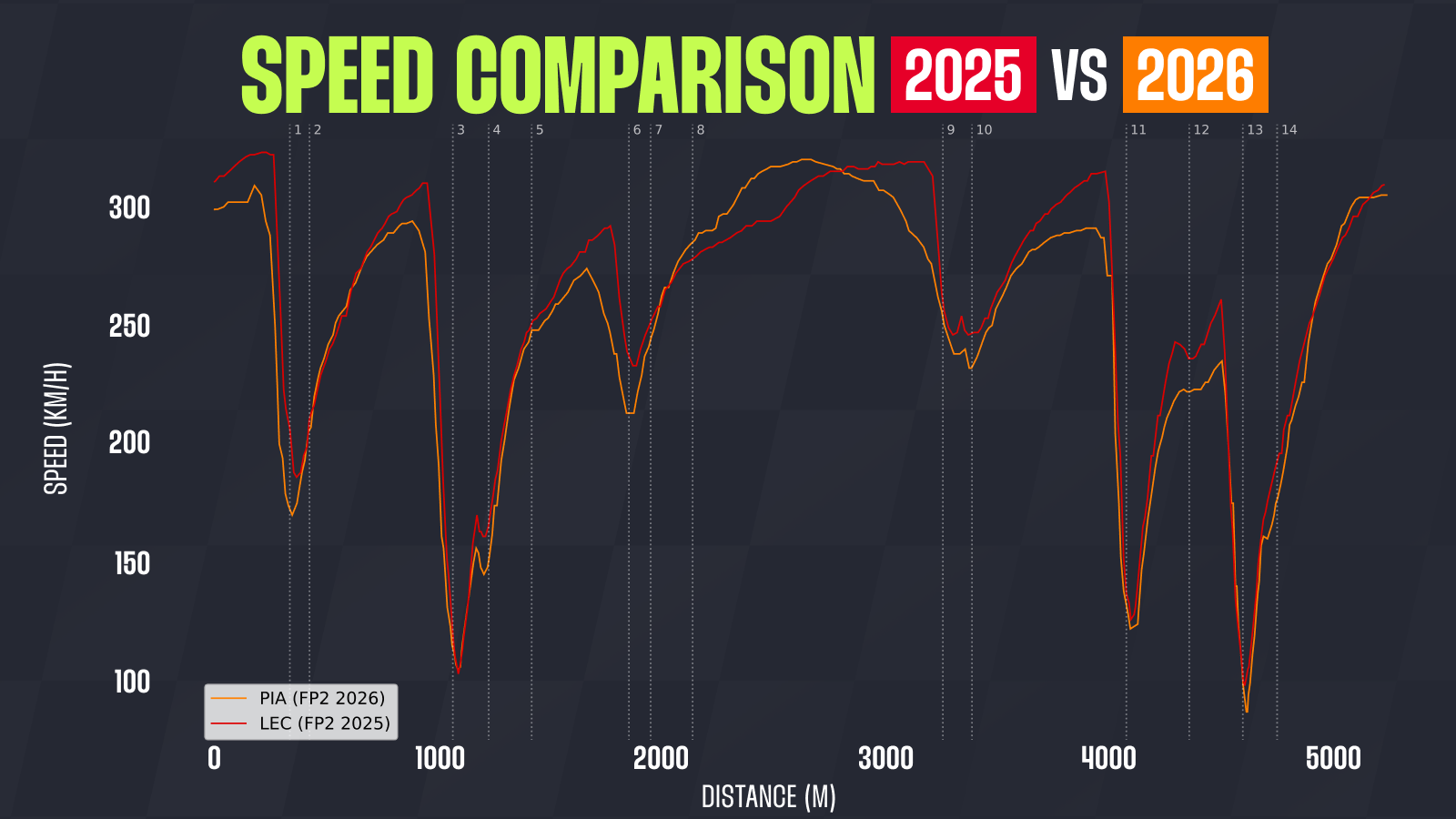
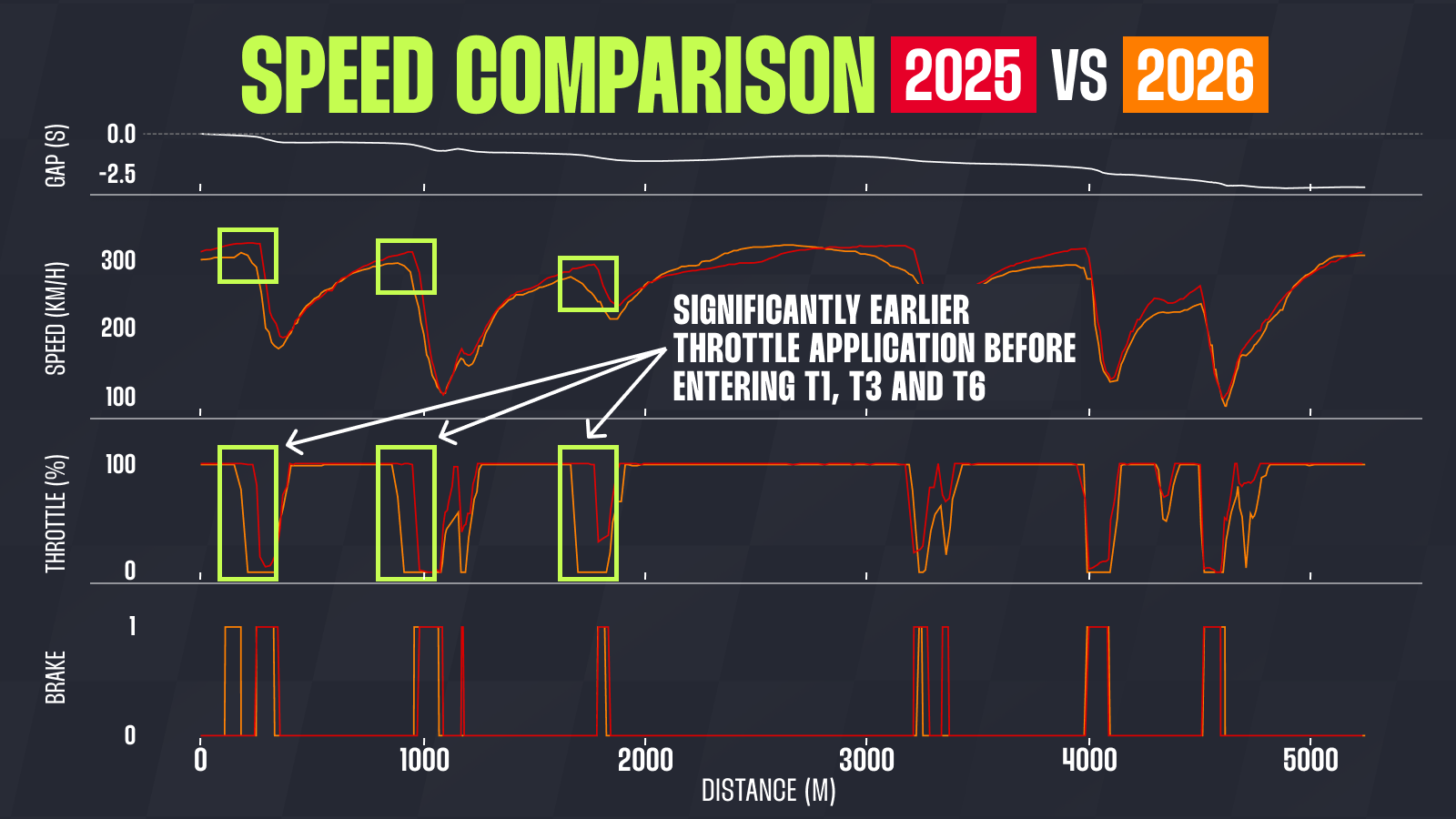
Right from the start of the lap, we can observe how teams are utilising braking zones for energy recovery. In Turns 1 and 3, there is a massive disparity in lift-off timing; it’s clear that in the case of the 2026 car, the driver lifts much earlier, specifically to allow the ERS system time to slow the car down and convert that kinetic energy into electricity.
An even more dramatic early lift can be seen at T6, a high-speed corner that is likely very conducive to battery harvesting. Just look at how long Oscar Piastri (2026 car) remains at 0% throttle, whereas Leclerc only partially lifted at this spot last year. It is a truly immense shift in driving style, which naturally reflects in the car’s speed on track.
However, perhaps the most glaring difference occurs after this corner: the run down to T9, the longest full-throttle sector on the circuit.
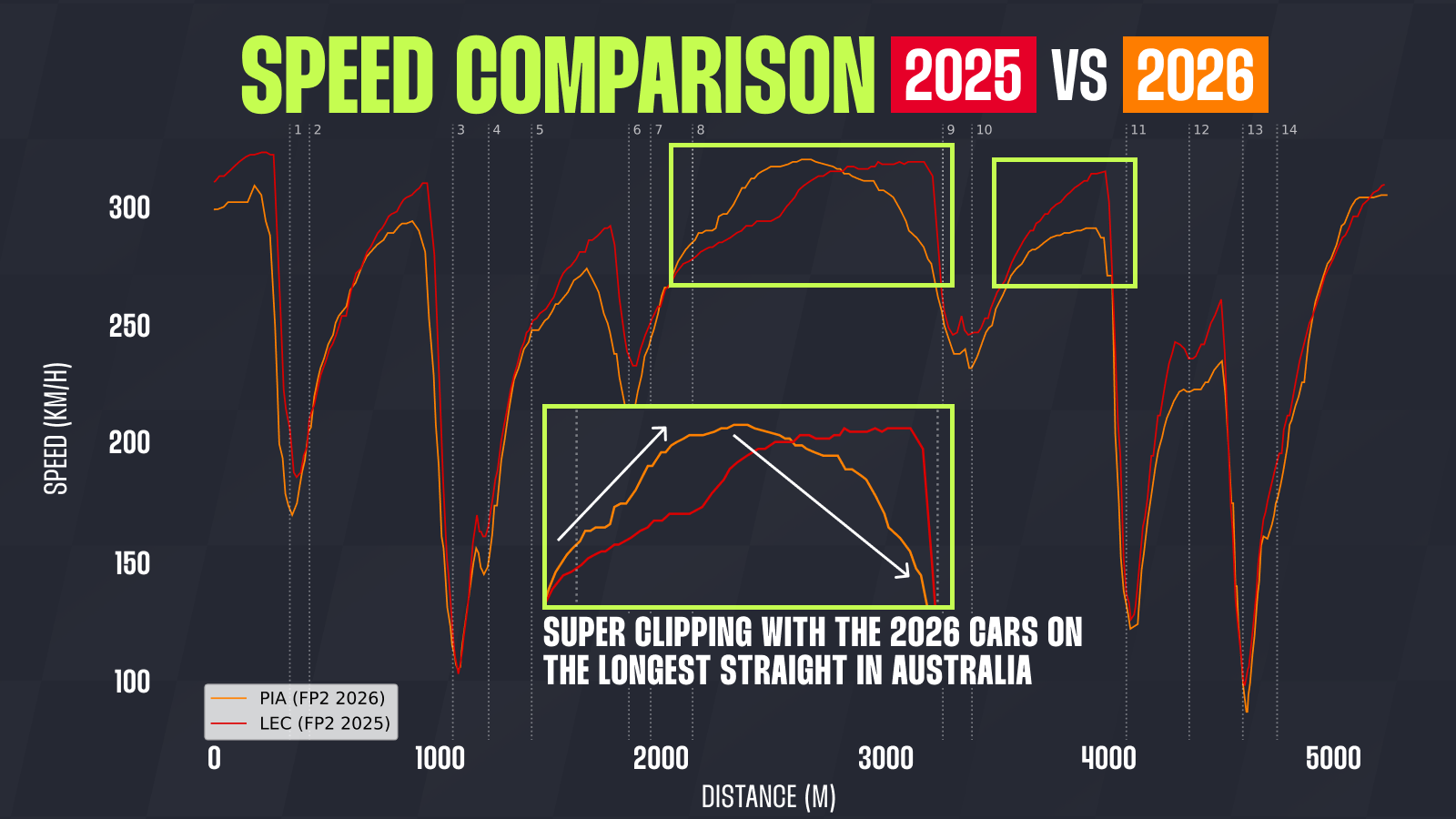
Notice how the 2026 car has significantly better acceleration at the start of the straight and reaches its top speed much faster. Yet, by the midway point of the straight, its speed begins to plummet at a rapid rate, even though the driver remains at full throttle. This is a classic example of the “clipping” we mentioned – in this case, “super clipping.” Simultaneously, the 2025 car continues to build speed throughout the entire straight.
Pay attention to the incredibly large speed delta with which both cars enter the corner. This exact story repeats itself on the shorter straight between T10 and T11, but with much higher difference in top speed.
Despite a completely different driving approach, some estimates suggest that cars during the Australian GP will only manage to recover between 3 to 4 MJ of electrical energy per lap, while the limit sits at 8 MJ.
How all of this will play out in a racing scenario when 22 cars are jostling for position is still impossible to predict. The silver lining is that the wait is almost over.
What we can assume is that team strategies regarding battery deployment and harvesting will be wildly diverse. The fact that the Albert Park Circuit significantly limits the pace at which you can recharge only places even greater importance on the strategy of energy management.
The team that solves this puzzle most effectively will undoubtedly be the one holding a massive advantage.
Want to be the first to know exclusive information from the F1 paddock? Join our broadcast channel on WhatsApp to get the scoop on the latest developments from our team of accredited journalists.
You can also subscribe to the PlanetF1 YouTube channel for exclusive features, hear from our paddock journalists with stories from the heart of Formula 1 and much more!
Read next: Australian GP: Oscar Piastri set fastest time in FP2 as Russell, Verstappen faced drama