
The haunting Verstappen question: Did Red Bull do everything it could win to the title?

Max Verstappen won the Abu Dhabi race, but Lando Norris took the title
With astonishing pace and a commanding victory in the final race of the 2025 season in Abu Dhabi, it seemed that Max Verstappen had done absolutely everything within his power to maximise his chances of securing a fifth consecutive world title.
However, several alternative strategies have emerged as ideas worth examining, so let’s take a look and, with the help of telemetry data, determine whether Max and Red Bull truly extracted everything they could.
Did Red Bull do everything possible?
Setting aside the lost championship, this was a near-perfect weekend for Max Verstappen.
On a circuit that undoubtedly suited the McLaren far more over a single lap, the Dutchman still claimed a dominant pole position (with two pole laps) on Saturday, while his race pace on Sunday looked superb.
He made a solid start, not quite the emphatic launch some might have expected, but he successfully shut down any potential attack from Norris and, with clean air ahead, was free to dictate the race exactly as he wished.
To make things even better for him early on, Lando Norris lost a place to Oscar Piastri on the opening lap and dropped to P3. In other words, Norris now needed to lose just one more position for the championship to fall into Red Bull’s hands.
The downside, however, was George Russell’s poor start. Losing two places before Turn 1 effectively removed him from any realistic fight for the podium. The only real threat to Norris became Leclerc, and in a Ferrari that was far from perfect. Moreover, Verstappen could control only his own pace, not what unfolded behind him.
In what appeared to be an attempt to influence that scenario, Verstappen seemed to be managing the gaps among the top four cars, although we do not have definitive proof to confirm this.
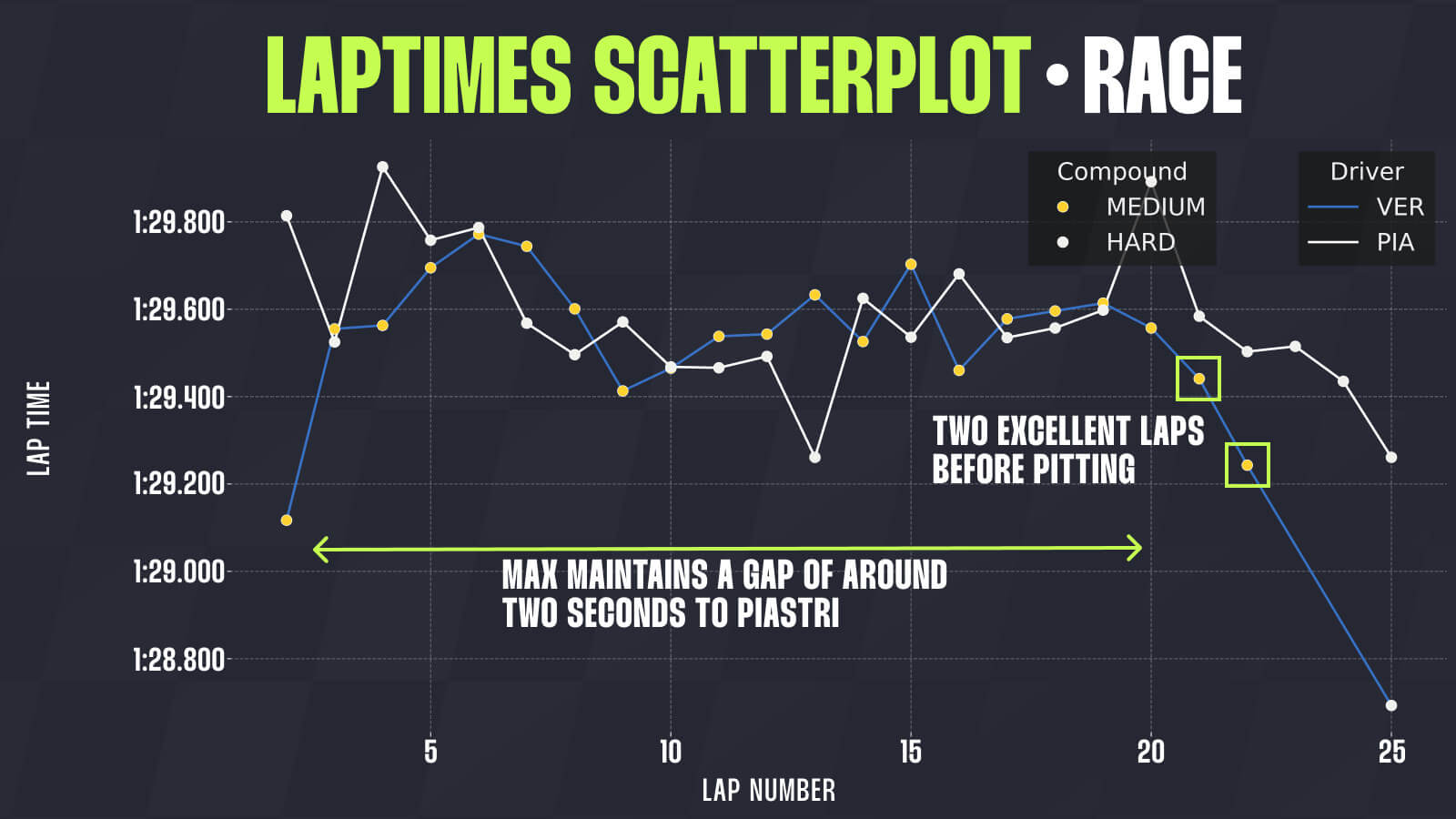
Max held a stable advantage of around two seconds over Piastri – close enough for the Australian to still feel the effect of dirty air and struggle to fully unlock the car’s potential, but not so close that Verstappen risked exposing himself to attack.
This approach appeared to work reasonably well in the first stint: Leclerc was consistently pressuring Norris until lap 17, when the both drivers pitted and Verstappen’s strategy diverged from Norris’s.

Should Verstappen have followed Norris into the pits?
Although this seems like a logical option, in reality it was far riskier than it appears. At that moment the gap between Norris and Verstappen hovered around five seconds. This meant Max would have had to deliberately lose roughly three seconds after his own pit stop to position himself close enough to Norris to influence his race pace.
That would have been a huge gamble so early on, and the four-time champion had little choice but to run his own race and hope a better opportunity would present itself later.
From the telemetry chart, we can see that Max delivered two very fast laps at the end of his first stint, which tells us he truly was managing the tyres and maintaining the gap behind deliberately.
After his stop on lap 24, Verstappen rejoined on fresh hard tyres with a comfortable gap to Norris – and behind Piastri, who was on a completely different strategic path. Again, all Max could do was wait and hope for an opening.
The first driver to trigger movement in the second part of the race was Leclerc. His stop forced Norris into the pits, and one lap later Piastri did the same.
This created a larger gap behind Verstappen and sparked an intriguing idea: now that Max had a clear margin, could he pit and rejoin just ahead of the McLarens and Leclerc? In theory, he might then attempt to slow Piastri and Norris, giving Leclerc a chance to attack.
Telemetry data confirms that from lap 42 to lap 46, Verstappen did indeed have a large enough window to pit and emerge in front. After that, the gap fell below 21 seconds, meaning Max would rejoin behind Piastri.
One factor that seemed favourable was that Leclerc was on mediums, while Norris was on hards.
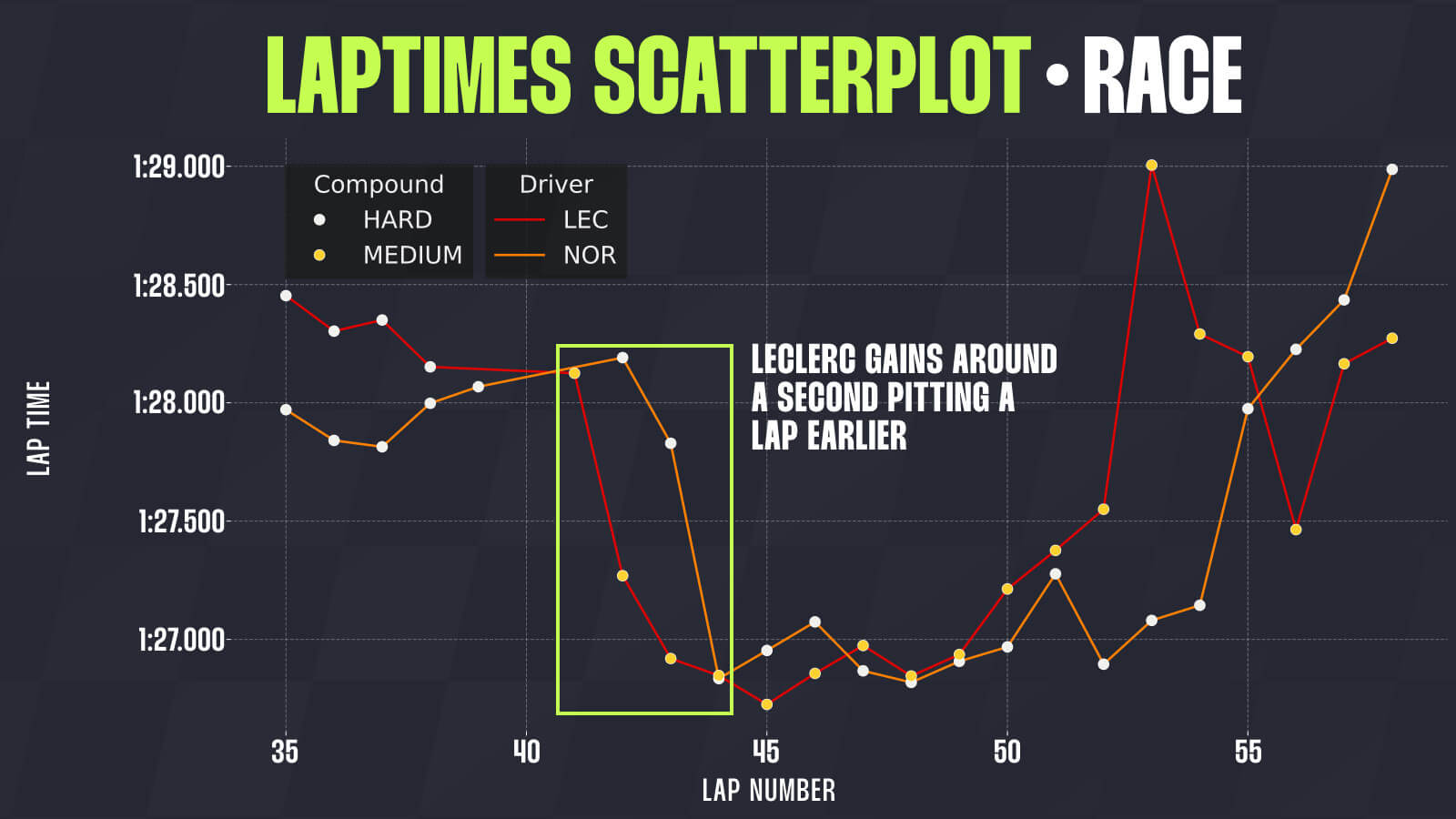
However, deeper analysis shows this wasn’t the advantage it appeared to be. Leclerc needed one full lap after his stop to exploit the fresh tyres, while Norris required two laps. As a result, Leclerc gained only a single second from his earlier stop.
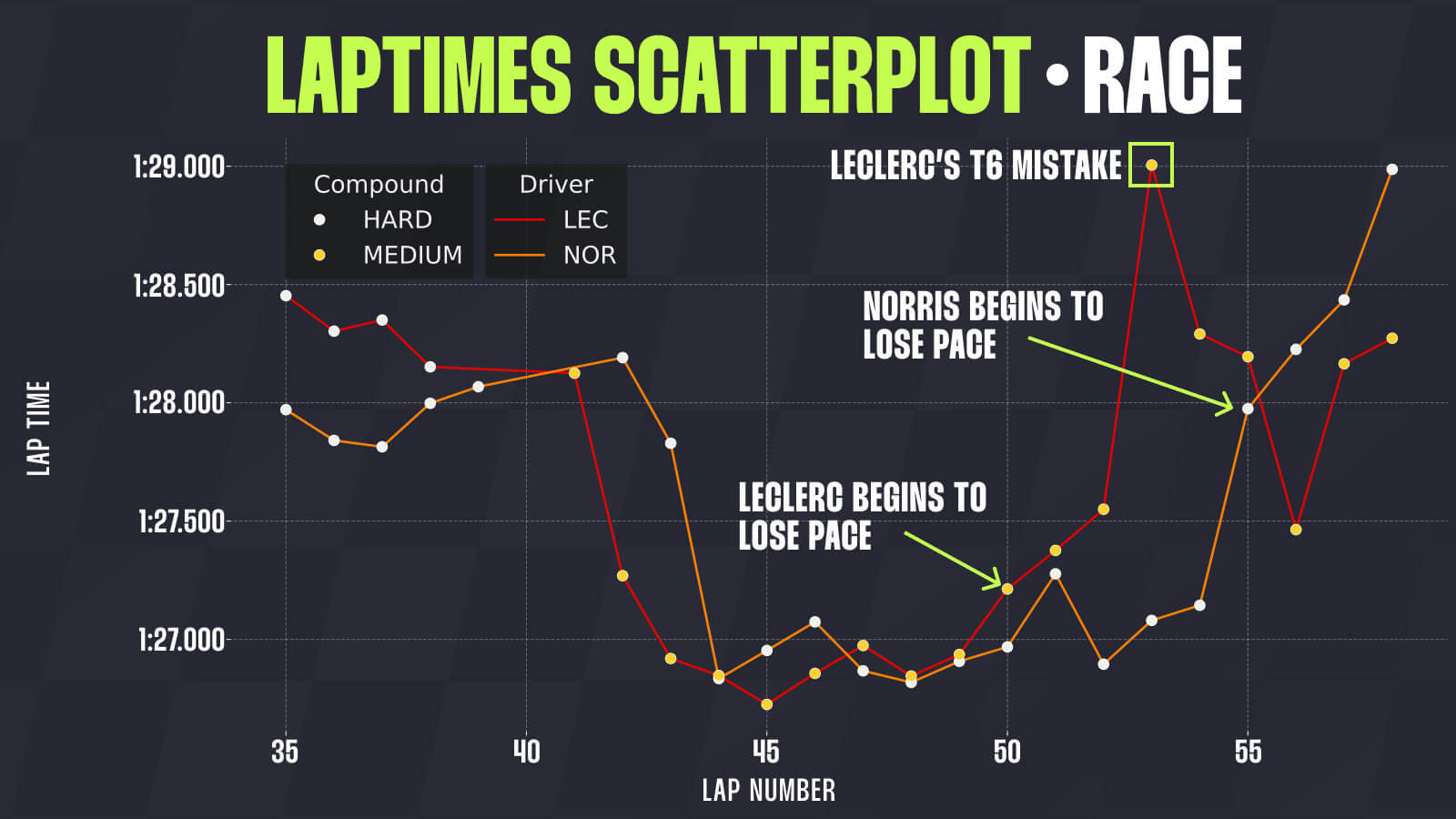
Telemetry also shows that Leclerc’s pace dropped off far sooner than Norris’s, with a mistake in Turn 6 on lap 54 costing him around 1.5 seconds.
In simple terms: even if Verstappen had attempted the strategic play, Leclerc did not have the pace to convert it. The overtake was never realistically on.
Red Bull engineers clearly recognised this, deciding not to compromise Verstappen’s victory and instead allow him to execute the original race plan.
So what can we conclude?
The data shows that Red Bull genuinely extracted everything available in Abu Dhabi. Considering where Verstappen stood at the summer break – over 100 points behind – it is remarkable that he and the team managed to take the championship fight all the way to the final race.
In the end, Verstappen did everything right. The title slipped away not because of his performance in Abu Dhabi, but because McLaren were simply errorless when it mattered most.
Read next: Abu Dhabi GP driver ratings: End of year feel as Norris pips Verstappen in season finale