
The cunning McLaren strategy that cornered Red Bull and delivered Norris the title

Lando Norris is world champion!
Lando Norris is the world champion! He entered the season as the leading favourite and ultimately lived up to those expectations, even though the road to the title was anything but easy.
Let’s take a look at how McLaren, through strategy, ensured it kept maximum control in its own hands, giving the team the best possible chance of sending one of their drivers home with the championship trophy.
McLaren’s Championship Strategy
It is by no means an easy task to create a strategy that suits both drivers, maximises their chances as individuals, and simultaneously prevents Verstappen from spoiling the party.
But it seems McLaren executed this in truly phenomenal fashion.
The core idea behind its Abu Dhabi plan was for the drivers to start on different tyre compounds – a clever move given how different Norris’ and Piastri’s paths to the title were.
Norris began the race on the medium tyre, likely with the initial plan of staying as close to Verstappen as possible throughout the race, while Piastri started on the hards with the intention of extending his opening stint as much as he could.
Since Oscar required something genuinely unexpected, such as a Safety Car, a longer first stint increased his chances of capitalising should an opportunity arise. At the same time, with one driver ahead of the pack, McLaren still retained the flexibility to adapt and support Norris if required.
F1 2025: The season’s winners and losers
👉 The results of the F1 2025 championship
👉 The updated Drivers’ and Constructors’ Championship standings
A crucial moment of the race was, of course, the start, where all three contenders launched extremely well. Piastri, who desperately needed to overtake, produced a spectacular move into Turn 9 on the opening lap, passing Norris for P2. Despite this positional change, McLaren’s strategic framework remained intact and control stayed firmly in their hands.
A beneficial factor for them was Russell’s poor getaway, dropping two places even before Turn 1 and effectively removing himself from podium contention. Leclerc, on the other hand, replaced him and immediately applied heavy pressure in the opening laps.
Up to lap 10, he remained within Norris’ DRS window and delivered excellent pace considering how the SF-25 is clearly a step below the McLaren car. But Lando responded brilliantly, refusing to give the Ferrari driver a proper overtaking opportunity. As it later turned out, this was one of the two decisive moments of the Abu Dhabi GP.
From lap 11 onwards, the pace of both Norris and Leclerc began to drop as they approached the end of the medium tyres’ life. McLaren decided to be the first to pit, removing any risk of a potential Ferrari undercut. From the chart below, we can see that Norris produced a fantastic in-lap.
Seeing Norris head into the pits, Ferrari reacted quickly and mirrored the strategic decision.
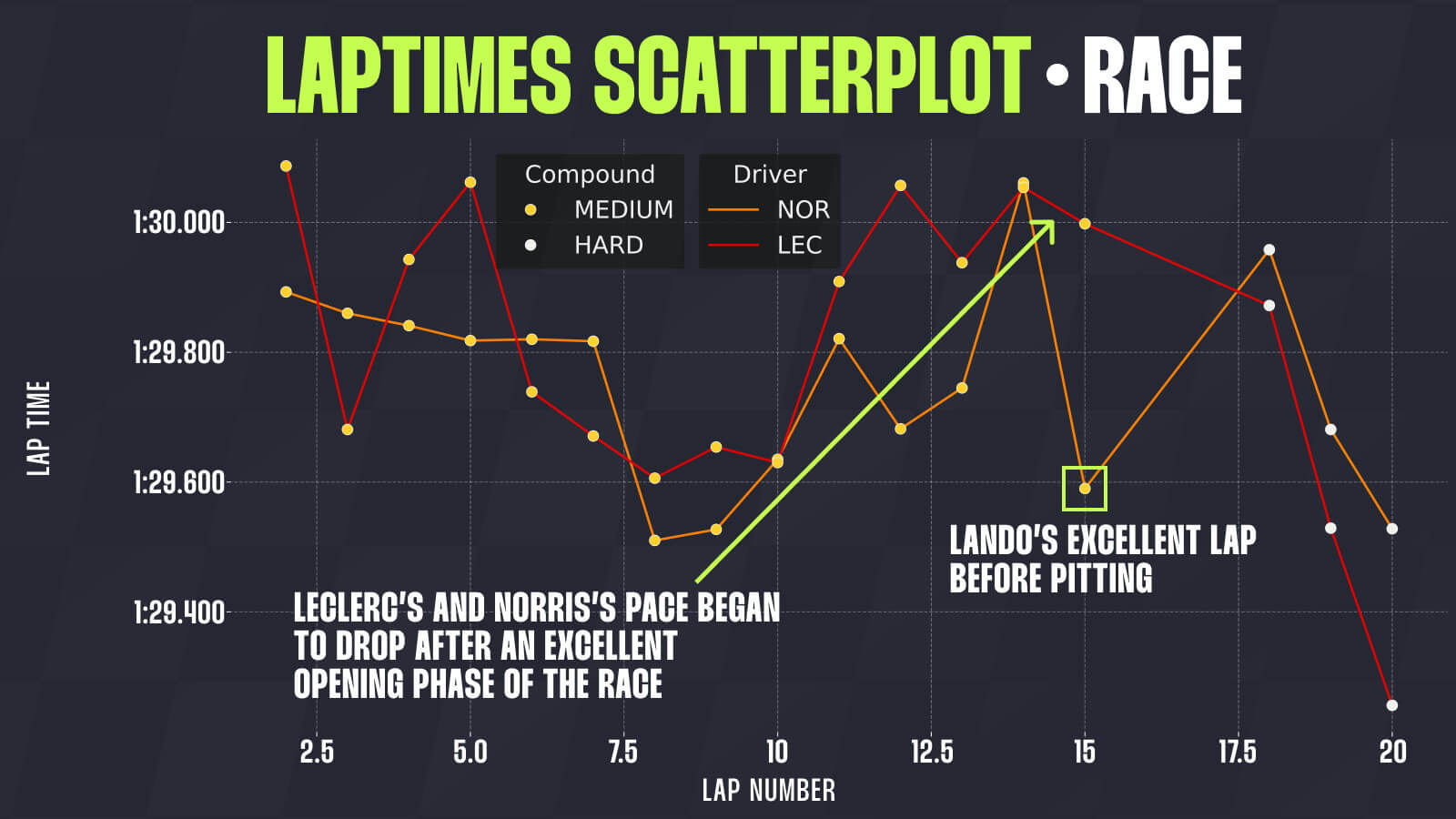
However, the downside of an earlier pit stop was that Lando rejoined in traffic among slower cars.
Once again, Norris handled the pressure superbly and overtook the slower runners with no meaningful time loss relative to Verstappen, all while maintaining a safe gap to Leclerc.
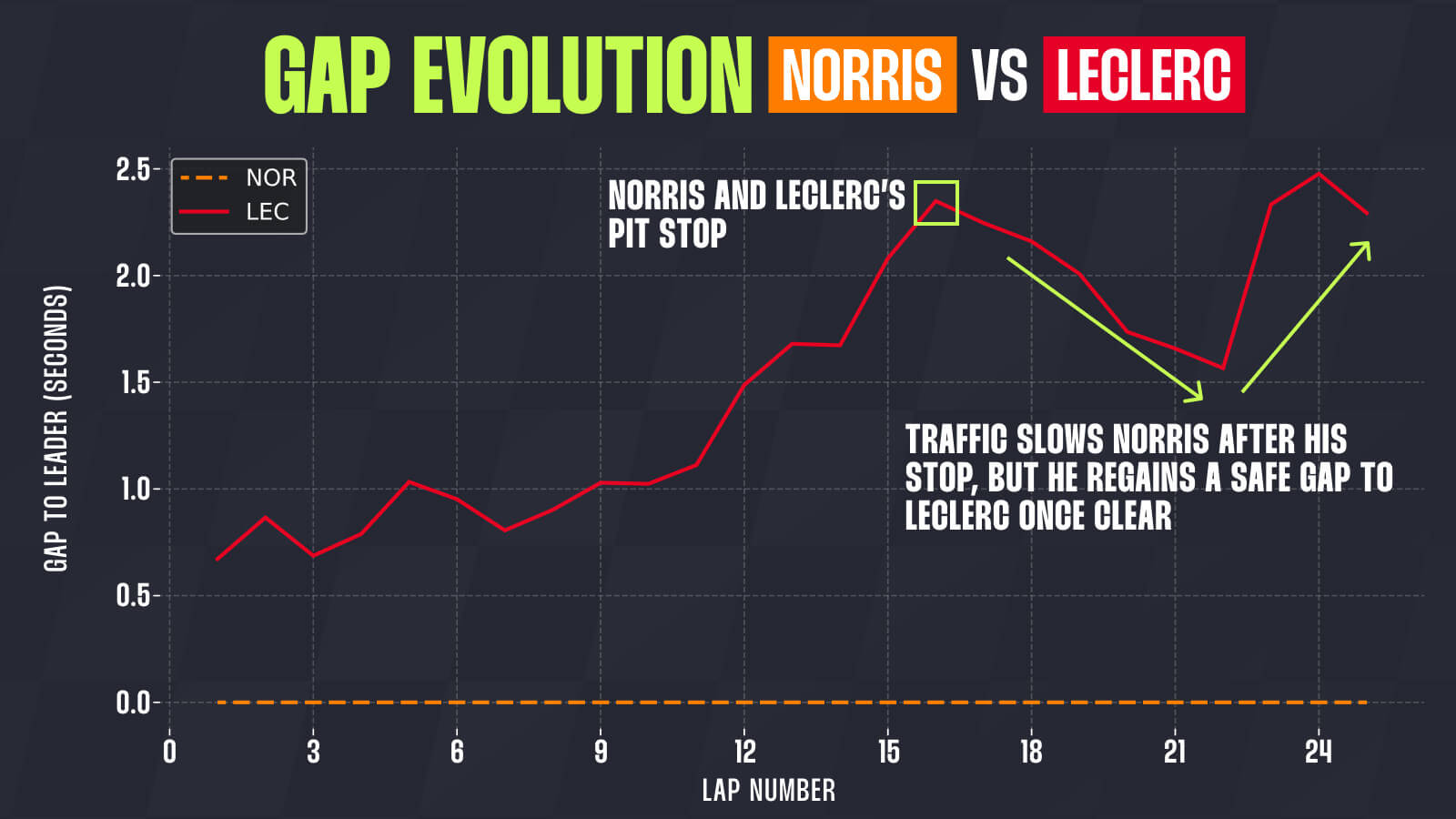
After a dramatic overtake on Tsunoda on lap 24, it looked as though Norris had completed the most difficult part of the job needed to secure third place – and with it, the world championship. With clean air ahead and a five-second deficit to Verstappen, all he needed at that point was consistent pace, which he most certainly had.
In lap 40, Leclerc pitted again in an attempt to execute the only realistic option he had: an undercut. McLaren responded immediately on the next lap, brought Norris in for another excellent stop, and neutralised Ferrari’s attempt. From the data below, we can see the gap between them remained almost unchanged throughout this phase of the race.

It seems the two-stop strategy was not McLaren’s primary plan, as Piastri’s example showed the hard tyre could last more than 40 laps. The key difference was simply that Leclerc switched back to the mediums, whereas Norris received a fresh set of hards. The Ferrari driver did manage to exploit that grip advantage during the first laps of the stint, but only marginally and with no real consequence for the on-track battle.
Once Leclerc’s mediums began to fade, the gap grew even larger than before, and nothing remained between Lando Norris and the championship that could possibly derail him.
On the other side of the garage, Piastri produced a superb 40-lap stint on the hard tyre. He extracted the maximum from the tyres and waited for his opportunity on track for as long as he could. After Norris made his second stop, Oscar pitted for the first time and rejoined five seconds ahead of Lando.
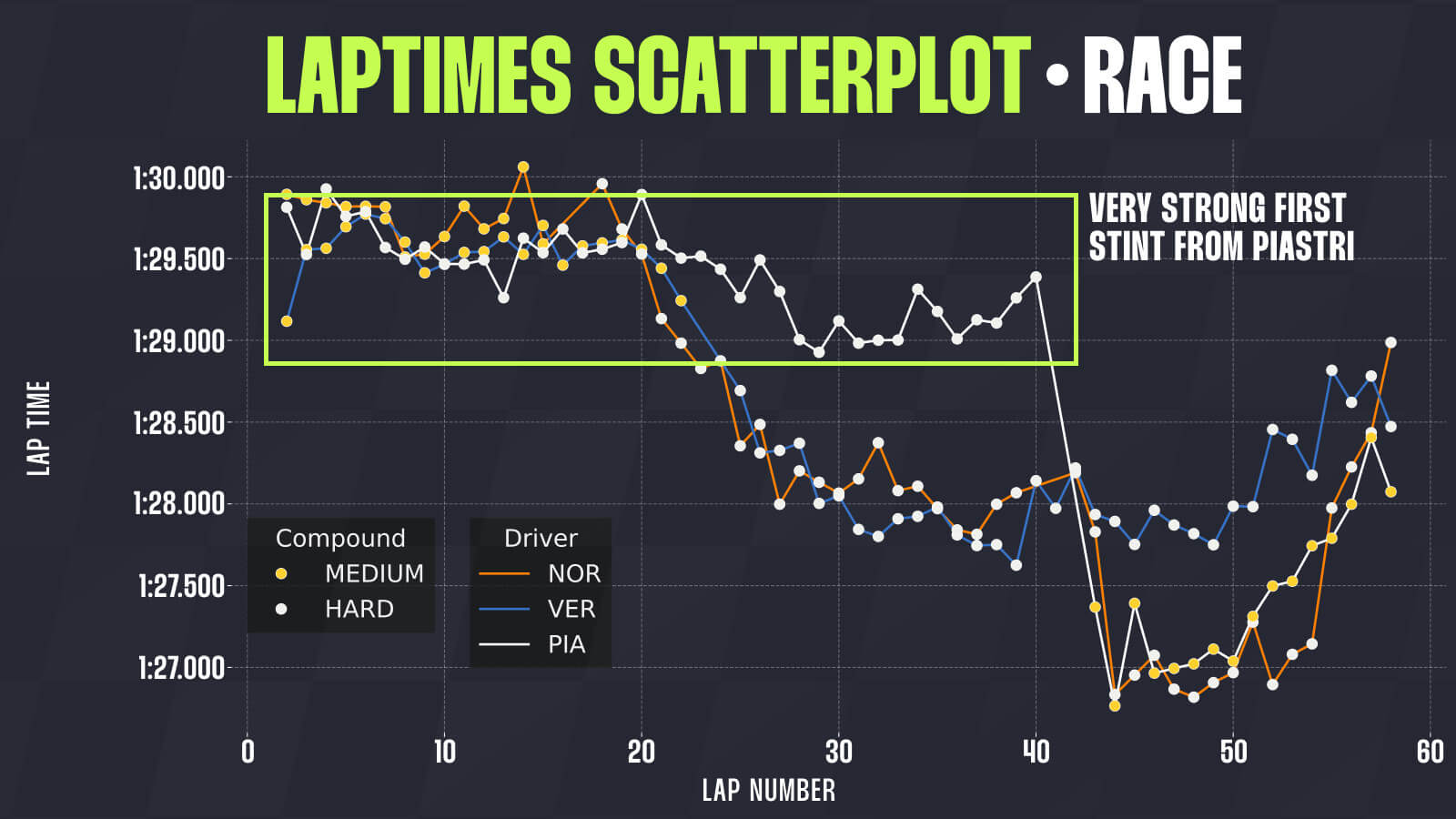
Unfortunately for him, the race saw no Safety Cars to shake up the order, leaving him with little else to do but maintain solid pace to the finish and secure another career podium.
What we can say with confidence is that McLaren executed its strategy extremely well this time. Both drivers were given a fair shot, but the winner can only be one – and it was deservedly Lando Norris. Despite his moments throughout the season, he was the more consistent driver, and that consistency ultimately built the advantage he preserved, fulfilled his childhood dream, and became world champion.
Read next: Abu Dhabi GP conclusions: Lando’s big realisation, Max error punished, the McLaren way