
Telemetry reveals secrets behind Max Verstappen’s Brazilian GP charge
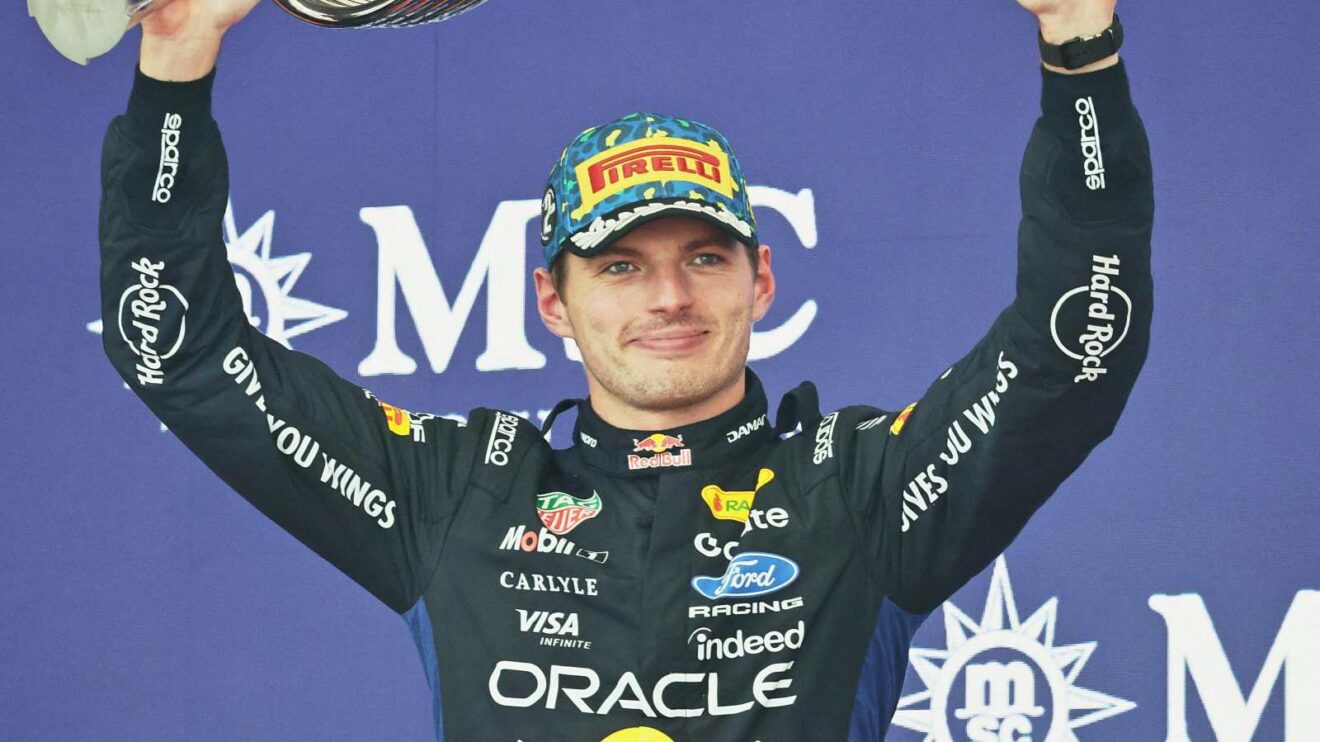
Max Verstappen rose from the back row to the podium at Interlagos.
Starting from the very back of the grid, Max Verstappen climbed to P12 after just one lap of racing in wet conditions, and by the end of the first stint, the four-time World Champion had already broken into the podium places.
How did he pull off a 19-place rise at the Sao Paulo Grand Prix, you ask? Telemetry data tells us exactly how he orchestrated his remarkable recovery.
How did Max Verstappen make up positions so quickly?
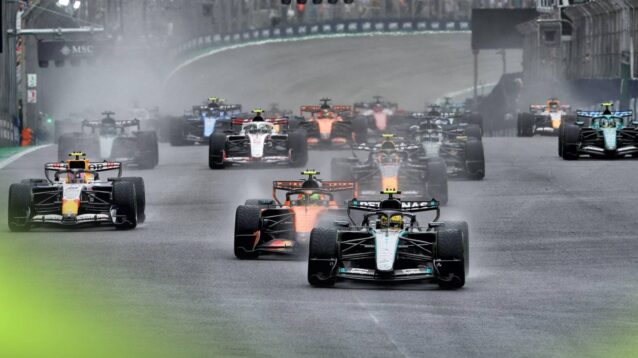
Conditions at the start of the race meant everyone started on brand-new intermediate tyres, leaving zero room for strategic variation, at least initially. As expected, Verstappen made up places right from the opening lap.
These conditions suit him down to the ground – recall 2024 when he surged from the rear of the grid to secure an extraordinary victory and put one hand on the championship title.
We saw he was on course for a similar charge when he gained nine positions on the opening lap alone, jumping from P21 to P12.
The first obstacle in the form of a front-running car was Hamilton on Lap 4, who started one position ahead and was also carving his way through the field. Hamilton got stuck behind Piastri and Albon as they fought for position, and Max capitalised on Hamilton losing rear grip on the exit of Turn 12 to pass him for P9.
The very next lap, Max overtook both Piastri and Albon.
The graph below illustrates just how quick Max was during those opening laps. The lap-time delta compared to Hamilton is stark: a full second per lap up to Lap 7, after which the gap widened further. Even more fascinatingly, Max matched the pace of Norris, who was running in clean air without needing to fight through traffic.
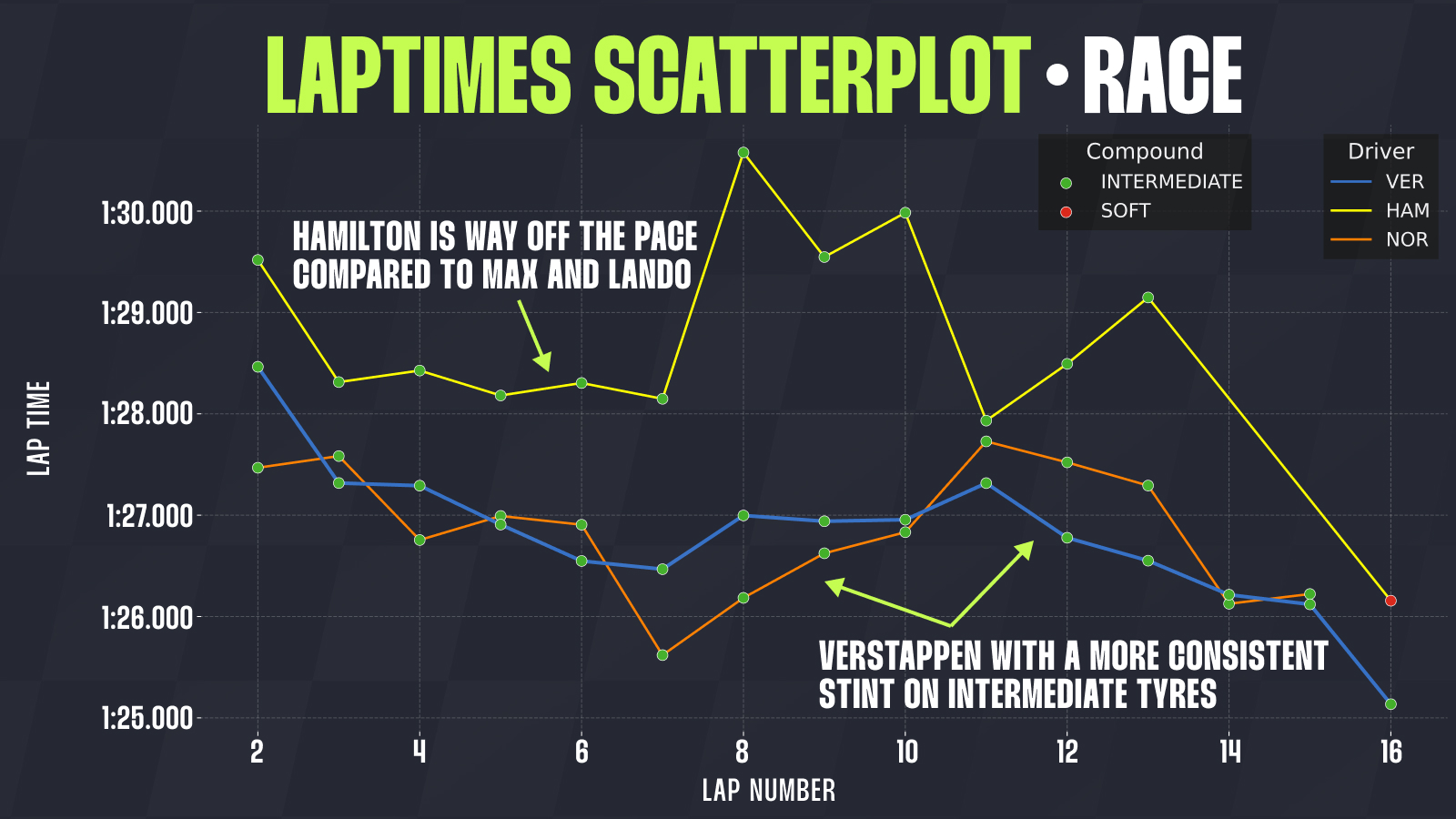
You can also spot Lando’s quick laps from Lap 7 to Lap 10, after which the trend reversed. This was the phase where the track began drying and lap times improved, but Verstappen chose not to force the issue initially; he maintained a steady, consistent rhythm that paid off massively in the second half of the intermediate stint.
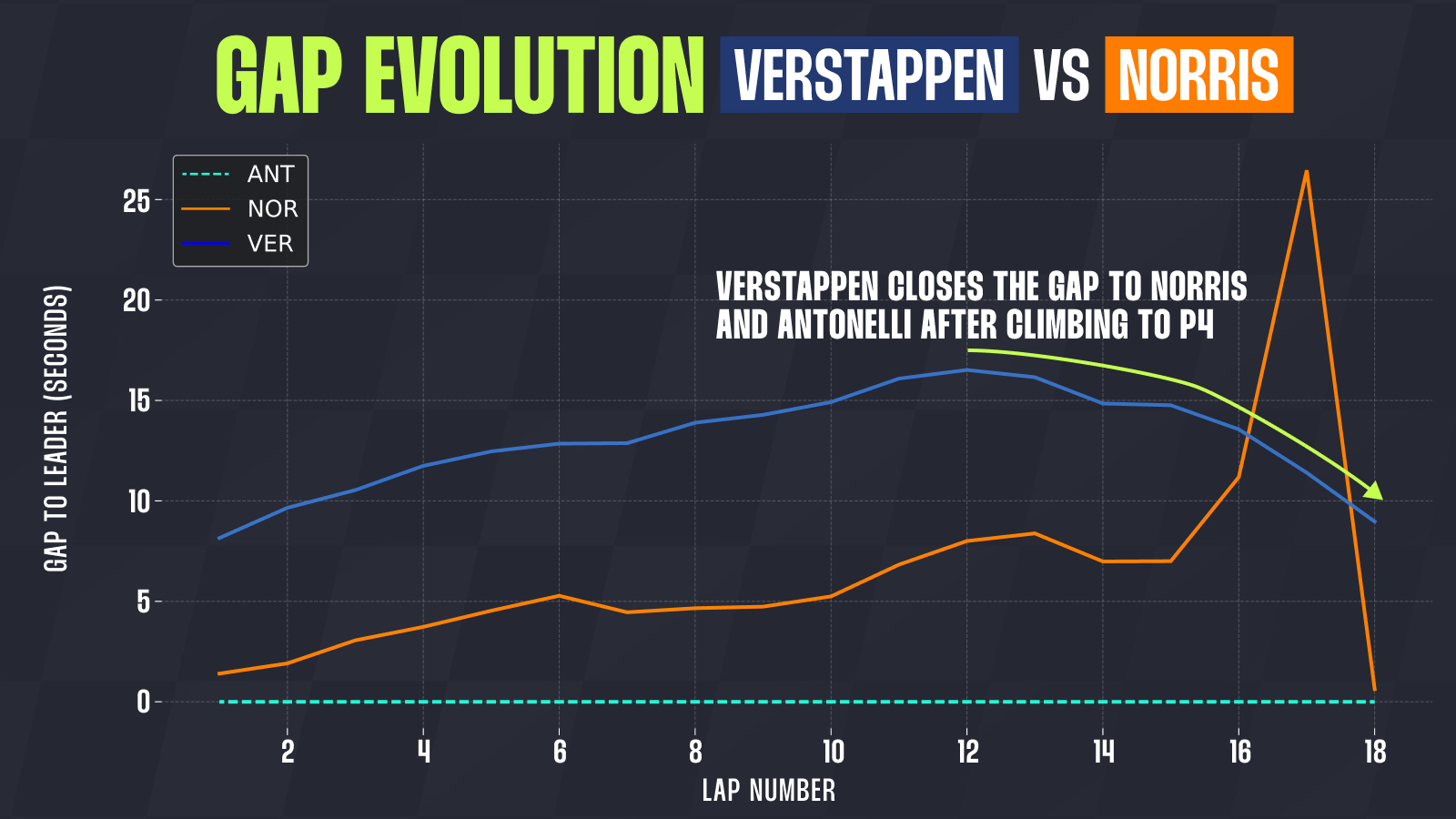
Maintaining this pace, Verstappen swept past Lawson on Lap 11 to take P4, five seconds behind his teammate (who started P5) and 15 seconds adrift of race leader Antonelli.
However, by the time Verstappen pitted on Lap 18, that 15-second gap had shrunk to under 10 seconds, thanks to smart tyre conservation and superior pace between Laps 11 and 18.
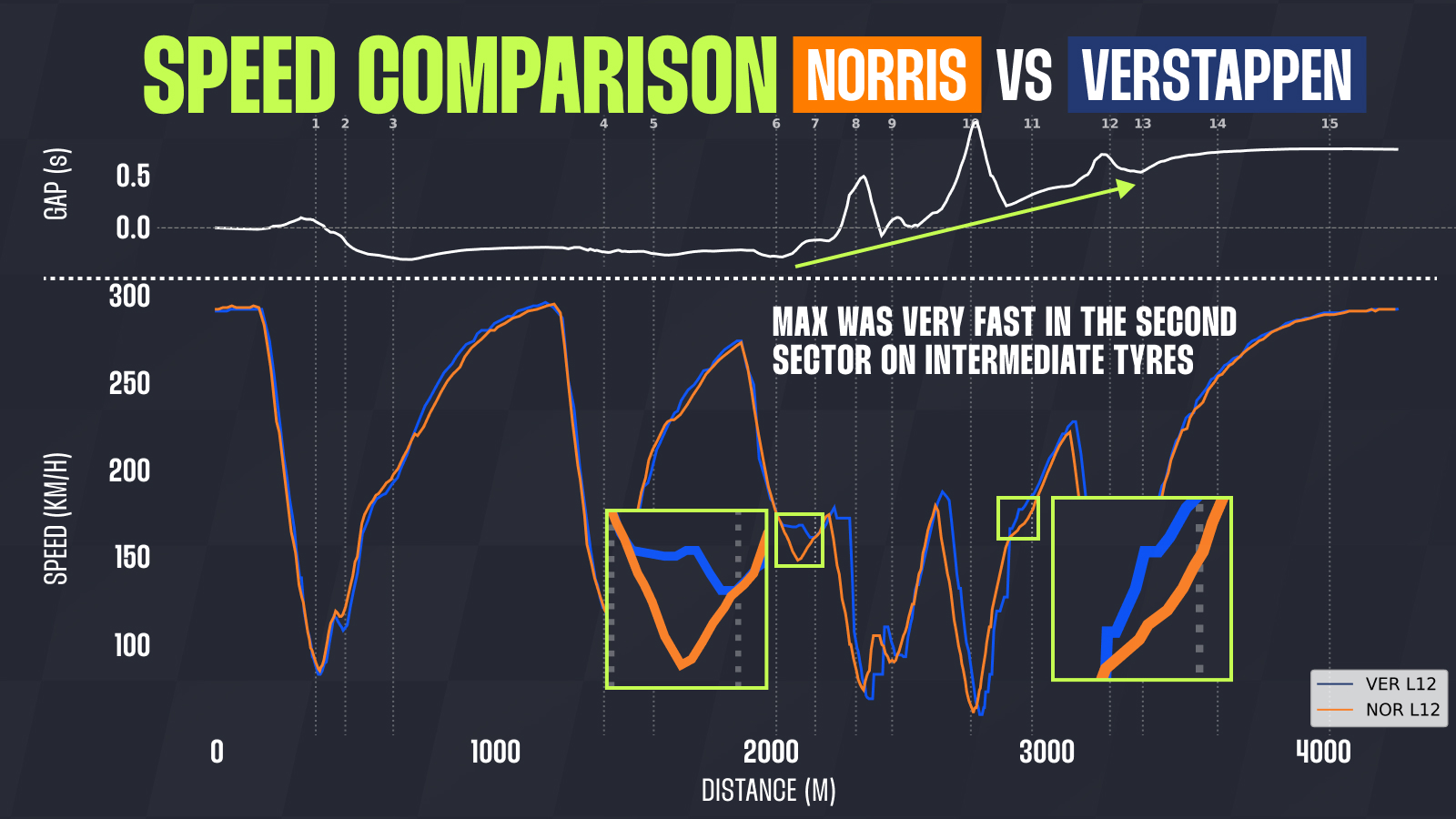
Digging a little deeper reveals that Verstappen clawed back the bulk of that time in Sector 2, through the slow-speed corners. Compared to Norris, we can see massive speed deltas through Turn 7 and Turn 11 – corners characterised in these wet conditions by partial-throttle application.
In short, in corners where you needed to be delicate with the throttle and constantly ride the limit of rear grip, Max was exceptional.
Essentially, Max did the heavy lifting by this stage of the race. That extraordinary pace from the first stint didn’t carry over into the second, where Norris was clearly faster.
An error and excursion off-track by Antonelli at Turn 1 completely destroyed his pace, promoting both Hadjar and Verstappen up a position and officially putting Max into the podium places.
Meanwhile, Hadjar made a few minor errors on soft tyres and lacked consistency; Max closed in rapidly, and the team instructed them to swap positions so Max could maximise tyre performance.
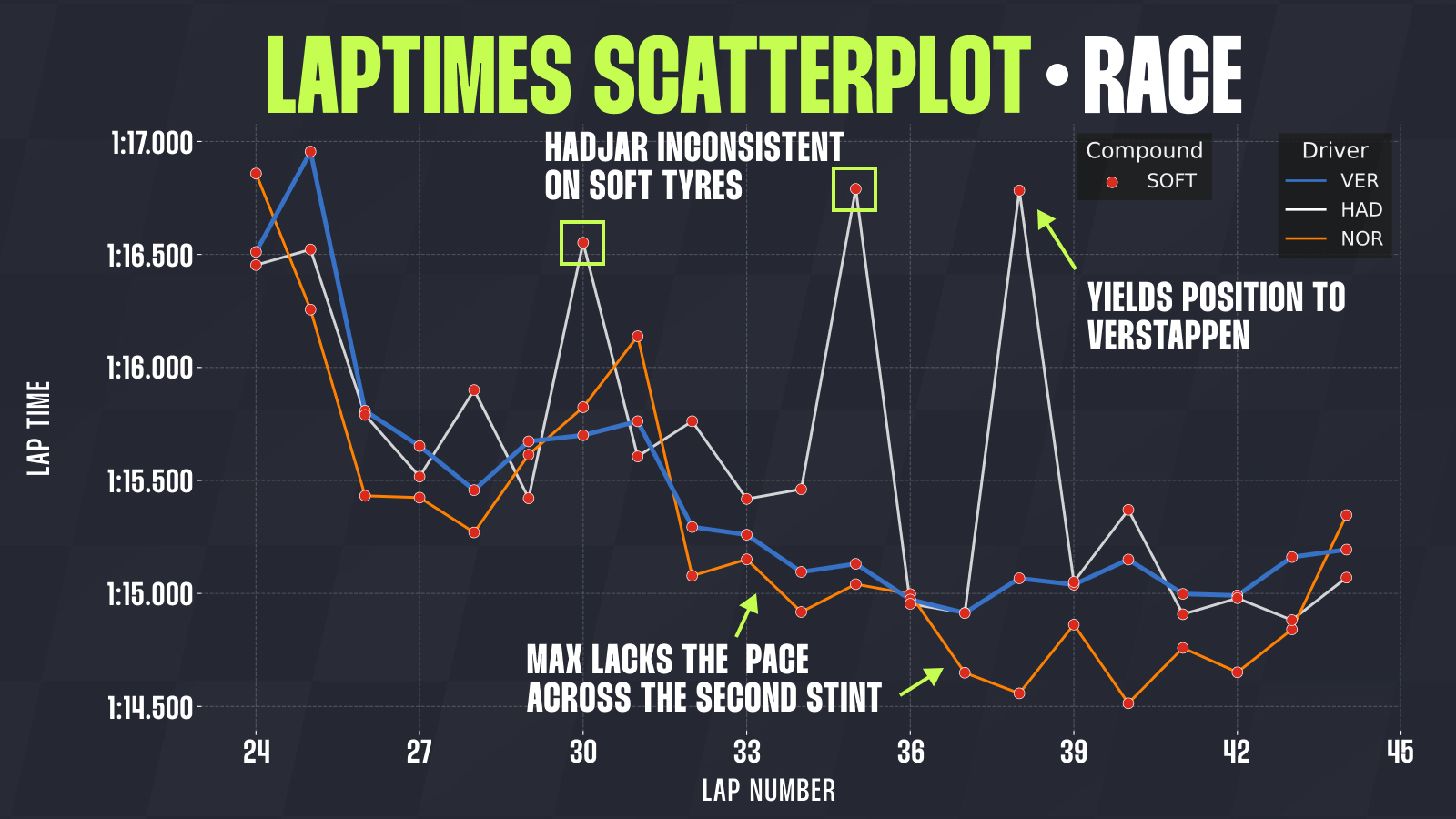
Despite starting his stint six laps later, the Dutchman was roughly four tenths of a second per lap slower than race leader Norris and had no realistic chance of challenging for P1. Even Verstappen himself described the swap to soft tyres as he felt something being wrong on the car – “night and day”, as he said to the media after the race.
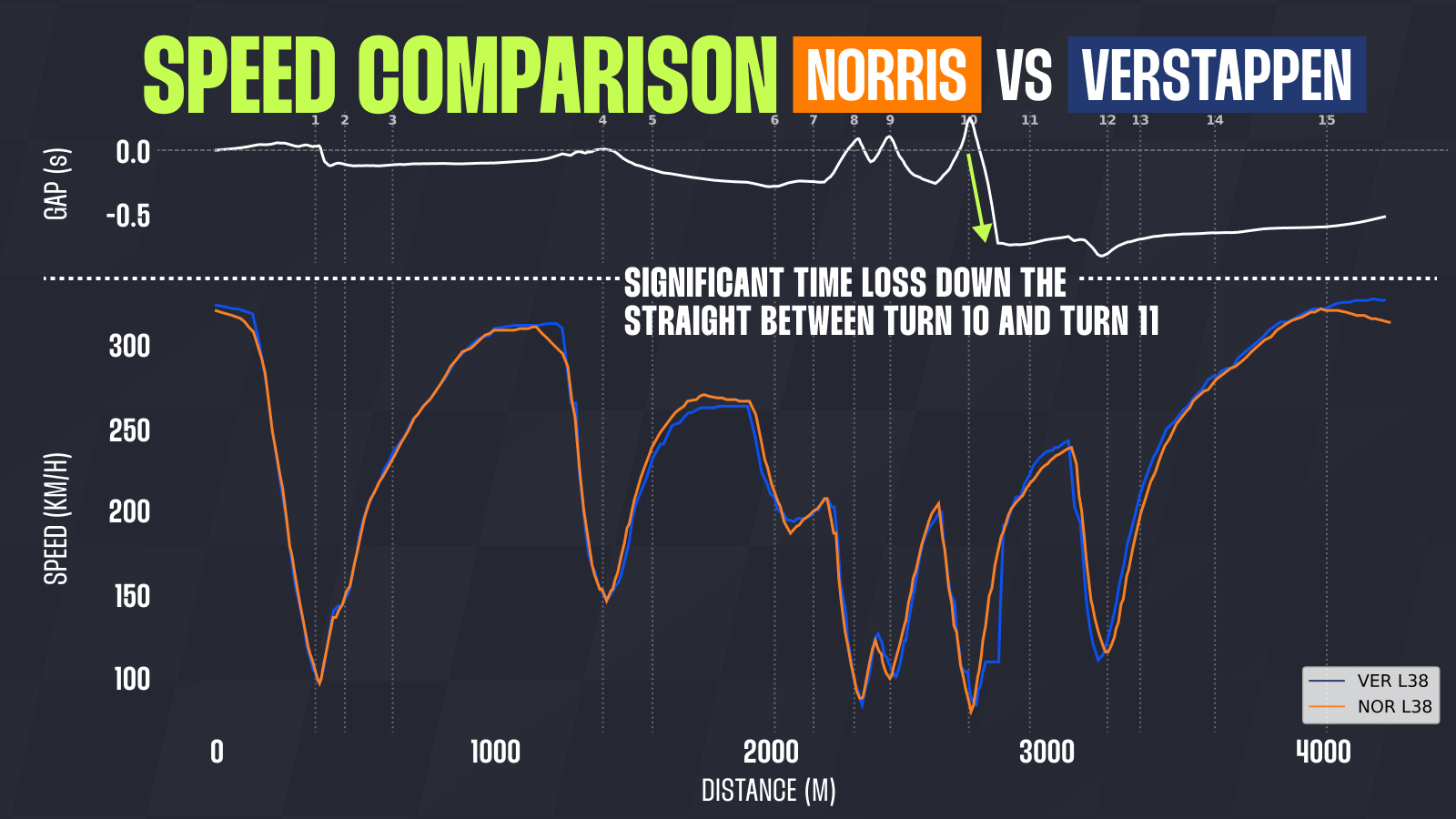
What the telemetry shows in this case is a sudden loss of time on the short section between T10 and T11. Lap after lap, Max is losing a lot of time here, even though nothing unusual is happening on the rest of the lap. He even had to brake on a few occasions through this short stretch between the two corners.
A potential turning point arrived when rain returned, forcing all runners back onto intermediate tyres. Both Lando and Verstappen made the switch on the same lap, creating no significant time deltas.
In the space of just few opening laps, Max Verstappen charged from near the back of the grid all the way to the podium. An astonishing drive from the Dutchman and a fantastic result for Red Bull.
Read next: George Russell ‘paid the price’ for bizarre pit lane spin during Brazilian GP