
Why Kimi Antonelli’s ‘unrealistic expectations’ played a factor in European slump
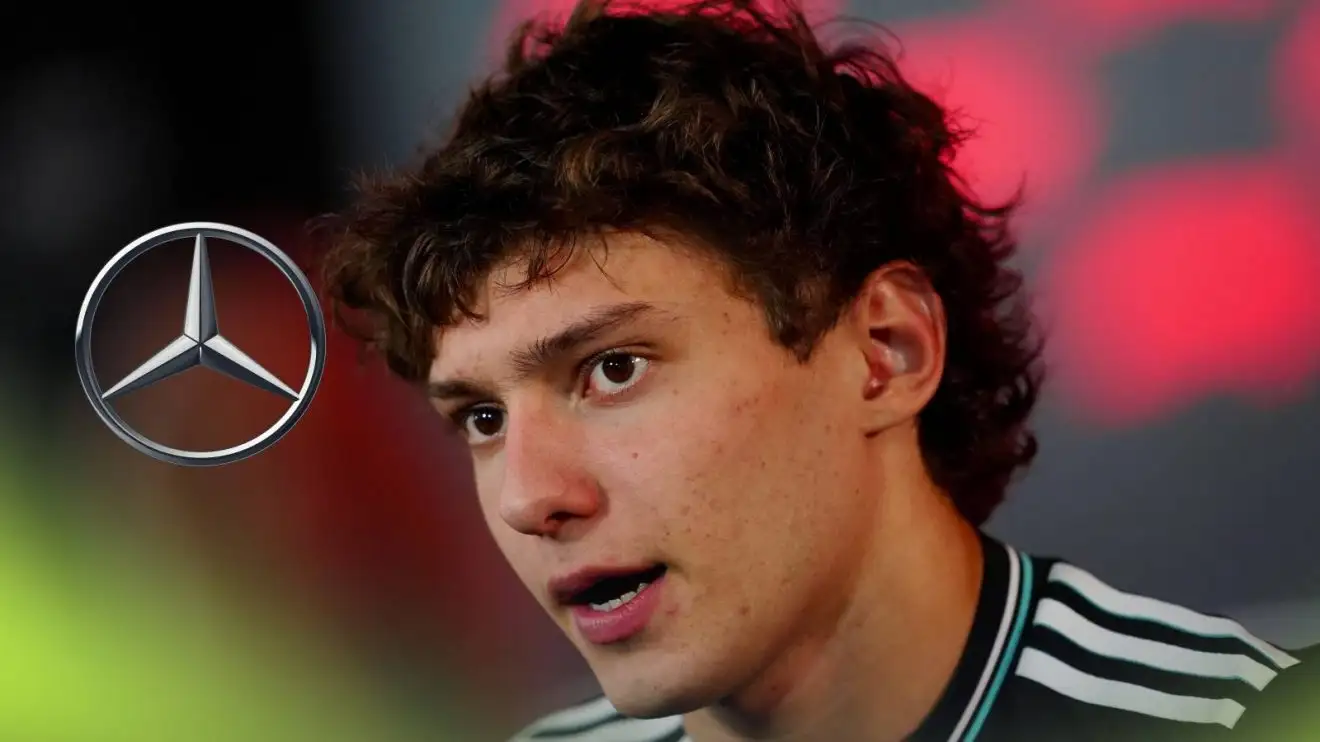
Kimi Antonelli may have been trying too hard at circuits he knew already, Andrew Shovlin has theorised.
Some of Kimi Antonelli’s mid-season struggles in F1 2025 may have come about from the Italian having “unrealistic expectations”, believes Andrew Shovlin.
Having started his rookie season with Mercedes in strong form, the highly-rated Italian fell off the boil through the middle third of the season before finishing the year in impressive fashion.
Andrew Shovlin: Kimi Antonelli may have had unrealistic expectations
Arriving in F1 as Lewis Hamilton’s successor at Mercedes, Antonelli stepped up from Formula 2 with high expectations from his new team.
He immediately delivered upon these hopes with a fourth-place finish in treacherous conditions in Australia, and scored five strong points finishes in the opening six races.
This included a maiden ‘pole position’ after securing top spot in the Miami Sprint Qualifying session, but Antonelli’s form took a dip upon returning to Europe, mostly circuits he had raced on before through the junior ladder.
Aside from a maiden podium finish in Canada as Mercedes secured a 1-3 finish, it took until Hungary for Antonelli to return to the points.
With results evading him, to the point where Antonelli was becoming visibly upset about what he dubbed his “overdriving”, his performances picked up after the summer break and, in the final races, he even showed a clean pair of heels to experienced teammate George Russell at several events, as well as scoring podiums in Brazil and Las Vegas.
“It will be easier for him when we come around to having done all the tracks again,” Mercedes‘ head of trackside engineering, Andrew Shovlin, said of Antonelli, while speaking to select media, including PlanetF1.com, in Abu Dhabi.
“There may have been an element in Europe where he had unrealistic expectations.
“He thought he knew the circuits, the results were going to come, and they didn’t. Whereas, driving tracks he doesn’t know, he doesn’t have that expectation going in, and the weekends have seemed to flow quite smoothly.
“But we’re starting to understand him a lot better. He’s getting very comfortable in the team. He’s comfortable in his own performance. We’re excited to see how he does next year, and adapting to next year’s rules, that is really about practice.”
With his rookie season now behind him, Shovlin offered examples of how Antonelli had struggled with some aspects of maximising the potential of the car beneath him, but that the Italian had shown clear progress in understanding throughout the year.
“Now, he has a far better understanding of the flow of a race weekend, even in the face of what you need to do ahead of it in terms of preparation,” he said.
“Kimi’s ability to tell you what the car is doing has always been very strong. To be honest, one of the least important jobs is getting them to understand all the ins and outs of all our engineering tools to try and balance it, because Kimi can describe to Bono [Pete Bonnington, race engineer] exactly what the car is doing.
“Bono knows what to do with it, and over time, you can start to explain how everything’s working and all the various ways of balancing the mechanical balance of the car around the lap, all the tools we’ve got.
“But that’s increasingly coming to him, and they start to build up this database of ‘When I made this change, this is what it felt like and, therefore, I know if I’ve got this balance, that might be a useful trick to deploy’.
“One of the big things for him is just understanding how to approach a race, how to approach a qualifying session. Just learning how hard you need to push. He kept either underhitting or overhitting.
“[For example], you get a snap in Turns 1 and 2, where you’ve applied too much power and you just can’t get rid of that temperature around the lap. Budapest was a good example of that, where he just overcooked it.
“As the results were getting better towards the end of the year, there were a number of sessions where he’s probably got a bit ahead of himself. He performed very well in Q1, Q2, and then he just overdid it in Q3, and you pay the price.
“This is all the real fine detail that drivers with six years, 10 years under their belt, have learned by going through it, learning it the hard way.
“But what has been good is that he does get through to Q3, which means you can maximise the learning. He has been finishing all the races, which means you maximise that learning.”
More on F1 2025
Why Red Bull 2.0 left no room for renegade Helmut Marko
Lewis Hamilton ‘praying’ for 2026 after ‘worst’ spell of F1 career
Andrew Shovlin: We expected a different set of problems with Kimi Antonelli
Part of the adjustment process for Antonelli was learning how to best exploit the Pirelli tyres. Despite his rigorous testing of previous cars (TPC) programme with Mercedes in 2024, Shovlin revealed that one factor of this may have inadvertently slowed Antonelli’s initial understanding due to the specific compounds in use for TPC programmes.
“The issue is, though, that the tyres that you get for that, the academy tyres, have quite a weak front, and you never end up with the same balance that you actually have on the race car,” he said.
“But that work was going on, and it was very much focused on race weekend prep, single lap work, and long-run work. We knew that there was always going to be a learning year with him. We knew that there were always going to be mistakes.
“There’s always going to be an element where he is gaining performance as he goes through race weekends.
“We could see that he had very good car control, but the weekends are complicated, and some of the things that caught him out… Melbourne Qualifying was just not getting out of the garage quickly enough.
“He didn’t realise, even though we talked through it, just how fast everyone moves when they all move together. If you don’t get it into gear and go within a second, suddenly you’re boxed in, and you can’t get your car out. And that led to him getting bumped out.
“The start of the year was actually okay, which perhaps lulled us into a bit of a false sense of security with him. In Europe, the weekends were busier for him, and we did what we could to try and streamline that.
“We made sure we were doing a lot more simulator work. We were trying to cut out all his external commitments with sponsor days and things as far as we could.
“But, ultimately, getting performance out of a driver, a lot of it just comes from preparation, making sure they know what they need to focus on, making sure they understand what the sessions, what the weekend is going to look like, where the challenges will be, and what you have to focus on on a Friday.”
With things gelling far better by year’s end, following confirmation that Antonelli had secured a contract extension with the team, Shovlin revealed that the obstacles presented in Antonelli’s rookie year had actually been quite different to the expectations pre-season.
“It’s great that we managed to get it all back on track,” he said.
“I’d say, overall, we were expecting a different set of problems.
“We always thought it’d be the long run that would be the thing that took the longest to learn. But actually, Kimi was performing really well in the long run straight off.
“It’s just that, if you qualified out of position, you don’t get to show it, because you’re surrounded by cars that are holding you up.
“The single lap we thought would come to him quite naturally, and that actually took quite a bit of work.
“Some of it was even when you start a lap, and the tyres are too cold, if you go into the first corner cautiously, you don’t generate enough temperature.
“Actually, it was learning to sort of just trust that if you throw it in, the grip will come.
“Suzuka was a good example where they had a new tarmac. You need a lot of temperature at Turn 1, and it’s a real confidence corner. It took him almost all weekend to learn that.
“But the nice thing with Kimi is, when he learns things, they become embedded. He’s not making the same mistakes time and time again.
“Overall, it’s very much on track with him. It was just that where we thought we’d need to focus isn’t necessarily exactly where it is, but it’s great for us going into next year that we’ve had a very positive run of results in this back end of the year, with all the flyaways.”
With F1 going through a huge regulation change for F1 2026, with a revolution on both the chassis and power unit side, Shovlin said Antonelli’s proclivity for the sim stands him in good stead for the sweeping changes.
“Kimi, because he’s a youngster, has a pretty impressive ability to sit in the sim and drive it all day long,” he said, “and I think all the younger drivers who’ve grown up gaming actually develop that spare mental capacity to drive while talking, while making fun of everyone else who’s on the game with them.
“It does help them with that sort of composite thing of thinking while you drive, and the driving becomes secondary. It frees up your brain to think about energy and strategy and how you overtake, but he enjoys driving it, and he’ll do as many hours as required. I think that’s by far the biggest bit.”
Read Next: ‘Intense’ Adrian Newey ‘exchanges’ uncovered as Honda issues Aston Martin update