

F1 2026 power unit homologation deadline explained as March 1 arrives
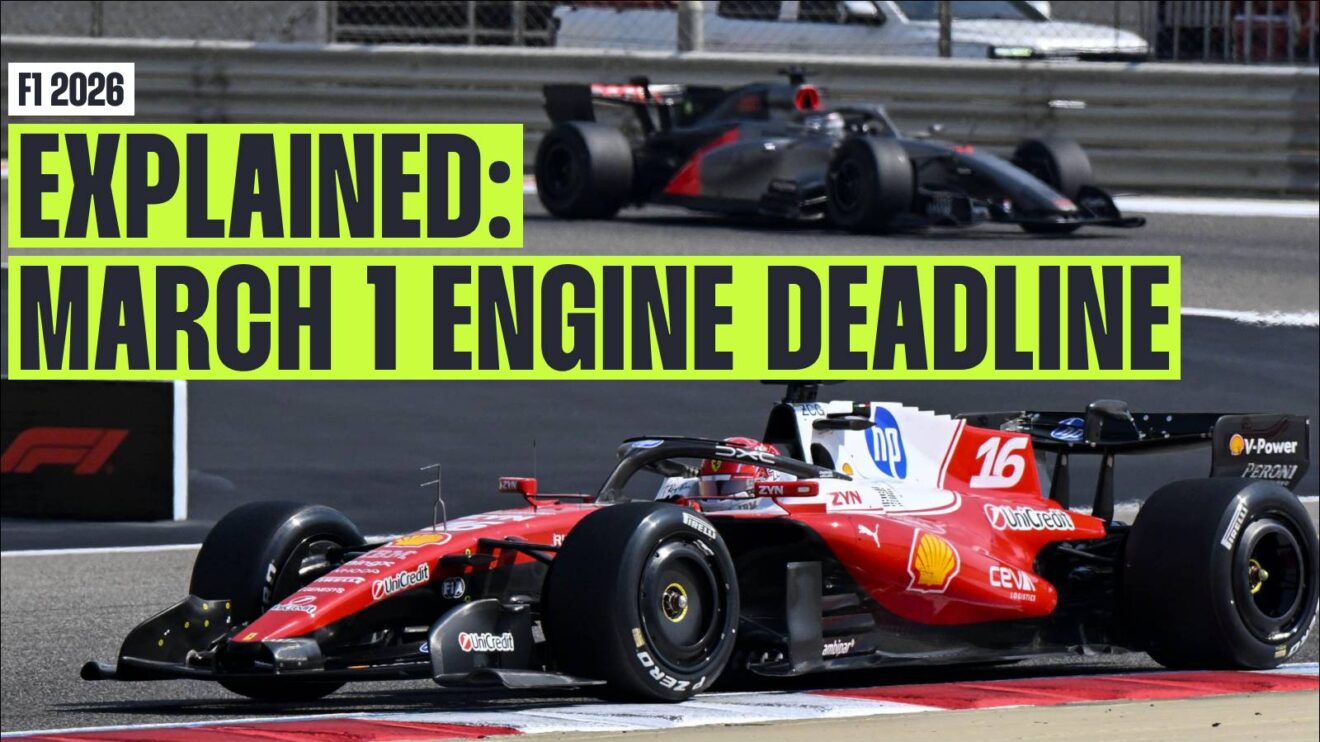
Sunday marks the cut-off day for power unit homologation for F1 2026, but what does this actually mean?
Sunday, March 1, is an important day in the F1 2026 regulations, with the power unit manufacturers reaching their deadline for homologation after spending the last few years getting ready for this moment.
F1 2026 power unit homologation deadline and March 1 explained
Want more PlanetF1.com coverage? Add us as a preferred source on Google to your favourites list for news you can trust.
Appendix C5 of the technical regulations pertains to power unit homologation, with each of the power unit manufacturers [PUMs] required to conform with the process before supplying any F1 team.
Homologation is the process by which components are signed off on by F1’s governing body, the FIA, as being fully in compliance with all regulatory standards and requirements.
The power unit is just one of the areas the FIA homologates, and the deadline date for submission of power unit designs conforming to the brand-new regulations is March 1. Each PUM that is registered with the FIA for F1 2026 must submit a full homologation dossier to the FIA no later than this date.
This date applies throughout the entirety of this 2026-2030 regulation cycle, meaning any PUM that enters the sport between now and then must also submit its dossier on or before March 1, in the year in which the PUM is entering competition.
For example, the Cadillac F1 team is set to use General Motors’ power unit when the American manufacturer arrives in 2029, meaning it will be required to submit its homologation dossier no later than March 1, 2029.
For the five PUMs racing in 2026, Ferrari, Mercedes’ High-Performance Powertrains, Audi, Red Bull Powertrains [RBPT], and Honda, they must submit their documentation no later than March 1, 2026, having had the chance to use the real-world data from pre-season testing to make any last-minute adjustments to their designs, as needed.
Each manufacturer is permitted to submit just one homologation dossier to the FIA, covering its period of competition through the 2026-’30 cycle, with homologated designs remaining valid until the conclusion of the 2030 championship.
What is the power unit homologation dossier?
In order for a PUM to be granted homologation approval, the dossier submitted to the FIA needs to comprehensively detail every critical component of the power unit.
There are specifics to this, with the submissions being required to include technical specifications and explanations for all components classified as ‘PU elements’ in Appendix C4 of the technical regulations.
These include:
- Internal Combustion Engine [ICE]
- Control Electronics [PU-CE]
- Exhaust System [EXH]
- Turbocharger [TC]
- Energy Store [ES] (ie. the battery)
- MGU-K [Motor Generator Unit – Kinetic]
The PUM must also provide a complete and detailed breakdown of all minor parts associated with each of the prescribed power unit elements above.
Supporting documentation must also be provided.
Upon receiving all of the above, the FIA will pore through each manufacturer’s submissions and approve the power unit for homologation within a maximum of 14 days. Once approved, the units become ‘sealed’ to prevent any illicit modification and allow for easy detection of the same.
These seals apply to most of the components of the power unit, although some components, such as filters, spark plugs, flywheels, coils, sensors, etc. are given an ‘unsealed’ classification to allow for legal changes, given their more consumable nature.
A power unit that has not been homologated for use will not be legal to race with in the F1 2026 championship. It is not expected that any of the five PUMs will fail to be homologated.
Following approval, each PUM must then present a complete reference power unit, including all elements, to the FIA. This must be done by April 1 of the PUM’s first year of competition.
These power units are kept by the FIA as a physical representation of the documentation lodged with the governing body, with the unit sealed to allow for easy comparison against what the power unit manufacturer has declared.
How does homologation work for customer teams?
A PUM may supply multiple teams. For instance, Mercedes supplies its factory team as well as McLaren, Williams, and Alpine, while Ferrari supplies the Scuderia, Haas, and Cadillac. RBPT supplies the two Red Bull-owned teams, Audi supplies only its factory team, and Honda only supplies Aston Martin.
But, regardless of how many teams a PUM supplies, the single homologation dossier applies to all, with every power unit required to be identical and operated in the exact same manner.
From technical specification to control software and operations, the PUM is also required to ensure the same specifications of oil and fuel are available to each customer team. However, individual customer teams can apply to utilise their own preferences of fuel and oil supplier, if desired, although a third-party supplier is unlikely to have as deep a knowledge of the characteristics of the power unit compared to the one used by the factory squad.
Should a customer team run with a different oil and/or fuel supplier, the PUM must specifically declare this in their homologation dossier.
To give customer teams the chance to keep up with the knowledge of the factory teams, the PUMs are required to provide all customer teams with details such as physical interface locations for installation in a chassis, estimates of operating parameters such as heat rejection and engine stiffness, and details of any specific parts, procedures, and operating conditions or limitations that would have any impact on the operation of the power unit.
For any of the customer teams racing in 2026, these details must have been declared by the PUMs to them no later than August 1, 2025.
As a PUM rolls out updates to its units through the five-year cycle, a minimum of one power unit with the updated specification must be made available for each customer at the first event the modifications are introduced.
For any PUM supplying more than two teams, ie. Mercedes and Ferrari, a single exception per season will be granted in the event of genuine supply issues, meaning a possibility of a customer team or two not receiving the updated specification unit for that single event.
More on F1 2026’s new regulations
Explained: F1’s complex power unit upgrade system
Explained: How F1’s new ‘overtaking mode’ will work in 2026
What happens as the engines are upgraded?
As previously written about, there is a process to allow for performance-related upgrades throughout the five-year regulation cycle, with these opportunities clearly defined at certain timings throughout the next five years.
These are separate from the Additional Development and Upgrades Opportunities [ADUO] afforded to struggling PUMs.
By and large, performance-based development is quite restricted from now on, but that doesn’t mean the power units won’t evolve.
Provisions within the regulations allow for changes on the grounds of reliability concerns, subject to the usual approval process of submission to the FIA, which will convene with the other PUMs to ensure proposed solutions are valid and legitimate.
Minor tweaks, with approval, are also permitted for the likes of wiring, wastegate positioning, turbocharger positioning, engine air intake systems, hoses, valves etc., although the fundamentals of each system must remain the same.
Regardless of the reason for changes to the power unit design, a submission of an updated homologation dossier must be submitted to the FIA at least 14 days before the introduction of any modification.
These will be considered as an update of the initial dossier, with PUMs required to indicate version numbers and all changes highlighted prominently.
Want to be the first to know exclusive information from the F1 paddock? Join our broadcast channel on WhatsApp to get the scoop on the latest developments from our team of accredited journalists.
You can also subscribe to the PlanetF1 YouTube channel for exclusive features, hear from our paddock journalists with stories from the heart of Formula 1 and much more!
Read Next: F1 and FIA closely monitor Bahrain and Saudi Grands Prix amid Middle East conflict