

Explained: How F1’s new ‘overtaking mode’ will work in 2026
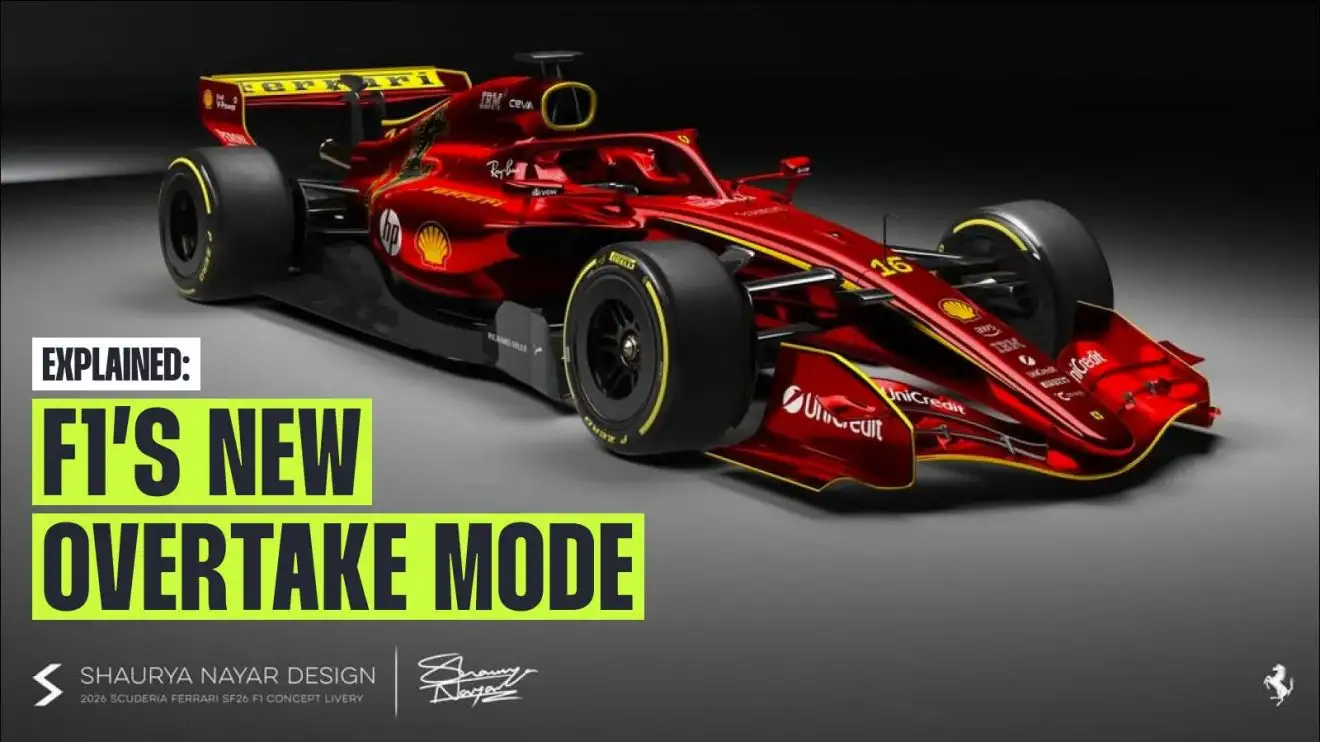
Ferrari SF-26 livery concept by Shaurya Nayar (Instagram: shauryanayar.design)
With the long-established DRS consigned to history, the Formula 1 drivers will have the use of a new ‘overtaking mode’ to assist passing in 2026.
F1’s revolutionary new regulations for 2026 see the removal of the drag reduction system (DRS) but, in its place, the drivers can now call upon an ‘overtake mode’ on their cars. So how does it?
What is F1’s new ‘overtake mode’?
From 2011 until 2025, Formula 1 overtakes were assisted by the DRS. This utilised a simple rear wing mechanism that would raise a flap to reduce straight-line drag for the car on the attack, increasing its top speed.
This system was active for any driver who was within a one-second window of the car in front, measured at a set detection point on the circuit.
It was a simple solution and undoubtedly did make overtaking more straightforward as drivers no longer had to be quite as imaginative about how to get past a slower car, thanks to the straight-line advantage it offered.
However, with the new regulations for 2026, F1 embraces a new era of active aerodynamics that will see all the cars utilise low-drag configurations while powering down the straights.
But that doesn’t mean a weapon for attacking the car in front is no longer available, but the system that has been created does work quite differently.
Rather than relying on aerodynamics, the new overtaking assist will utilise the configuration of the power unit and, put simply, grants the attacking car more engine power than the car attempting to defend.
How will F1’s ‘overtake mode’ work?
While DRS usage had many years of data to fall back on in order to help the FIA plan out the locations for detection points and the appropriate length of the DRS zones, there is no such data available to help with the planning for the detection and activation zones for overtake mode.
The plan for 2026 is to utilise the maximum electrical DC power of the energy recovery system to provide for this energy boost, with the ERS-K providing a maximum power output of 350kW.
Article C.5.2.8 of the Technical Regulations outlines how this power output can be utilised, which is a complicated equation fundamentally dependent upon the speed of the car.
Let’s ignore overtake mode for the moment to explain how this works.
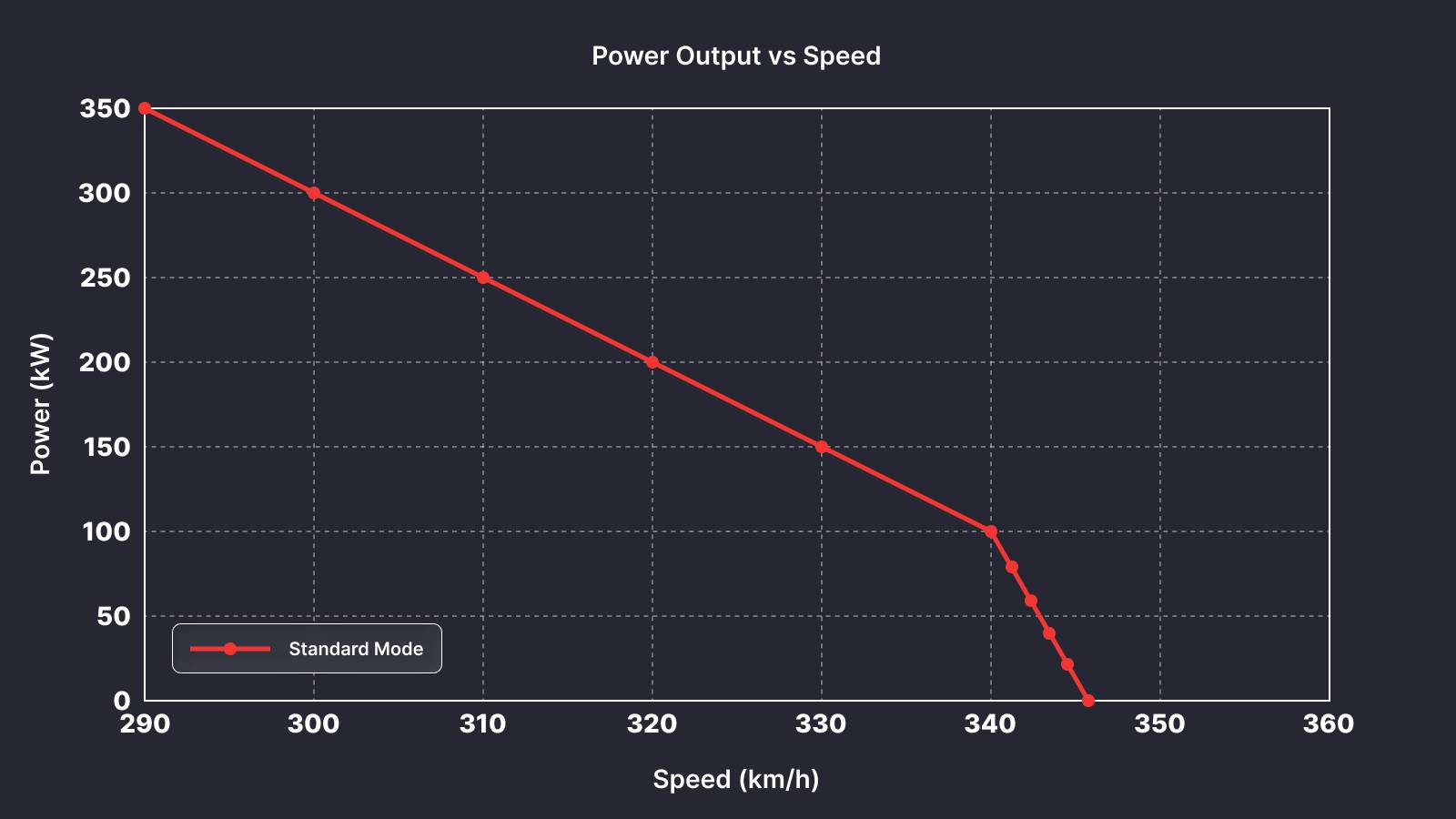
Carefully calculated and outlined in the regulations, a car going below the speed of 340kph can utilise the ERS-K to a maximum power output, in kilowatts, of 1800 minus the sum of 5 times the car’s speed.
Using simple maths, this translates to the cars all hitting 290kph before the energy deployed by the ERS starts to taper off on a glidepath.
Extrapolating along this glide path, a car travelling at 338kph hits a figure of 1690, meaning it can use 110kW from its ERS-K. At 339kph, this tapers down to 105kW.
At 340kph, the figures change for the power output formula, with the power output from the ERS-K restricted on the formula of 6900 minus 20 times the car’s speed.
Subtracting the resulting figure of 6800 from 6900, this grants the driver 100kW. At 341kph, this shrinks to 80kW, at 342kph down to 60kW… and so on and so forth until 345kph, when the ERS-K power output must hit zero kW.
However, for cars granted the use of overtake mode, these figures are different.
Overtake mode uses a different formula for power output, which states the ERS-K can put out 7100 minus 20 times the car’s speed, all the way up to 355kph.
Going back to the initial figure for the car travelling at 338kph, using 110kW of output, the pursuing car in overtake mode can use 340kW – almost the full potential of the ERS-K.
This power output tapers away as the car goes faster, with overtake mode topping out at 355kph, where the attacking car’s ERS-K finally hits zero kW.
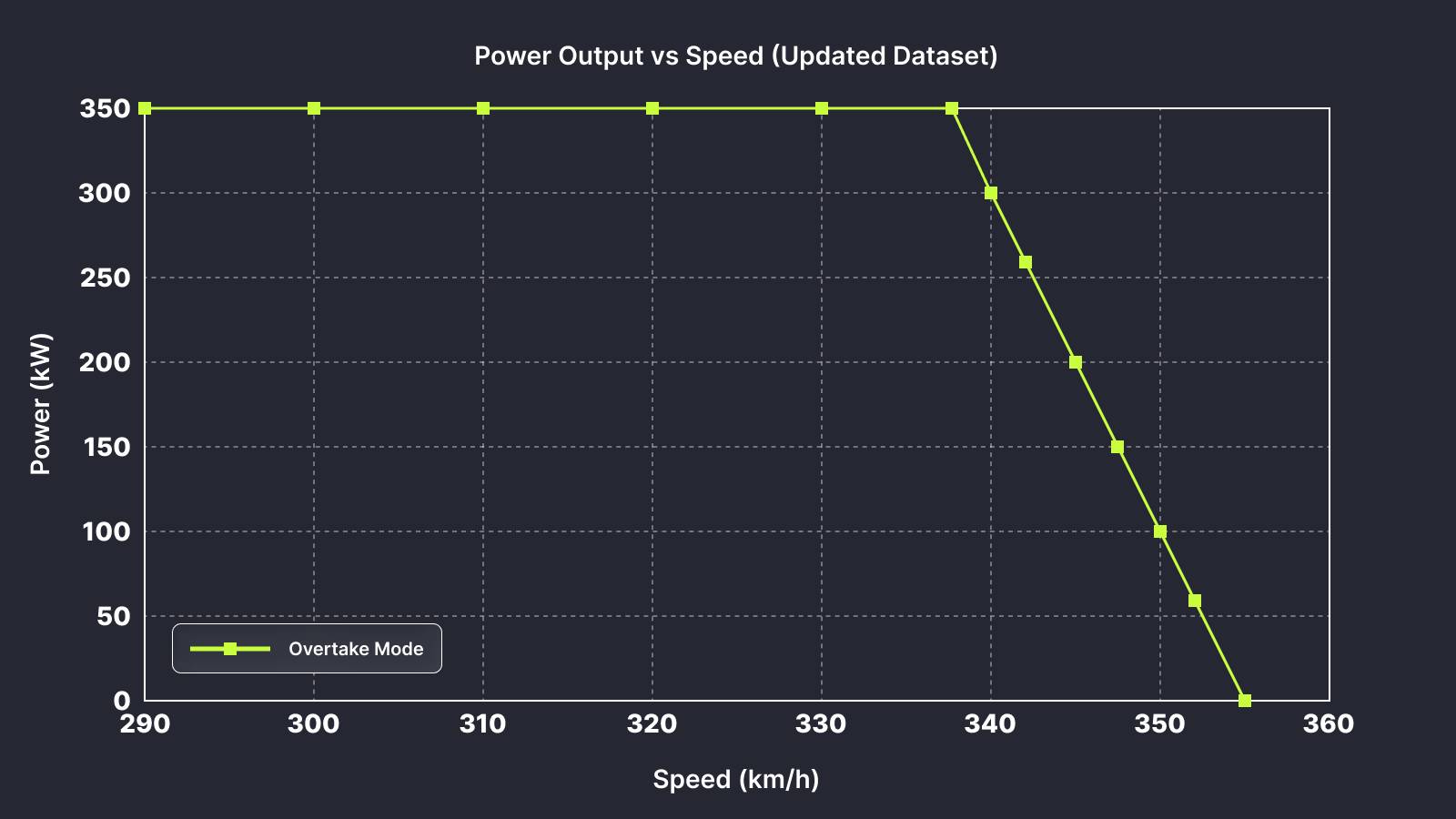
The following graphic displays how the attacking car can use its additional power for longer than the car in front, with its power output only starting to taper off at 337kph – far past the 290kph speed at which a car in standard mode has started to taper off.
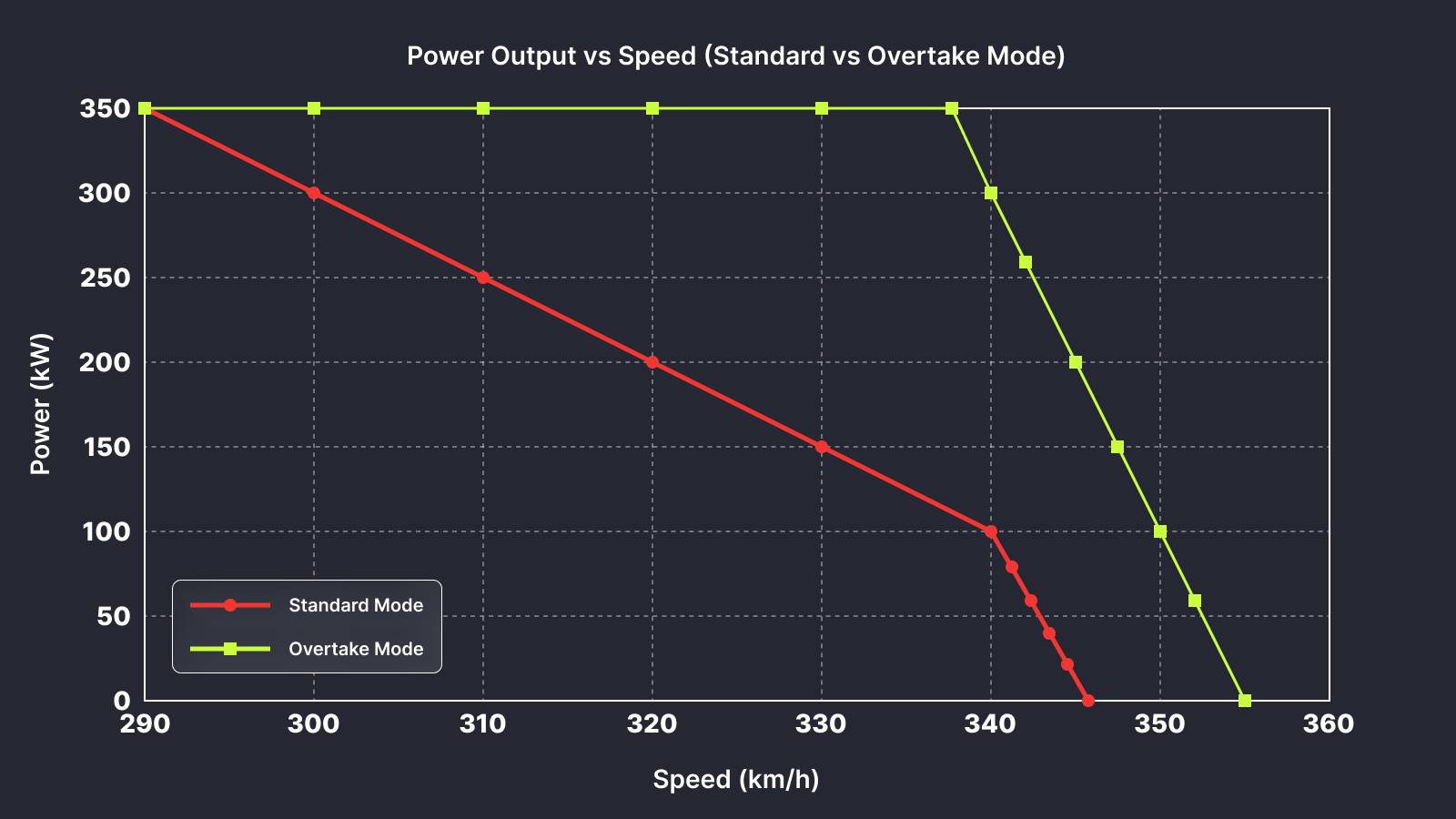
For safety purposes, the FIA has the right to make changes to the maximum power output of the ERS-K in order to ensure the maximum speeds of the cars remain compatible with the design and construction of each circuit, with any altered limits applying to both standard and overtake mode.
These outputs are the maximum permitted, subject to the drivers’ ERS-K harvesting at its full potential. The maximum permitted energy harvested is 8.5MJ per lap, although this can be increased by 0.5MJ for drivers in overtake mode on any given lap.
When can the overtake mode be used?
Information related to the use of overtake mode will be communicated to the teams at least four weeks before any given Grand Prix weekend.
Similar to DRS, the detection point to determine the gap between the cars will be communicated, including the value of the detection gap. This was set at a second during the DRS era, but is not set in stone for the purposes of overtake mode.
The positioning of the detection line for this, as well as the activation line for the use of overtake mode, will also be communicated to the teams at the same time.
Many of the same operational considerations that applied to DRS also apply to the use of overtake mode:
- Overtake mode won’t be in effect on the first lap of a Grand Prix, only being enabled for use once the leader has passed the detection point for the first time.
- After a Safety Car intervention, the system will be enabled after all cars have passed the detection point for the first time.
- The overtake mode can be disabled at the Race Director’s discretion, such as in conditions of poor visibility or low grip.
- As the system will be enabled for use throughout practice and qualifying, as DRS was. If the system is disabled at any point during a period of qualifying, it will remain out of use until the conclusion of that segment of the session.
- While drivers may only use the mode when the automated systems notify them that it is now enabled, a system failure that prevents them from being notified of its enabling or of their permission to use it while within the detection gap means the competitor affected must ask the Race Director for permission to operate the system manually. The onus will then be on the team to monitor its correct usage.
Read Next: Explained: F1’s complex power unit upgrade system