

F1 compression ratio controversy explained ahead of key FIA vote
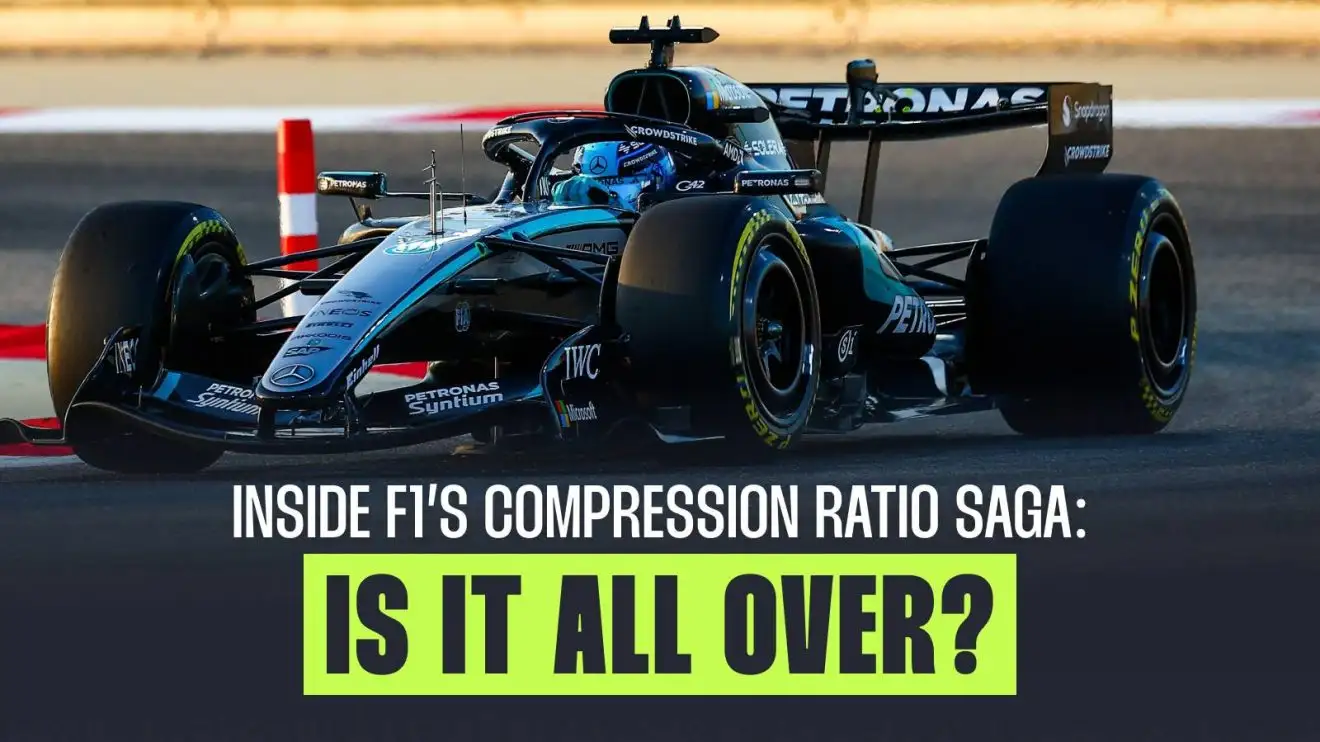
With a major advancement in the F1 compression ratio saga coming on Wednesday, how close is a conclusion to the entire scenario?
After weeks of speculation, the next step in the ongoing power unit compression ratio saga has been decided.
On Wednesday, the FIA confirmed details of a new compression ratio measurement technique that has been put before the power unit manufacturers for a critical e-vote that could have implications on the competitive order later this season.
What is the F1 compression ratio argument all about?
Want more PlanetF1.com coverage? Add us as a preferred source on Google to your favourites list for news you can trust.
The entire argument around which the situation has developed over the winter centres on the wording of one seemingly innocuous rule as defined in the technical regulations.
Article C.5.4.3 states that, “No cylinder of the engine may have a geometric compression ratio higher than 16.0,” with this regulation having been defined in the very first iteration of the 2026 regulations, first published in 2022.
This geometric compression ratio is a reduction from the 18.0 figure that was used in the previous regulation cycle, and the 16.0 figure has remained the same 14 different iterations of the 2026 technical regulations that have been fleshed out and tweaked over the intervening years.
However, in October 2025, an addendum to this exact regulation was made, outlining that the measurement procedure for the geometric compression ratio would be carried out at ambient temperature, ie. when the car has been parked up and the power unit has cooled down to the natural temperature of the external environment.
This seemingly innocuous change in the wording of the regulation has opened up a grey area – the first line states the maximum compression ratio, and the second line states how it is measured.
But what happens if the interpretation of this is that, as long as the compression ratio passes the measurement test at ambient temperature, it’s possible to run the power unit at a higher compression ratio the rest of the time, ie. while out on circuit?
Depending on who you talk to, the benefits of this ability vary from practically negligible, to as much as 20-30 horsepower. Per lap, it could be worth a few tenths, or it could be worth nothing at all.
But, presumably, if a power unit manufacturer has deemed it worth their while to dance this fine line, there is a net gain to be found, however marginal that may be.
Since the beginning of the entire saga, the suggestion has been that it is the Mercedes High-Performance Powertrains [HPP] units that have figured out how to make this engineering challenge work, although early reports also pointed to the new Red Bull Powertrains [RBPT] units.
This probably wouldn’t be surprising, given that RBPT has grown by way of snaffling up a significant number of personnel from HPP during its formative years since 2022 – indeed, RBPT’s technical director is one Ben Hodgkinson, formerly a senior engineer at HPP. The ethos of stress-testing every regulation and examining the possibilities of such grey areas could be one that’s shared across the two companies.
The suggestion has been that the alleged ‘knowledge’ of what Mercedes has done with its power units was leaked by RBPT, perhaps due to an inability to make the same engineering grey area work to the same extent as HPP.
Certainly, from an early stance of three power unit manufacturers [PUMs], who have never been linked with having the same idea, facing off against the two, that has now changed to an apparent four-on-one showdown.
The matter has come to a head in the final weeks before the engine homologation date of March 1, the date upon which the five PUMs are required to submit their designs to the FIA for sign-off and lockdown for the F1 2026 season.
With (now) four of the PUMs believing Mercedes’ exploitation of this grey area is in breach of the regulation, the argument has come down to which side is correct: has Mercedes merely identified an opportunity and exploited it, exposing the other PUMs as having missed a trick, or is Mercedes in breach of a regulation that, through 14 different iterations until October 2025, was much more straightforward in its wording?
“Obviously, when you design an engine, you’re keeping the FIA very close to the decisions you make,” Mercedes’ team boss Toto Wolff said on the matter last week.
“That’s what we did, and we have had all the assurances that what we did was according to the rule.”
It’s difficult to argue that a full breach of the technical regulations is being carried out, given the ambiguous wording introduced by the October 2025 update, but this is why the matter has escalated through a series of meetings held by the Power Unit Advisory Committee [PUAC].
The PUAC is the body of governance that shapes the regulations for power unit matters, and consists of the five PUMs, the FIA, and FOM – the individual teams do not play a role in this regard.
During these meetings, PlanetF1.com understands that the four non-Mercedes PUMs proposed a new compression ratio measurement methodology, to occur at operating temperatures, as the quartet has sought to establish clarity on whether what Mercedes has done is legal, or whether it can convince the FIA and FOM that a change in the regulation is needed.
To succeed in making a regulation change, a super-majority must be formed at the PUAC, through a voting process. This would mean that the four non-Mercedes PUMs must convince the FIA and FOM to vote in the same direction as them, with Mercedes powerless to prevent a change should it find itself the isolated party amongst the seven.
What is the proposed solution put to the manufacturers?
On Wednesday in Bahrain, the FIA confirmed that the vote will be held, virtually by e-vote, by the members of the PUAC.
Sources have indicated to PlanetF1.com that this next step was decided upon almost two weeks ago, with discussions continuing in the days since before an informal meeting of the four PUMs, a table at which Mercedes was not included, was held on Wednesday morning in Bahrain.
This would tie in with comments from Wolff, who said that he had been given the impression that “things wouldn’t change”, but that this position could have been revised on the Friday previous, February 6th.
“The FIA has recently launched an e-vote primarily centred on a proposed change to the assessment of the power unit compression ratio in running condition,” read a statement from the FIA issued to PlanetF1.com.
“Over recent weeks and months, the FIA and the Power Unit Manufacturers have collaboratively developed a methodology to quantify how the compression ratio changes from ambient to operating conditions.
“Following validation of this approach, a proposal has been submitted whereby, from 1 August 2026, compliance with the compression ratio limit must be demonstrated not only at ambient conditions, but also at a representative operating temperature of 130°C.
“The vote has been submitted to the Power Unit Manufacturers, and its outcome is expected within the next 10 days and will be communicated in due course.
“As with all Formula 1 regulatory changes, any amendment remains subject to final approval by the FIA World Motor Sport Council [WMSC].”
Put simply, the five PUMs, the FIA, and FOM must vote on whether or not to introduce this new measurement test and formalise it in the regulations via the WMSC.
When will these steps be made?
The e-vote process has opened, with a 10 day window that expires on February 28th – just one day before the engine homologation cut-off date.
The seven parties of the PUAC have been given this time period in order to read through the documentation presented pertaining to the test procedure, with the question then asked of whether or not to introduce it.
Should the supermajority be reached and the motion passed, the updated test methodology will be written into the regulations, upon ratification by the WMSC, and come into effect from August 1.
However, it’s worth remembering that, while the regulation in its current form will remain in effect until that date, the homologation date looms large on March 1.
With set windows of opportunity for PUMs to make changes to their designs, even for those awarded additional opportunities through the ADUO safety net, the implication of the e-vote proposal is that all the PUMs will effectively have to submit their designs on the assumption that the supermajority will be achieved.
This would suggest that, even though it appears like a mid-season change that offers an affected PUM the chance to capitalise upon any potential competitive advantage, not starting the season in compliance with the proposed regulation change is a big risk to take given the apparent inability to make changes to the PU later in the year.
Mid-season changes are nothing unusual: in 2025, technical directives – effectively regulation changes – were used to introduce flexi-wing measurement protocols, with TD055A introduced at the Chinese Grand Prix to tighten up the levels of flexibility on the rear wing, and TD018 brought in at the Spanish Grand Prix to clamp down on front wing flexibility.
If a supermajority is not reached, the updated regulation will not be passed and nothing changes – although this does not mean that protests against Mercedes-powered cars can be fully ruled out if any competitors continue to feel aggrieved by the situation in Australia.
The season will start with the power units in their current configuration and can be used right up until August 1, as the updated test methodology will not be introduced until after the Hungarian Grand Prix.
Of course, it’s worth remembering that the entire situation is an assumption – while it certainly appears as though Mercedes may be exploiting a grey area in the regulations that it could benefit from the first half of the season, it is by no means an actual fact.
Sources have suggested to PlanetF1.com that the Mercedes power unit has already been tested at hotter temperatures by a fact-finding FIA expedition to Brixworth, with the unit said to have passed this.
More on F1 engines in 2026
Explained: F1’s complex power unit upgrade system
Explained: How F1’s new ‘overtaking mode’ will work in 2026
What questions does this proposed change raise?
The official stance from Wolff is that Mercedes HPP is convinced of its engines’ legality and compliance with the regulations, with only his admission that there has been constant communication with the FIA even hinting at the possibility that it may have had a different interpretation to the other four PUMs.
It’s therefore entirely possible that all five of the PUMs already fully comply with the regulations as proposed for later in the season, which would mean that this entire situation has been little more than a storm in a teacup.
But the key point, as mentioned by Red Bull’s Laurent Mekies on Wednesday, is that all parties will have full clarity on the exact intent and scope of the regulation as it stands.
The grey area introduced by the October 2025 regulation update can thus be clarified and tightened up.
But the obvious questions raised by this whole furore is one that has been raised by Steve Nielsen and James Vowles in recent days.
Both are heads of teams powered by Mercedes engines, which is worth remembering, but Vowles pointed out how F1 should seek to ensure it remains a meritocracy and that “the best solutions” don’t get punished, while Nielsen questioned whether it’s wise to set a precedent in which competitors can, effectively, attempt to form a cartel to lobby for changes in regulations that have offered others an opportunity to benefit.
There can be little doubt that, assuming all the speculation about Mercedes is actually correct, the Brixworth-based manufacturer spotted an opportunity in the regulations and exploited it – exactly what a competitor in F1 is supposed to do.
Such opportunities, such as the infamous Brabham BT46 fan car of 1978, the double-diffuser on the Brawn GP car in 2009, the ‘fiddle brake’ on the McLaren in early 1998, or Mercedes’ own DAS system in 2020, gave their creators the chance to capitalise upon their ingenuity, however briefly, and Mercedes appears to have done exactly that once again.
Want to be the first to know exclusive information from the F1 paddock? Join our broadcast channel on WhatsApp to get the scoop on the latest developments from our team of accredited journalists.
You can also subscribe to the PlanetF1 YouTube channel for exclusive features, hear from our paddock journalists with stories from the heart of Formula 1 and much more!
Read Next: Aston Martin ‘solution in place’ as Fernando Alonso lifts lid on ‘difficult start’


