

FIA data highlights frequency of ‘controversial’ F1 penalties
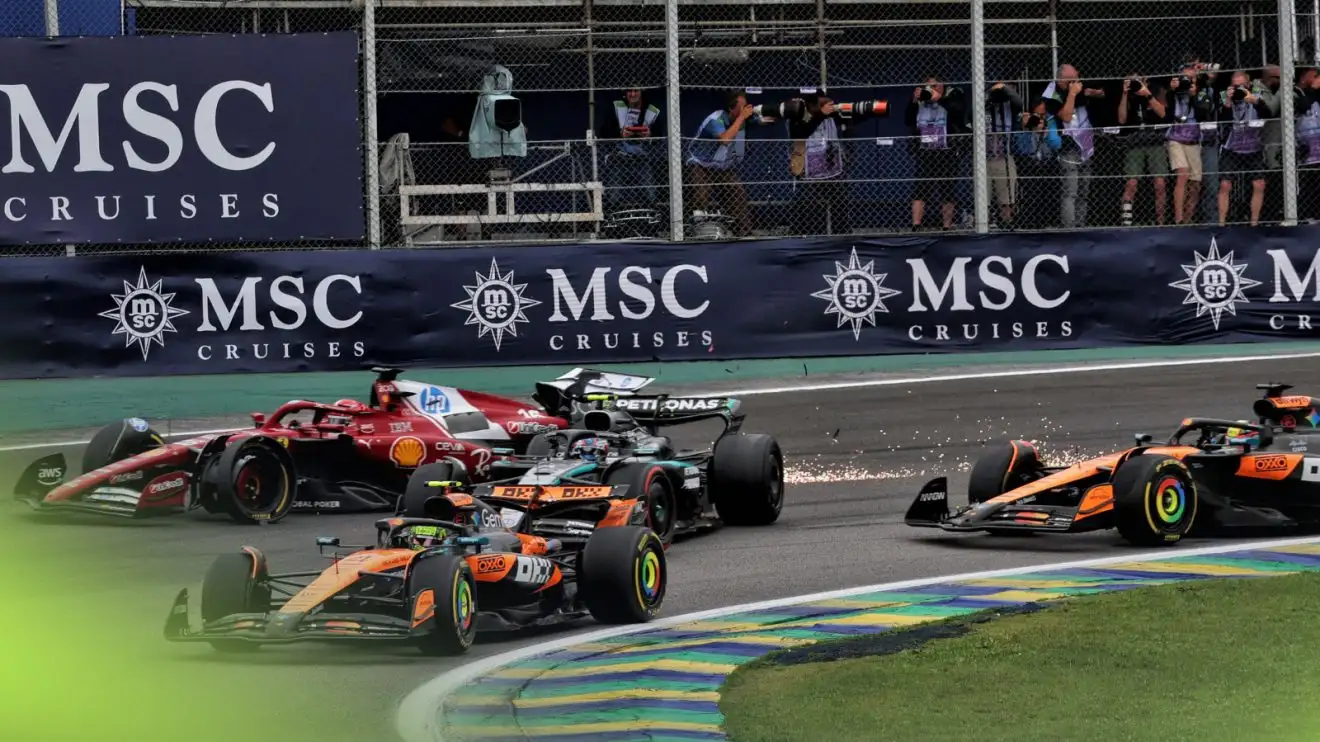
Oscar Piastri was penalised for his clash with Kimi Antonelli in Brazil.
The FIA has revealed data regarding the number of stewarding decisions made in 2025, and how many have been deemed ‘controversial’.
In Qatar, the FIA met with drivers to discuss the Driving Standards Guidelines with a view to better understand both sides of the discussion.
Data shows less than one per cent of F1 incidents are ‘controversial’
Among the drivers, there were concerns that the interpretation and application of the Driver Standards Guidelines was leading to penalties that would not otherwise be applied.
While reported in some corners as being unproductive, sources have insisted to PlanetF1.com that the discussion was quite the opposite.
Indeed, the outcome of the meeting was such that there is now an intent to increase the frequency of them from F1 2026 – likely with the end of season discussion in Qatar complemented by another mid-season.
During the Qatar meeting, chairman of the stewards, Garry Connelly, presented a number of key figures to the drivers.
That was headlined by 509 incidents and cases that were referred to the stewards up to the conclusion of the Las Vegas Grand Prix.
Of those, 405 were placed under investigation, resulting in 410 written decisions (which includes two petitions for review, and three protests).
Just over a quarter of the incidents investigated resulted in penalties, with a total of 153 dished out.
However, the key figure is the number of ‘controversial’ decisions which drivers wished to discuss and review.
There were just five such instances, representing less than one per cent of incidents and cases referred to the stewards in F1 2025.
F1 2025 Penalties by type
- Number of pit lane speeding fines: 12
- Number of other fines: 11
- Number of Formal Warnings to drivers and/or competitors: 31
- Number of Reprimands to drivers and/or competitors: 19
- Number of 5 second penalties: 25 (6 for causing a collision)
- Number of 10 second penalties: 22 (11 for causing a collision)
- Number of Drive Through penalties: 2
- Number of Stop and Go penalties: 0
- Number of drops in grid positions or pit lane starts: 22
- Number of disqualifications: 9
The Driving Standards Guidelines have been described as a ‘living’ document, which is subject to period change and amendment.
It was created in conjunction with the drivers with a view to clarifying the rules of engagement on track.
The document sits alongside the FIA International Sporting Code and F1’s Sporting Regulations, and is designed to guide stewards when it comes to making decisions.
Included within it are details on how far cars should be alongside one another to be entitled to racing room, and how to regard relative positioning and car placement in an array of given scenarios.
However, given it is impossible to cover off the nuance of every possible incident, there is room for interpretation.
The concern was that the guidelines were being instead treated as regulations in their own right, leading to unexpected and undesired consequences.
Following the Qatar meeting, it was clarified that the guidelines are just that; designed to help inform the stewards when incidents occur but holding no regulatory value in themselves.
In addition to details surrounding the number of incidents that have been passed to the stewards in 2025, the FIA also moved to explain the stewarding process and how the panel is comprised.
How the Stewards panel is comprised
The FIA Formula 1 Stewards comprise, for 2026, 4 experienced Chairs, 3 former Formula 1 Drivers and 5 Number 2 FIA Stewards. At each event there is one Chair, one Number 2 FIA Steward and one Driver Steward. All FIA F1 Stewards must hold an FIA Super Licence, are required to attend annually the FIA International Stewards Training Programme and pass a rigorous assessment at its conclusion. They are joined by one ASN [Autorité Sportive Nationale, or National Sporting Authority] Steward per event who must hold an FIA Super License and who also must have attended the annual FIA Stewards Training Program and passed the written assessment.
The permanent panel of FIA F1 Stewards comprises only 12 persons over the entire season, a significant reduction from the numbers 10 years ago.
Decisions are taken by the entire panel based on the applicable regulations independently of the FIA. For driving incidents, great emphasis is placed on the views of the experience Driver Steward present. The Driving Standards Guidelines and the Guidelines for Penalties and Points are also taken into consideration.
There are many processes that have been developed to ensure consistency of decisions including, in also every case, having one of the Stewards from the previous race, present. Where this is not possible, the chair of the previous race is available on line.
How Stewards deal with incidents
Race Control will NOTE the incident. This appears on the Timing Screens. It is also immediately advised to the Stewards who then conduct a preliminary examination of the incident to determine if further investigation is warranted.
If the Stewards believe that the incident does NOT warrant further investigation, a message stating “No Further Investigation Required” is posted on the Timing Screen.
On the other hand, if the Stewards believe that the incident requires further investigation, a message stating “Under Investigation” will be posted on the Timing Screen and the Stewards will immediately commence a very detailed examination of the incident, using all available tools including broadcast vision, CCTV (which is not available to the public), on board camera vision, individual car telemetry, radio messages between teams and drivers, GPS and other car tracking data and timing including mini-sector timing, plus any reports from track or race control officials.
If the stewards can come to a swift but considered decision, and determine that no breach has occurred, then a message is immediately posted on the Timing Screen stating “No Further Action”. Alternatively, if a breach is determined, then any penalty is posted to the Timing Screen. In both cases, (no further action, or penalty) a full written decision is created listing the breach, the penalty and most importantly the reasons for the decision. In some cases, the matter is considered after the race or the relevant session.
Read next: Oscar Piastri makes feelings clear about McLaren ‘papaya rules’ before F1 2025 finale


