
FIA confirms permanent F1 race stewards in major 2027 change
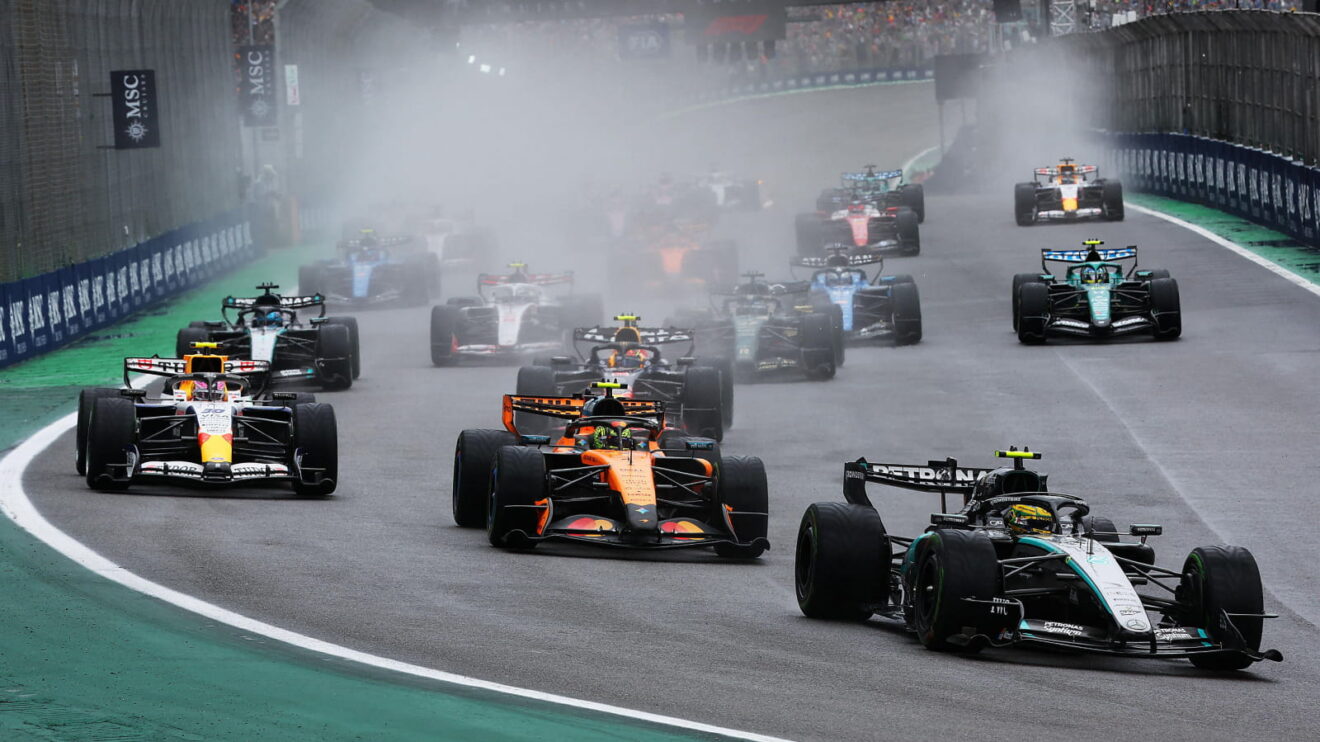
Kimi Antonelli (Mercedes W17) leads at the start of the 2026 Brazilian Grand Prix
After years of debate, the FIA will introduce permanent Formula 1 race stewards from the F1 2027 season.
The FIA announced a phased introduction, aimed at bringing “greater levels of consistency” and dedication to race officiating at the “highest levels.”
FIA to recruit 12-15 full-time stewards as F1 targets greater consistency
The debate over permanent stewards reached fever pitch in late 2024 as Max Verstappen and Lando Norris went wheel-to-wheel for the world title.
Several incidents between the two protagonists were penalised, including two 10-second time penalties in one lap that dealt a blow to Verstappen’s title quest at the Mexico City Grand Prix.
It reignited the debate over whether permanent stewards would lead to more consistent decision-making – consistency being the application of the same principles to the specific details of individual incidents every time, as opposed to the stewards reaching the same decision on every occasion.
Following on from the commencement of full-time operations of the new Remote Operations Centre at Biggin Hill, the FIA has sought to further bolster its stewarding abilities, and, as of next season, the Formula 1 championship will have permanent stewards augmenting the roster of volunteer stewards that oversee a race weekend.
The FIA announced: “FIA to begin recruiting full-time stewards, with a phased introduction during the 2027 Formula 1 season.
“Programme aims to establish a department of 12-15 full-time stewards over the coming years, further professionalising officiating and expanding coverage across FIA Single-Seater Championships.
“The initiative builds on the recent opening of the FIA Remote Operations Centre at Biggin Hill, UK, and forms part of the Federation’s wider investment in the people, expertise and infrastructure through its FIA Officials department.
“The introduction of dedicated full-time stewards to the FIA’s flagship championship will provide continuity and expertise within the stewarding structure, further advancing the FIA’s commitment to fairness through the ongoing review and continuous improvement of sporting regulations and stewarding guidelines.
“It will also allow for deeper implementation of best practice and greater consistency in decision-making.
“Beyond race weekends, it will provide increased capacity to identify emerging trends and areas requiring regulatory clarification, helping to inform the evolution of sporting regulations.”
The goal is to have between 12 and 15 full-time stewards on board, building to that number over the coming years.
Speaking to PlanetF1.com, one of the four chairmen of the F1 stewards, Garry Connelly, explained how permanent stewards will slot into the structure.
“They will be people who will possibly come from the existing pool of FIA stewards, not necessarily Formula 1 stewards,” he said.
“They could be stewards from elsewhere, people who want to work full time for the FIA, and they will not only do stewarding; they’ll do some work in the Remote Operations Centre, the ROC, at Biggin Hill.
“They’ll ultimately also be doing a lot of work in coordination of stewards, like rosters, administration, things like that, and they’ll also be doing training other stewards, particularly training in different categories, and training in different regions of the world.
“They’ll be part of the FIA’s Officials Department, but the stewards will always remain independent.
“In fact, it’s quite possible that, in the first year, we might only have one or two of those people involved in a lot of F1 events. So it could be a phasing-in period depending on who’s recruited because we don’t know who really wants the job, but they will be full-time professional stewards to augment the current pool of part-time professional stewards.
“What I mean by part-time professional stewards, the pool of F1 stewards, for example, was around 30 people 15 to 20 years ago, sometimes even more in a year. So it was like a revolving door.
“People would come in and do one event a year, which led to enormous inconsistencies.
“For 2027, we’ve got a core pool of 11, so four permanent chairs, four number twos, and three driver stewards. So that’s the smallest pool we’ve basically ever had.
“All of those are highly professional. We do an enormous amount of training through the year.
“We also commit to a three-day meeting; it’s in Milan next year in January, and, for F1, we now do a debrief meeting after every F1 race, where the entire pool of F1 stewards is involved. There is also an online training programme that runs the entire season.
“These new full-time permanent stewards, they’ll be involved not only in F1 but F2 and F3 as well. They may ultimately go to things like Formula E, WRC, and maybe WEC, as well.
“You’ll always have a rotating pool, and I think that’s a good thing because, if you go back to the days when there was one permanent chairman, for example, that caused a lot of unrest and ill feeling, with some teams believing that one chairman was either very much against them or very much in favour of another team.
“So the only difference in the way they’ll be doing things is they’ll be full-time versus the current crop of part-time. There’ll be a mix at events of full-time and part-time, at least for the next few years.
“Now, whether ultimately it ever goes to 100 per cent full-time stewards in F1, we’ll have to wait and see whether enough people are wanting to do the role, who are capable of doing the role and who want to be full-time.
“Everyone’s pretty happy with the initiative.”
Connelly pointed out that, in recent years, greater consistency in stewarding has already been accomplished, a feat “not easy to do” amongst volunteer staff.
“I think what we need to do is look at the areas of improvement that we’ve done in recent years to ensure greater consistency in what we do,” he said.
“I think that will just continue and probably work better with some full-time stewards sitting within the FIA able to better coordinate that because previously, until the advent of the Officials’ Department, the stewards were basically a group on their own and, of course, to a certain extent, they should be because we are independent.
“Prior to the establishment of the Officials’ Department, there was really no one who was responsible for coordination and training.
“A lot of the training and coordination, we had to basically arrange amongst ourselves.
“But I think this will help with greater consistency because we’ll have more resources, more ability to add to those things and improve consistency.
“I would hope that AI also ultimately will help us improve consistency. I don’t know if it’s quite at that level yet. We have done a little bit of playing with it, but it’s not really at the stage yet where we could rely on it within the Stewards’ Room. However, for sure, it’s coming!”
More on the FIA and F1’s governance
FIA explained: What does it stand for and how does it govern F1?
Explained: How the FIA develops potential new F1 rules and regulations
FIA president Mohammed Ben Sulayem welcomed the decision to appoint permanent stewards to the roster.
“This latest major investment in FIA officiating reflects our dedication to delivering the highest standards of decision-making, fairness and integrity in motorsport,” he said.
“The recruitment of full-time stewards is a significant step in our longstanding mission of building a dedicated officiating ecosystem in the FIA Formula One World Championship; it is also an investment in the future of our sport.
“Following the milestone opening of the new FIA Remote Operations Centre and strengthening of officiating development through initiatives such as the FIA High Performance Programme, this development will help to build greater expertise and continuity within our stewarding structure, strengthening our ability to review and improve regulations, support the development of future officials and ensure the highest standards of consistent officiating across all our championships.”
Read next: Why Liam Lawson is ‘grateful’ Helmut Marko isn’t ‘calling the shots’ at Red Bull