
F1 takes unprecedented action ahead of Qatar Grand Prix
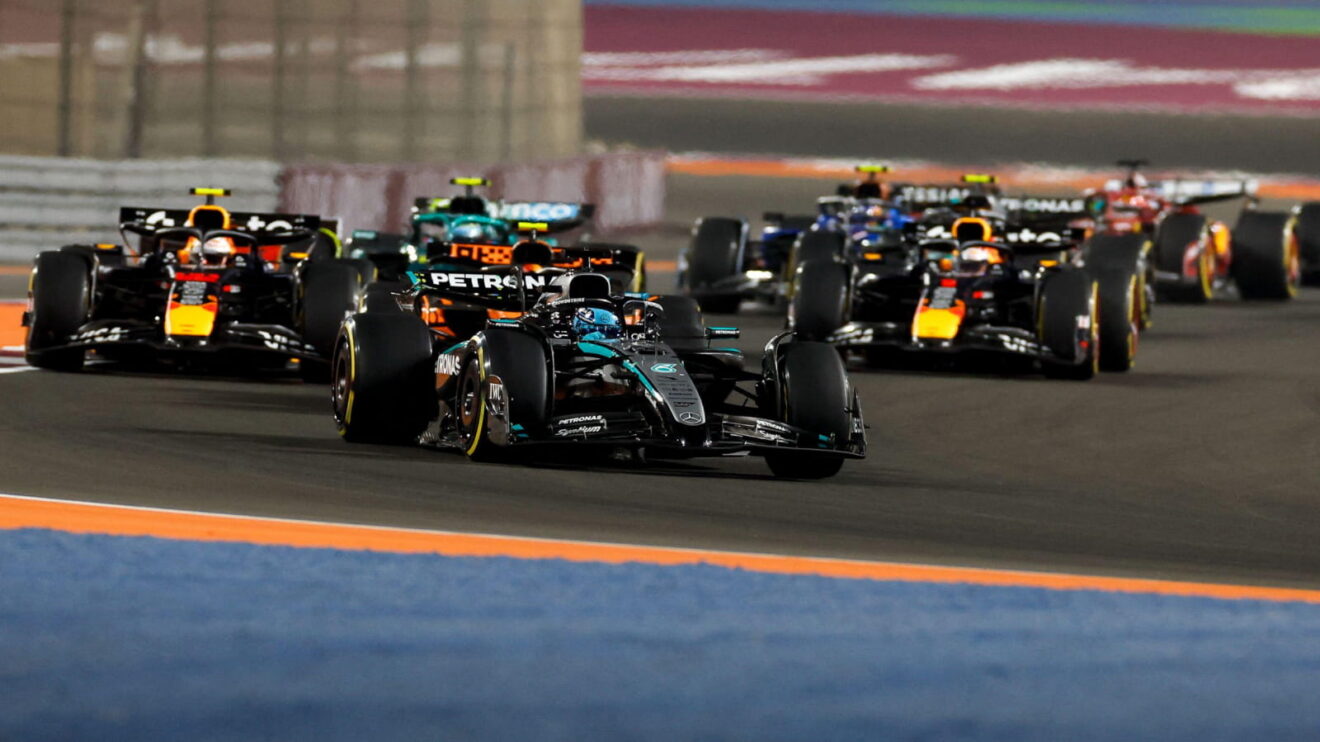
George Russell (Mercedes W16) leads a queue of cars at the start of the Qatar Grand Prix sprint race in 2025
The F1 2026 cars will be forced to run minimum front-tyre pressures of 29psi at this weekend’s Qatar Grand Prix, the FIA has confirmed.
The move sets a new record for the highest minimum front-tyre pressures at the start of an F1 race weekend.
FIA confirms 29psi minimum front-tyre pressures at Qatar Grand Prix
The Lusail circuit in Qatar will host the penultimate race of the F1 2026 season this weekend.
The high-energy circuit has proven demanding since it arrived on the calendar in 2021, when the race was marred by a series of late tyre failures.
The FIA has taken a series of measures in the years since to guard against tyre problems, imposing a maximum tyre life of 18 laps per set in 2023 after issues were found with the circuit’s pyramid kerbs.
A mandatory stint length of 25 laps was introduced for the Qatar Grand Prix in 2025, effectively forcing drivers to make two pit stops each.
It was confirmed last week that a similar measure will be in place for 2026, with the mandatory stint length increased to 27 laps.
The hardest tyres in the Pirelli range – the C1, C2 and C3 compounds – will be used in Qatar this weekend to cope with the high lateral loads of the Lusail circuit.
In a further move, the FIA’s competition notes – distributed to teams by race director Rui Marques on Thursday – confirmed that the minimum front tyre pressures will be set at 29psi in Qatar.
It marks a new record for the highest minimum front-tyre pressures at the start of a Formula 1 race weekend.
The previous benchmark for minimum front-tyre pressures in the F1 2026 season was 28psi, which was in place in Japan (Suzuka), Britain (Silverstone) and Belgium (Spa).
Pirelli increased the minimum front-tyre pressures to 29psi in Qatar in 2025 after cuts were found in the tyres following Friday’s running. A minimum pressure of 28psi had been set at the start of the weekend.
It remains to be seen whether the tyre pressures will be raised further still as the weekend unfolds.
Meanwhile, the minimum rear tyre pressures in Qatar will be 27.5psi, slightly down on the 28psi in place at Spa and Las Vegas.
The starting pressures for the rear tyres in Qatar are 4psi higher than in 2025, the last year under the previous ground-effect rules.
Preview: Qatar Grand Prix 2026
Qatar GP predictions: Ferrari fireworks, awkward Russell and Verstappen, 400 overtakes
FIA makes key decision ahead of Qatar Grand Prix
In its Qatar Grand Prix preview, Pirelli explained that the lower levels of aerodynamic load produced by the F1 2026 cars have resulted in the increased mandatory stint length of 27 laps.
The tyre manufacturer also noted that the absence of the sprint format, which limits practice running to a single hour on Friday, will help teams adapt to the unique challenge of Qatar.
Pirelli said: “The track layout remains unchanged from last year and continues to provide a particularly severe test for the tyres, especially in terms of lateral loads and operating temperatures.
“For this race, Pirelli has selected the three hardest compounds in its range: the C1 as Hard, the C2 as Medium, and the C3 as Soft.
“The choice is dictated by the characteristics of the Qatari circuit, which generates a particularly high level of wear, especially on the front-left tyre.
“The circuit features 16 corners and its high level of severity stems from the succession of high-speed turns, which subject the tyres to continuous stress for much of the lap.
“The relatively smooth track surface and the high track temperatures can encourage graining on all compounds, a phenomenon that further increases wear.
“Despite operating in very demanding conditions, the tyres deliver consistent performance throughout the stint. Experience from previous years has shown that performance degradation remains relatively limited even when wear levels are high.
“To prevent tyres from being used beyond their intended life, managing degradation while placing excessive fatigue on the structure, Pirelli has introduced, in agreement with the FIA, a maximum stint length of 27 laps for each set.
“As a result, the race will inevitably be a minimum two-stop event for all drivers.
“The maximum lap limit has been increased compared to last year because the 2026 tyres feature a further reinforced construction and the cars generate lower levels of aerodynamic load than their 2025 predecessors.
“The introduction of this restriction, as an alternative to other measures such as increasing minimum starting pressures, will allow drivers to push harder during their stints, reducing the need for pace management.
“The absence of the Sprint format, which was in place last year, will also make life easier for the teams, both in managing the remaining mileage available on each tyre set and in fine-tuning their cars during free practice.”