

Formula 2 eyes permanent North America expansion after Miami debut success


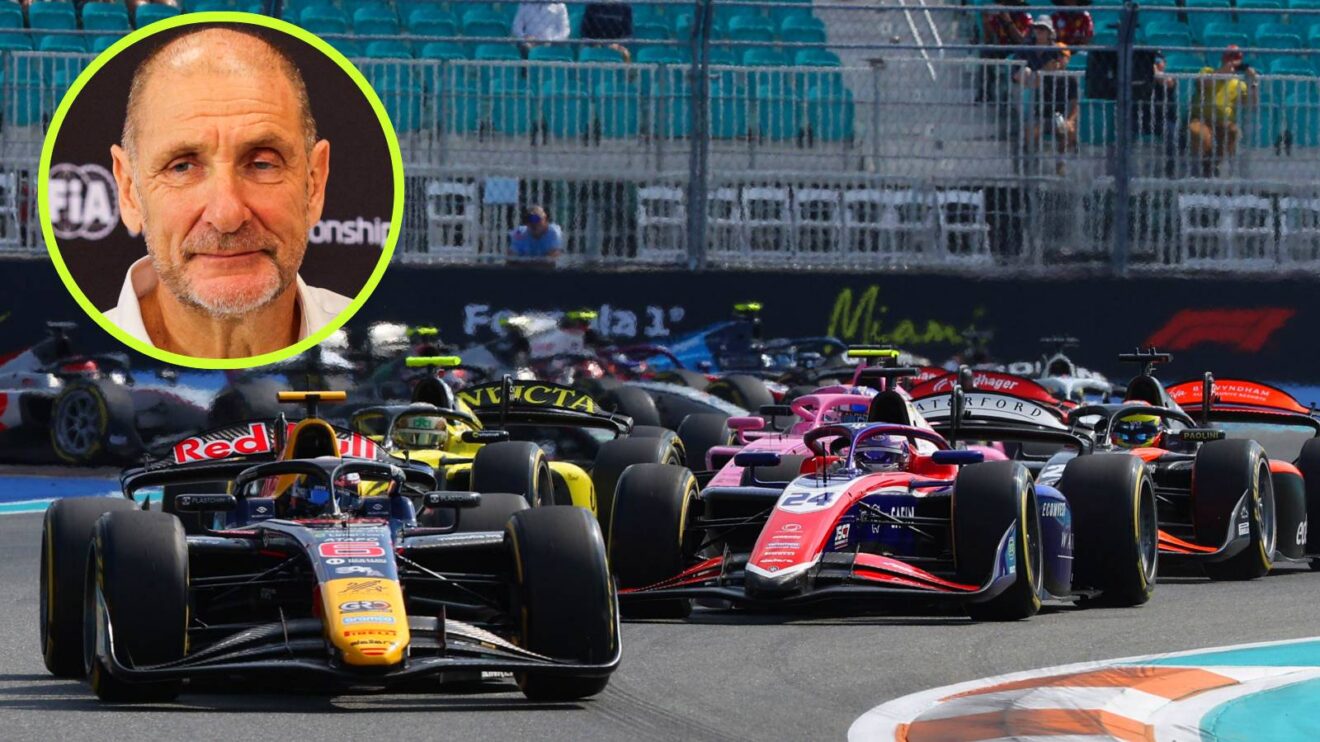
Will Formula 2 be back in America again soon after its maiden race on the continent?
With Formula 2 now intrinsically linked with the F1 ecosystem, will its first visit to North America see it become a regular visitor after a successful weekend in Miami?
The junior category raced in North America for the first time last weekend, having organised races in Miami and Montreal as a contingency following the cancellation of the two scheduled Middle Eastern races.
Bruno Michel discusses Formula 2’s future in North America
Want more PlanetF1.com coverage? Add us as a preferred source on Google to your favourites list for news you can trust.
With the Bahrain and Saudi Arabian Grand Prix weekends cancelled in April due to geopolitical tensions, Formula 2 faced a disconcertingly long gap in its own calendar.
Having raced as part of the F1 support programme at the season opener in Australia, the cancellations meant that the junior category would have had a three-month absence before returning at the Monaco Grand Prix – an extremely long period of inactivity that would have meant rustiness for the drivers and teams setting in, potentially losing the interest of fans, and a too-short calendar, particularly if further disruption happens later in the year with more Middle Eastern races planned at season end.
But Formula 2 was added to the schedule for the Miami and Canadian Grand Prix weekends, the very first time that the FIA-organised category has flown over the Atlantic to race in North America; usually, F2 only races in Europe, the Middle East, and Australia.
Even F2’s predecessor, GP2, never raced in America.
That all changed when the lights went out for the Sprint race in Miami last Saturday, a race won by Nikola Tsolov for Campos, while the feature race on Sunday was won by MP Motorsport’s Gabriele Mini.
For 2025, the inclusion of Miami and Montreal on the F2 calendar is merely a one-off idiosyncrasy brought on by external factors, but could a trip across from Europe on an annual basis become more viable?
“We’re discussing,” F2 CEO Bruno Michel told select media, including PlanetF1.com, during the Miami GP weekend.
“Let’s say, with Montreal, we are really discussing. Miami is a bit more complicated, for one simple reason: Miami already has support races, and they’re good; they have the Porsche and McLaren trophies, and that’s why it was not easy.
“Honestly, in terms of logistics, it’s quite complicated, but yes, there is a possibility.
“We haven’t started discussions for the future yet, because the situation was really to make it happen now, and that’s what is happening.
“I would love to come back. We’d love to have F2 in America anyway. I’m sure there will be other opportunities, because F1 is racing also in Austin and Las Vegas.
“So there are a lot of possibilities. But for sure, it’s important for F2. We had never been in North America before.
“It’s very important for F2 to be there. It’s very important for F2 to be seen. It’s very important for American drivers to be willing to come to F2 like Carlton or Sebastian are doing, and to try to reach F1 after that. So yes, I think for the whole F1 group, not only for F2, it’s important to have F2 coming and race in North America, definitely.”
Michel’s pointing out of Formula 1’s racing in Austin and Las Vegas was notable: F2 has become so intrinsically linked with F1 at a logistical and organisational level that hosting a standalone event, as GP2 was once capable of, simply can’t happen.
If F2 is to race in America again, it will thus have to be on the same weekends as Formula 1’s arrival in town, meaning latching on to the existing races in Miami, Austin, and Las Vegas.
“We can’t do standalone anymore,” Michel said, ruling out the hypothetical that F2 could have run its own race event at some point during the long gap between Australia and Monaco, if the American contingency hadn’t been possible.
“That was something that could have been considered, and we’ve done in the past with GP2, not with Formula 2.
“We’ve done some standalone races in the past. Now we’re so much intricated into the systems of Formula 1, with the FIA, with the marshalling system, the DRS, the Race Control system there.
“It would be almost impossible for us, or we would not be racing the same way. I’m not sure we would have a DRS if we’re not racing with Formula 1! It’s as simple as that.
“So the answer is no, we can’t go without Formula 1 now, which is good, because it’s also something that we want, and it’s also something that the Formula 1 group really wants.
“I was in a meeting with Stefano [Domenicali, F1 CEO] just earlier, and we’re talking about next year, and where we’re going to go, because, for Formula 1 as well, we’re bringing a great show when you have F2 and F3 coming to a race weekend.
“Formula 1 likes us to be there. There are more and more circuits that would like us to come. But the limit is the cost of the season. At the moment, we’re doing 14 events with F2, 10 with F3, two races per event. I don’t want to go much above that, because otherwise our costs are going to be completely crazy.”
More on Formula 2 in 2026
McLaren hidden gem driver tipped for long-awaited F1 chance
Invicta Racing’s impromptu home race: Formula 2 heads for Miami and Montreal
How did Formula 2 end up in America?
With the venture across to Miami and Montreal being pulled together in reasonably short order following the cancellation of Bahrain and Saudi Arabia, Michel said the idea to visit North America had come about following conversations as far back as the Australian weekend, and was sparked by an unrelated conversation with the Montreal promoter.
“We didn’t know yet if Bahrain and Jeddah were going to happen or not, or impossible or whatever, so we started to look at different plans,” he said.
“The interesting thing is that I had been talking to Montreal a bit earlier, but about the future, not about ’26, and Montreal had asked me, ‘Would you come for ’26?’ and I said, ‘No, guys, my calendar is already finished. We’re not going to change it’.
“So I thought maybe there’s a possibility. And since we were trying to optimise all the costs of coming to North America, it made complete sense to discuss with Miami as well, to be able to have all the freight going to America, and then going from Miami to Montreal by truck.
“So it was something that was quite a simple thing to think about. But after that, to organise, a more complicated thing to put together, because Miami already had support races, so it was not completely obvious for them.
“Montreal, also, was a question of organisation. Miami then immediately said, ‘Yeah, we’re interested’, but we had no paddock, so we had to create one from zero quite far away!
“It’s been really difficult to put together, but they’ve been incredibly helpful because they wanted to have us, and we’ve worked together a lot for the last month and a half.
“The same thing for Montreal; it took a while before we could announce it, because I wanted to be sure that, before we make a proper announcement, we were completely clear with the organisation.
“Then we had to go through the World Council of the FIA [WMSC], because it was a change of the calendar, so it’s always a process that is not so easy to put together, but, in the end, we’re here. It’s great, and we go to Montreal, and it’s great as well. But it’s been more complicated to do than just saying, ‘Okay, we’re going to North America!'”
Given F1’s push to break the American market in recent years, following its purchase by US media conglomerate Liberty Media nine years ago, it might seem surprising that F2 has never raced in North America before, given that it falls under the umbrella of the F1 ecosystem (even if the championship itself is not owned by Liberty Media).
“[It has been] logistics and money!” Michel laughed when asked why it’s never happened before.
“We had to be against the wall to do it, but it was in the plans anyway; let’s say that we anticipated it slightly.
“Being in America is going to do that, definitely. You just need to ask our drivers and our teams.
“When I told them that we were going to come here, they were over the moon. They were really, really happy, and they know that it’s very, very important, because we want to develop our image in America.
“I’m not sure we had so much exposure for Formula 2 in America. It’s becoming real. It’s becoming different. I’m sure people will realise how interesting and thrilling our races are.
“I hope that we bring more people to follow us and watch us, because this market is so important for us. There are as many drivers in America as there are in Europe.
“And, at the moment, doesn’t pass very much from one to the other, and that’s why we also want to try to improve.
“There are quite a few F2 drivers that are coming to America and to IndyCar, and they’re all very successful, by the way.
“But, in the other direction, this hasn’t been working so well. So that’s something that we also want to improve. Colton [Herta], for that, is a fantastic example.”
Formula 2’s regulations dictate a minimum number of six competitions to make up a championship, meaning there’s never been any particular danger of that number not being reached, even in the worst-case scenario of all Middle Eastern races being called off.
But tacking on Miami and Montreal keeps the championship closer to its maximum limit, rather than minimum, and ensures far fewer contractual headaches between drivers and teams, given the very different operating model of the junior category.
With drivers being in a ‘pay-to-play’ arrangement, cancellations could have complicated the picture, so finding alternatives for Bahrain and Saudi Arabia was something of critical importance, as Michel explained.
“We are quite safe because we have already replaced the two we had,” he said.
“Losing two races for Formula 1 is not a big deal because it’s less than 10 per cent of the calendar.
“For us, it’s a big difference because we have fewer races. So that’s why finding a solution was very, very important.
“After that, I don’t know, I hope everything will be okay with the end of the season. Otherwise, we’ll need to discuss it with Formula 1, because maybe Formula 1 will decide something differently as well, and to see what we want to do.”
Asked whether replacement is the preferred action if the Qatar and Abu Dhabi Grand Prix weekends are cancelled later in the year, Michel said, “Ideally, yes, because we’re in a different situation with Formula 1 as well.
“The drivers are paying for the season. The teams have contracted the drivers for a certain number of races, and that’s one of the reasons why it’s very important for us to deliver a calendar, because, otherwise, the teams are going into long discussions with the drivers, and that’s exactly what we want to try to avoid.”
Want to be the first to know exclusive information from the F1 paddock? Join our broadcast channel on WhatsApp to get the scoop on the latest developments from our team of accredited journalists.
You can also subscribe to the PlanetF1 YouTube channel for exclusive features, hear from our paddock journalists with stories from the heart of Formula 1 and much more!
Read Next: Juan Pablo Montoya defends F1 2026 with blunt ‘so boring’ V8 warning