
How ‘overpaid’ F1 driver lost his motivation in ‘burnout’ Sauber season
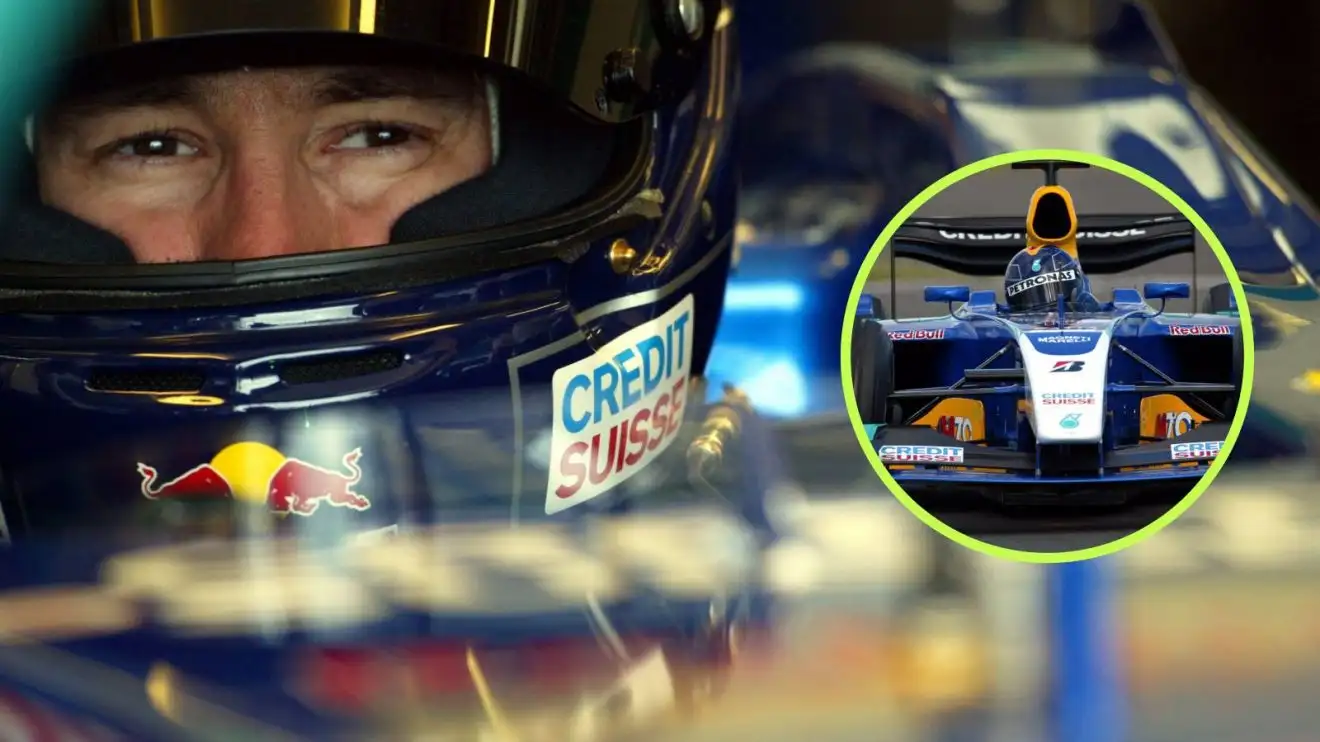
Heinz-Harald Frentzen has revealed why he lost his motivation to race in F1 during his final season in 2003.
Heinz-Harald Frentzen believes he was “overpaid” towards the end of his time in F1, leading to a serious loss of motivation while at Sauber.
After being dropped as a full-time F1 Grand Prix driver by Eddie Jordan at his eponymous team in 2001, it took until 2003 for Heinz-Harald Frentzen to find career stability again, only for the German driver to call time on his career after that season.
Heinz-Harald Frentzen: I completely lost motivation at Sauber
After splitting ways with Jordan in mid-2001, Frentzen spent the next year racing for Prost and Arrows. Both were struggling minnows of the field, marking a big drop in expectations for Frentzen after his years at the much more competitive Jordan and Williams outfits.
Taking to the social media platform X, Frentzen revealed that he hadn’t been paid anything at all during this period of time.
“When Eddie sacked me in 2001, I went to Prost GP for the rest of the season. But Alain [Prost] couldn’t pay me,” Frentzen said.
“He said it right away. I said it’s ok, I race for you for free, and my target is to help you go as fast as possible, and my motivation is to beat the Jordans with your help.”
Scoring zero points during this five-race stint, he moved to Tom Walkinshaw’s Arrows squad for 2002, but was similarly uncompetitive in a year he “wasn’t paid a cent”, as the team folded in the late mid-season due to financial difficulties.
Finding refuge at Sauber for the last two races of the year, Frentzen put pen to paper to race for the Swiss outfit in 2003, marking what seemed to be a full comeback at a solid midfield squad.
Frentzen scored 13 points en route to 11th-place overall that year, including an unlikely return to the podium in the United States in what would prove to be his penultimate race, but the year wasn’t a happy one for the three-time Grand Prix winner as he felt plenty of potential had been lost due to a difference of opinions with the team’s then-technical director Willy Rampf.
Rampf had been Frentzen’s engineer at the same team at the start of the German’s F1 career, and climbed into the technical director role in 2000; a role he held until 2010.
Rampf’s approach was that drivers’ input was not important to the technical development of the car, and, with Frentzen infamous for his desire to tinker with the mechanical intracies due to his deep technical understanding of a car, Frentzen became frustrated to the point of wanting to hang up his helmet.
“Yeah, that’s why I stopped after Sauber in 2003,” he said on the Beyond the Grid podcast.
“When I came back to Sauber, for which I was grateful and happy, I found a car that had a very small window for drivers’ input.
“Willy Rampf said to me, ‘You cannot touch any construction side of the car anymore, the only thing you can touch is the anti-roll bar, the stiffness of the diff, or the rear wing’.
“‘But you cannot touch caster, roll centres, anti-dive, anti-lift, you cannot touch the dampers’.”
Want more PlanetF1.com coverage? Add us as a preferred source on Google to your favourites list for news you can trust.
Asked why that was the case, Frentzen replied, “He didn’t want to do that. He said it’s not the job of the driver to make this input.
“I tried to explain, ‘Willy, I have gone through all these discussions. Believe me, trust me, we can make the car much better than it is’.
“He said, ‘No way you’re going to touch one single screw on this car’.
“At the end of the day, he showed me the way to go: either go home or accept the terms.
“That’s where I completely lost the motivation. He didn’t want to know all the experience I had in the past with teams. Like, bloody f**k, the dampers! Throw them out if necessary, but do something!”
But this incompatibility wasn’t the only reason for Frentzen choosing to walk away. Having had a tumultuous final few years in F1 after a decade in the sport, he had received an olive branch from Jordan at his final race but, despite this, opted against continuing in the sport.
“Eddie came to me at Suzuka 2003 and tried to convince me to do another year with Jordan. It was a very short conversation,” he said.
“I couldn’t do it; today, we would call it burnout syndrome. In those days, that word didn’t exist. I was absolutely finished.
“I was already looking forward to doing DTM because I thought DTM might be a different story and just fully racing, making some money and having fun.
“That was my idea. I didn’t want to start again from zero.”
Having not made any money while at Prost or Arrows, his salary at Sauber was, in Frentzen’s opinion, too much for the level of work he was required to put in.
“I loved all the challenges, but, at the end, what I felt at Sauber in my last year was that I was basically overpaid,” he said.
“Because I was capable of getting a lot more out of the car because I knew the difficulties of the Sauber.
“I knew there was something wrong; if you made a few changes to the car, the car would go one second quicker. I knew that.
“But every other driver could do the same job as I. Nick Heidfeld [my teammate] was beating me occasionally. That was the best example. If you can’t touch anything on the car, if you have similar cars, there’s not much difference you have in the settings you can do, from the intelligent point of the driver, to make this forward step to increase the car’s performance.
“I wasn’t able to do that. I wasn’t allowed to touch any screw that was necessary to touch.
“I felt so, because I was coming to the race weekend just being paid for driving and not starting my brain, not using the brain. So I was only allowed to use the brain to keep my foot down.”
More on F1 nostalgia
Jenson Button reveals his best F1 car, and it’s not the Brawn BGP 001
30 years on: The full story of Mika Hakkinen’s life-threatening crash in Adelaide
Having shown huge potential during the early stages of his career, a potential that appeared to be unlocked during his early days at Jordan in 1999 as he won two races en route to an unlikely title tilt, the petering out of his career left Frentzen with some regrets.
“When I finished in 2003, I wasn’t happy like I finished because I thought I could have done more and achieved more,” he said.
“I was blaming myself that I was not being politically strong enough when dealing with the situation with Eddie when he kicked me out.
“I didn’t start to get political either. That’s not my type of character.
“I loved technology more, but I could not convince the people of the direction in which I would like to go.
“Like what I have learned at Williams, I would have learned at Prost or at Sauber, I could not convince Willy Rampf of a different approach to racing.
“I blame myself, there I found myself not being a complete racing driver, not capable of getting the people behind me, to convince them.”
Put to him that he was being too harsh on himself in this assessment, Frentzen explained that this is the mindset he always took to his racing days.
“That’s what you are as a racing driver,” he said.
“As a racing driver, we learn quite quickly, you never blame the team or somebody else for your poor performance, of whatever mistakes you make and so on.
“You never blame anybody else but yourself. It’s better to shut your mouth, not say the truth, but not blame everybody else.
“So you don’t go there and blame the team. As a driver, you can’t do that, and that means also, you’re always very harsh to yourself.”
Read Next: Five things we’re glad to see the back of ahead of F1 2026