

Explained: Honda’s abnormal vibrations triggered Aston Martin’s testing setback
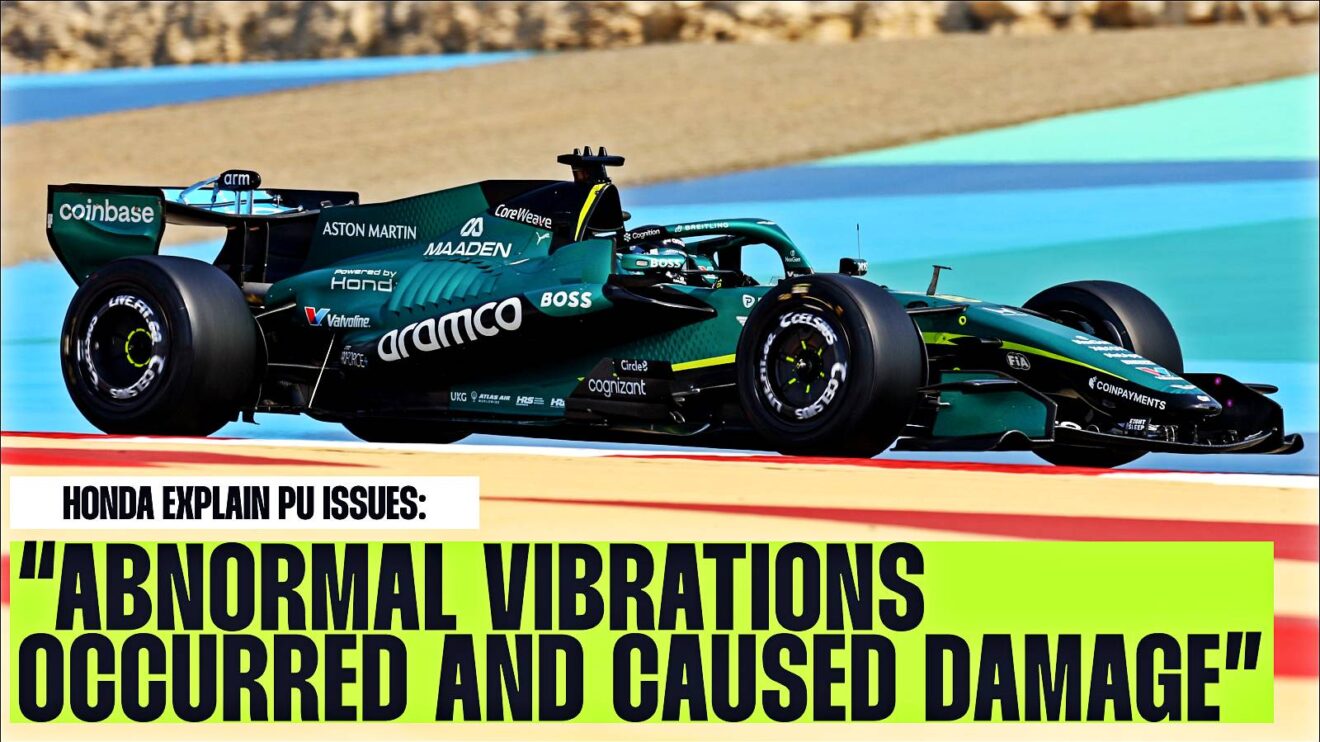
Honda has explained the issues that plagued Aston Martin's pre-season testing programme in Bahrain.
Honda is confident the ‘abnormal vibrations’ that compromised its testing programme in Bahrain can be rectified.
Honda’s return to Formula 1 didn’t get off to a smooth start during Bahrain pre-season testing with Aston Martin, as constant reliability issues curtailed on-track running.
Honda: ‘Abnormal vibrations’ hamper Aston Martin AMR26 testing
Want more PlanetF1.com coverage? Add us as a preferred source on Google to your favourites list for news you can trust.
Aston Martin racked up the lowest lap count of any of the teams during the three pre-season test events, with a grand total of 400 laps. It’s half of what Williams achieved, while brand-new team Cadillac managed 750.
With Aston Martin being the only team running the Honda power unit, the Japanese manufacturer’s lap tally is less than 10 per cent of what Mercedes’ High-Performance Powertrains [HPP] managed, with the Brixworth-based manufacturer achieving 4100 laps across four teams.
The AMR26 proved troublesome throughout Bahrain testing. Having brought out the red flags due to a precautionary stoppage on its first day in Barcelona, this was believed to be linked to a power unit electrical issue, and those issues continued in Bahrain.
On the penultimate day, Fernando Alonso was forced to stop and climb out of the Aston Martin as he ground to a halt with a particularly nasty-sounding technical gremlin, with this stoppage having ramifications for the final day as Honda ran out of components.
The issue compromised the last battery available, with Honda having used up its ancillary components at a faster rate than anticipated.
Speaking in an annual pre-season briefing in Japan on Thursday, Ikuo Takeishi, Honda Racing Corporation’s managing director, said that his organisation has identified that unexpected vibrations had been a primary factor in many of the issues encountered in Bahrain.
“Abnormal vibrations occurred and caused damage to the battery system; this was the main reason the car had to stop,” he said.
“We are investigating the cause on the PU side, while the chassis side is also implementing countermeasures. Specifically, at Sakura, we’re using the real-vehicle dyno to simulate the actual vibrations and analyse them.
“We’re currently testing multiple countermeasure proposals. Simply put, abnormal vibration caused by combined factors during running damaged the battery system. We are working to improve it before the opening race.”
“The vibration caused damage to the battery. Whether the battery itself is the fundamental cause is unknown,” HRC president Koji Watanabe added.
“There was damage to the battery system, but we cannot say definitively that it was the root cause,” Takeishi said.
“The battery pack is being shaken. Which means the structure to which the battery pack is attached is vibrating.
“If this were expected, we would have addressed it earlier. Unfortunately, the situation developed in a severe direction.
“We’re giving maximum effort and want to solve it as soon as possible. We’re working at SK right now. If we could identify a single cause, it would be easier to fix, but because multiple linked factors generate the vibration, we don’t know whether fixing just one will solve it.
“There is a possibility it takes time. But in terms of determination, we want to fix it immediately.”
Asked whether Honda has been able to identify the specific frequency causing the issue, and how vibration on the car is measured, he said, “In any car, the excitation source is usually the engine.
“What matters is how the engine outputs vibration and how the chassis responds. We know which parts are shaking, but we are currently testing how to dampen or shut down those vibrations. Yes, measurement is possible, and we carried it out during testing.
“We can reproduce the issue. Track input also affects vibration, but even though we couldn’t do long runs, we still have data to work with.
“We can’t yet say whether the suspension is or isn’t contributing. That analysis comes next.”
More on Aston Martin and Honda
Can Adrian Newey and ADUO save Aston Martin’s F1 2026 season?
Adrian Newey to be ‘critical’ in Aston Martin F1 2026 turnaround
How Aston Martin and Honda can work together to resolve issues
While power unit homologation is looming, the cut-off date being March 1, manufacturers are permitted to make changes on the grounds of reliability and durability, but Watanabe confirmed the priority and focus at present is on maximising the performance of the homologated PU through operational improvements.
Takeishi agreed, saying, “At this stage, our priority is to solve the current issue. Aston Martin is also involved in addressing it. We are looking ahead, but right now we’re fully focused on the immediate problems. Whether we introduce a major update or not is something to be discussed later.”
The plan is to submit the Bahrain-spec power unit for homologation, with countermeasures introduced for the battery vibration.
Confirming that it’s not yet possible to confirm whether the new Aston Martin gearbox or suspension is playing a part in the vibration, Watanabe also said, “vibration countermeasures are top priority. Without resolving that together with Aston Martin, we cannot progress.
“We propose solutions with them, reproduce them in the Sakura real-vehicle dyno, apply provisional fixes, and work toward the opening race. Once solved, we can shift to performance work.”
As for speculation about tension having already set in between Honda and Aston Martin, Watanabe said, “We aim for a long-term partnership. Right now, we’re unified to solve the issue.
“I’ve spoken with Chairman Stroll and Newey, our discussions are positive and focused on solutions for the opening race.
“Of course, drivers may get frustrated, but our goal is to ensure they can drive properly.”
Takeishi agreed, saying, “On-site, the atmosphere is focused on solving issues using data.”
While Honda had formally left F1 after 2021, the introduction of an engine freeze saw it continue to manufacture and supply homologated designs across the four seasons, delivering Max Verstappen multiple Drivers’ Championships, and Red Bull two Constructors’ Championships.
The difficult start with Aston Martin is more to do with the regulations, rather than any integration with a team, Takeishi explained.
“In car development, it’s common that the excitation source is the PU, but vibrations occur due to multiple combined factors across the whole car.
“As a result, Red Bull didn’t experience it. Why is it happening now? It’s difficult to pinpoint a single clear reason. It’s not about one side having higher or lower technical capability—unfortunately, the combination of factors has aligned unfavourably this time.”
“We ended full-works participation in 2021, and our engineers returned to mass-production and other roles,” Watanabe said.
“Many engineers left in March 2022. Only mechanics and a small number of engineers remained to support RB. So in reality, there was a period of inactivity. We were approved to re-enter in 2023 and began bringing people back from that point, so it is true that there was a period of inactivity. The impact of that is, frankly, being felt.
“When the broad framework of the new regulations was finalised in 2022, we did not have the necessary personnel in place. In addition, there was no cost cap restriction in 2022, and our engineers only began returning from 2023, when the cost cap came into effect for us. To put it precisely, there was a time lag in bringing the engineers back.”
Takeishi replied, “It’s a tough situation, but we will do everything possible before the season opener.
“Please watch the results first. We remain fully committed to ultimately fighting at the front. We cannot say how long that will take, but we will continue working relentlessly to build a package capable of competing at the highest level. We hope you will stay with us through that journey.”
With Honda’s struggles preventing Aston Martin from being able to start developing a greater understanding of the AMR26 from a chassis and aerodynamic perspective, chief trackside officer Mike Krack said developing synergy with Honda will prove critical to a rapid advancement in performance.
With the two sides just a few short months into their partnership, Krack said, “This is a formula that all the parties need to work very well together. I think the better you integrate, the quicker we can make progress.
“We are in a situation where we have a new partner that we have to learn how to work with, but we have made very good steps already.
“We speak the same language, we have the same objective, and then the timeline is always something that is difficult to say. I think we take it step by step in the moment.
“The partnership or package that we have, you need to develop. It is not something that you turn the knob, and it works.
“There are humans involved, there are different cultures, there are different philosophies. But I think we are at a very good level, and we share our issues, we share our priorities. There is no magic in Formula 1. You really have to work hard.”
But not all the issues are on Honda’s side, Krack acknowledged, pointing to other various factors that have added to his team’s pre-season woes.
“You have a lot of little problems that prevent you from running, and they are in all areas of the car. We have new electronics, we have new partners, we have a new gearbox, and we have new suspension,” he said.
“So, it is difficult to isolate one single area. That would be the easiest because, if you have just one item to fix, you can put all your efforts on that.
“So I think it is probably lateness that put us into a bit more difficult situation on the reliability side.
“But I said it earlier, if you do not accumulate the laps, and I think we have three times fewer laps than some of the best competitors, that puts you behind.
“You have to be realistic about it, and then you need to catch up. There’s no other way, but they are not waiting for us, so we need to really do our best not to lose touch.”
Want to be the first to know exclusive information from the F1 paddock? Join our broadcast channel on WhatsApp to get the scoop on the latest developments from our team of accredited journalists.
You can also subscribe to the PlanetF1 YouTube channel for exclusive features, hear from our paddock journalists with stories from the heart of Formula 1 and much more!
Read Next: FIA confirms Overtake Mode adjustments possible if system proves unbalanced