

Bearman Suzuka crash raises mental ‘overload’ facing Formula 1 drivers


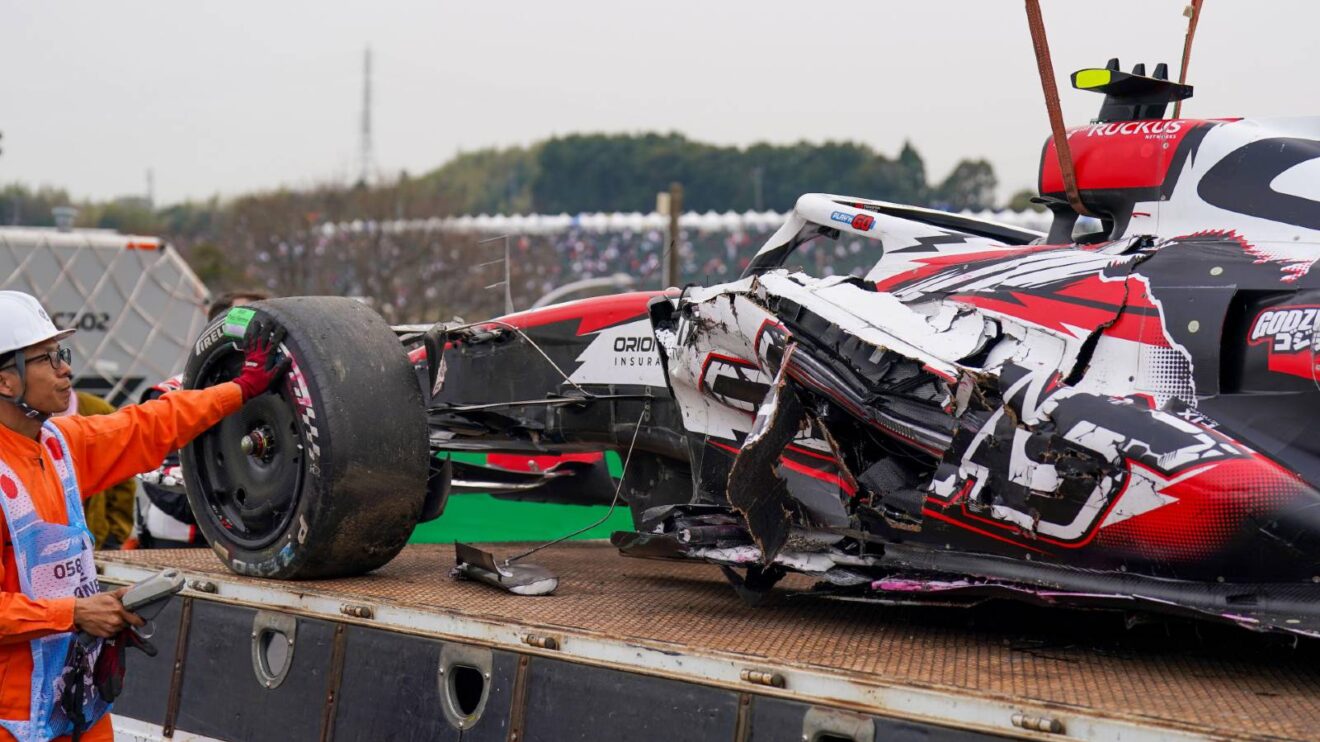
The remains of Oliver Bearman's Haas after his 50G crash at Suzuka.
Harvesting the battery power. Deploying the energy. Hitting Overtake Mode. Then use Boost Mode. Putting the wings in Straight Line Mode. Closing it. Now Cornering Mode. Now closing it.
Driving a Formula 1 car is not just physically taxing, it’s mentally exhausting.
Oliver Bearman crash highlights Formula 1 mental strain
Want more PlanetF1.com coverage? Add us as a preferred source on Google to your favourites list for news you can trust
And even the smallest lapse, such as not realising your closing speed to the car ahead, could not only hurt your race, but also your body.
That’s what Oliver Bearman learnt on Sunday when he closed up on Franco Colapinto at an excess of 50 kph. The Haas driver had to evasive action, went onto the grass at the entrance to Spoon Curve, went flying across the track in front of Colapinto and slammed sideways into the wall in an impact that was recorded at 50G.
Fortunately, Bearman, who limped away from his stricken Haas, had suffered nothing more severe than a right knee contusion.
His rivals, led by Carlos Sainz, were up in arms about it as the Williams driver called for an urgent change to the regulations, as Bearman’s crash was just the “warning”.
“These kinds of accidents,” he added, “were always going to happen, and I’m not very happy with what we’ve had up until now.”
The situation, though, has been helped by how exhausting it is – mentally – to race today’s cars.
This was brought up by F1TV pundit Alex Brundle after the Japanese GP.
More analysis from the Japanese Grand Prix
Kimi Antonelli leads winners and losers as Japanese Grand Prix shifts momentum
Japanese GP 2026 driver ratings: Piastri surge, Bearman crash, and Alonso’s quiet performance
“I don’t know if it’s coming across to the viewer, but every driver that comes and stands next to us, they are drained,” said the F1TV analyst.
“They have worked hard. You can see it in the eyes of the drivers that join us. They’ve really done the job.”
His fellow pundit Jacques Villeneuve agreed, but says it is more down to mental exhaustion, than physical.
“It’s not physical. It’s mental. It’s the mental drain of all the energy and the focus they need for it, because physically, the cars aren’t quick compared to last year. So, it’s not physical, it’s mentally draining.”
1996 world champion Damon Hill joined it and called it “overload”.
“No, because when we did it was very easy,” Hill laughed. “I was speaking with Jacques about this, this morning, and I mean they are overloaded with things to think about.
“I think it is literally like patting your head and rubbing your tummy at the same time and then juggling and trying to do a mass equation. I mean it really is… They’ve got so many buttons and stuff to deal with.”
Drivers have raised concerns about this in previous weeks with Norris saying they have to look at their steering wheels every “three seconds” to know what is going on with the car.
“I’m looking at my steering wheel, because I have to look at what the speed I’m going to get at the end of the straight and know if I need a brake 30 metres earlier, 10 metres later,” he said.
“So that’s also the problem, you have to look at the steering wheel every three seconds to see what’s going to happen otherwise you’re going to end up off the track.
Racing Bulls driver Liam Lawsona admitted he was “mentally drained” following the Suzuka race. “Good, a little bit mentally drained,” he told F1TV after the race. “It’s very intense this year. You have a lot more that you’re thinking about when you’re driving. So, it was actually quite a tough race.”
Want to be the first to know exclusive information from the F1 paddock? Join our broadcast channel on WhatsApp to get the scoop on the latest developments from our team of accredited journalists.
You can also subscribe to the PlanetF1 YouTube channel for exclusive features, hear from our paddock journalists with stories from the heart of Formula 1 and much more!
Read next: