
How Ford is shaping Red Bull 2026 F1 power unit programme
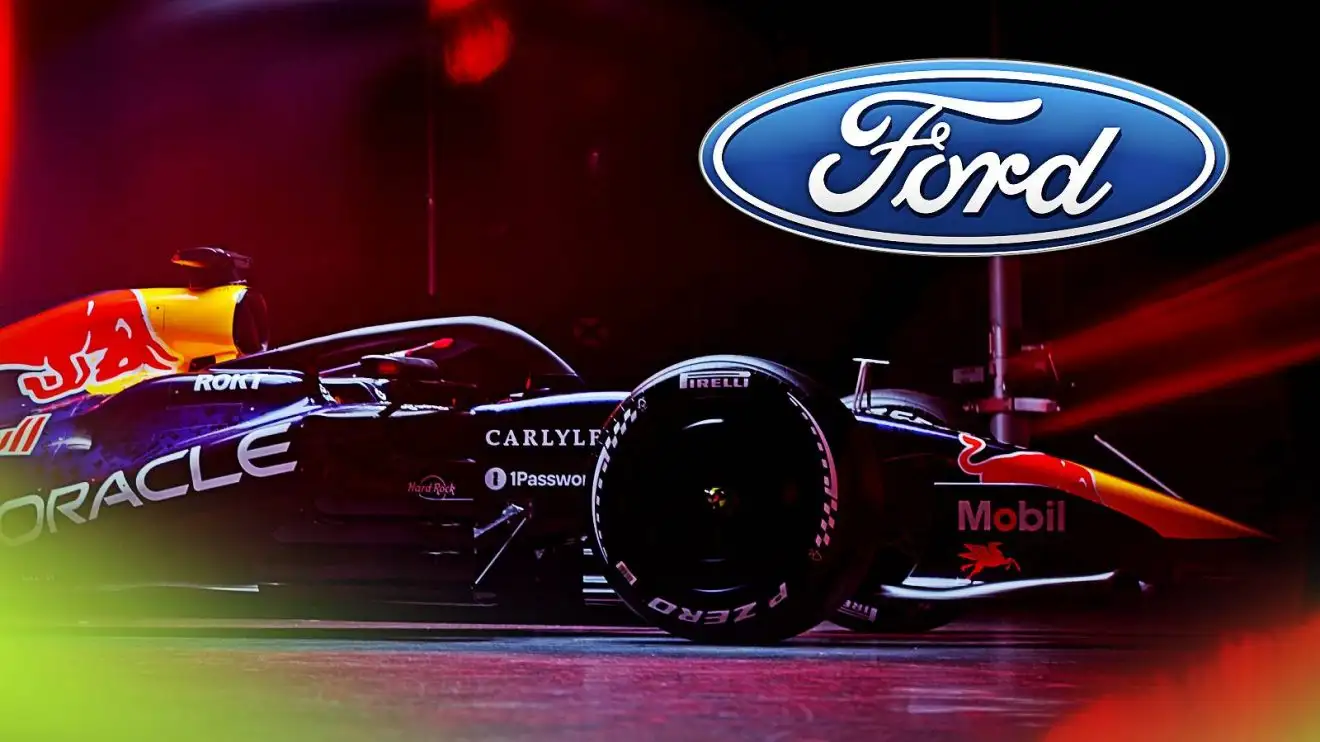
Red Bull's RB22 will be powered by an RBPT-Ford engine.
Red Bull’s engine partnership with Ford will bear fruit for both sides in the medium- to long term, believes Laurent Mekies.
Red Bull Powertrains [RBPT] is working closely with US automotive giant Ford to create the power unit that will be in the back of the cars of its two F1 teams from 2026.
Laurent Mekies: ‘Foolish and naive’ to think RBPT will be on top
Want more PlanetF1.com coverage? Add us as a preferred source on Google to your favourites list for news you can trust
F1 2026 marks the first year of competitive running for the Red Bull Powertrains project, the long-awaited engine department kicked off in 2022 by former Red Bull Racing team boss and CEO Christian Horner.
Four years on, Horner and Red Bull have split, but the project has continued unabated through several generations of power unit as the department, led by Ben Hodgkinson as technical director, has grown to a personnel count of several hundred.
This has been bolstered by a partnership with one of the US automotive industry’s ‘Big Three’, with Ford coming on board as a strategic partner to Red Bull in early 2023.
With Laurent Mekies succeeding Horner in the role of overseeing the F1 team and the Powertrains company, his first full season in charge coincides with the competitive arrival of RBPT and Ford, with the sixth-generation power unit created at its own facility in Milton Keynes in the UK powering Red Bull Racing and sister squad, Racing Bulls.
It marks Ford’s arrival back in F1 for the first time since the end of the 2004 season, when it sold its Jaguar team to the Red Bull company it has now partnered with.
With Mekies quickly getting up to speed with the project in the second half of 2025, following Red Bull‘s split with Horner, he spoke of the scale of the challenge facing RBPT and Ford as the Milton Keynes-based squad enters the championship as a fully autonomous constructor for the first time in its history.
Revealing the RB22’s new look at Ford’s season launch event in Detroit, Mekies revealed just how the US manufacturer has already proven hugely beneficial to RBPT’s operations.
“They have been helping us on many different topics, and that list of topics is expanding every day,” he told Bloomberg.
“But let me give you a couple of practical examples. Jim’s [Farley, Ford CEO] team has unique advanced manufacturing capabilities that we use to produce some of the most critical parts of our engine, and not only are they able to manufacture these parts for us, but also they do it in less time than we would otherwise.
“That gives us a crucial… our business is a time-to-market business. We call it a time-to-race business.
“When we are able to manufacture complex components in a shorter amount of time, at this incredible level of quality that we are looking for, that’s a key competitive advantage.”
With Ford’s involvement very much a partnership that extends beyond a mere sponsorship arrangement or of simple logo placement, Hodgkinson explained just how, from a technical perspective, he has been able to lean on Ford’s input in the creation of the power unit that’s set to be homologated with the FIA on March 1st.
“Yeah, in all honesty, when I first got involved, Ford wasn’t in the picture,” he told select media, including PlanetF1.com, when asked about how the Ford relationship has evolved since he started with RBPT in 2022.
“I think it was about a year in. We’d built some factories, and we’d got our first engine running.
“I took the fact that they wanted to get involved as a real vote of confidence in where we’d got to, actually, because they could see what we’d done in not much more than 12 months, and wanted to be part of that.
“It was really important to Ford that they did it as partners, and so we got a few of their members of staff on site.
“One of the biggest challenges I had with putting everything together was finding that number of experts in such a short amount of time, and I definitely had some holes that Ford tried to help me fill. So that was very, very valuable indeed.
“Then, Ford’s manufacturing capability, I’ve exploited some of that for sure. There’s the direct metal laser centring that is something they’ve helped me out with. It sort of replaces castings effectively and allows me to turn parts around much, much quicker than if I use traditional suppliers.”
More on Red Bull in F1
Red Bull RB22 revealed in fresh images ahead of Barcelona pre-season testing
F1 2026 uncovered: The game-changing potential of ‘Active Aero’ revealed
While RBPT can benefit from Ford’s manufacturing capabilities, the American manufacturer also benefits from the expertise inherent to a top-level F1 squad such as Red Bull.
“The tech transfer, this team that Laurent leads [is a] leader in aerodynamics, predictive failure components, and software control of the hybrid system and high-discharge batteries…these are all core capabilities that we need for the next five to 10 years as a company,” Farley told Bloomberg.
“So the tech transfer is very relevant for us, like maybe four valves or overhead cams were in the 1960s, you know? But the tech transfer is totally different today.
“Formula 1 is a complete digital sport, and that’s where we’re going as a company.
“Also, racing, especially in the off-road world, gives us credibility for customers, that the product they buy has real capability that’s been tested in a way that a brand that doesn’t race can’t say.
“That’s what Porsche and Ferrari knew for a long time – especially for us in the off-road world, this is really important. Racing is a fundamental part of our company’s business, because to beat all the great off-road brands and to establish ourselves.
“Now, we’re twice Jeep sales in the US – to keep that going and keep growing the off-road brand, off-road racing into cars, Baja, is where our customers will say, ‘Hey, that Ford has the real deal. It’s the real deal. It’s not a poser product’.
“So racing is integral to our credibility as a company.”
The benefits to both sides may be far-reaching and useful in both sporting and engineering arenas, but Mekies moved to downplay the possibility that the very first RBPT-Ford engine can be a standard-setter right from the start of the new regulation cycle.
Hodgkinson’s pedigree includes a long and successful tenure at Mercedes, where he was a key cog in the creation of the hybrid power unit out of Mercedes’ High-Performance Powertrains in Brixworth that dominated F1 upon its debut in 2014.
HPP evolved out of the long-established Ilmor company and facility, and Mekies warned that expecting a new company like RBPT to match the experience and inherent knowledge of the likes of HPP or Ferrari at its very first attempt could be a step too far.
“You will have to bear with us a little bit. The scale of the challenge is monumental,” he said.
“We have started to design and build these engines in what was a field, you know?
“We’ve made the factory, we’ve bought the dyno, we’ve put together an unbelievable group of people, and a group of partners such as Jim and his team.
“It would be foolish and naive to think that, from the first day, you are going to be at the same level as people who have been doing it for 90 years.
“So bear with us. It will give us a few sleepless nights. It will give us a few headaches. We feel we have the right people, the right tools, the right spirit across what Red Bull means and what Ford means. We will eventually come out on top, but the first few months will certainly be full of learning.”
Want to be the first to know exclusive information from the F1 paddock? Join our broadcast channel on WhatsApp to get the scoop on the latest developments from our team of accredited journalists.
You can also subscribe to the PlanetF1 YouTube channel for exclusive features, hear from our paddock journalists with stories from the heart of Formula 1 and much more!
Read Next: Why McLaren is resisting early upgrade temptation with MCL40