

Why McLaren is resisting early upgrade temptation with MCL40
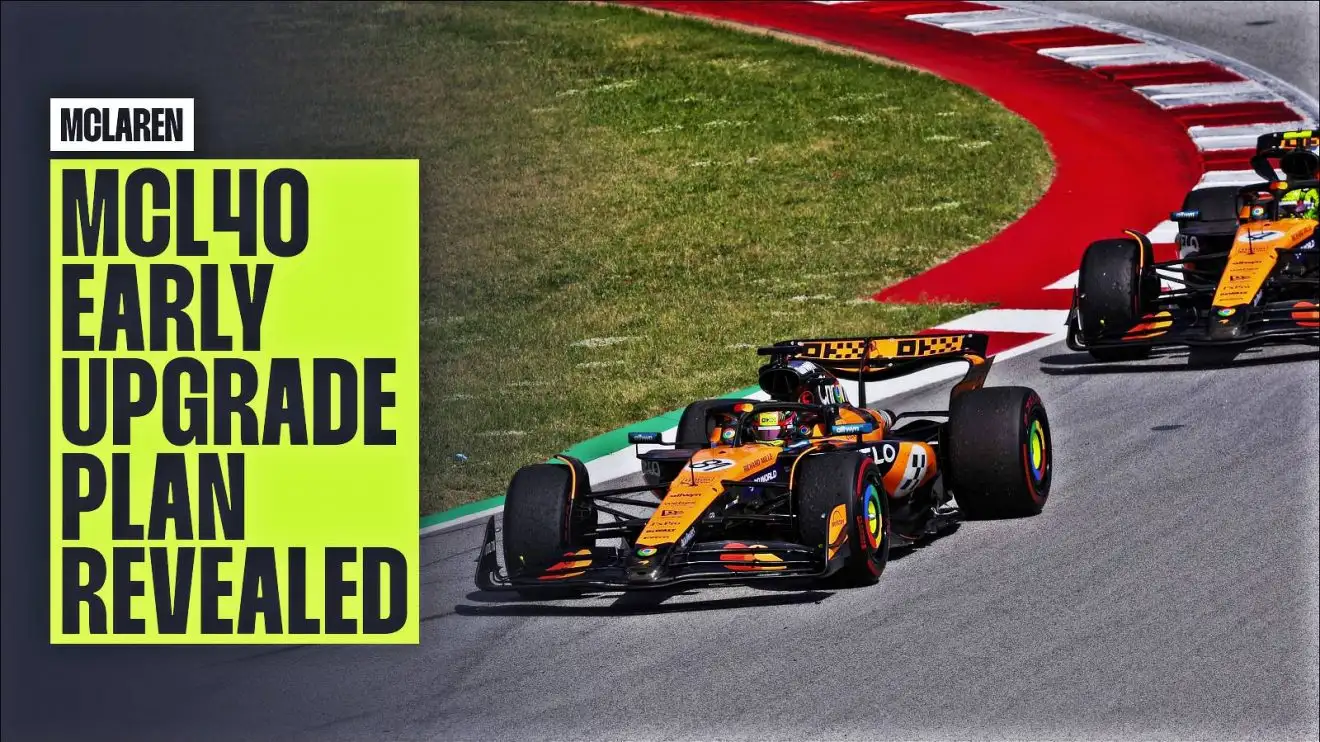
McLaren is set to take a conservative approach to its upgrade plans for the MCL40.
McLaren has outlined its intent to keep upgrades to a minimum at the start of the MCL40’s life, given the complexity of the new ruleset.
The reigning F1 World Champions will roll out the new MCL40 at the first pre-season test in Barcelona next week, and this specification of the car won’t evolve much before the season-opener in Australia.
McLaren: A complicated and new car means focus is on understanding
As reported by PlanetF1.com on Thursday morning, McLaren has outlined its plans to skip at least the first day of pre-season testing in Barcelona, with team boss Andrea Stella revealing the intent as being a focus on development of the car right up until the last possible moment.
The MCL40 will be flown into Barcelona from Austria’s AVL facility, where it is going through dyno testing for the engine and gearbox, before taking to the track for the first time on the second or third day of the Barcelona shakedown.
A key question heading into the new era of Formula 1, with revised regulations tearing up the formbook as new power units and chassis rules are introduced, is just how much evolution will be seen in the early stages of this season.
Given the overall lack of real-world data, having been restricted to simulator data for preparation, the potential for very rapid development is there, particularly if a radical approach from one or two teams steals a march on the rest; this would force the others into having to play catch-up as quickly as possible.
McLaren heads into the new regulations as reigning Constructors’ Champions, and the Woking-based squad’s approach is going to be one of methodical consideration, with chief designer Rob Marshall explaining that quickly gaining a full understanding of a new package will be more important than bolting on parts without the benefit of fully comprehending why, or why not, something is working.
“Between Barcelona and Melbourne, I think what you’ll see is probably pretty much what we’ll bring to the first race,” he told select media, including PlanetF1.com, in a pre-season briefing held at the McLaren Technology Centre.
“A lot of our effort will be into understanding this. Also, we need to take into account what the opposition is up to – we need to be inspired by what they may or may not achieve and may or may not show us.
“We really are going to have to be very focused on getting our heads around this car. It’s very complicated. It’s all new.
“There’s a lot of stuff that we need to dial in and tune in. So I think bringing a lot of new stuff to it early doors would complicate stuff, and I think we’re better off understanding our platform before we get too keen on redesigning it before it’s turned the wheel, if you see what I mean!”
But, while upgrades might not be immediately forthcoming, McLaren may be starting from a more advanced stage of development than some of its rivals, as team boss Andrea Stella revealed when confirming the team’s intent to sit out the first day of testing.
Audi, Cadillac, Racing Bulls, Alpine, and Mercedes have all carried out filming days as an initial shakedown of their cars, and Stella said the extra time McLaren is taking before taking to the track could be beneficial.
“It means that [rivals] might have committed to the design and the realisation of the car relatively early, so you will have a compromise against development time and ultimate performance,” he said.
“Obviously, there will be updates pretty much, I guess, for every car between testing in Barcelona and the first race, but we thought that, in the economy of a season, it was important to start and launch the car in the most competitive package and configuration.
“That’s why we pushed all the timing to the limit, but within a very manageable limit.”
McLaren’s approach is in stark contrast to what Ferrari’s Fred Vasseur said of the Scuderia’s attitude to the beginning of testing, with the team boss revealing last month that Ferrari will bring an initial ‘Spec A’ car to Barcelona – a situation he expects to be the case for most of the grid.
“I think everybody will do it,” he said.
“In this situation, the most important thing is to get mileage. It’s not to chase performance.
“It’s to get mileage to validate the technical choice on the car in terms of reliability. And then to get performance.
“It means that I think everybody will come to Barcelona with – not a mule car – but let’s say a spec A.
“The first focus in Barcelona will be to get mileage with the car, to understand the reliability of the car, where we have to improve, and what we have to react.
“Because if you understand something in Bahrain, by the second test, you won’t have time to react for Australia.”
More on McLaren and F1 2026
McLaren launches Puma collaboration and it is already selling out
Mercedes confirms lucrative Microsoft sponsorship ahead of W17 launch
The new MCL40 looks set to be unveiled with a pushrod suspension, according to pre-testing renders of the car seen by PlanetF1.com, having run with a pullrod front suspension on the MCL39 last year.
Such a decision doesn’t add undue complexity to understanding, as technical director for performance, Mark Temple, explained.
“Push-rod, pull-rod, various cars had push or pull-rod last year and in previous years,” he said.
“It really comes down to an aerodynamic choice and what front suspension set suits your new front wing. And obviously, the new front wings are all new.
“So I guess the way that the teams that you’ve seen so far developed have basically organised their suspension stakes to suit their front wing package and their front end package. So it’s really aerodynamically driven – both are quite easy to do mechanically. They’re not particularly difficult mechanical challenges.”
To give an example of just how little understanding the teams have of the new cars heading into the season, Temple explained that even knowing the correct amount of rake isn’t yet known.
Rake refers to the angle of attack of the floor of the car relative to the ground. During the ground-effect era, to generate downforce, the entire length of the car was run as close to the ground as possible.
During the previous generation, up until 2021, a high angle of attack with a low front and a high rear was common, and, based on initial footage from the few filming days already carried out by the likes of Racing Bulls and Audi, 2026 could mark a return to similar levels of rake.
“The 2021 and earlier cars, in terms of the way they looked on track, obviously, the cars were set up a lot higher,” Temple said.
“You had high rear ride heights. The car was a long way in the air.
“Then, when we went into the sort of 2022 to 2025 era cars, we saw with the underfloor tunnels and the aerodynamic performance, the cars were run much lower. It was very much a car performance driven by ride height, in terms of the characteristics of the aerodynamics.
“For 2026, we’re somewhere between the two. It’s neither one nor the other, and it’s also not exactly in between them. We will still see, I think, because you have a little bit less extreme sensitivity to ride height than we had in the previous years, there will be a little bit more freedom to manipulate, if you like, the car attitude to suit and to affect the handling without just simply making the car go slower.
“So I think it will be interesting to see what that does. I think it will give us a little bit more freedom to tune the car to suit a particular handling through-corner. I think the other aspect to consider is the approach with the kind of energy harvest and recovery in the braking zones and into the corner, that creates a new challenge that we haven’t seen in either of those previous generations, and how that affects what the driver has to do and also what they need from the handling of the car, we don’t know for sure yet.
“That’s something we’ll learn from testing, and then understanding that and understanding how we can exploit it is going to be really important for us.”
Read Next: McLaren plans delayed Barcelona test start for MCL40


