

Rwanda F1 circuit: What we know about the new RISE Motordrome


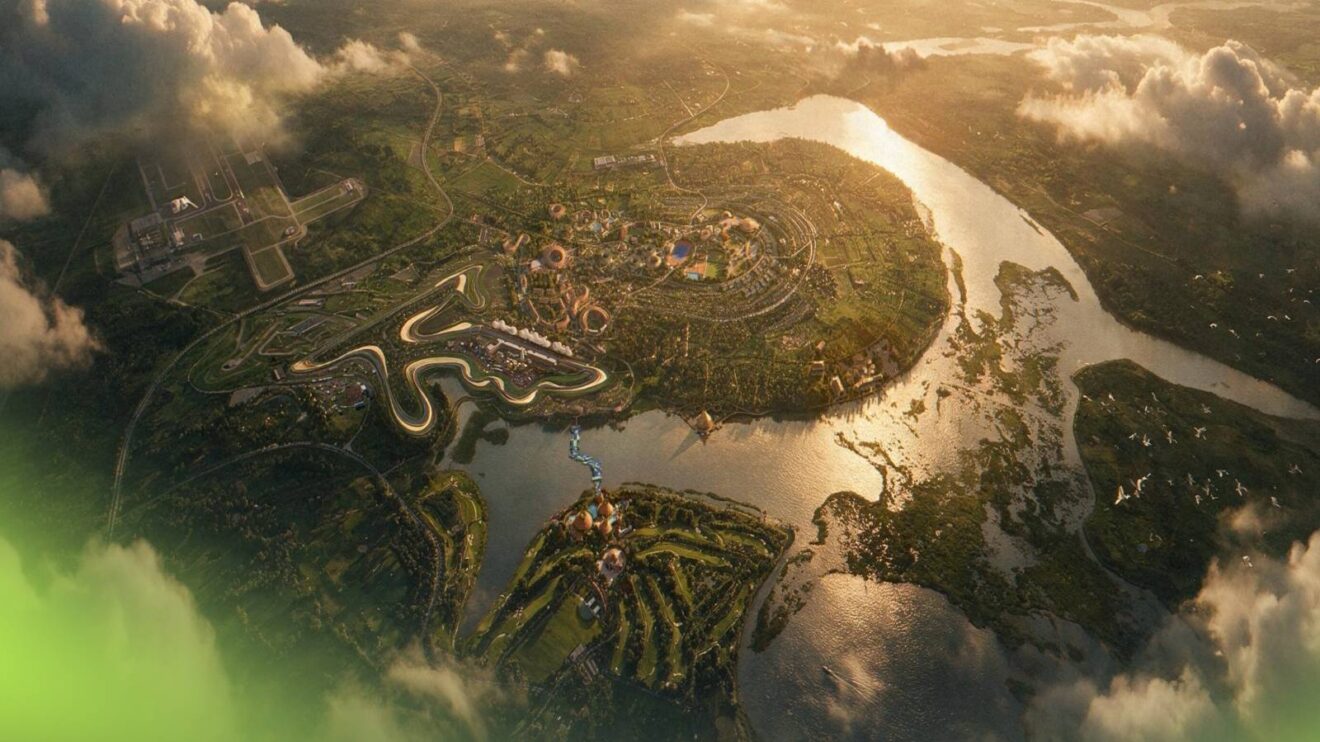
Circuit renders of the African Grand Prix venue in Rwanda, the RISE Motordrome.
The first details of the brand-new Rwanda F1 circuit have been confirmed by the circuit’s designers during the event’s launch in Kigali.
Formula 1 will return to Africa for the first time in almost four decades when the sport heads to Kigali for the newly-announced African Grand Prix, starting in the early 2030s.
Rwanda F1 circuit: What we know about RISE Motordrome
The event was confirmed during a lavish launch ceremony in Rwanda’s capital city of Kigali, with President Paul Kagame announcing the African Grand Prix alongside FIA President Mohammed Ben Sulayem and F1 CEO Stefano Domenicali.
Amongst the attendees of the ceremony was select members of the F1 media, including PlanetF1.com, who joined the post-launch press conference with the Minister of Sports, Nelly Mukazayire and Rwanda Development Board CEO Jean-Guy Afrika, speaking at length about the infrastructural, logistical, and economic elements of the future event.
Alongside these local dignitaries were key figures from the design and engineering companies overseeing the project, including former F1 driver Alex Wurz from Wurz Design, and Carsten Tilke, who was appointed lead consultant to the build in mid-2026.
Tilke will oversee the overall design and development of the entire facility, with Wurz contributing by way of consultation on the features and layout of the circuit itself.
Rwanda F1 circuit designers explain key track features
When asked by PlanetF1.com to elucidate on the key priorities and targets for the new racetrack, Tilke began by commenting on the importance of spectator proximity.
“I must say we are very proud to be part of this project here,” he said.
“We have been involved in a lot of Formula 1 tracks around the world, but this is really special for us.
“I guess we have really the perfect team here to design and develop the best track possible together with Alex and with that other partner of us, DAR, we make sure to deliver the track in the best way possible.
“So when we talk about the track, first of all, it was always important for us that it’s amazing to drive, challenging to drive, but, on the other hand, also creating great races. So we need to create overtaking points. We need to make sure different strategies are possible at that track, and so on, so that we have a nice qualifying, but also a nice race.
“The other thing very important for us was in the focus is that the spectators must be close to the track, must feel the track, must be part of it.
“So this, all together, was our objective when we all started that, and we have here a really unique site that makes it really special. So when we design a racetrack, of course, we need to always work with the site we have.
“Here, we were very, very lucky because it’s very hilly topography. We have a lake. We have everything that you dream of when you design a track, and this gives also the character of the track. Very flowing, very fast.
“It’s really shaped by the natural features and beauty of the site, and this is why we also have a lot of elevation changes.”
At present, the circuit’s interim name is RISE Motordrome, and is being constructed just a few kilometres away from the new state-of-the-art Kigali International Airport.
Scheduled to open in early 2028, the new airport’s commissioning is the key factor in determining the readiness of the racetrack facilities to handle the international requirements for F1 access and the thousands of spectators anticipated to attend.
The track is set to be able to host 100,000 spectators, utilising the natural hills around the circuit to help create natural grandstands.
Rwanda F1 circuit to use natural hills and lakeside setting
These hills will also be used to create vertical sweeps for the drivers on track.
With the Rwandan government ferrying media, including PlanetF1.com, out to see the area, one clear example is that of what is currently a downhill dirt road that will become a steep downhill back straight that gives way to a compression in a dip before powering back up a steep hill.
One of the very visible areas we were shown yesterday in Kigali was this section of straight out the back of the circuit.
It will see the drivers power down a hill, enter a short valley that will trigger compression G-forces, then back up a climb, all at around 12-13% steepness. #F1 #AfricanGP
— Thomas Maher (@thomasmaheronf1) October 14, 2026
RISE Motordrome to feature record-breaking 197-metre elevation gain
“When you look at one lap, the elevation gain is 197 metres per lap, which is record breaking for the calendar of Formula 1,” Tilke said.
“So it really is a rollercoaster track with a lot of banking. It goes up and down also 13 percent then 12 percent up again.
“So it’s really making use of this topography.”
With the Rwandan project kicking off thanks to Kigali’s hosting of the FIA General Assembly in 2024, which triggered the conversations with the local government about how to make a race happen, Wurz explained how the identification of the circuit area became quite easy.
“One of the first decisions was what sort of circuit and what location should it be. There were discussions about street circuit relocating elsewhere, maybe occupying the old airport, and multiple locations came up,” he said.
“But, when we learned about the development in Bugesera, from the Rwanda development board for the strategic airport masterbelt, and then we actually saw it, and you see the hillsides and the lake.
“I said, ‘Guys, there’s only one location this circuit should be because it doesn’t need us to design it’, because the nature designed already the perfect topography.
“It’s two hills with the lake below. That means we can drive up and down the beautiful landscape, and we want to live a picture-perfect African Rwanda landscape.
“The spectators will be integrated in the beautiful landscape, and you have the two hills, either side around 35 to 40,000 spectators. So, in the middle, you have the track oscillating up and down with the hill, coming to the record-breaking elevation gain, and this is pure integration into the experience of the locals who are coming here live to watch the Grand Prix and other races – it’s for two and four wheels.
“The rest, you play around with an old school sheet of paper, topographic lines, a ruler and a pencil, and you go through the experiences we have collectively as designers and and make sure that we deliver and tick the boxes.”
A very enjoyable afternoon being flown out to see the new circuit construction outside Kigali. First time in a helicopter too! #F1 #AfricanGP https://t.co/QjomVq0ajW
— Thomas Maher (@thomasmaheronf1) October 13, 2026
How Rwanda’s F1 circuit will challenge drivers and riders
With the initial render of the circuit suggesting that some corners would even have negative camber, Wurz revealed that, while camber will be used throughout the layout, it will all be at positive angles.
“From a more technical aspect, we will have, of course, camber. We work with it,” he said.
“We have to be aware that we are at 1,300 to 1,400 metres above sea level. That means we have less pressure in the air. That means also less grip from the aerodynamics. So we can counter that with some of the cambers.
“We go over 12 percent on some corners. We don’t have off camber corners, which maybe it looks like this on the render perspective.
“Some of the elevations, as is up to 14, I think almost 15 percent, up and downs in some locations, and I can tell you it’s going to be a drivers and riders track.”
Wurz revealed that some of F1’s current elite drivers have already had the chance to power around a simulated lap, although declined to reveal whom.
“If you believe me a little bit, it’s going to be one classic of a track immediately, and the luxury we have also collectively between the two teams, I would think more than a dozen world championship titles have seen the circuit,” he said.
“Some have also already tested it on the simulator. I’m the lap record holder. I’ve done thousands of laps to ensure we leave nothing for chance. That’s for the driving sensation!”
What we know about the Rwanda F1 circuit surface
As for the circuit surface itself, PlanetF1.com enquired what the intent is: will the RISE Motordrome be a tyre killer, utilising abrasive asphalt, or aim for a smoother, silkier bitumen?
“Carsten’s company has enormous experience in the asphalt. I have enormous experience on abusing the asphalt as a driver, and I’ve done so much tyre test development,” Wurz said.
“So, first of all, when we’re talking that this Grand Prix is for the future, we will see maybe different tyre manufacturers and different rule sets coming to play on this circuit, and the first thing we all do is to see what can we source locally in materials, because we need to ensure that also value can be taken for the local industries and economy.
“But, of course, the stones should be robust and supply good grip, not shredders, in my opinion. But we will decide that.
“That’s something which we will be work out in close cooperation with the FIA and F1. But we also have to make it good grip for the wet because we do have sometimes rain showers which can make a race very spicy and interesting. As a driver, I always love the wet. Of course, the circuit is designed for it.
“But the exact final asphalt mix, I think we would never tell you, but it should be a good grip sensation.”
“We are in the detailed design phase now,” Tilke said.
“So this comes now where we will source the material. We need to see what can we source locally because that’s very important.
“But of course, we need to guarantee the quality, the evenness, and also the longevity of the asphalt, which is very important. So we are in this process and, I think, on a good way.”
Rwanda F1 circuit construction and opening timeline
While the finished circuit is some years away, with construction yet to begin in earnest, the plans for what is a permanent facility — rather than another city-based street circuit of ‘temporary’ construction — are promising that a rewarding and challenging racetrack awaits in the early 2030s.
“I would hope all of the 17 corners are iconic, and that’s the circuit itself, which will be on the favourite list of all the drivers and riders,” Wurz said.
“If I name just some of the segments, Turn 2 is pretty impressive because you come at top speed down the hill with over 10 percent descent, and you go into a compression, which you will experience high G-forces vertically and laterally. The corner is then going into 12 percent and then the corner exit, when you go all the way up to the hill, you’re facing sky with almost 15 percent of incline, and you’re still at 240 kilometres an hour, having just undergone so much G-forces.
“So that’s one of the the corners which I can’t wait to drive and see the races unfolding. It is also the corner where actually we all believe that you could go side by side through the entire corner. Then you come to a technical section which is playing a lot with the hills, with cambers, to challenge the engineers and the drivers to not make it easy but yet to have a special flow and then we have indeed which you’ve seen on the renders, a very fast-flowing section through the lakefront.
“That’s multiple corners added to each other. But it’s not that you just say one after the next. It’s designed that, when you miss one corner, the entire sequence is getting ultra challenging, and you lose lap time.
“So it is technically ultra challenging, visually absolutely beautiful. So that’s the task of the design. So hopefully everything will be named iconic and be a favourite circuit of many drivers.”
Want to be the first to know exclusive information from the F1 paddock? Join our broadcast channel on WhatsApp to get the scoop on the latest developments from our team of accredited journalists.
You can also subscribe to the PlanetF1 YouTube channel for exclusive features, hear from our paddock journalists with stories from the heart of Formula 1 and much more!
Read Next: How McLaren avoided Lewis Hamilton strategy trap at Singapore GP