

Why F1 2026 changes everything in hard reset for Red Bull
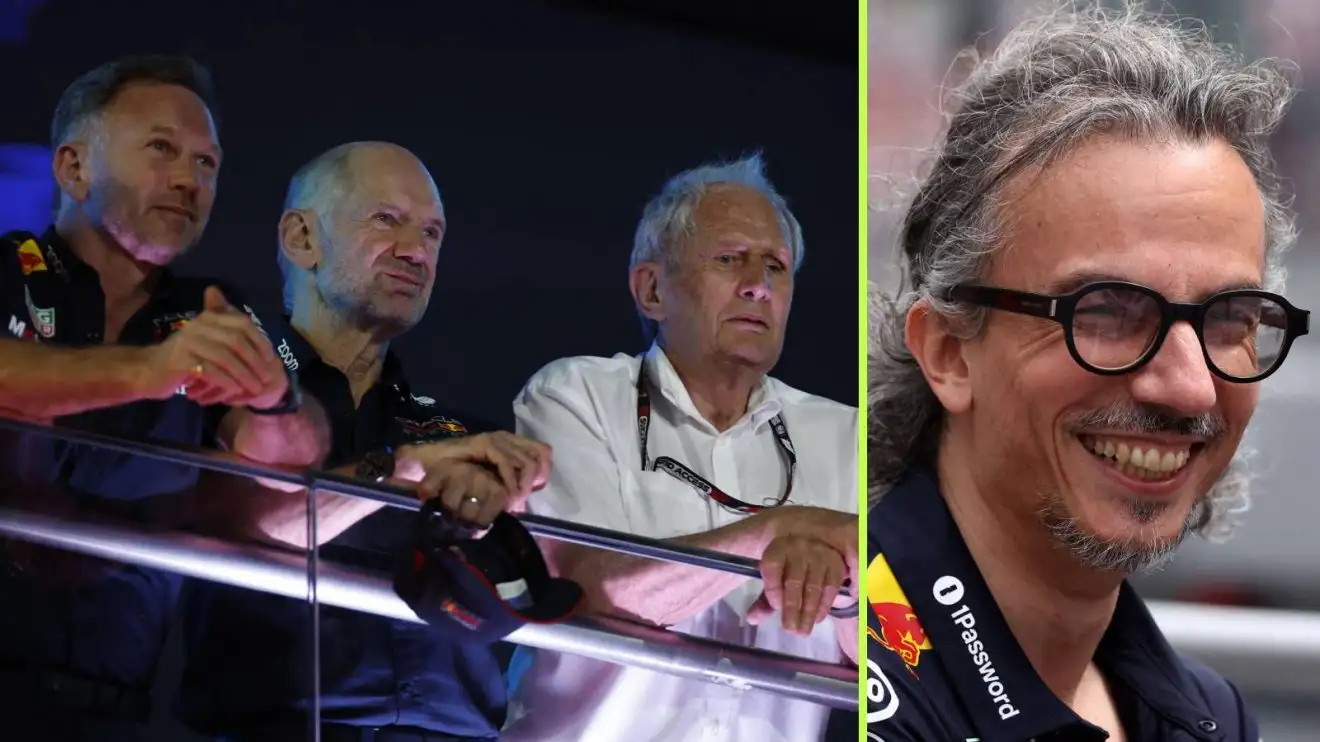
Red Bull's Christian Horner, Adrian Newey, and Helmut Marko have now all parted ways with Red Bull.
F1 2026 marks an entirely new chapter for Red Bull Racing, with the leading figures who made it so successful now departed in favour of new and unproven faces.
The true test of whether Red Bull can continue as a giant of the sport over the coming years starts in F1 2026, with the momentum created by its previous regime petering out.
Two decades that created an F1 behemoth
The F1 2025 season marked the last breaths of the Red Bull Racing team as it has been for two decades, during which time it has become one of the most impressive F1 teams to have ever raced in the sport.
It was the culmination of a vision overseen by Red Bull company founder Dietrich Mateschitz, who, after years of dabbling in involvement in the highest echelon of motorsport in the mid-to-late 1990s and early 2000s, pulled the trigger on a team purchase by buying the stagnant Jaguar outfit at Milton Keynes in late 2004.
Mateschitz knew he had to get the right people in place to lead his new passion project, and put Helmut Marko in place as an advisor for his new team, with Marko having worked with Red Bull’s junior driver programme through his RSM Marko racing team. Dany Bahar, Red Bull’s chief operating officer, was also in place, but a team principal was needed to head up the team and lead the revolution taking place at the former Jaguar factory.
It was Marko, who, upon getting acquainted with Horner, who was purchasing a trailer for his junior Arden team in 1997, pitched him as a worthy candidate to Mateschitz and, after a few meetings in early 2005, the Austrians were convinced the young and unproven Arden International team owner, a former racing driver with the introspection to realise he was nothing special behind the wheel, was the right man to lead Red Bull’s efforts.
Mateschitz’s ambition was to turn his team into race winners, but not by simply conforming to the same corporate constraints that most of the established players lived by. Mateschitz wanted to disrupt and upend the F1 world, and Horner and Marko fully leaned into this.
Very quickly, the far-from-inconspicuous Red Bull Energy Station appeared in the paddock, an open house for paddock guests to drop in. Together with raucous music blaring in the garage, Red Bull’s rambunctiousness was in stark contrast to the grey austerity of Ron Dennis’ McLaren, and the considered haughtiness of Ferrari.
Concentrating on the basics in 2005, Horner’s management nous saw him quickly identify the weaknesses of the former Jaguar team, with a key focus being on increasing the confidence of the factory staff after a few years of ambition and talent being tempered by feeble management from Jaguar’s leaders.
Former McLaren man David Coulthard, signed as a Red Bull driver for 2005, was instrumental to this, helping to quickly establish a friendly connection between Horner and then-McLaren chief technical officer Adrian Newey, who was intrigued by this new, upstart team.
Between Horner and Coulthard, the duo managed to convince Newey to meet Mateschitz in Austria. Between that meeting, the obvious enthusiasm of Coulthard for the project, and Horner succeeding in convincing Mateschitz to part with an eye-watering salary for Newey’s services, Red Bull landed the biggest technical fish in the paddock within 12 months of arriving in the sport – a poke in the eye for a flabbergasted McLaren.
The masterstroke was greatly helped by Mateschitz’s autocratic approach to leadership. While the minority shareholder of Red Bull GmbH, with 49 per cent, his unique arrangement with Red Bull’s co-owner Chaleo Yoovidhya meant Mateschitz essentially didn’t have to answer to anybody.
This directness helped Horner massively, as he landed appointment after appointment: first came Rob Marshall and Jonathan Wheatley from world champions Renault, Marshall to become chief designer, a significant land after his design of the Renault mass damper system in 2005, and Wheatley as team manager after being Renault’s chief mechanic. Newey also convinced former McLaren colleague Peter Prodromou to jump ship, to become Red Bull’s aero chief.
The pieces were all in place, and momentum built at Milton Keynes as the cars became more competitive and the team began to find self-belief. One by one, the weaknesses were addressed, as, just like its approach to marketing itself, Red Bull took a disruptive and proactive approach to its racing. With daring moves on the driver front after Coulthard called time on his career, Sebastian Vettel emerged as a world champion in waiting and, inside the magic ‘five-year’ window that many teams have aspired to in the years since, Red Bull became race winners before embarking on an astonishing run of titles that began in 2010.
Of course, the history of the team’s last 15 years has been written about plenty in the last few seasons. For over a decade, stability reigned supreme as Horner, Marko, Newey, Marshall, and Wheatley, as the most visible and prominent senior members of staff, spearheaded the transformation of a forgettable midfield organisation into razor-sharp winners, aided by disruptive strategy calls led by Will Courtenay’s department.
It wasn’t all rosy, of course. There was a period in which Mercedes ruled the roost, a feat not only brought about by its own technical excellence and mechanical acumen, but a feat made somewhat easier by Red Bull being hamstrung by an underwhelming Renault hybrid power unit.
While the chassis and aero remained strong, only for the engine to be the weak point, it meant Newey’s interest briefly wavered, but the strength of a driver pairing of Daniel Ricciardo and Max Verstappen meant the team remained a constant threat for victories.
But it wasn’t until a daring move in 2019 to Honda power, after years of watching McLaren struggle with the same engine, that winning became properly regular again. With Red Bull and Honda finding rapport, the combination of team, engine, and Verstappen quickly became a proper threat again, winning its first title since 2013 at the conclusion of the ’21 season.
The revolution at Red Bull begins
Having held a winning team together for so long, the harmonious status quo came to an end with the death of Mateschitz at the tail end of the 2022 season.
Mateschitz’s share of the parent company passed to his son, Mark, who opted against a similar autocratic approach and, instead, agreed on a new management structure for GmbH with the Yoovidhya majority shareholders.
This created a triumvirate of power, with Franz Watzlawick as CEO for beverages, Alexander Kirchmayr as chief financial officer and, most pertinently for the F1 team, Oliver Mintzlaff as CEO for projects and investments (such as the F1 team).
Against the backdrop of this seismic change in the business, there was a change underway within the F1 team too, although it took some time for the effects to take hold. Six months after Mateschitz’s death, Marshall called time on a 17-year career with Red Bull and jumped ship to McLaren.
All the while, a quiet battle for power and control over the team itself was being waged. With the team having become synonymous with Horner’s leadership, the British executive had brought key facets of the team under his roof at Milton Keynes, including marketing – the key ingredient behind Red Bull’s very involvement in F1.
As for Marko, whose loyalties had always been towards Mateschitz, he has since revealed that he was doing “everything possible” to stop Horner taking complete control of the team, despite the immense loyalty built up in the factory towards the team principal.
Unfortunately for Horner, despite the years of success and his length of tenure, he never had a position of equity or shareholding in ‘his’ team, unlike his long-time grid rival Toto Wolff at Mercedes.
This left Horner vulnerable if there was ever a change of heart against him, simply an employee, from the new powers-that-be, and Marko also revealed that Horner identified this and set about establishing a closer relationship with the Yoovidhya side of the shareholding.
For the year after Mateschitz’s death, all was fine as Red Bull duly delivered the most dominant car ever seen in F1, and Verstappen romped to 19 wins from 23 Grands Prix. It appeared Horner had managed to keep everything together in the wake of the death of Dietrich.
But, in the space of just 18 months, it all collapsed, and very quickly. First, in early 2024, came the bombshell of the internal investigation at GmbH into allegations of Horner’s behaviour with a fellow employee, allegations of which he was twice cleared, but this coincided with a cooling of the relationship between Horner and Newey.
With Jos Verstappen calling for Horner’s head, at a time when the team’s RB20 continued to prove the class of the field, an astonishing civil war had emerged. With Horner’s job on the line during the investigation, the obvious potential successor was Wheatley. When Horner’s position re-solidified, helped by the unwavering support of the Yoovidhyas, Wheatley’s awareness of the glass ceiling at Red Bull meant he was open to fresh opportunities and, within a few months, was announced as taking up a new role as team principal at Sauber/Audi for 2025.
Newey, too, decided to call time on his Red Bull career after almost two decades, and, after a short break, took up a new role, with a small shareholding position, at Aston Martin, where he has since taken on the responsibility of team principal for the first time.
In September 2024, Courtenay also agreed a deal with McLaren to jump ship, although he stayed with Red Bull until the end of 2025. Over the weekend, Courtenay confirmed he has started work with McLaren, months ahead of schedule.
On track, the RB20’s dominance had collapsed against an emerging McLaren, whose MCL38 had transformed after the first upgrade package overseen by Marshall, although an uneasy peace appeared to set in as correlation issues were addressed and updates brought to the Red Bull rescued Verstappen’s title pursuit.
The last two players standing, Horner and Marko, were removed from the chessboard in 2025. While the RB21 was clearly a competitive car, its full potential was rarely seen during the first half of the year as Verstappen was open about feeling he was not in contention for the championship. Against the threat of losing Verstappen to a rival like Mercedes, particularly after two disastrous home events in Austria and Great Britain, Mintzlaff listened to what Marko was saying and pulled the plug on Horner’s involvement by removing him as team boss, as well as axing other Horner-aligned staff members, including group chief marketing and commercial officer Oliver Hughes.
The rationale was to quickly remove the idea that Red Bull Racing was a ‘Horner team’, and was less about any individual but more about the company as a whole. To that end, Mintzlaff quickly made changes to marketing and communications to bring back control of these aspects to Austria, as well as installing the affable Laurent Mekies as team boss and CEO of the Red Bull companies, promoting him from the Racing Bulls squad.
As I recently wrote about, Marko may have thought he’d won the battle against the man he’d brought into Red Bull 20 years ago, but only ended up a loser himself as his position came under threat after making some unilateral decisions without any involvement of Mekies and Mintzlaff. The 82-year-old chose to step down before being pushed, having outlasted Horner by a mere five months.
The new Red Bull begins
Much was made about the resurgence of Red Bull in the latter half of the F1 2025 season, a transformation of the team’s fortunes that resulted in a restoration of positive feeling with the squad after a tumultuous season. This coincided with the arrival of Mekies, leading to the optics that it was the French engineer who was responsible for the on-track turnaround.
This was boosted by positive comments from Verstappen and Marko, both of whom hailed Mekies’ analytical mind and engineering prowess – a prowess that the departed Horner wouldn’t have had to the same extent, given his self-taught background in administration and management.
These skills may have helped Red Bull utilise the car’s potential more quickly, even if Mekies continues to insist that his contribution to the team’s fortunes has been “zero”, but it’s worth remembering that the upgrades that transformed the RB21’s consistency were signed off on during Horner’s tenure.
Indeed, it’s only from 2026 that the momentum of the previous regime starts to fade significantly and, even then, not entirely.
Given the largely stable ruleset between 2022 and ’25, the RB21 continued to develop from a platform initially overseen by Marshall and Newey, fundamental DNA that wouldn’t have disappeared despite Newey’s departure.
Operationally, some small pit errors occurred – particularly in early 2025 – that had been all but eliminated under Wheatley’s watch as sporting director, although these errors proved short-lived as Red Bull stabilised through the season.
2026, therefore, is the first car concept entirely overseen by Pierre Waché’s leadership as technical director, a man who has learned directly alongside Newey for many years.
Given his immense talent, as evidenced by his creation of the most dominant F1 car ever in the RB19, the stability of his continuation alongside the likes of Craig Skinner, Enrico Balbo, and Paul Monaghan all remaining in place, means there’s little reason to doubt the technical ability of the squad, but it’s worth remembering that the initial platform for the new regulations won’t have had an eye akin to someone of Newey’s long-proven elite ability on it.
For Mekies, too, the pressure for his team to deliver only escalates from here. Having inherited a team where the momentum and direction of travel were already in place, 2026 is a hard reset and, as likeable and determined as Mekies is, he is relatively unproven at the sharp end of the grid, with his previous experience in an expected front-running team being that of his sporting director role at Ferrari between 2019 and ’23.
Mintzlaff, whose remit also includes overseeing Red Bull’s football operations with RB Leipzig in Germany and RB Salzburg in Austria, has been the key decision-maker behind the changes, including the removal of Horner.
Cutting and removing Horner suggests that Mintzlaff might have a more short-term view of how success is achieved and sustained in Formula 1, perhaps shaped by his football experience, given that Red Bull’s performance ‘slump’ still meant it was the second-best team on the grid.
But the constant noise and political fighting surrounding Red Bull was something Mintzlaff sought to quell, but the big question in having done so is whether or not he has also removed key ingredients that made Red Bull so successful.
Unlike the established and powerful Horner, Mekies is a figurehead for an entirely new corporate approach taken to F1 by Mintzlaff and the GmbH board, a more hands-on approach than Mateschitz had taken by letting Horner get on with things. Sources have indicated to PlanetF1.com that Mintzlaff has made it very clear to the F1 team that he, not Mekies, is the key authority and decision-maker from now on.
Mintzlaff may well achieve what he has sought to do by bringing about a clean slate at Red Bull and significantly reducing the noise and distractions around the team (and far fewer headlines to help with marketing), but there are other questions to be answered, which can only be answered in time.
Aside from the technical side of whether the car and engine are competitive, will Red Bull continue to fight for every single opportunity, off-track and on? Think of examples such as Red Bull’s post-race complaint about George Russell in Canada, a complaint that Verstappen is said to have been against making. Irritating for all involved? Probably. But recognising the slight possibility of improving the team’s position and taking that opportunity? Certainly.
Horner is an infamously astute political player and has gone to war on behalf of his team on numerous occasions over the years. Mekies’ personality appears very different. One only has to look across at McLaren in 2025, a team with the fastest and most versatile car on the grid, to see how a team may have the equipment but still almost fumble the title.
As an example of how Red Bull’s approach may have changed, the opportunity to pit Verstappen in the late stages of the 2025 Abu Dhabi Grand Prix was there. It was a move that could have put Verstappen in a potentially disruptive position against the McLarens, while armed with fresher tyres, but it was an opportunity not taken, with the team instead taking a more docile, albeit “respectable” victory miles up the road from its rivals. Would a Horner-led Red Bull have opted against taking its last possible opportunity to do something, anything, to try to make the title happen?
Mekies appears eager to create a cleaner, more corporate entity, representative of a global brand such as Red Bull and, when asked about this very scenario, spoke about Red Bull racing “with respect for its rivals”. The schoolyard scrap approach that has been Red Bull’s way for so long appears no longer welcome, despite its success, but there will come a time, inevitably, when Mekies and/or Mintzlaff will need to get their hands dirty. Can they? Will they?
As Williams, Ferrari, and McLaren have each proven over the decades, eras of domination and spells of competitiveness can come to a rapid end, and it can take years, even decades, to rebuild back to the top.
Red Bull’s core of senior leaders is gone, the lightning-in-a-bottle extinguished, by a company and management structure now eager to make its own mark, without any of the benefit of experience in this area, while hopeful that the many talented individuals who thrived under the previous regime can reward this bold plan of action.
What will be important is to allow time for the new Red Bull to find its feet, even if the team doesn’t hit the ground running in the new regulation cycle straight away. Just like it takes time for momentum from the past to dissipate, it will take some time for the full effects of the seismic changes of the past 18 months to become fully apparent at Red Bull.
Of course, it may work out exactly as hoped, and Mekies, like Horner did 20 years ago, thrives in his role, blossoming in a similar way to how Horner rewarded Mateschitz’s faith in him. Alongside that, Mintzlaff’s football experience may translate well to F1, but the unique story of the already-established heritage of the team is… well, unique. If it were so easy to achieve, many more would.
Red Bull teeters on the precipice of the unknown. Not only must it stand on its own two feet as a completely autonomous team, completing with its own power unit (a programme also pulled together by Horner), but it must do so against the expectation of being a frontrunner as it has been for so long. This expectation crushes Ferrari, year on year, but can Red Bull put that expectation aside and keep itself at the sharp end? And will it do enough to continue to convince Verstappen that its greatest days aren’t behind it, for now?
With Austria having taken charge of the new-look Red Bull as it kicks off a succession plan that was, in reality, far from rooted in long-term planning, a quote from the respected management consultant Peter Drucker (coincidentally, also Austrian) comes to mind.
“Succession planning often results in the selection of a weaker representation of yourself.”
Read Next: Max Verstappen reveals true toll of F1 ground effect with 9G impacts


