

‘God knows how the paddock knows’: Mercedes react to F1 2026 favourites tag
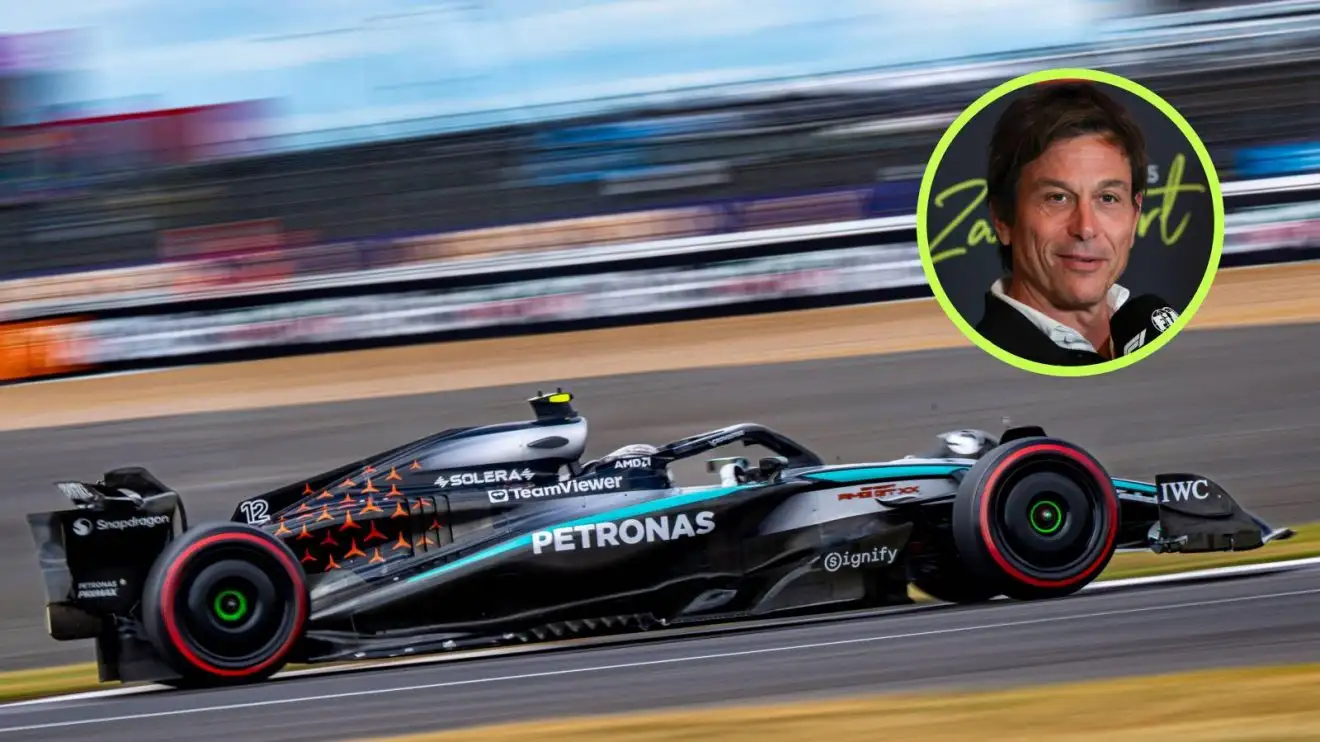
Toto Wolff and Hywel Thomas have reacted to Mercedes' 'favourites' tag ahead of the 2026 power unit regulations changes.
The rumour mill suggests Mercedes will have the power unit to beat at the start of the F1 2026 season, rumours which have been addressed by Toto Wolff.
Having had a clear advantage at the start of the last engine regulation change in 2014, Mercedes has been tipped as the power manufacturer to beat once again in 2026, according to paddock rumours.
Toto Wolff: Mercedes are ‘glass half empty’ people
Want more PlanetF1.com coverage? Add us as a preferred source on Google to your favourites list for news you can trust.
With the engine regulations changing to a new evolution of the 1.6-litre V6 hybrid, focusing on increased electrification and sustainable fuels, F1 2026 is likely to be the first year in many to be influenced by disparities between the performance of the offerings from the five engine manufacturers on the grid.
Coming off the back of a four-year engine freeze, the manufacturers have been hard at work on creating the new-generation engines, which will hit the track for the first time in late January when the 11 F1 teams turn up at the Circuit de Barcelona-Catalunya for a collective five-day closed-doors test.
With the ratio of power between the internal combustion engine and the electrical ancillaries now at a 50/50 ratio, the new units have represented a huge engineering challenge as the intent has been to ensure no significant drop in laptime compared to the outgoing regulations.
To make this happen, the chassis regulations have introduced active aerodynamics in order to increase downforce through corners and reduce drag down the straights.
No aspect of the new regulations is the work of a moment, but one of the big question marks heading into the F1 2026 season has been which of the power unit manufacturers is the favourite to get things right from the get-go.
While the FIA has outlined the details of ADUO (additional development and upgrade opportunities) available to power unit manufacturers struggling at the start of the new cycle, it’s quite likely one or two manufacturers will enjoy a clear advantage before the usual natural convergence begins.
As for who those favourites might be, gossip must always be taken with a large pinch of salt, but a consistent name whispered about in the paddock is Mercedes’ High-Performance Powertrains, the Brixworth-based power unit engineering arm of Mercedes.
Supplying its own factory team, Mercedes HPP will also supply reigning Constructors’ Champions McLaren, as well as Williams and new signing Alpine, in 2026.
Appearing on the Beyond the Grid podcast, Mercedes’ CEO and team principal, Toto Wolff, was asked about his level of confidence going into the new year, given the favourites tag that has been thrust onto the power unit side of the business.
“Never confident. We are glass-half-empty people, never half-full,” he said.
“It starts with the enemy in the house. McLaren has been the better team this year with a Mercedes power unit.
“So, if the power unit were to be superior, which we never say and we never feel entitled to say so, then you’ve got to beat Williams, you’ve got to beat McLaren, and you’ve got to beat Alpine.
“Some of them will have had more development time in the wind tunnel because they’ve not been placed very well in the Constructors’ Championship.
“Some will have come with innovation that maybe we haven’t spotted, etc, etc. So you can’t take anything for granted, even if our power unit, the Mercedes power unit, was the strongest.
“On top of that, these rumour mills are always dangerous, because someone, somewhere in another team or another power unit manufacturer or fuel supplier will think, ‘Well, we like to position you guys in the favourite role, but we are coming’, and that’s why we are not being carried away by any gossip that’s been discussed at the hairdresser.”
More on Mercedes in F1
Who is Bradley Lord? Meet Toto Wolff’s trusted Mercedes lieutenant
Andrew Shovlin details Mercedes’ suspension misstep after ‘confusing’ European run
Hywel Thomas: God knows how the paddock knows our power levels!
Appearing alongside Wolff was Mercedes HPP managing director Hywel Thomas, the engineer responsible for overseeing the entire engine programme.
He revealed that, in the last major regulation change when F1 ditched V8s for the hybrid V6s, he believed Mercedes was in a state of peril ahead of the 2014 season; fears that turned out to be completely unfounded as the engine proved the class of the field.
Joking that he feels “really similar” about his engine’s prospects for 2026, he admitted that there is rarely an off-season in which he believes Mercedes has found enough power and reliability and that “everything isn’t good enough”.
But, more positively, he reckons the three pre-season tests – one in Barcelona and two in Bahrain – will be sufficient to iron out any kinks before the racing season begins.
“I think it’s enough for our preparation,” he said.
“There’s been a lot of investment over the years in dynos, in the way that we run in the factory, even virtual running, and to get yourself prepared.
“Getting that first test will be important to shake it all down, because there’s so much interaction, so much new… car, tyres, everything. So I think that’s probably long enough to keep us going.
“The pecking order, we never think we’ve got enough power, we never think we’ve got reliability, and we never think we’re the best at putting that down on the track.
“If you always think you’re a bit behind and you’re always pushing to get that extra bit, I don’t think that’s a bad thing.”
Addressing the rumours of Mercedes being a step ahead, he said, “Quite frankly, I don’t know how much power we’re going to get to the first race, so God knows how the rest of the paddock knows what we’re getting there!”
But Thomas did reveal that the nature of the regulation changes opens the door for someone to steal a march on the rest of the field.
“Always possible. Definitely always possible,” he said.
“Although the regulation set was put together in a way to try to avoid that.
“So there are some constraints on there that do constrain you to certain ways of doing things. So if that’s gone well, it’s less likely that someone’s going to steal a march.
“But who’s to say someone hasn’t found a loophole, hasn’t found the amazing thing that nobody else has?”
Asked about the factors that will differentiate the five power unit manufacturers from each other this year, and whether it’s as simple as down to just how aggressive each manufacturer has dared to be while striving for reliability, Thomas said that it will play a part.
“I think the project was very much of our own building,” he said.
“The elements all existed, so you’re talking about putting incredible stretch targets on yourself and taking some leaps and doing that.
“But it was all created by ourselves. It wasn’t unlike the fuel, where the sport’s gone, ‘You’ve got to do this’.
“For us, it was more, ‘How are we going to pull this together? What should our part targets be, and where should we be investing our cash?’
“Because, at the same time, we’ve been added into a PU cost cap, so that’s another competitive element that all of a sudden appears.
“Where advantages come from, I think there are probably three elements, I’d say. Crank power is always going to be. We love crank power, and that’s going to be one of them.
“The efficiency of the electrical system, the more efficient you are with your electrical system, the more time you’re going to be able to keep it on, which means you’re going quicker.
“But I think the third element is, how does it all work together? How do you make that work together? How do you transiently get, use all that energy? How do you transiently use the power? How do you interact with the car, a completely new car?
“How do you interact with the driver? The driver is going to be able to do one straight incredibly quickly, if they really want to, but they’ll be knackered for the rest of the lap, so they can’t do that even if they want to.
“So that strategic element and working out where you use all of this, I think, is that there’s a big part of that too.”
But, while the way the racing will play out requires a big change in thinking from the driver and team in terms of execution, the actual overhaul of the regulations hasn’t been as revolutionary as the one introduced in 2014.
“I remember back to when we were first talking about those regulations around 2012/2013, you looked at it, and you thought, ‘Oh, my God, there’s stuff in here that we’re genuinely inventing’,” Thomas laughed.
“That electric turbo, running an electric motor at over 100,000 rpm, these things just didn’t exist, and we were having to invent that stuff. What a push and what an incredible project. Plenty of dips in the road, but that was incredibly difficult from a hardware point of view.
“I think this 2026 regulation set, any element within it, you can take a battery, we can take the electric motor of 350 kilowatts, they exist.
“Okay, they don’t exist in an F1 framework. They don’t exist in the right size, the right shape, but they do exist. So, in that way, this regulation set doesn’t feel as big.
“But what is going to definitely change with this regulation set is the interaction with the driver. Because of the electrical aspects of it, we are generally going to be slightly energy-limited.
“So it’s going to be working with the driver to make sure they’ve got the right energy at the right time to defend, to attack, to go as quickly as they can.
“It’s definitely going to need some real thought from the driver and from the engineers around them to understand how to go racing and how to do this the right way. I think that is a bigger challenge than the one we faced in a similar area around 2013/2014.”
Read Next: Max Verstappen ‘is motorsport’ as Red Bull boss hails single-minded approach


