

Why Mercedes holds F1 2026 edge over its customer teams, including McLaren
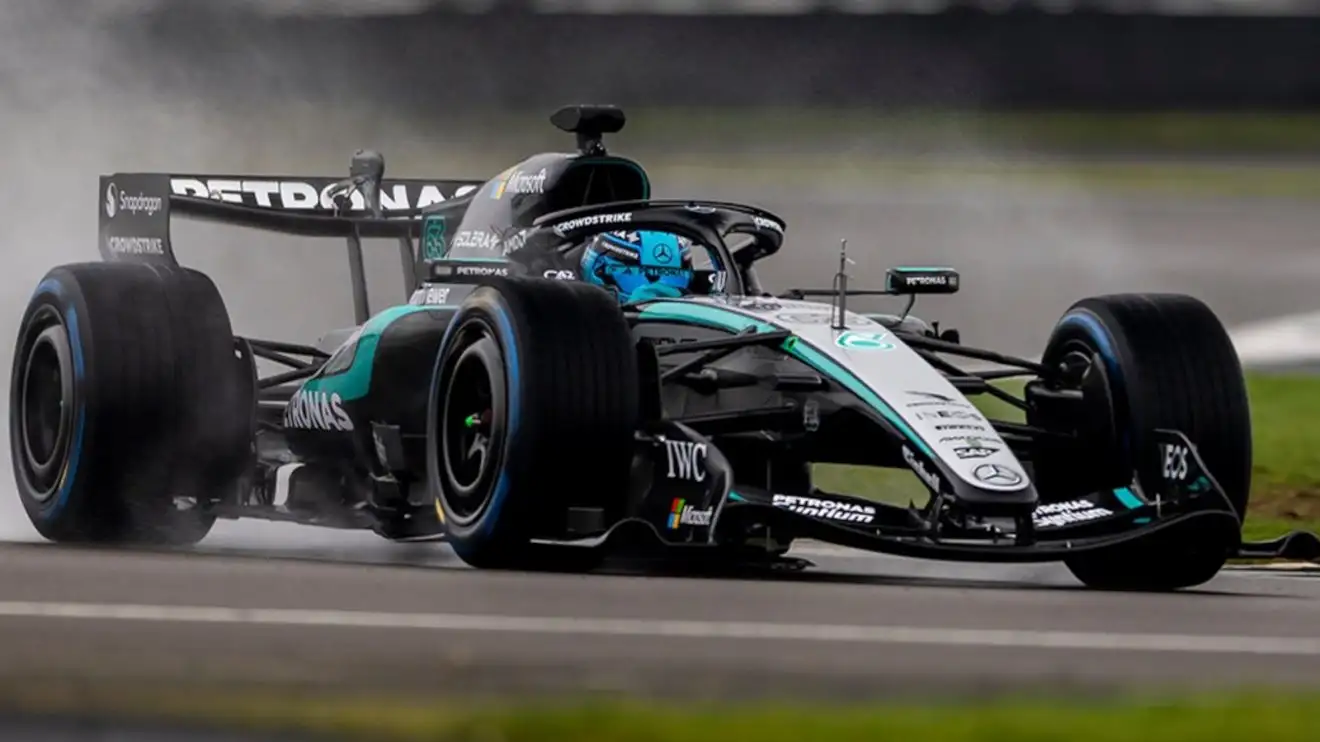
George Russell W17 shakedown, credit Mercedes F1 team
Mercedes enters F1 2026 with an advantage over its customer teams, including McLaren, because it could integrate its engine into the W17 chassis from the start of development.
And that, says Bernie Collins, is one of two notable advantages for the Brackley squad’s works team.
A ‘theoretical advantage’ for Mercedes and its customers
Want more PlanetF1.com coverage? Add us as a preferred source on Google to your favourites list for news you can trust
This season Formula 1 has tweaked the engine regulations, dropping the MGU-K and putting more emphasis on electrical energy, with the engines powered by a 50:50 split between electrical and combustion. They will run on fully sustainable fuel.
This season there are five manufacturers on the grid in Mercedes, Ferrari, Red Bull-Ford Powertrains, Audi and Honda.
Formula 1’s power unit regulations Appendix 4 1.4 states that “each power unit manufacturer must submit one homologation dossier which applies to all Competitors it intends to supply. Only the fuel specification, the engine oil specification and power unit wirings may differ between Competitors.”
It goes on to state that “all power units supplied by a single power unit manufacturer must also be operated in the same way, they must therefore be:
“a. Identical according to the dossier for each Competitor.
“b. Run with identical software for PU control.
“c. Capable of being operated in precisely the same way.”
More on F1 engines
F1 2026 uncovered: How Boost, Overtake, and sustainable fuel change the game
Explained: F1’s complex power unit upgrade system
But while Mercedes’ three customers – McLaren, Alpine, Williams – will also receive the same power unit that Mercedes puts in its W17, the Brackley squad has the advantage of being able to design the engine and the chassis together to optimise the entire package.
In contrast, McLaren, Alpine and Williams had to wait on Mercedes to send them details of the engine before they could refine the design of their cars.
“When the engines are designed, each team – customer or works – requires the same hardware and software,” former Aston Martin strategist Collins explained to Sky F1.
“So, if Mercedes produce five engines, theoretically, the ones that go to Mercedes should be exactly the same as the ones that go to McLaren.
“Where the works team has an advantage is if they had a particular design philosophy. For example, they want to put the oil radiator on the right-hand side of the car for whatever reason.
“Then they will work more closely with the integration of the engine, how the pipes are positioned around the engine, where the oil pickup is – whatever the required elements are.
“So, it’s things like that which sounds little from the outside, but actually, the more that you can integrate your chassis design with the engine design, the lighter the overall package will be.
“When I was working at McLaren in 2012-13, we had our engine supplied by Mercedes. At the beginning of the year, Mercedes would send you a CAD model of their engine, and you’d put that into your CAD and try to build around it, making sure everything you’re designing on the car fits around the engine model you’ve been given.
“But the thing with the customer relationship is that you get that engine model maybe once a week or every two weeks, while for the works team, it’s updating live.
“It’s maybe improved over the years, but there’s been many instances when you’re working around an old version of the engine model, and then a new version comes through and suddenly something doesn’t fit. So, it can just slow down the entire design process on the chassis side.”
Collins also noted another advantage that Mercedes will have over its rival engine manufacturers, it has four teams to gather data about the engine whereas the likes of Audi and Honda, who will power Aston Martin this season, have just one team running the power unit.
“All the teams running a Mercedes engine should have a theoretical advantage from there being four of them, because Mercedes are getting four times as much as data as the likes of Audi and Honda, who will have just one car on track with their engine in it,” she added.
Even before the first lap in anger in F1 2026, Mercedes and Red Bull have reportedly found themselves in the middle of an engine controversy with the two manufacturers said to have found a loophole in the wording of the regulations.
Relating to compression ratios, which are set at 16:1 this season when measured in ambient temperatures, it has been alleged the two manufacturers have designed their engines such that, when at normal operating temperature, that ratio increases.
A higher compression means more power and improved fuel efficiency that could be worth as much as 15bhp, and several tenths of a second per lap.
Want to be the first to know exclusive information from the F1 paddock? Join our broadcast channel on WhatsApp to get the scoop on the latest developments from our team of accredited journalists.
You can also subscribe to the PlanetF1 YouTube channel for exclusive features, hear from our paddock journalists with stories from the heart of Formula 1 and much more!
Read next: Main Ferrari target emerges in Lewis Hamilton race engineer search – reports


