
Winners and losers from the 2026 Dutch Grand Prix


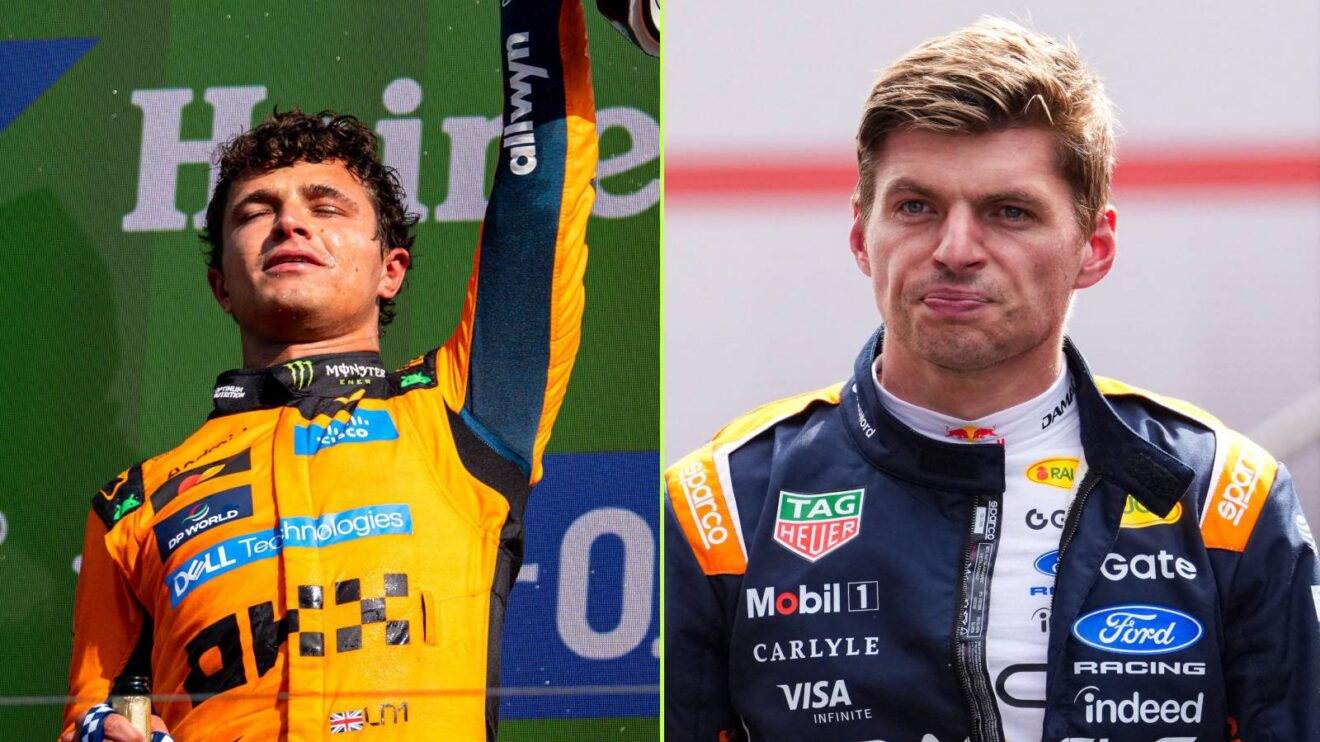
Lando Norris and Max Verstappen each feature on the Winners and Losers list from Zandvoort, for differing reasons...
ZANDVOORT – Lando Norris underlined McLaren’s resurgence with victory at the Dutch Grand Prix, while it was a disappointing farewell to his home race for Max Verstappen.
Here is PlanetF1.com’s full list of winners and losers from the 2026 Dutch Grand Prix.
Winners and Losers from the 2026 Dutch Grand Prix
Winner: Lando Norris
Following up on his emphatic Hungarian win with a second consecutive victory, the nature of Lando Norris’ win won’t have been lost on Mercedes.
Having faded in the Sprint race, McLaren made gains on the setup and tyre understanding to bring Norris into a better window for the Grand Prix and, no matter what Kimi Antonelli did, he was unable to shake off the attentions of the British driver.
On Lap 54, having built up a seven-lap tyre offset to Antonelli, Norris’ superior pace saw him sail around the outside of the championship leader in undisputed fashion, before seizing the lead from Lewis Hamilton later in the lap.
“I saw Lewis defended and I knew that was my moment,” Norris said of the clincher.
“I did a couple of clicks of brake balance. I knew I was going to commit to the braking, and that move won me the race. So, well played from my part.
“I knew I had to make it, and I probably had one chance to really make it happen, and I made the most of it.”
With Norris and his crew turning things around after the disappointment of the Sprint, the rapid development of the McLaren through the mid-season is starting to reignite the championship battle – something that Toto Wolff said Mercedes is “very conscious of” as the W17 has been beaten on merit at two consecutive races.
With an 80-point deficit to overcome against Antonelli, Norris will still need a miracle from here to successfully defend his crown, but the British driver is raising his game proportionally to the car’s step-up, something that Oscar Piastri isn’t yet able to do.
Norris’ overcoming of his own self-doubts following his championship win has unlocked a new level of performance from himself, and an assured self-confidence that he is as matter-of-fact about as he was when revealing his own internal mental battles in the past.
“I know how good of a job I’m doing behind the wheel,” he said.
“And of course I’m never one to over-talk about myself, normally always the complete opposite.
“But for once I would give myself a little bit of credit that I feel like I’m doing a better job than everyone, and I think that can also make a difference. We certainly have a car now capable of beating them.”
Another factor that separated Norris from his immediate rivals was something Andrea Stella pointed out afterwards: the reigning World Champion appeared to have a better feel and understanding for the hard tyre, which proved crucial in making the different relative to Antonelli.
From here, it’s all about development: McLaren has outdeveloped Mercedes over the first half of the season, but the advantage Brackley and Antonelli has is large. While Wolff has downplayed how significant Mercedes’ updates will be, saying the team “doesn’t have the money” left in the budget cap, Andrea Stella bluntly said he “doesn’t believe that”.
If McLaren can beat Mercedes at Monza, a track with very different characteristics to Budapest/Zandvoort, then Norris can really start dreaming of a Max Verstappen-esque comeback.
Loser: Max Verstappen
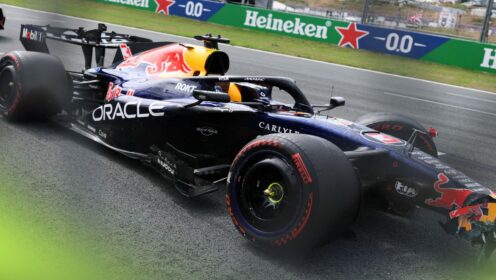
It’s not often that Max Verstappen is responsible for ending his own race early, but Sunday’s race at Zandvoort was perhaps the first example in over a decade of the Dutch driver being the creator of his own demise.
While crashes with other cars always have an element of divided culpability, simply spinning or crashing out of a race by himself is something Verstappen just doesn’t do – and hasn’t done since the 2016 Monaco Grand Prix.
There’s no denying that the four-time F1 World Champion wasn’t quite himself over the weekend, with Verstappen visibly lacking energy in the media pen as he spoke, with his eyes giving away that he was battling illness.
Given his feeling unwell, it may explain why Verstappen made the small error in judgment that resulted in his crash – touching a white line on a banked corner with a still-slippery damp surface was always going to be a recipe for disaster.
While he spoke in his pen appearance of welcoming a short break in order to recover after “not feeling great” all weekend, he didn’t lean on it as an excuse for his rare error, just holding his hands up to say that he had been “caught out” as the corner was slightly more damp than he’d anticipated – meaning he shouldn’t have attempted to plant the throttle as early as he did.
Realistically, a big result likely wasn’t lost, with Red Bull clearly the fourth-quickest team, as Laurent Mekies said there is “nowhere to hide” on the fact that the RB22 appears to be a step behind rivals after the summer break.
Winner: Nico Hulkenberg
“A hell of a save” was Allan McNish’s summary of Nico Hulkenberg’s reactions to save Audi’s race on the first lap, and potentially Gabriel Bortoleto from being injured in what would have been a very nasty T-bone shunt.
Bortoleto, like Verstappen, had lost control of his car through the banking and Hulkenberg, bearing down on his teammate, had to choose which side to go in a split-second as the gap between them disappeared.
Hulkenberg briefly looked as though he might end up ploughing into the side of Bortoleto but, somehow, managed to establish the momentum of the Brazilian’s car through the smoke and dodged to the left at the last moment to ensure both he and Bortoleto emerged unscathed.
“When I first saw Gabby spinning and then Nico coming out the other side of it, I didn’t quite realise that he had gone into the smoke,” McNish said.
“So it was a bit too much ‘Days of Thunder’ for my heart, but ultimately both of them did a good job.”
“I wasn’t sure where he’s going to go, if he was going to roll up or roll down,” Hulkenberg explained.
“So I was like hesitating until the last moment, and I think a good portion of luck not to hit each other there, but that was pretty too close for comfort.”
A well-executed race saw Hulkenberg use the soft tyres for two lengthy stints after the red flag restart, with his race helped by Arvid Lindblad and Pierre Gasly squabbling – a push from Lindblad forced Gasly wide, to enable Hulkenberg to go past and latch onto the Racing Bulls into Turn 1.
With four points finishes on the bounce for Audi, the Hinwil-based squad is emerging as a strong midfield force, with Racing Bulls and Alpine left to watch on as Hulkenberg came home in eighth to take the best-of-the-rest position.
More from the Dutch Grand Prix
Dutch GP Conclusions: No tears for Zandvoort, Verstappen power play, Lawson makes his case
Dutch GP driver ratings: Norris delivers again as Verstappen makes rare costly error
Winner: Liam Lawson and Yuki Tsunoda
Both of the Red Bull substitutions delivered at the first time of asking in their temporary cockpits, with Lawson going toe-to-toe against Verstappen in a spirited battle on the first lap.
Following Verstappen’s retirement, Lawson was left to pick up the pieces for Red Bull and he duly delivered the result that could be expected for the only driver of the fourth-quickest car on a day where the two drivers from the top three teams finished: P7.
It wasn’t perfect, as he was given a 10-second time penalty for failing to slow sufficiently for a yellow flag, although this is a transgression that isn’t car-dependent.
His race was exactly what Red Bull needed on a day where the car wasn’t fast enough to compete for more, and can give the team confidence that he can continue to be the best substitute option for Monza and Madrid, should Isack Hadjar not be fully healed by then.
As for Tsunoda, the Japanese driver picked up where he left off at Racing Bulls at the end of 2024 and, while the VCARB03 wasn’t fast enough for points on this occasion, he was not the weak link.
Indeed, his Lap 28 overtake of Alpine’s Pierre Gasly was beautiful – spotting that his friend had lost momentum by trying the inside line at Hugenholtz, Tsunoda got in position to force an opening through the sweeps and seized the inside line into Schievlak.
Having progressed “faster than he expected”, Tsunoda’s drive showed that his problems last year weren’t all down to him, he reflected on his weekend as “overall positive”, and had a funny moment in the press pen when he was asked whether he believes he’s increased his chances of finding an F1 refuge next season as the remaining slots are filled.
Before walking away, he smiled and said, “Call me, please!”
Loser: Ferrari
Would Lewis Hamilton have finished on the podium with a more decisive call from the pitwall to get him in front of Charles Leclerc when the pair were on different tyre strategies?
As our data analysis suggests, it’s quite possible – Hamilton needed Leclerc out of his way to capitalise on his superior hard tyre pace, but Ferrari opted against instructing the Monegasque to do so.
It led to a series of spirited team radio messages from Hamilton, including one where he he sarcastically praised the team’s ‘great job’ in wasting precious seconds.
The loss of time meant that Hamilton’s late stop for fresh rubber reduced his chances of pulling back the British driver and, with a late VSC on Lap 70, what was his remaining best chance was lost.
As he pointed out later, Mercedes executed differently by instructing George Russell to move aside for Antonelli immediately.
“What’s clear is I’m looking ahead and seeing the Mercedes – they execute like that. They’ve got the car. They’re fighting this for the championship, and they did it straight away. And here I’m sitting back, losing seconds. Something that we need to discuss offline.”
But Hamilton, out of the heat of battle, declined to be overly critical of his team and, instead, pointed to the pride he has in them for having more updates ready for Zandvoort.
As for Leclerc, he lost out on the restart to Oscar Piastri, but a swap to the medium tyre for the ‘second’ stint proved difficult as the hard tyre emerged as the better race tyre.
Winner: Kimi Antonelli
“We’re clearly not the fastest car anymore on the grid,” Antonelli posited after finishing second to preserve his championship lead over Russell at 59 points.
“We’re probably second or third, at least in today’s race, and McLaren has taken a huge step, especially since Hungary, since the big upgrade package they brought.”
Antonelli took the lead from Norris at the start, and controlled the first half of the race but, on the hard tyre, began to struggle for feel as he took to team radio to complain about what felt like aero degradation.
“I felt decent on the first hard, but then on the second one it just felt really odd, really odd to drive, and just sliding a lot,” he said.
“I need to see why it was that, but for sure it’s something that we need to look at because the drop in pace was quite significant.
“I mean, I think in the first stint I was almost matching my second hard in terms of pace, so for sure I need to look into it and why it went like that. But, yeah, happy with the P2 today.”
With Antonelli saying earlier in the weekend that the return to racing has been a “wake-up call” in emphasising to him how he needs to remain at the top of his game if he is to turn what looks like a relatively relaxing lead into a maiden title, the Italian did just that through the remainder of the weekend.
Realising that fighting Norris too hard was pointless, Antonelli took the measured approach to bank a solid result on a weekend where it was evident McLaren had the superior package over a race distance – and it’s in those moments of circumspection that titles can be won and lost.
But, given his belief McLaren is now superior, he suggested upcoming races could rebalance the scales back in his favour.
“I’m confident with the team,” he said.
“The team has been working super hard on this next package that is coming up, and they just want to make sure that it’s going to work out well once we put it on.
“So for sure, in this race, it’s going to be more difficult, it’s going to be challenging, but we’re ready to do our best and to maximise every opportunity. And then hopefully it’s going to be our turn to bring the package that’s going to give us a little bit of the upper hand again.”
Loser: Williams
16th and 17th for Williams on a day where it became clear that Aston Martin has moved into the midfield, but added to that was the ignominious way the team’s race petered out as Carlos Sainz and Alex Albon made hefty contact into Turn 1.
Granted, there was nothing more to it other than it being a clumsy moment for Sainz, brought on by locking up on ancient tyres, but it was an undignified and uncoordinated incident that was wholly unnecessary.
“It’s not a Verstappen/Ricciardo incident!” Albon said, referring to the infamous Baku clash between the former Red Bull teammates.
“It’s less serious than that. So yeah, it happens. I think I was on better tyres than him at that stage in the race.
“He locked up, and I saw him lock up, so I immediately tried to follow him in a straight line. But we made contact, and my floor was pretty damaged, so we had to box.”
Sainz was apologetic for the incident, a second messy incident in two weekends for the Spaniard.
“When I went to brake on the inside, there is a massive bump in the inside of Turn 1,” he explained.
“When you are further on the inside, the bigger it gets. I just hit it with the plank. I had the front tyres in the air, and, as soon as I touched the brake, I locked up and I took Alex with me, which is the worst possible outcome for that race because it’s not like we were fighting for anything big.
“Apologies to him because it’s the last thing I wanted.”
With Sainz revealing that, on race pace, Williams is only ahead of Cadillac at present after Aston Martin’s AMR26 upgrades, the team is “pretty much where we expected”, and that position is currently quite distant from the points places.
Winner: Fernando Alonso
Rival teams suggested to this writer before the weekend that Aston Martin’s pace in Hungary had made them sit up and take notice, and Alonso proved those worriers correct with a stellar drive in the Netherlands.
It’s been a while since we’ve heard an Aston Martin driver talk about racing tactics, but Fernando Alonso was able to do just that after taking ninth place with a one-stop strategy.
“We were faster in the corners, and slower on the straights than our rivals,” he explained afterwards, revealing how clear track was what Aston Martin wanted – even if that meant abandoning a more conventional strategy choice.
With the focus being on circulating in clear air, it led Alonso to running a 28-lap stint on softs before swapping to the hards until the end.
It proved fruitful, and the AMR26 chassis has made “another step forward”, according to the two-time F1 World Champion, with the team optimising around the upgrade package.
While drivability and the Honda power unit remain less optimal, with downshifts and engine braking inconsistent on top of the power deficit, the efforts of Adrian Newey and Enrico Cardile to address the chassis problems are clearly reaping rewards – although don’t expect much from Monza.
His race was in stark contrast to Lance Stroll’s who retired mid-race with car damage from an unknown incident, with the effects of this meaning he was well off the pace.
Want to be the first to know exclusive information from the F1 paddock? Join our broadcast channel on WhatsApp to get the scoop on the latest developments from our team of accredited journalists.
You can also subscribe to the PlanetF1 YouTube channel for exclusive features, hear from our paddock journalists with stories from the heart of Formula 1 and much more!
Read next: Ferrari biggest strategy blunder emerges after Hamilton Dutch GP frustration