
How Azerbaijan GP exposed a problem F1 simply cannot fix


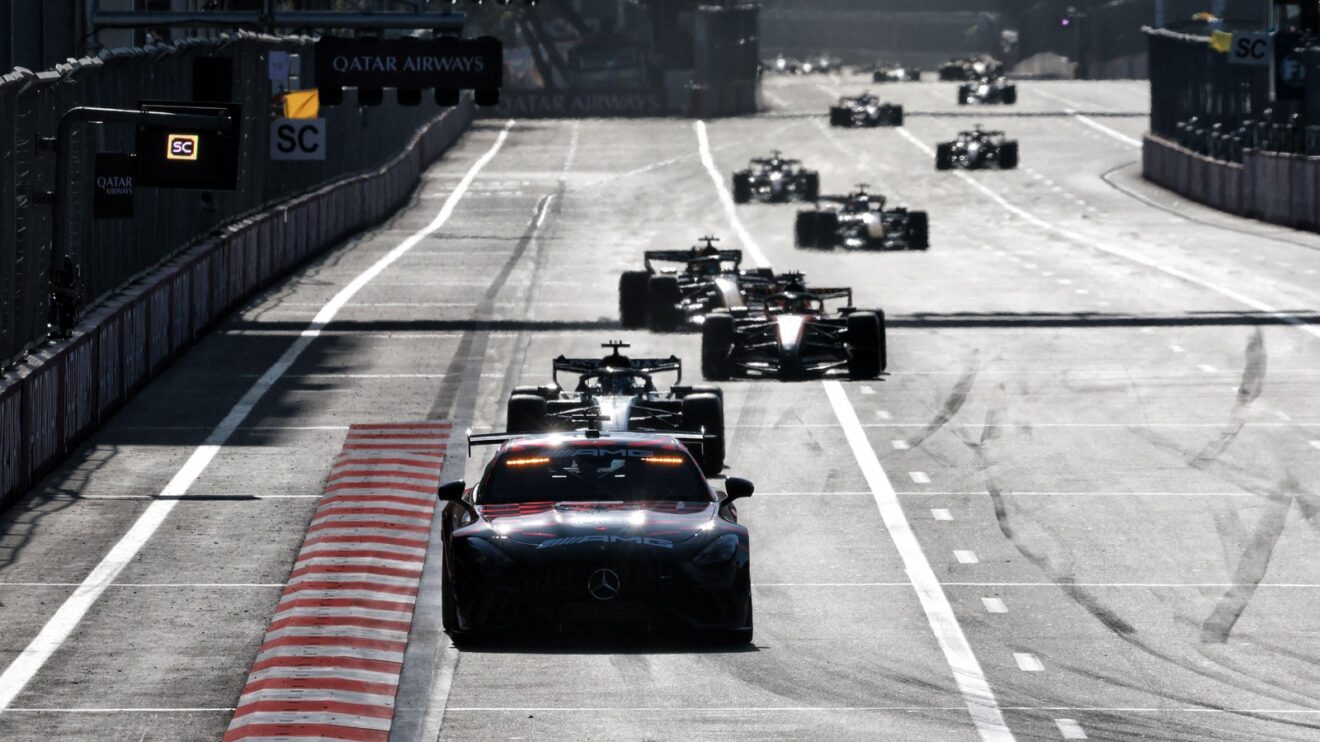
The safety car masked a key issue during the Azerbaijan Grand Prix.
Had it not been for two Safety Car deployments, which ultimately set up a thrilling late-race duel between George Russell and Max Verstappen, the 2026 Azerbaijan GP would have been an undeniably dull event.
The primary reason for that was the tyres, with telemetry data clearly revealing how there is no straightforward solution.
Why tyres make the Azerbaijan GP dull
It was known even prior to the race was that the hard tyre compound was almost guaranteed to see zero action during the Grand Prix.
FP2 demonstrated that both the soft and medium compounds were remarkably durable, while a quick look at last year’s strategy trends only reinforced that theory.
The sole difference was that last year’s hard and medium compounds corresponded to this year’s soft and medium allocations, following the introduction of the ultra-soft C6 compound the previous season.
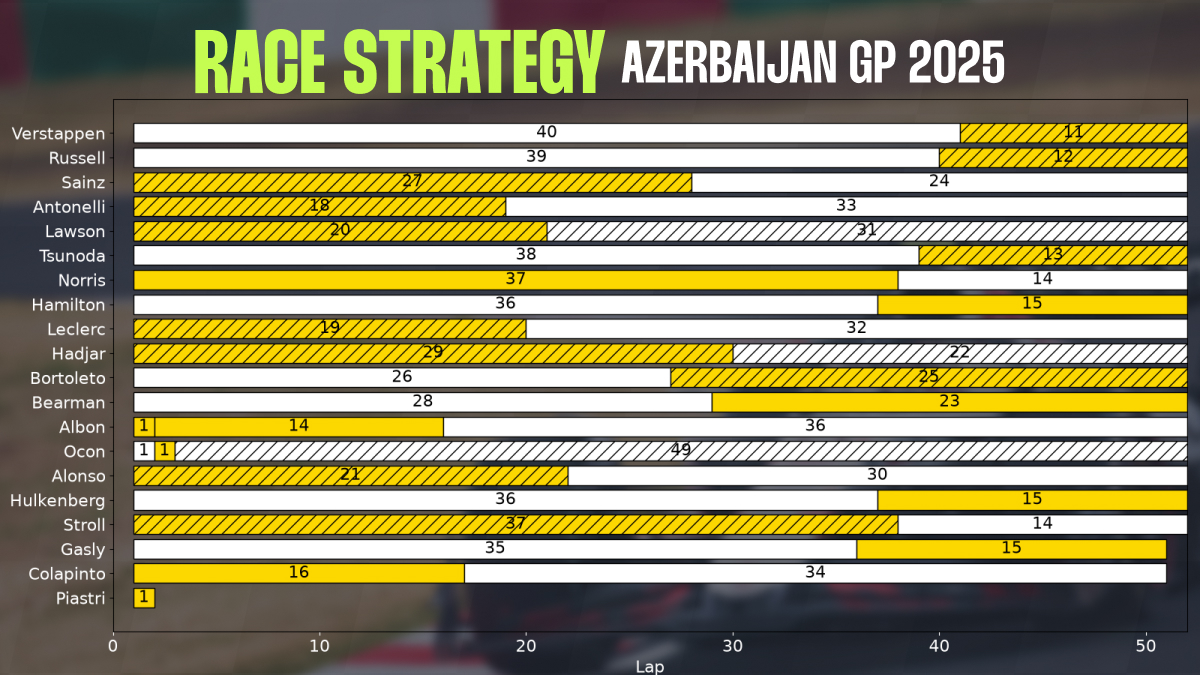
Thus, teams faced a straightforward decision (decidedly simpler than at other venues): start on either the mediums or the softs, knowing full well that the performance delta between the two compounds was minimal.
The softs could offer a slight edge off the line at the start, while the mediums allowed for a longer opening stint. As the race unfolded, however, even that divergence proved negligible.
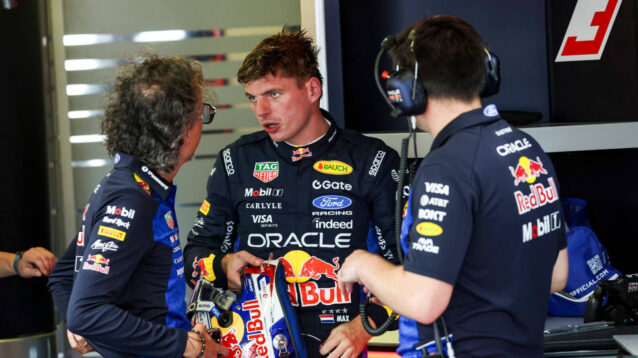
Prime evidence comes from the Red Bull garage.
Versatppen started on the yellow-marked mediums, while Isack Hadjar opted for the red-marked softs.
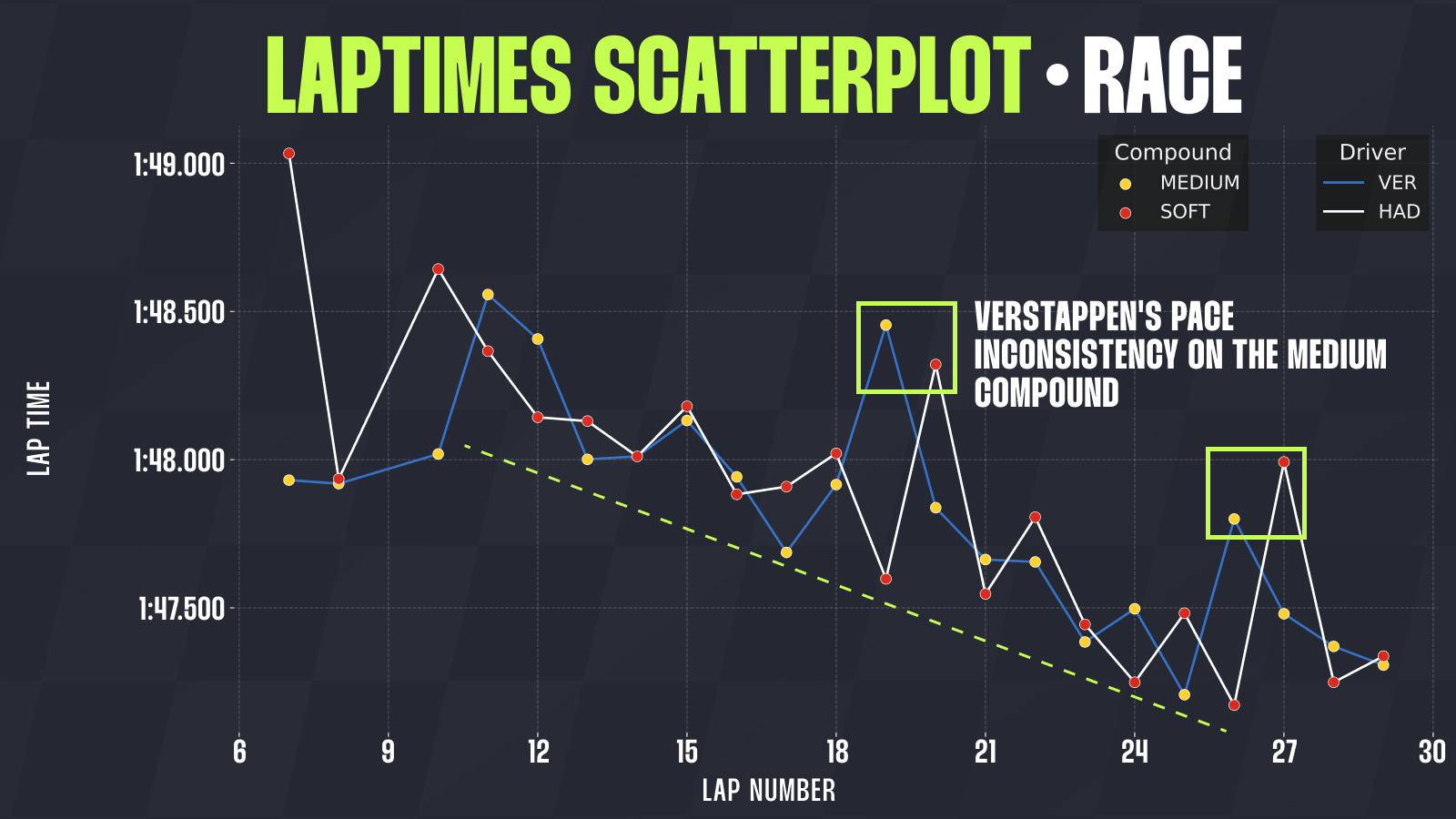
After twenty-odd laps, the Dutchman was complaining over team radio about his rubber, while the Frenchman insisted his tyres were holding up fine, suggesting he possessed superior pace. And telemetry confirms his assessment.
The graph below compares Verstappen’s and Hadjar’s lap times, with the former’s inconsistency evident as he suffered lap time drops on lap 19 and lap 26, whereas Hadjar remained remarkably consistent (even while having to back off a lap later on both occasions to maintain a safe gap behind his teammate).
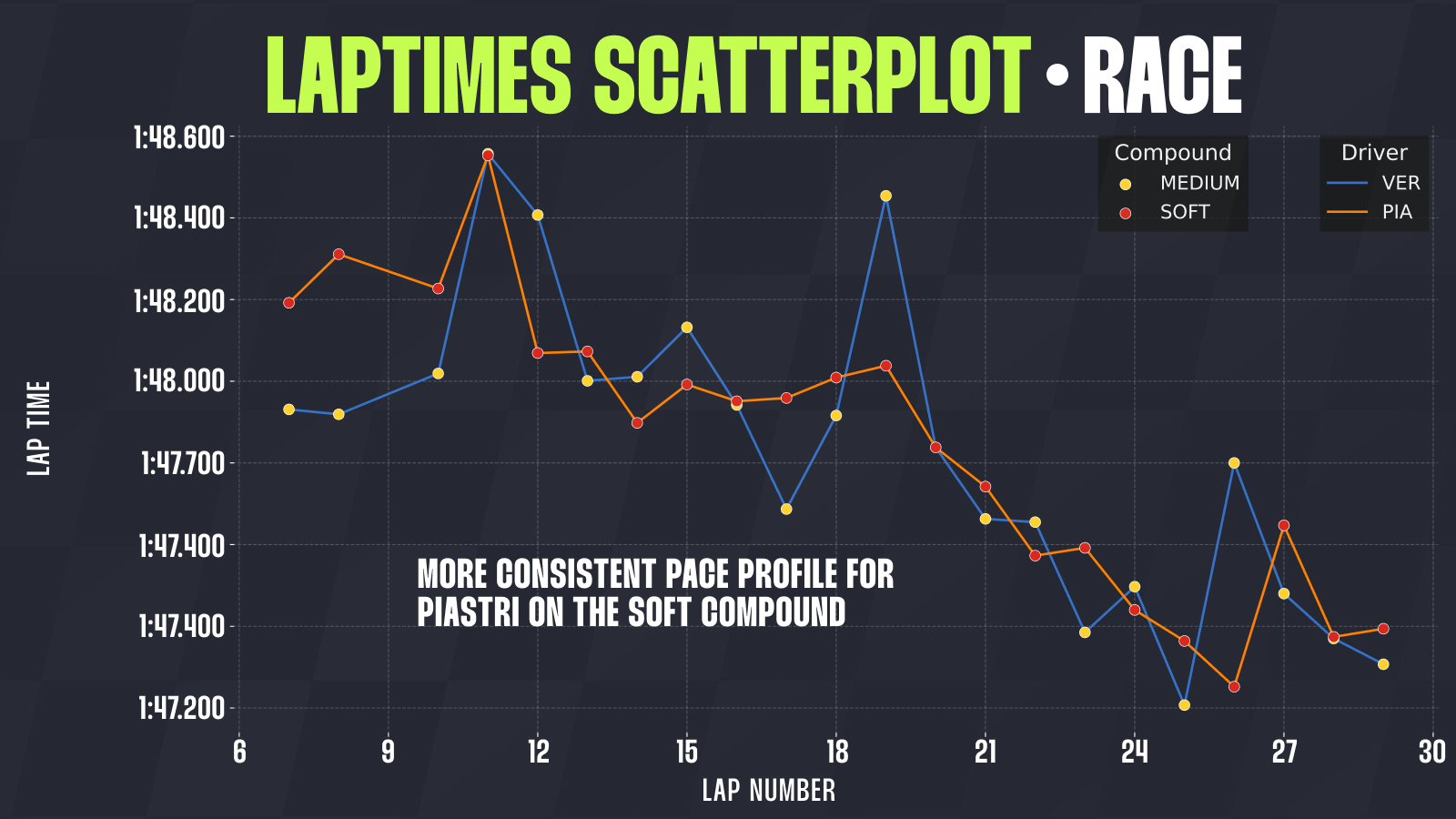
A similar trend emerges when comparing Verstappen to Oscar Piastri, who posted far more consistent stint times than the Red Bull driver.
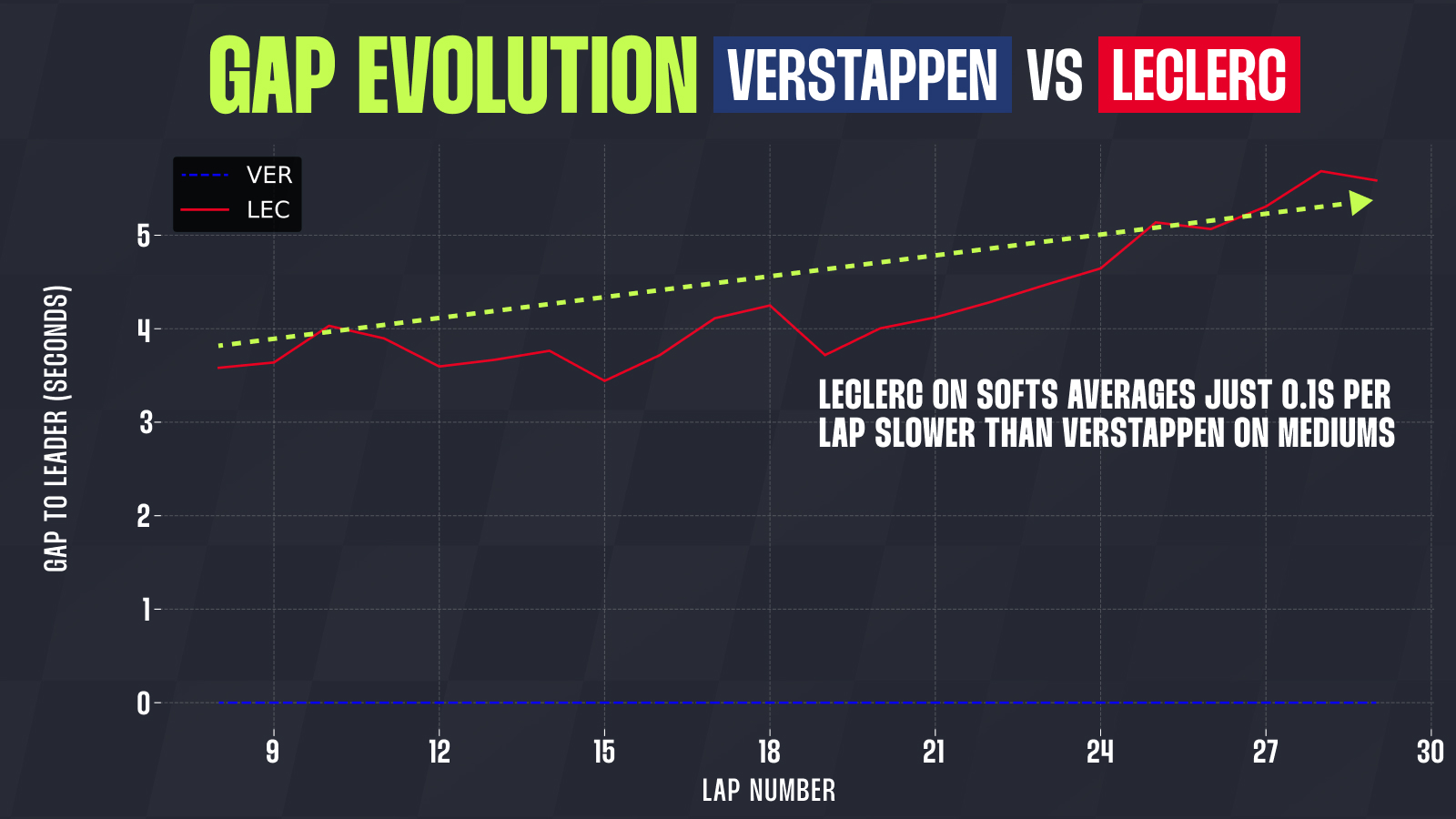
The Ferrari driver ran roughly 0.5 seconds off the pace on average, yet because he was running the soft compound while Versatppen was on mediums, the Monegasque was only 0.1 seconds slower per lap between lap 8 and lap 29.
Consequently, one could even argue that the soft compound was the superior race tyre overall.
Pinpointing a single root cause for this behaviour is virtually impossible as tyres are immensely complex systems influenced by countless operational variables.
Key contributing factors certainly included the dusty street asphalt, which severely compromised baseline grip, and Baku’s exceptionally long main straight, which significantly cools surface tread temperatures prior to braking for Turn 1.
This inevitably triggered a tactical waiting game: whether running softs or mediums, drivers simply coasted, waiting for the optimal pit window.
Lap times dropped continuously, and as long as the pace remained stable, there was zero incentive to pit early and surrender track position.
This stalemated dynamic was further amplified by a compressed field.
Norris was informed by his race engineer that Sergio Perez in P21 was sitting roughly 21 seconds behind him, which is precisely the pit-lane time loss in Azerbaijan, making a stop at that juncture entirely counterproductive.
The waiting game finally ended for all drivers on lap 31 with the deployment of the first Safety Car, which the entire field exploited.
Drivers on softs swapped to mediums and vice versa, though the strategic picture likely wouldn’t have looked much different even under green-flag conditions.
As observed during FP2 and reinforced after the restart, new tyres required at least one full warm-up lap to reach operating temperature. Any undercut attempt could have been easily neutralised.
Under such conditions, teams boasting superior outright chassis performance shine (most notably Mercedes, alongside Red Bull on this occasion), while squads that typically excel at tyre management (such as Ferrari) found themselves hamstrung.
F1 2026: The season’s winners and losers
The results of the F1 2026 championship
The F1 2026 Drivers’ and Constructors’ Championship standings
Why there is no easy fix
Fortuitously for spectators, two Safety Car deployments spiced up the spectacle, triggering a thrilling late duel between Verstappen and Russell for the race win.
However, this brings us back to the core premise: this tyre dilemma cannot be easily resolved.
Pirelli had assigned its softest available compounds for Baku; there was little else it could do.
Put simply, the magic of racing in Azerbaijan lies in the relentless concentration, and occasional lapses, of the drivers. A millisecond lapse in focus and you are instantly in the wall.
Grands Prix here have historically been decided far more by driver error and attrition than by pure on-track strategy.
The last time Baku witnessed a completely clean, incident-free Grand Prix was in 2016. That makes nine consecutive races featuring at least one Safety Car, Virtual Safety Car, or red flag.
Quite simply, that is the nature of racing in Azerbaijan. Without driver error, and any strategic variance, it’s a circuit that will lend itself to processional racing.
Want to be the first to know exclusive information from the F1 paddock? Join our broadcast channel on WhatsApp to get the scoop on the latest developments from our team of accredited journalists.
You can also subscribe to the PlanetF1 YouTube channel for exclusive features, hear from our paddock journalists with stories from the heart of Formula 1 and much more!
Read Next: Russell wins lights-to-flag in Baku as Verstappen charges and McLaren suffers double disaster