
Telemetry data uncovers new angle on Hamilton Leclerc Ferrari clash
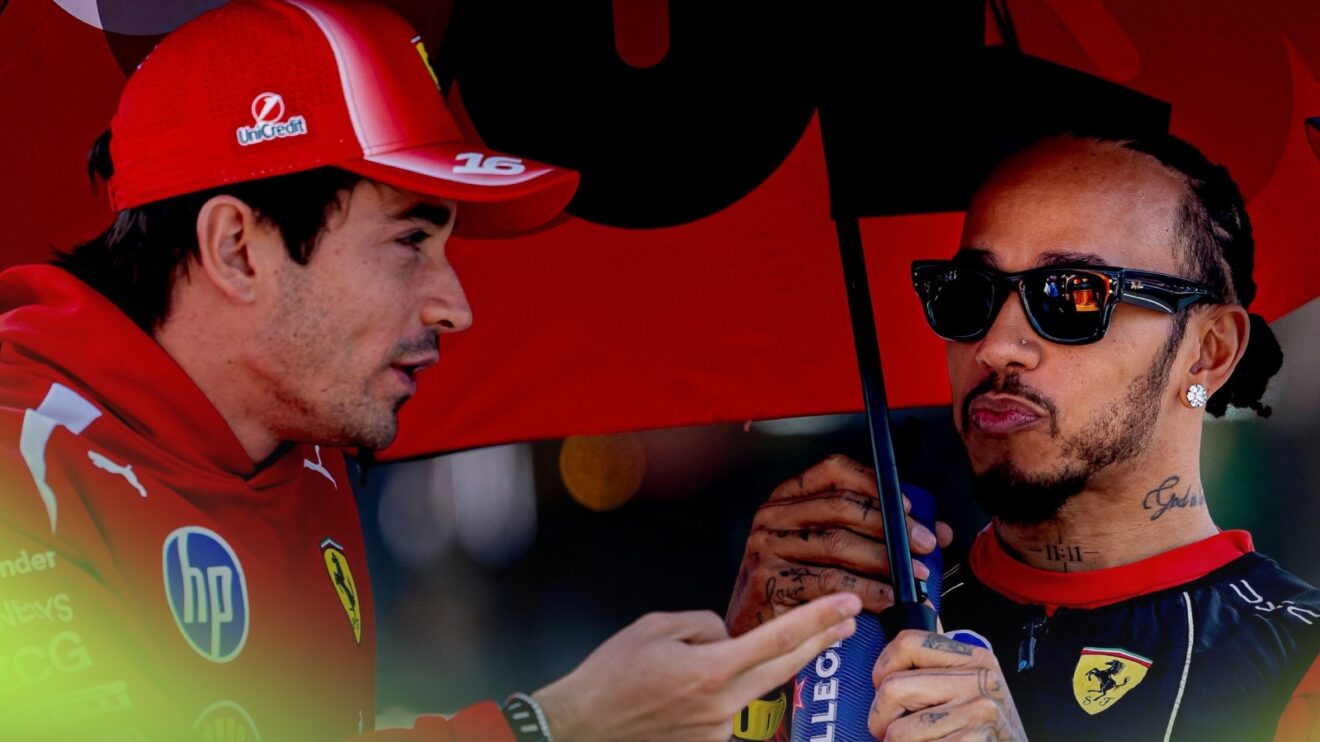
The reality is that by battling each other, Lewis Hamilton and Charles Leclerc effectively threw away victory and handed it straight to Max Verstappen.
In attempting to answer the question of who was to blame for the incident, who went too far, and whose responsibility it ultimately was, telemetry data offers a fresh perspective.
Who went too far in Hamilton-Leclerc incident?
Having secured pole position, Hamilton started Sunday’s race from the front of the grid, with Leclerc lining up third. However, the run down to the first corner in Mexico City is exceptionally long, allowing the Monegasque driver to capitalise on George Russell’s depleted battery and challenge Hamilton for the lead through the opening complex of corners.
Initially, the Ferrari drivers exercised mutual respect: Hamilton left room at Turn 1, Leclerc yielded on entry to Turn 3, and everything remained clean with the former retaining the lead. Then came the far-from-clean Turn 4.
Specifically, Leclerc secured a better initial exit out of Turn 3 and utilised the slipstream, which is notoriously potent in Mexico, down the ensuing straight to carry superior speed on the approach to Turn 4.
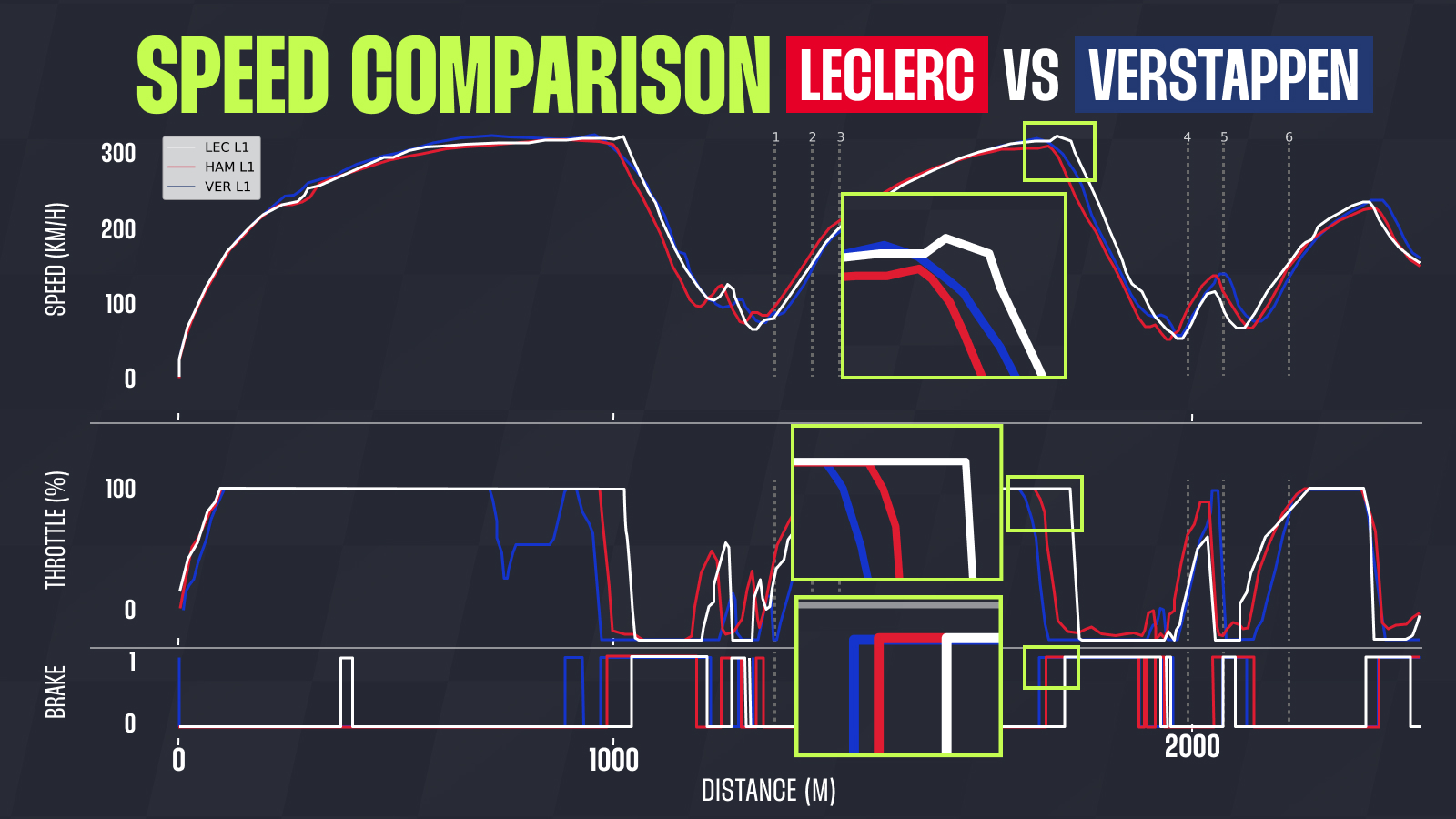
Data indicates that prior to braking, Leclerc clocked a terminal speed of 325 km/h compared to Hamilton’s 310 km/h, which is a massive delta.
However, a closer look at Leclerc’s telemetry reveals that he braked exceptionally late – a full 25 metres deeper than Hamilton – while lifting off the throttle roughly 40 metres earlier. His approach speed was simply too high, leaving zero chance of Leclerc successfully making T4 corner inside the white lines.
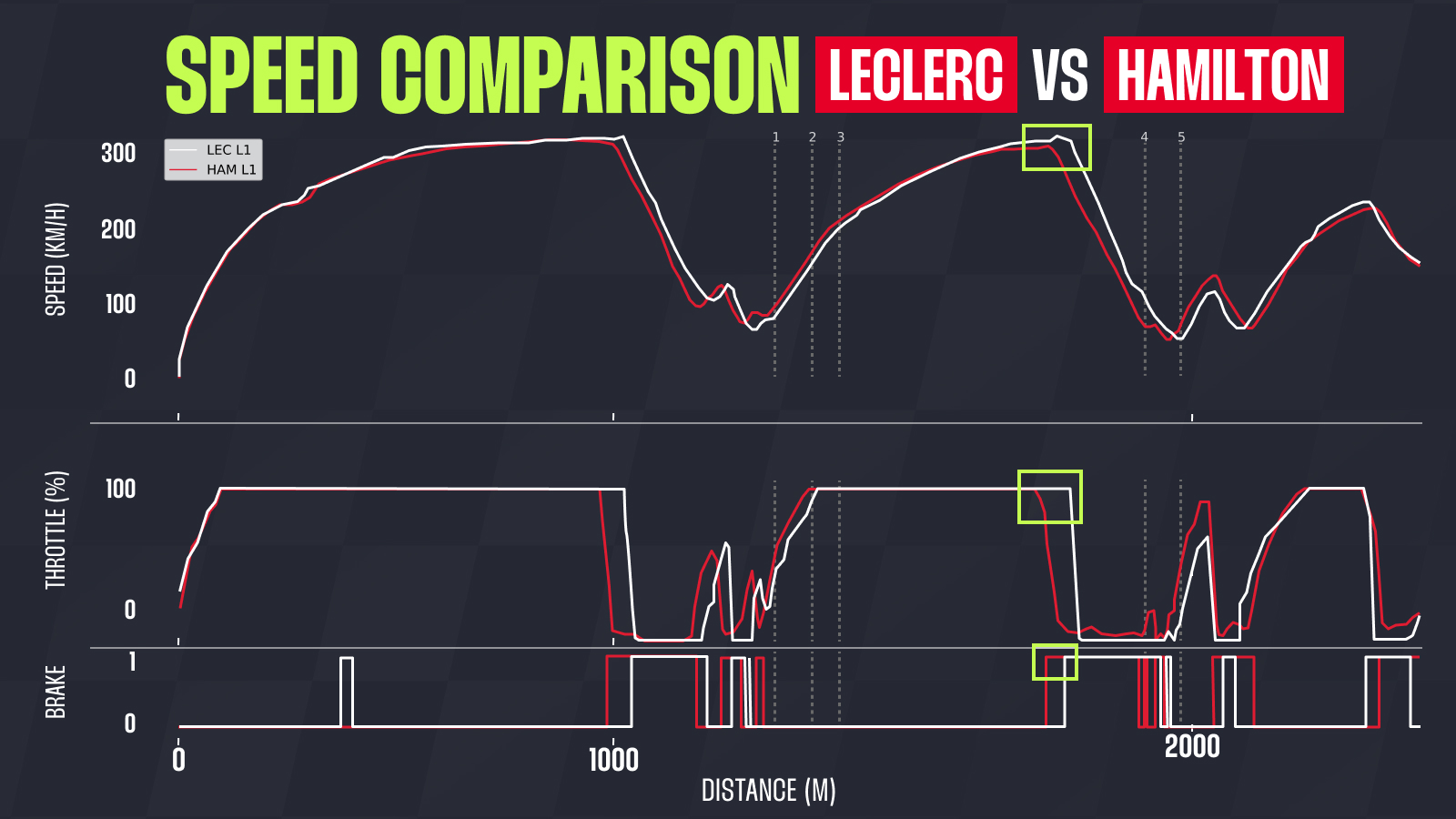
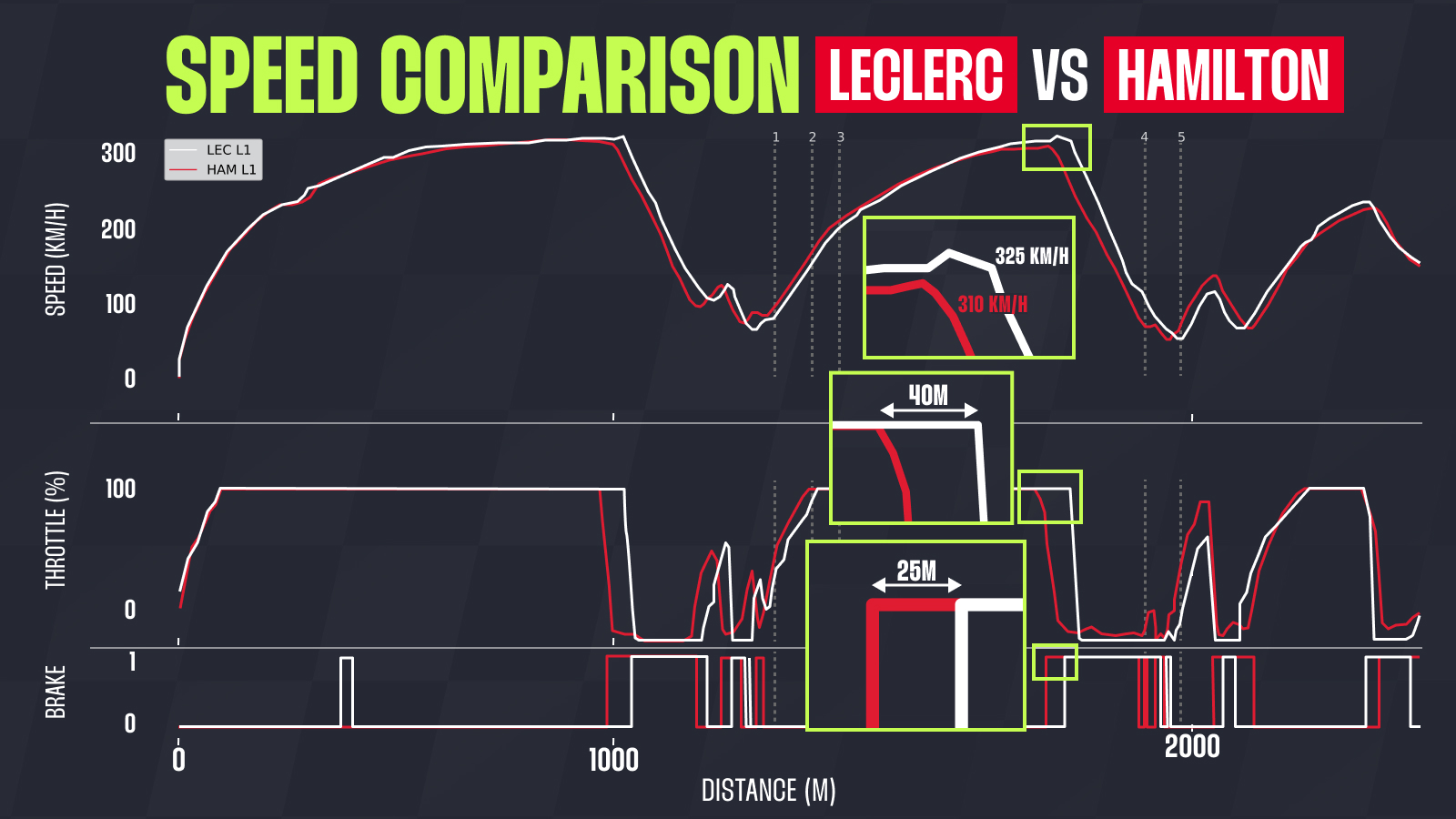
Further proof is found when comparing Leclerc’s first-lap speed with his fastest race lap set right at the end of the Grand Prix, when the car was significantly lighter. Even under those optimal conditions, his maximum speed before braking into Turn 4 was 320 km/h – 5 km/h slower than on Lap 1.
Reviewing the onboard footage clearly shows Leclerc locking his steering wheel to the left, yet the car simply pushes straight, leaving him with no option but to cut the corner and rejoin ahead of both Hamilton and Verstappen.
On the other hand, shifting to Hamilton’s perspective reveals an intriguing detail. Although his braking points were far more realistic and he initially managed to enter Turn 4 cleanly, at one point – presumably upon realising just how aggressively Leclerc was lunging – he applied a touch of throttle, as clearly shown on the graph below.
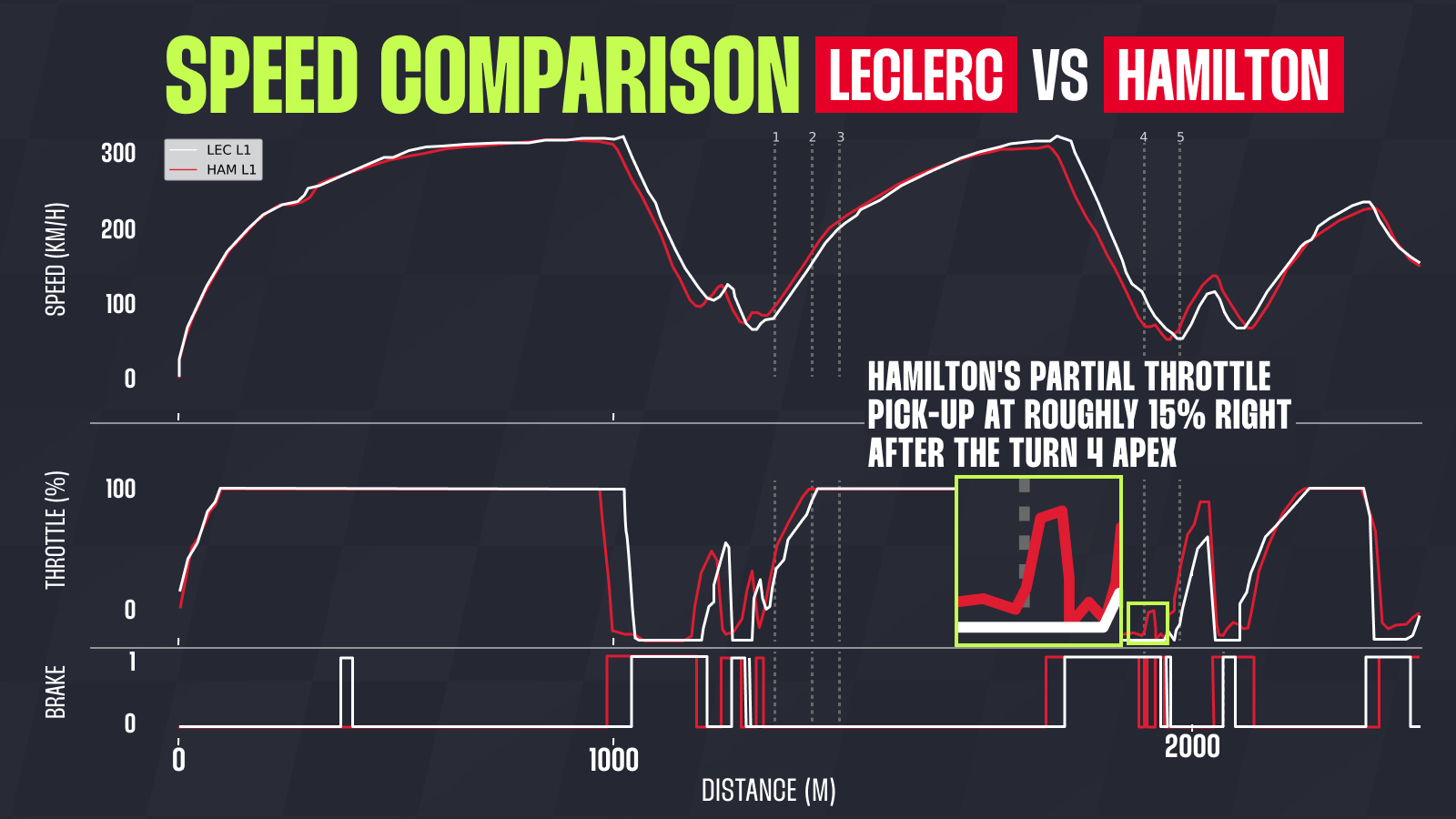
This minor throttle application disrupted his rotation through the corner, forcing him wide off the track on the exit of Turn 4 and severely compromising his trajectory through Turn 5.
An even clearer comparative baseline emerges when using Verstappen as a reference point.
We can see that both drivers braked late, but Leclerc’s dive was extreme. Hamilton, by contrast, matched Verstappen’s speed profile much more closely. It is reasonable to deduce that had he avoided that minor mid-corner throttle blip, he likely would have navigated the complex far more efficiently and retained his position relative to Verstappen.
Whether Leclerc would have been forced to hand the position back is impossible to know, but a scenario where Hamilton remained ahead of Verstappen would have dramatically boosted his winning prospects.
This is corroborated by race pace data: even though Verstappen spent the majority of the Grand Prix running in clean air, Hamilton averaged only 0.06 seconds per lap slower than the Red Bull driver. Overtaking on track was extraordinarily difficult, meaning anyone able to hold track position, and especially with clean air ahead, held a massive advantage.
We saw how Leclerc managed to pull away from Verstappen during the opening stint, though unfortunately for him, he couldn’t build a gap exceeding five seconds before losing position following the first round of pit stops.
In other words, the Ferrari drivers possessed a pace profile more than sufficient for a 1-2 finish, yet settled for P2 and P4. There is no single scapegoat: both Hamilton and Leclerc bear a share of responsibility, alongside the team as a whole for failing to establish a cohesive pre-race strategy. The data lays it all out, allowing everyone to draw their own conclusions.
Read next: Lewis Hamilton calls for FIA action after Max Verstappen exchange emerges