
Huge Lewis Hamilton missed opportunity as data confirms clear Ferrari mistake


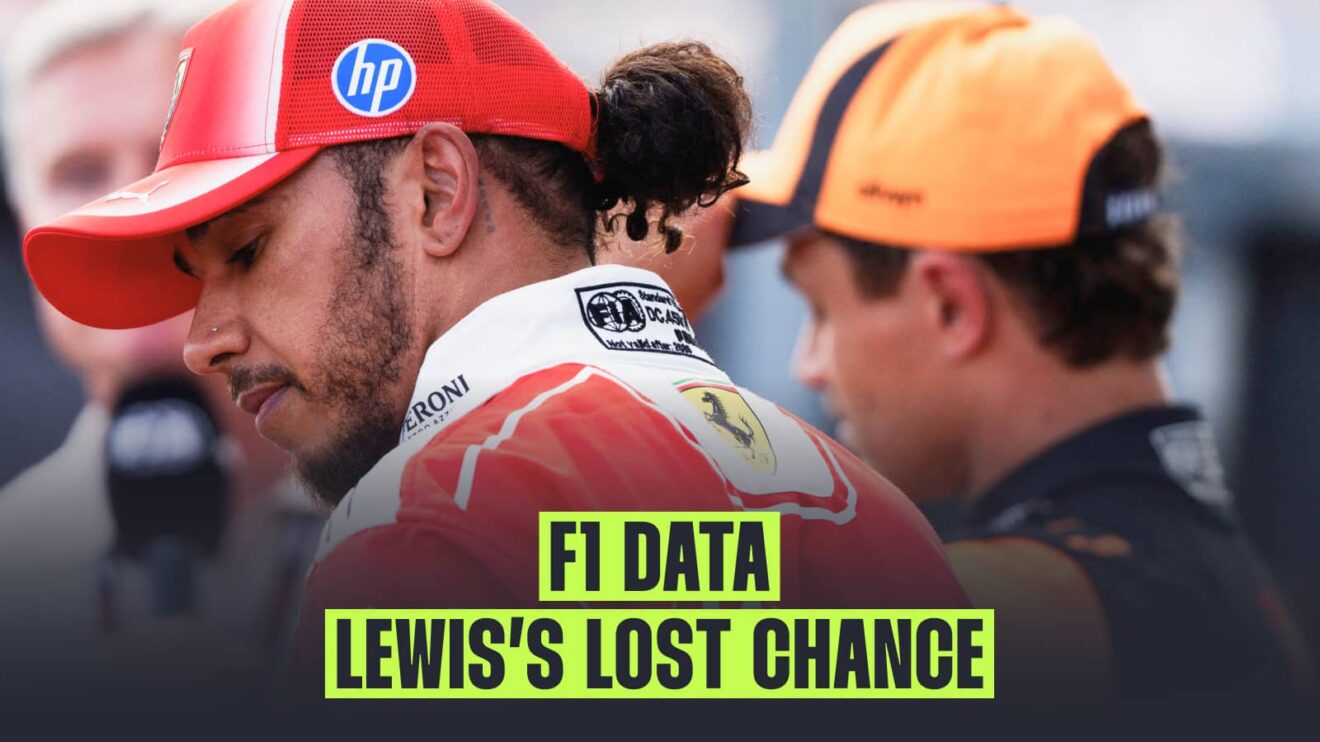
A post-qualifying penalty added insult to injury for Lewis Hamilton in Hungary
Ferrari driver Lewis Hamilton will start the Hungarian Grand Prix from fifth place after the FIA issued a three-place grid penalty for impeding Oscar Piastri’s McLaren.
Before that, Hamilton was so close to a record tenth pole position at the Hungaroring – reigning world champion Lando Norris was faster by just 0.012 seconds. However, Hamilton set this time on his very first Q3 attempt – whether heading out onto the track early for a second hot lap cost the Briton pole position, we discover with the help of telemetry data.
Lewis Hamilton data emerges after Hungarian Grand Prix qualifying
Want more PlanetF1.com coverage? Add us as a preferred source on Google for news you can trust
Even before the start of the weekend in Hungary, Ferrari held the title of favourite for pole position and the race win.
At the Hungaroring, downforce and tyre degradation optimisation are key parameters, while engine power and deployment systems are secondary, which perfectly suits the current characteristics of the red car.
And the Italian team completely justified these expectations during Friday’s two free practice sessions.
They definitely hit the track with the best baseline setup for the car, for which credit must be given to the engineers back at the factory.
McLaren (primarily Norris) only entered the frame in FP3 – the papaya team arrived with an upgraded floor, and they certainly needed a bit of time to find the right setup for the updated car.
During FP3 McLaren definitely achieved that, proving to everyone that it too is a team with a car capable of pole position.
This ultimately proved entirely true when Norris snatched pole position on his final hot lap in Q3, making him the only driver alongside Kimi Antonelli who actually improved his lap time on the second attempt.
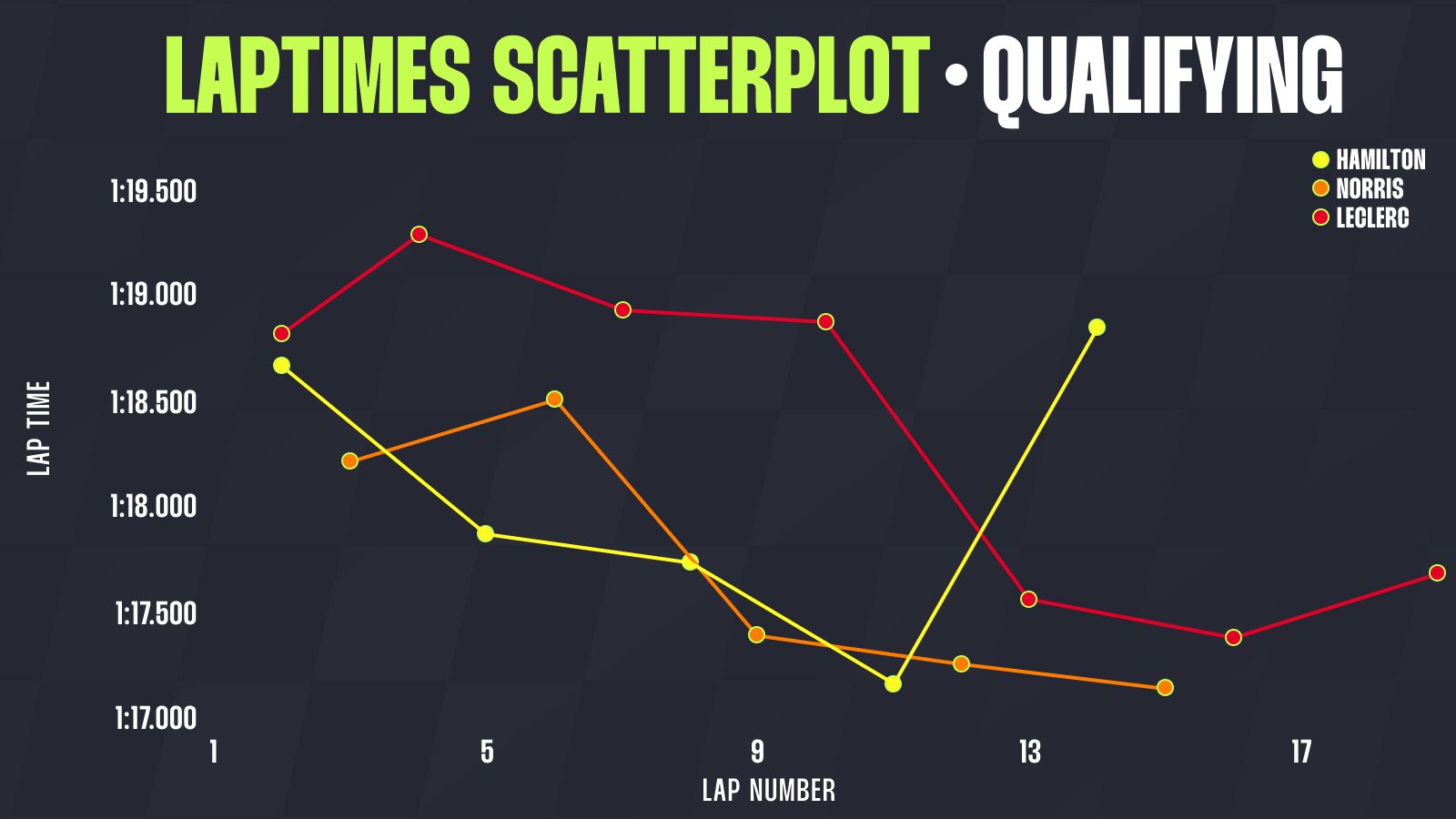
Which brings us to the question: why were the Ferrari drivers so slow on its final run, and on new soft tyres no less?
One of the main reasons is track position itself, which is extremely important at this circuit.
Ferrari was the first to send its drivers out, something Hamilton was not pleased with.
On the graph below, we can see a comparison of his two laps during Q3.
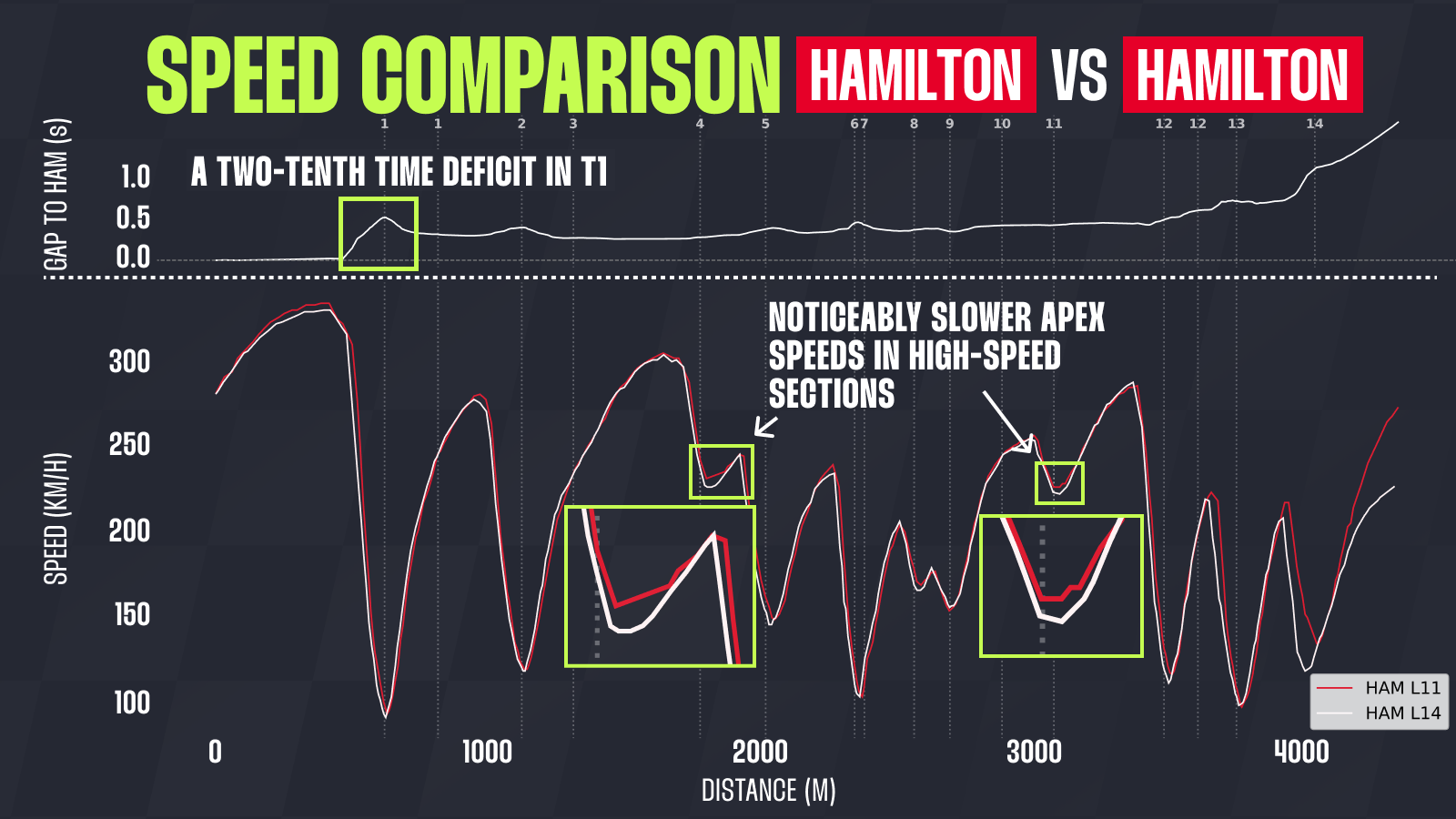
Right at the very start, the difference is noticeable – during his second run, Hamilton enters Turn 1 at 4 km/h lower speed, indicating that a different energy deployment also played a role here.
Consequently, he carried this deficit through the corner itself, creating a big 0.2-second gap through just the first corner on the track.
What is interesting is that despite the loss, he actually braked later on entry into Turn 1.
However, an even bigger difference can be seen in the high-speed corners of Turn 4 and Turn 11, where Hamilton was significantly slower on his second attempt and lost a lot of time.
Even in Turn 3, which can also be categorised as a fast corner, Hamilton had to momentarily lift off the throttle during his second Q3 run, whereas on his earlier run he was flat out.
This is proof that the grip simply wasn’t there and that track conditions had changed drastically.
In this regard, the Hungaroring is a unique track because the amount of dust on the surface heavily impacts grip levels – which is why we saw multiple times that if a driver strays onto the dirty side of the track in the final corner, rear tyre grip practically vanishes.
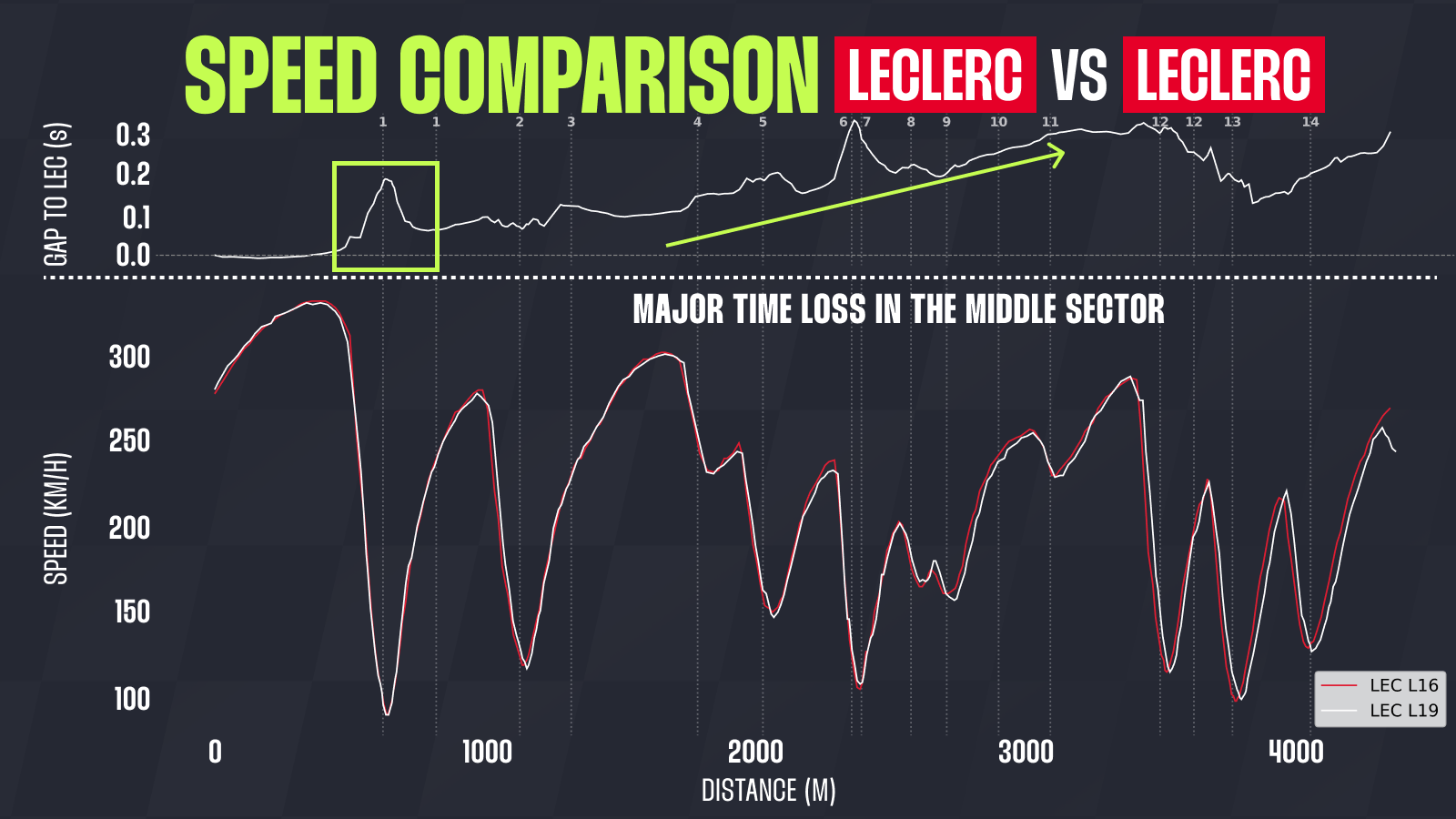
On the other hand, data from Leclerc’s laps shows very similar issues, although his second run wasn’t quite as slow as Hamilton’s.
He lost slightly more than a tenth in Turn 1 and a lot of time throughout the entire second sector, just like his teammate.
Did Ferrari make a mistake?
Absolutely, yes – heading out onto the track first after a multi-minute pause between the first and second flying runs is not the ideal solution, though it is the safest.
We saw how things turned out for some of the drivers caught in traffic – Verstappen going off track in the final corner affected Antonelli as well as Russell, while Piastri had to abort his hot lap because of Hamilton.
Ferrari didn’t want to take any risks, and this time it didn’t pay off.
Whether Lewis would have snatched pole position had the strategy been different is, of course, impossible to confirm.
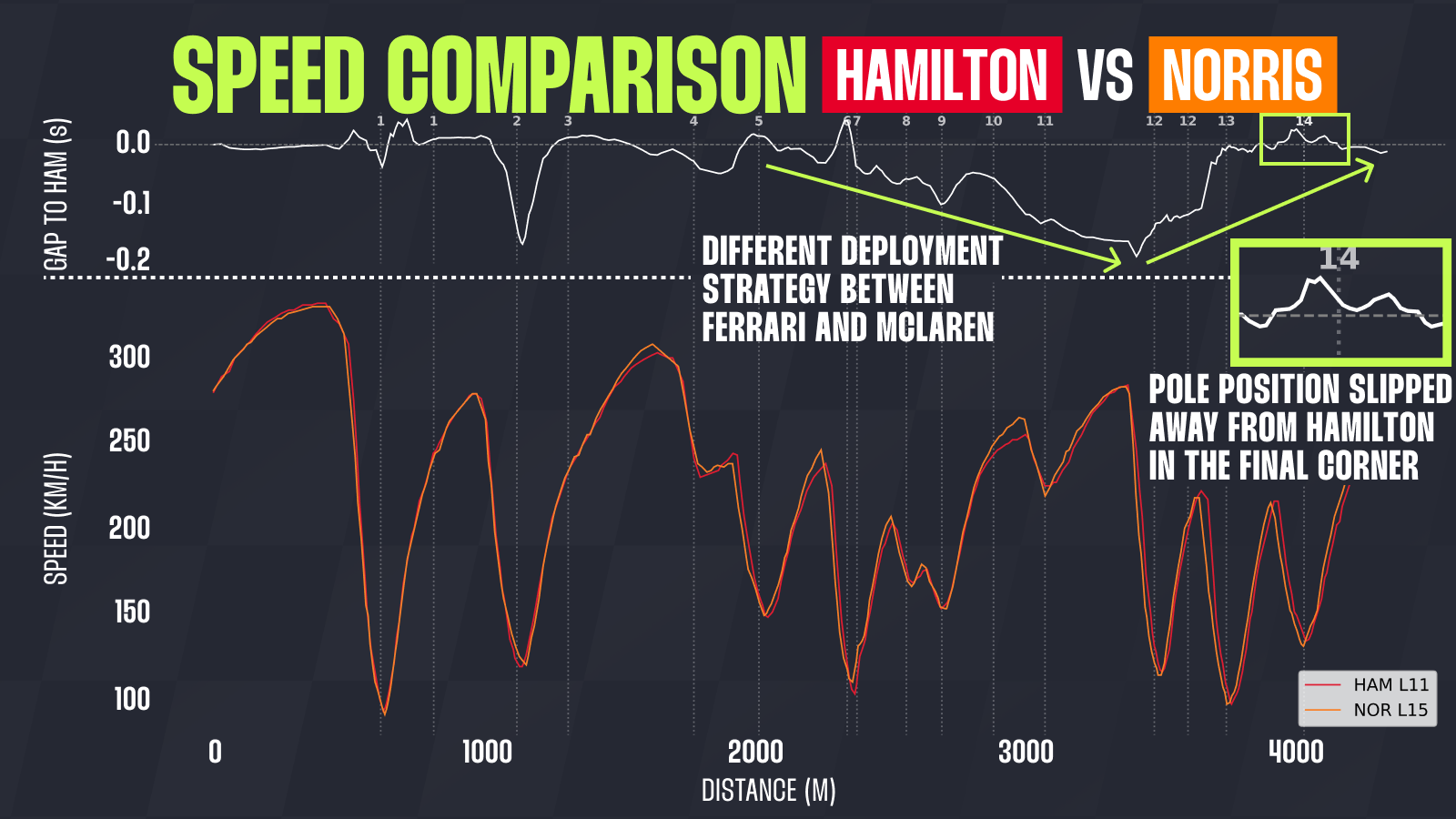
Even so, the gap was extremely small – the data shows that Hamilton actually had pole position in his hands while passing through the final corner, but Norris saved more energy for the final acceleration, which turned the tables.
What is also worth highlighting is the strategic battle between Ferrari and McLaren in Hungary regarding energy deployment.
McLaren was consistently faster in the middle sector, while Ferrari held the upper hand in the first and final sectors.
Pay attention to the delta line on the graph below, where you can clearly see Norris making up time in Sector 2, only for Hamilton to quickly gain it back in the final sector.
Beyond that, something rarely discussed in Hungary that definitely influenced Norris’s pole position is the specific gear ratios on the papaya car.
Namely, McLaren is the team with the shortest gear ratios on the grid, which can provide an advantage on a slow track like the Hungaroring.
For example, in the aforementioned final corner where Norris ‘stole’ pole, he shifted down from fifth to fourth gear and stayed in fourth throughout the entire corner, whereas Lewis had to drop down to third gear.
Even the smallest details decide who will be fastest on track and this time all the pieces fell into place for the reigning champion, who secured the first pole position for the team in the 2026 season.
Want to be the first to know exclusive information from the F1 paddock? Join our broadcast channel on WhatsApp to get the scoop on the latest developments from our team of accredited journalists.
You can also subscribe to the PlanetF1 YouTube channel for exclusive features, hear from our paddock journalists with stories from the heart of Formula 1 and much more!
Read next: FIA confirms Lewis Hamilton penalty after Oscar Piastri investigation