
Mercedes chief threat emerges in telemetry data; Ferrari Qatar GP blow
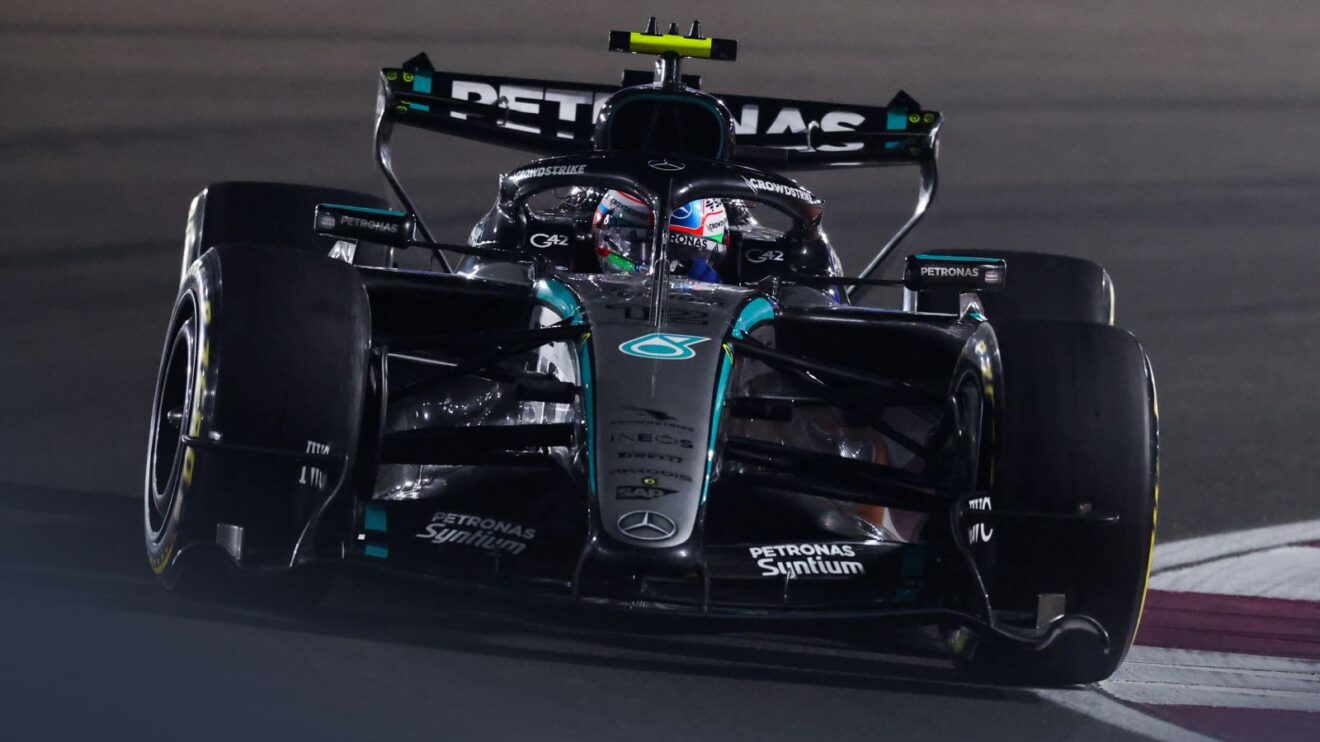
Kimi Antonelli driving the Mercedes W17
Mercedes confirmed their strong pace in Qatar, with Kimi Antonelli fastest in both practice sessions and George Russell right behind him each time.
Telemetry data shows who is best placed to challenge them, and why Red Bull appear to have the best chance of doing so.
Mercedes start strong in Qatar as Red Bull lurks
The large half-second gap the young Italian held over his teammate after a quiet FP1 shrank dramatically in FP2, during a session interrupted by two red flags that prevented Antonelli from completing his flying lap on soft tyres—meaning his benchmark time was actually set on mediums.
Speaking of tyres, it is vital to keep in mind that the Qatar circuit is exceptionally tough on rubber, pushing tyre stress levels to the maximum. For that reason, Pirelli brought its hardest compounds to the venue, yet a rule still limits stints in the race to a maximum of 27 laps, guaranteeing two mandatory pit stops.
The main reason behind this is the high number of long, high-speed corners in Qatar, with only a single straight offering a chance to cool the tyres down. What we saw across both practice sessions is that virtually every driver struggled with front-axle grip and understeer as a result.
There was scarcely a corner on the track where we didn’t see a wide exit due to understeer across just over two hours of running.
In other words, dialling in the car’s balance will be critical for teams, and whichever squad makes the best use of the overnight break between FP2 and FP3, and reads the collected data properly, will hold the strongest hand on Saturday and Sunday.
For now, the team setting the pace on track is unmistakably Mercedes.
From the FP1 data, we can see Antonelli experiencing heavier clipping on entry to Turn 1, losing time through the opening stretch, yet after Turn 4 his advantage over Hadjar and Norris steadily grows.
Alongside a strong first sector thanks to their potent power unit, Red Bull lose considerable time through the right-handers of Turns 4 and 5 as well as the fast sequence of Turns 12, 13, and 14. McLaren bled small amounts of time everywhere, looking short of overall grip, with a more notable deficit in the final corner. As for Ferrari during the opening session, they almost certainly ran a detuned engine mode, leaving their lap times more than 1.2 seconds adrift of Kimi.
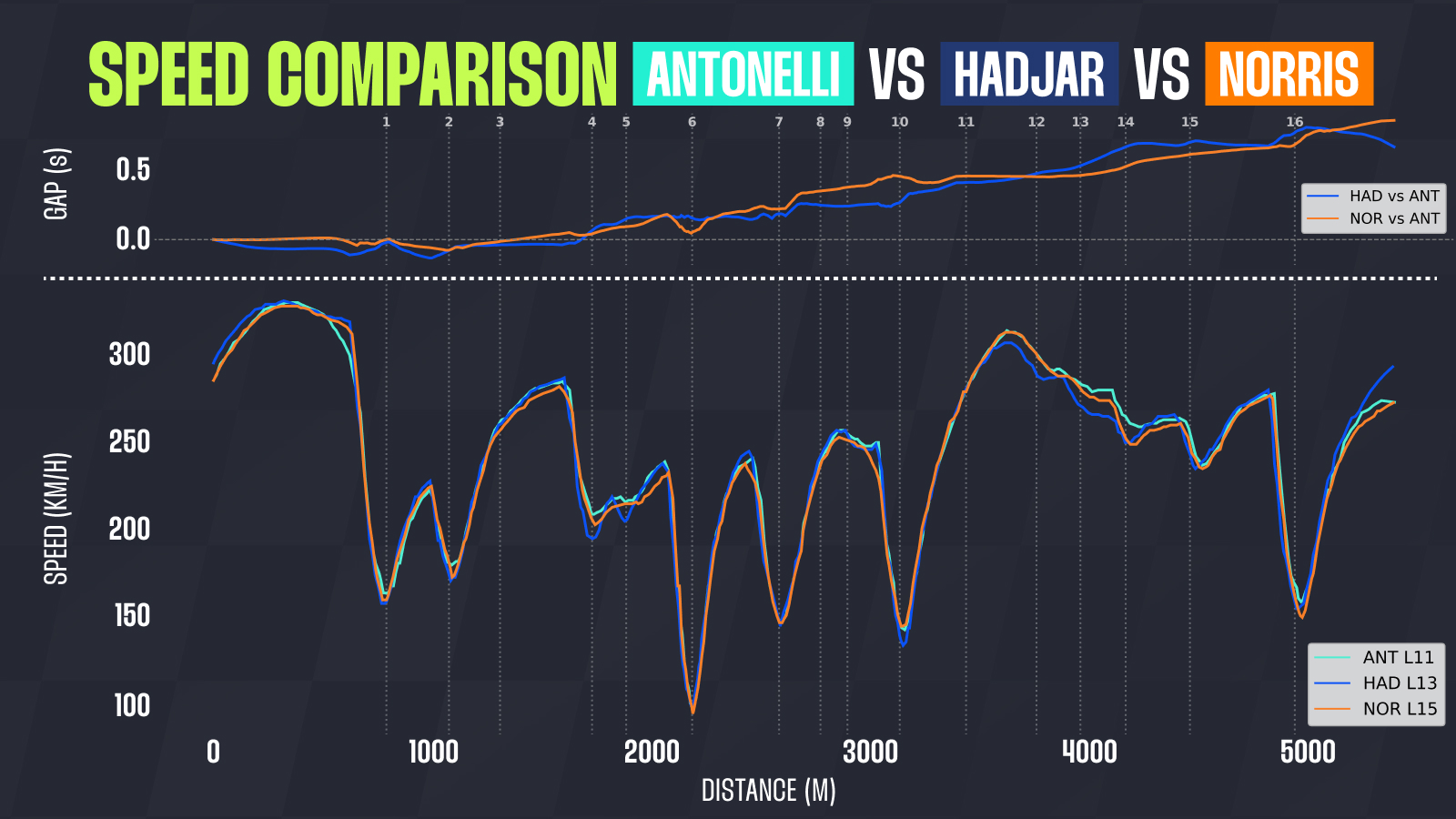
The picture did not shift dramatically in FP2: Russell remained the only driver capable of threatening Antonelli, while the rest of the pack trailed by around half a second for McLaren and Red Bull, and roughly one second for Ferrari.
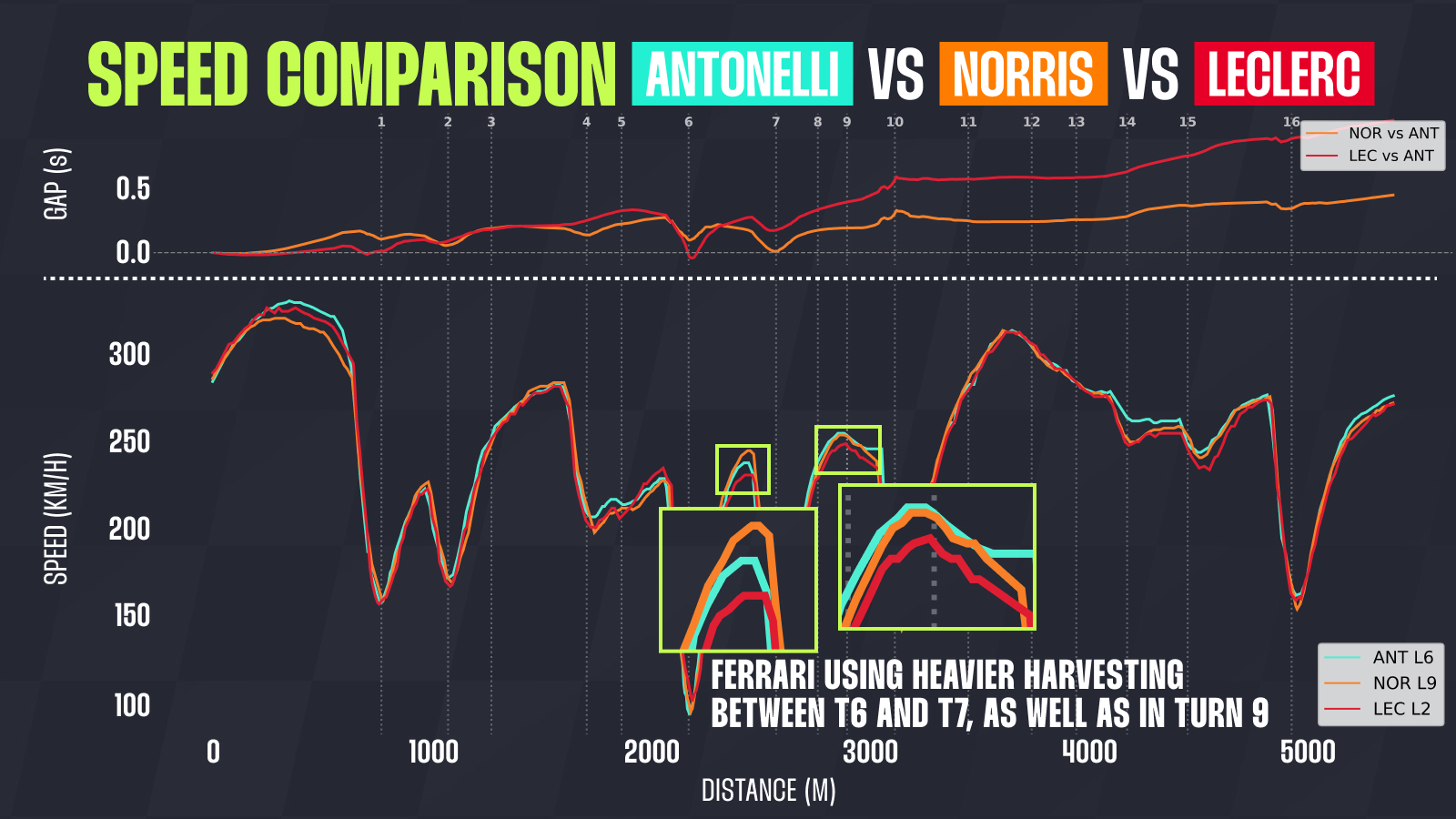
The graph below shows the Maranello squad losing the most time in the middle sector, specifically between Turns 6 and 7, as well as through Turns 8 and 9 where they harvest battery energy needed to stay competitive along the straight from Turns 10 to 12. Similar clipping also appears at Turn 15, and after a difficult session for both drivers, Ferrari currently looks like the slowest of the top four teams.
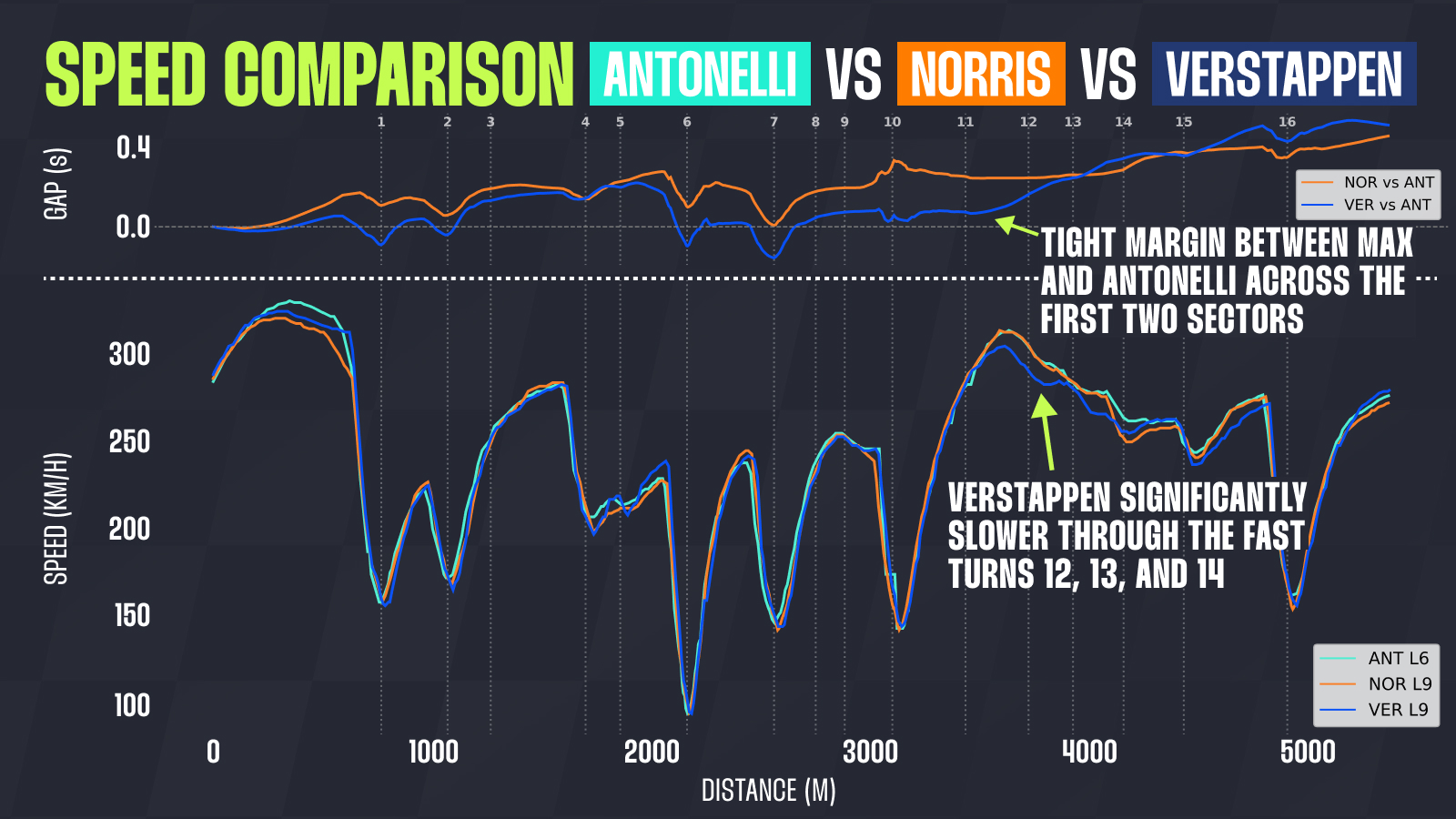
Turning to Red Bull, although their lap times look weaker than McLaren’s, they currently appear to have the best chance of challenging Mercedes. The graph below shows Verstappen staying very close to Antonelli right up to the end of the middle sector. Entering the final sector through Turns 12 and 13, Max is noticeably slower due to harvesting, surrendering substantial time and dropping out of contention against the Mercedes driver.
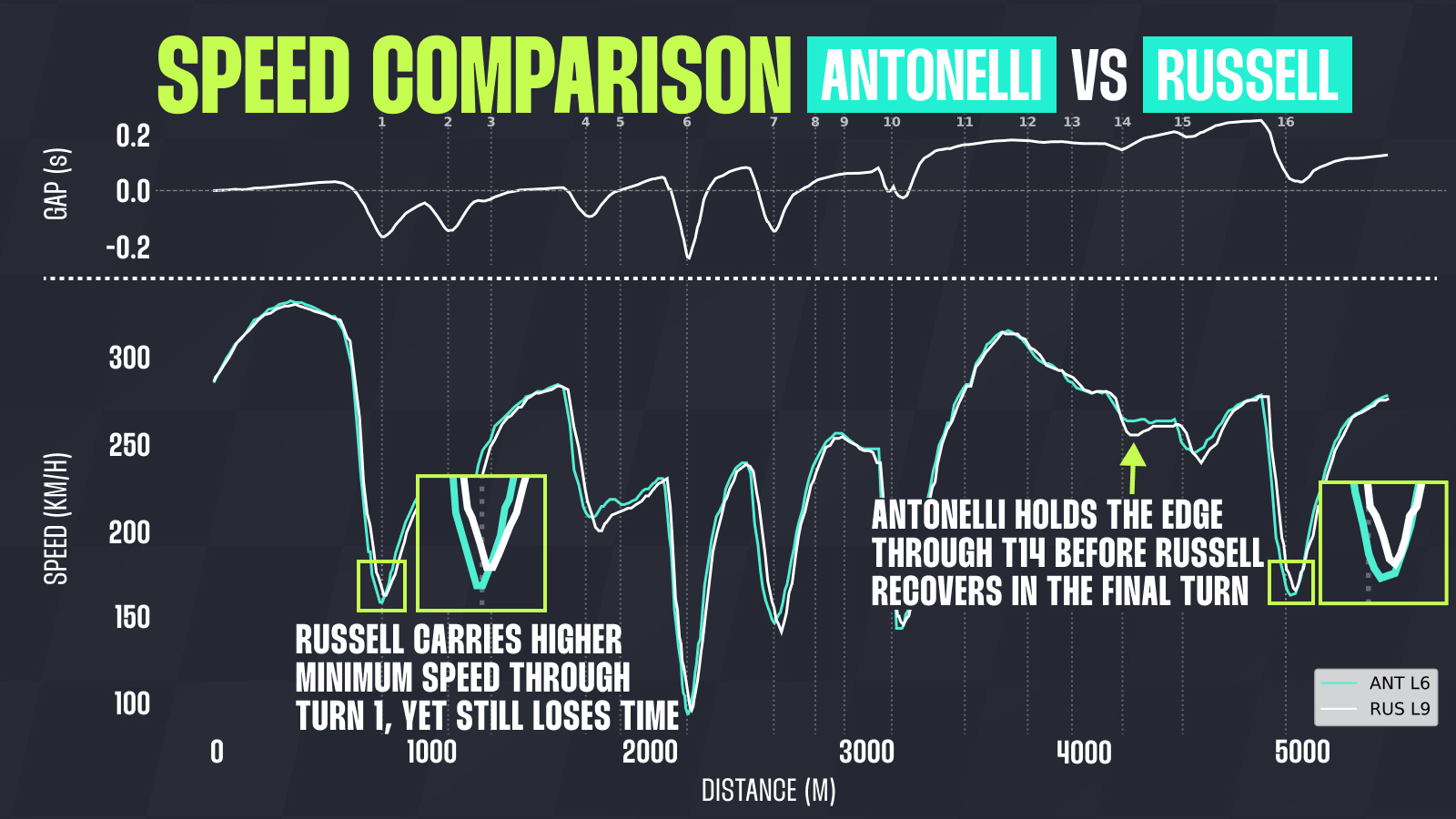
That leaves Russell as the only driver able to stay within striking distance of Antonelli. Looking closer at the telemetry, we once again see the familiar difference in driving style between the two teammates. A prime example is Turn 1, where Russell carries higher minimum apex speed—as shown in the graph below—yet Kimi gets a cleaner exit, leans harder on the outside tyre, and emerges with a slight edge over his teammate.
Building an initial margin of roughly two tenths after Sector 1, the Italian’s advantage holds fairly steady through the middle sector before another clear gap opens up across the three fast right-handers of Turns 12, 13, and 14. Here too, Kimi leans more heavily on the outside left tyres—which endure massive loads in Qatar—picking up another half-tenth.
However, Russell claws back more than a tenth through the final corner; one likely reason is Kimi overheating his tyres in the preceding section, leaving him slightly down overall across the final sector as a whole.
It will be interesting to see what qualifying strategies drivers adopt here and where they push their tyres to the limit.
Latest Qatar Grand Prix talking points on PlanetF1.com
FIA confirms final decision as Audi F1 team loses Yuki Tsunoda appeal
F1 engine freeze confirmed as V8 transition plans revealed
Long-Run Pace
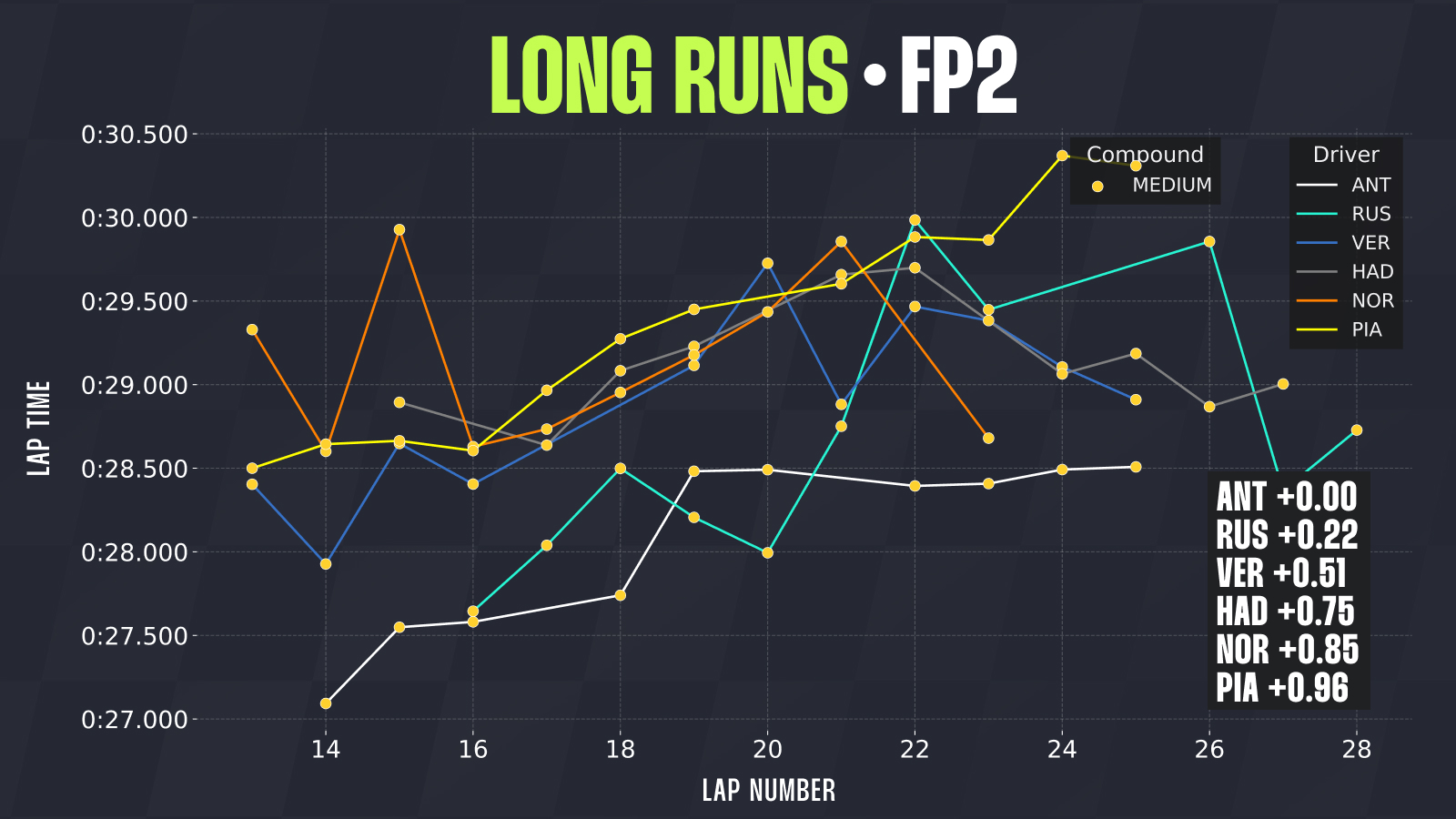
To round out the analysis, it is worth looking at long-run data, which is vital for Sunday’s race strategy. Unsurprisingly, Mercedes is the clear favourite here as well, with Kimi once again at the top and managing to stay more consistent than Russell on medium tyres.
Right behind them sits Max Verstappen, trailing by roughly five tenths of a second per lap overall, while everyone else was slower still—and Ferrari failed to post representative long-run figures.
As noted, the break ahead of FP3 will be decisive, and only then will we see if anyone can close the gap to Mercedes.
Read next: Kimi Antonelli reveals major concern for Qatar Grand Prix