
Audi’s early promise masked by power unit limits and costly race setbacks


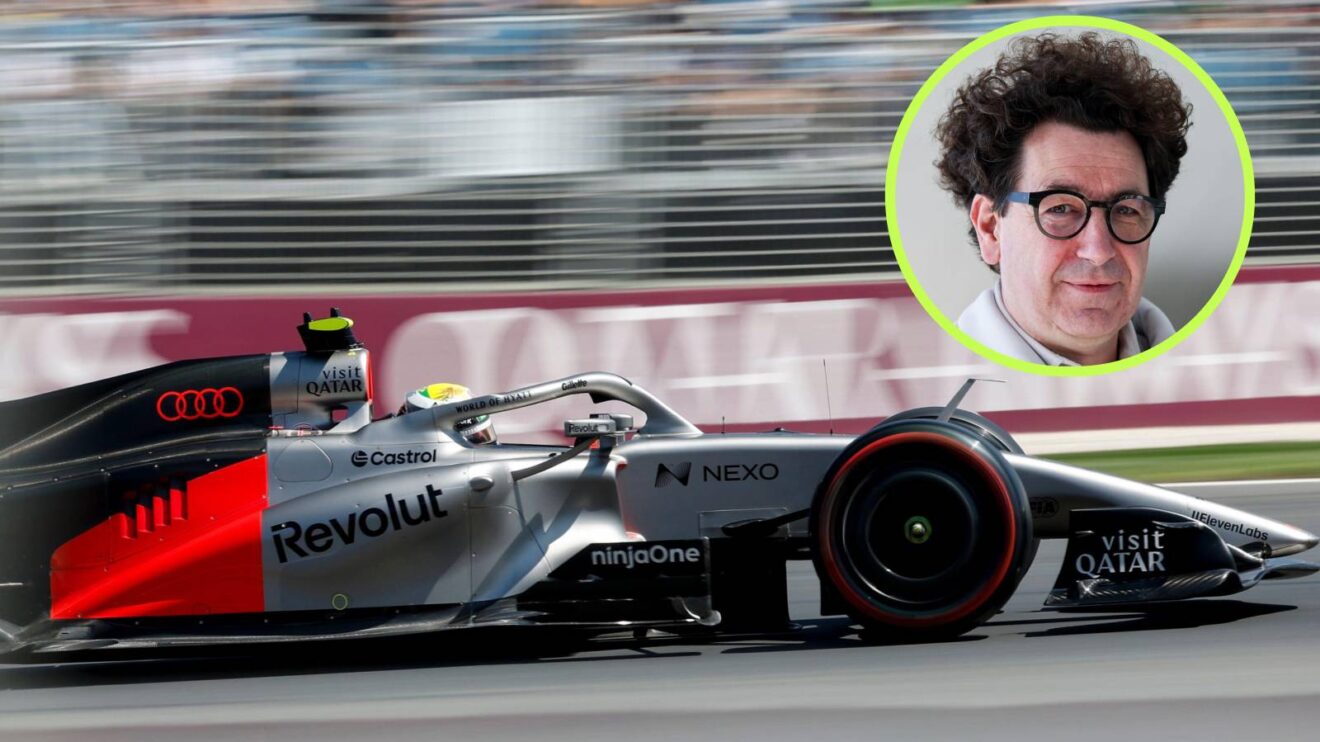
Audi has had a promising start to life in Formula 1, but has it underdelivered relative to its performance level?
Audi’s arrival in Formula 1 this year has only netted two points so far, but its F1 2026 performance level suggests that the former Sauber team is capable of much more.
Audi, as Auto Union, once enjoyed a fierce rivalry with Mercedes in a pre-World War 2 racing era, and that manufacturer battle has resumed as Audi has become one of the five power unit manufacturers alongside its team takeover of Sauber.
Mattia Binotto outlines Audi power unit weakness after strong qualifying pace
Want more PlanetF1.com coverage? Add us as a preferred source on Google to your favourites list for news you can trust.
Eighth place in the championship, with two points scored, is probably not quite the reward Audi deserves after three race weekends in which the car has shown itself to be quite a strong performer.
While not a ‘new’ team in the same way that Cadillac is, the other new name on the grid has seen German automotive giant Audi arrive in the sport as a fully autonomous manufacturer, creating its own power unit alongside its takeover of the former Sauber team.
The bolstering of resources for the Hinwil factory in Switzerland, a facility that has traditionally churned out tidy racing chassis over three decades, has seen the Audi R26 start life on the grid showing promise, as both Nico Hulkenberg and Gabriel Bortoleto have kept the car solidly in the midfield across the three weekends so far.
Indeed, such has been the pace of Audi, particularly in qualifying, that keeping up with Haas and Alpine – fourth and fifth in the championship – has been possible, with even Red Bull’s RB22 not out of reach.
In its first qualifying session, Audi made it into Q3 with Bortoleto as the Brazilian claimed 10th on the grid, and he also made it into Q3 in Japan as he took ninth place; any chance of Q3 in China went begging when he spun out of Q2.
Hulkenberg has been making 11th place his own, claiming that position in qualifying in Australia and China, and taking 13th on the grid in Japan.
But these strong qualifying sessions haven’t translated into solid tangible results just yet for a number of reasons.
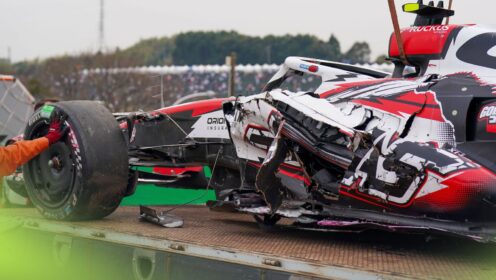
Reliability has been a factor in that: technical issues prevented Hulkenberg from starting in Australia, having developed a problem on the way to the grid, while it was Bortoleto’s turn to sit out a race when he encountered pre-race issues in China.
Any chance of Hulkenberg scoring points in Shanghai evaporated with an operational issue in the pits, when he had a 16-second stop due to a wheel gun failure, but poor starts have also been a major issue for Audi.
Hulkenberg slipped down to 15th at the start in China, and as far back as 19th in Japan, while Bortoleto also fell back to 13th off the line at Suzuka. It’s putting both drivers on the back foot right from the start of the race, meaning that fighting back into the points against rivals of comparable pace is proving difficult.
“There have been poor starts, and it’s not the first time. So that’s certainly not our strength at the moment,” Audi’s head of F1 project Mattia Binotto said after Japan.
“The reason it has not been addressed so far is that it’s not an obvious thing to be fixed. But, on the other side, we know it’s a top priority for us, because, again, we had a good quali and it’s not worthwhile starting with positions, and you are losing all the positions at the start.”
With the chassis proving to be a solid baseline for the start of the season, Binotto has been open in his assessment that the Audi power unit is the limiting factor in the team’s competitiveness at the moment.
Certainly, the larger turbo design on the AFR26 unit appears to be a leading culprit for its slow starts, in an opposite scenario to the design choice made by Ferrari that is proving so fruitful when the lights go out.
But aside from this, the overall power unit design, Binotto reckons, is the main limiting factor for the team; a factor that isn’t surprising given that it’s the first attempt at a complex F1 power unit, whilst also only having two cars on track to gather data with compared to the eight Mercedes-powered cars or the six Ferrari-powered cars.
“The lead times on engine development are very long, and we have assessed, I believe, that most of the gap we have to the top teams is from the power unit, which is not unexpected,” he said.
“We knew that it would have been the biggest challenge.
“Overall energy, the way we deploy it, and speed on the straight, that’s not our strength at the moment. So, if you deploy your energy and you somehow uncharge your batteries, you are exposed to be overtaken.
“So that’s part of our learning process, I would say, of these initial races. We need to review the data with the drivers and need to understand how to best mitigate, not only solving, but mitigate those situations.”
While the FIA’s ADUO [Additional Development and Upgrade Opportunities] may accelerate that development quite a bit, with Audi seemingly set to be one of those granted at least one opportunity when the first season checkpoint arrives after Miami, Binotto said his eye is on further down the road.
“Engine development, especially when it comes to some concepts, can take longer,” he said.
“It’s not by chance that we have set 2030 as our objective, because we know that it will take longer.
“I think what we need now is to be patient as well. I think we are very ambitious, and we would like to see things solved in a couple of races, but sometimes that’s not the case.
“So I think we need to understand exactly where we are as a team, what the plans are, and as well, stick to the plans, because miracles are not possible.
“We are not here to create miracles. It’s not us. We cannot do that, but we are here to have a proper plan to address and to improve in the future.”
Certainly, the break until Miami gives Audi the chance to properly assess its standing and its weaknesses, having spent the first few weeks of this season in what Binotto described as a very “reactive period” with “no time to start even thinking about developments” while attempting to rectify its pressing reliability issues.
“So, starting development will be one of the focuses in the next few weeks, and try to be better prepared for Miami.”
Moving on from Jonathan Wheatley
Of course, the fact that Binotto himself is the one addressing the media again has come as something of a surprise, given the sudden departure of Jonathan Wheatley.
The British engineer had settled in at Sauber over the past year, helping with the transition to Audi, and seemed to be a breath of fresh air as a new team principal on the grid, due to his personable manner and new perspective.
But as written about throughout the week of his departure, it’s understood that there were significant personal life factors that were influencing Wheatley’s ability to commit long-term to Audi.
Added to that were behind-the-scenes tensions between Wheatley and Binotto that hastened the decision-making process of Audi CEO Gernot Dollner when it became apparent that Wheatley had become a target for Aston Martin’s team principal role.
That move is yet to be clarified, although it is expected, and it’s left Binotto in the position of leading the team once again, even if his title is not that of team principal.
“For the future, I think we are not looking for a new team principal,” he said.
“I will keep the role, but I will need someone to support me at the race weekends, because I will not always be at the race weekend myself.
“I need to focus most on the factory, where there is the most to transform, I would say, not only to develop, to transform. So certainly, support at a race weekend is required.”
The suggestion is that someone will slot into a senior trackside role, with paddock speculation suggesting that this person could be long-time Audi stalwart Allan McNish, who was one of the very first people to become involved in the F1 project when it was announced four years ago.
But for Binotto, it’s not about the individuals and instead about team ethos.
“The team has remained very focused and concentrated this weekend, and, operationally, the team has performed very well, and we can be pleased showing that, at the end, it’s not about an individual, it’s about the team. What counts the most is the team,” he said.
“So I would not be concerned for the future because of individuals. If you look at the whole team performance again, it has been a great team performance.
“We had great pit stops this weekend, and from the pit wall, I would say, generally speaking, well managed.”
More on Audi in F1
Jonathan Wheatley relieved of Audi F1 duties in ‘surprise’ exit, claims Mattia Binotto
Nico Hulkenberg: My mother’s shock text message revealed Jonathan Wheatley Audi exit
What have the drivers had to say?
Despite the frustrations of each missing a race due to technical issues, and poor starts hampering potentially stronger results, both Bortoleto and Hulkenberg have broadly been quite positive and optimistic about the position Audi is in.
Given the openness with which Binotto has spoken about the power unit, Bortoleto has been similarly frank, explaining how the data proves the corners are not an issue, meaning the R26 chassis is competitive.
“I don’t like to point fingers at something but, when we look at data in corners, we see that our car in the corners is not bad. We just need to improve our speed a little bit,” he said.
“But I am proud of what we achieved in such a short time. First time doing an engine, two cars only running this engine in the whole grid, and we are ready with an engine that is competitive, it’s just not good enough, but it’s competitive. We keep working on improving it.”
As for Hulkenberg, a veteran of the midfield ever since he arrived in F1 in 2010, the German driver said he is confident that Audi is “competitive within the midfield, definitely.”
“We’ve had a few examples of that now,” he said.
“But like many other teams up and down the grid, there is work to do on the runnability side, on the power unit side, on performance and drivability.
“But to be honest, it was to be expected on the power unit side, we’re a new team, a new manufacturer. We’re the only ones. It all probably takes a bit more time than when you have four or six cars.
“All in all, we’re not in a bad position with where we are, with the kind of difficulties we’re still carrying around and living with.
“It gives me hope that if we get on top of our issues and have a strong development this year, there is a lot of opportunity ahead.”
With the task of morphing a small and independent team into a much larger factory effort having been carried out, the task ahead for the German manufacturer is in establishing a baseline of personnel stability that it has lacked over the past few years.
There appears to be inherent promise and capability, a fact that is thoroughly unsurprising given Audi’s past success in the World Endurance Championship, and there certainly doesn’t seem to be any reason that similar success can’t be achieved in Formula 1.
Certainly, Binotto has won the apparent battle to lead the team forward under Dollner, a political success that is perhaps unsurprising given his previous convincing of Ferrari to give him the team principal role and usurp Maurizio Arrivabene after 2018.
But if progress isn’t made over the next year or two, will Dollner be left questioning if he’s backed the right horse?
Want to be the first to know exclusive information from the F1 paddock? Join our broadcast channel on WhatsApp to get the scoop on the latest developments from our team of accredited journalists.
You can also subscribe to the PlanetF1 YouTube channel for exclusive features, hear from our paddock journalists with stories from the heart of Formula 1 and much more!
Read Next: Alpine’s 2026 reset delivers as Pierre Gasly leads stunning rise past Red Bull