

Safety concerns trigger calls for urgent change to F1 2026 race starts
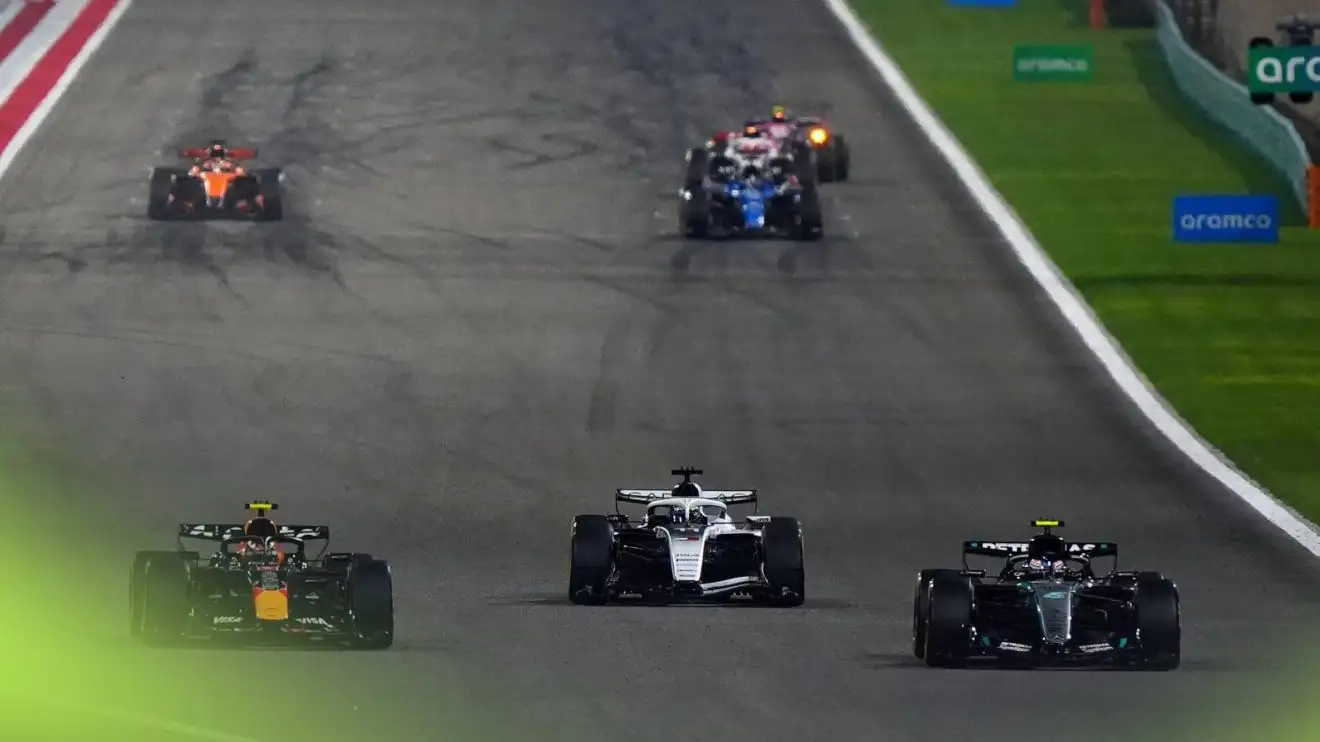
Race starts in F1 2026 are expected to be far more tricky and inconsistent, a potential safety matter.
The extra difficulty in getting the new F1 cars to make consistently crisp race starts could see a procedural change made.
The changes to the power unit regulations for F1 2026 have introduced a new hurdle for the teams – namely, getting the cars off the line cleanly due to increased turbo lag.
Why have race starts become more complicated in F1 2026?
The sport’s shift to a new-generation hybrid power unit has introduced very different driving dynamics to the cars, presenting new and varied challenges to the drivers in terms of unlocking laptime and ultimate performance.
But there is another side effect that has grown in prominence in terms of priority for the teams, given the potential safety hazard that it represents, and this pertains to the race start procedure.
The key issue that has become notable is that the changes made to the power unit architecture for 2026 means that it takes far longer for the drivers to get their cars into the ideal configuration for a race start.
This is due to the removal of the MGU-H from the 1.6-litre V6 hybrids, an electric motor that helped spool up the turbocharger in conjunction with the internal combustion engine, covering the turbo lag across the lower rev range until the MGU-K played its part.
Without it, the internal combustion engine and turbocharger cover the early phase of the start process, giving the teams less control over the inertia of the turbo and keeping the revs where they need until the MGU-K kicks in.
From standing at the end of the pitlane to watch the drivers carry out practice starts, it’s clear the process to prepare the car for launch takes considerably longer than the previous generation.
Indeed, it feels a ludicrous amount of time: hearing a driver rev their car for some 10 to 15 seconds to build turbo boost before dropping the clutch seems like an eternity, and the length of time required is understood to be down to the size of the turbo each manufacturer is using. On top of that, the window for optimal conditions for each driver varies, with Oliver Bearman revealing that there really only is “milliseconds” between being too early or too late, meaning consistent starts are difficult.
But the issue that all of this raises is that the race start procedure, currently defined in Article B5.7 of the Sporting Regulations, is quite efficient, with little time for dawdling.
Once the final car comes to a stop in their grid box, the first red light of the five-light start sequence illuminates. The rest of the lights illuminate at one-second intervals over the next four seconds, before the lights extinguish to start the race – this gap being at the discretion of the race starter, but rarely exceeding 2-3 seconds in duration.
All in all, it’s usually less than 10 seconds between the last car stopping on the grid, and the race beginning.
For drivers at the back of the field, this interval doesn’t give them sufficient time to get their cars into the right envelope for the race start, meaning that, while those in the front half of the field are likely hurtling towards Turn 1 after getting their engines to the right rev range, those towards the back are in chaos.
“I advise you to be sitting with your TV on in Australia, because it could be one that everybody remembers,” Pierre Gasly ominously said on Friday, when he was asked about what he expects race starts to look like.
“We’ll find out [what happens]. I’m not too sure myself! It is definitely going to be more tricky than it used to be.”
What is being done to address race start complications?
The FIA carried out a number of simulations and evaluations of systems processes and technical checks during the test, giving the governing body clear insight into the challenges the drivers are facing, ahead of the F1 Commission meeting next week.
The matter is set to be discussed at the meeting, with an eye to a potential tweak of the start procedure in time for the Australian Grand Prix.
Ferrari is understood to have been a dissenting voice during discussions on the topic during 2025, with the belief being that the Scuderia has pursued a design with a smaller turbo than rival manufacturers.
While the teams are now expected to be unanimous on the matter when the F1 Commission meeting is held, the FIA can nonetheless push through rule changes on the grounds of safety without all being in agreement.
The vast acceleration rates of F1 machinery means significant speed differences can quickly be generated between cars launching off the grid, with slow-moving and stationary cars being highly dangerous obstacles for accelerating cars behind, without a clear line of vision as cars jostle for position.
Start-line crashes of this nature have killed drivers in the past, with Riccardo Paletti dying in such an accident at the 1982 Canadian Grand Prix, while several spectators were injured by flying debris due to Pedro Lamy colliding with the back of JJ Lehto’s car when the Benetton driver stalled in his fifth-place grid slot.
Other notable incidents, thankfully without injury, included Michael Schumacher suffering a gearbox failure from fourth on the grid at the 2001 German Grand Prix, with Prost’s Luciano Burti being sent hurtling through the air after colliding with the back of the Ferrari.
Earlier that year, Mika Hakkinen had been fortunate to avoid being struck when he stalled from third-place at the Brazilian Grand Prix, triggering a panic response from the Finn as he waved his hands frantically as he cowered in his cockpit while the rest of the field powered past.
The potential for danger is evident, and McLaren’s Andrea Stella believes the matter is one of urgency.
“We need to make sure that the race start procedure allows all cars to have the power unit ready to go,” he said.
“Because the grid is not the place in which you want to have cars slow in taking off.
“This is a bigger interest than any competitive interest. So I think all teams and the FIA should play the game of responsibility when it comes to what is needed in terms of the race start procedure.
“I’m thinking about the timings, for instance, the timing of the lights, the timing before the lights – they need to be in the right place to make sure that, first of all, that’s a safe phase of the way we go racing.”
McLaren’s Oscar Piastri confirmed that the drivers are facing a difficult challenge to “have a safe start, let alone a competitive one”, while Mercedes’ George Russell believes the issue has already improved dramatically compared to the first test in Barcelona.
“I’m only doing my launch when I’m in a given window,” he said.
“But we are very conscious that, for a race start, you go when the lights are out, you don’t go when your specific turbo is in the right window.
“I think we have made progress. I don’t know what it’s like for the other manufacturers. I think Ferrari seem to be able to run higher gears than other manufacturers, which probably suggests they’ve got smaller turbo than other manufacturers.
“So, maybe, they’re in a slightly easier position for their race starts.
“But, as long as there’s not a safety concern… there probably was in Barcelona, but we have made big progress since Barcelona in that specific regard.”
Read Next: Oscar Piastri in ‘recipe for disaster’ warning; addresses practice start mix-up


