
Major German Grand Prix update as F1 return talks confirmed


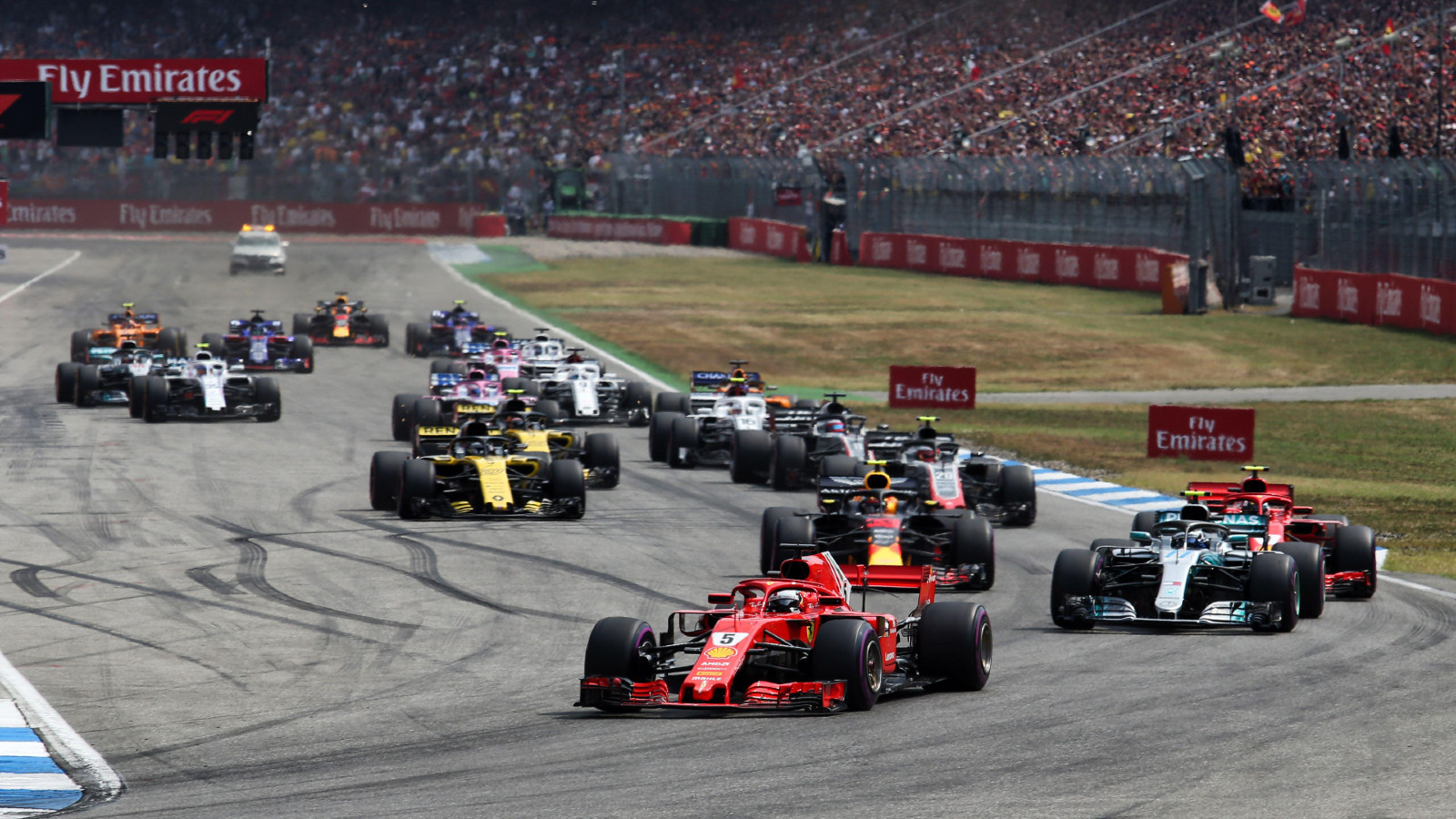
Ferrari's Sebastian Vettel leads the 2018 German Grand Prix. Hockenheim, July 2018.
A first discussion about a potential rekindling of a German Grand Prix at Hockenheim has already happened, according to F1 CEO Stefano Domenicali.
Hockenheim, long a mainstay on the F1 calendar, last held a race in 2019, but tentative discussions about how to potentially return to the German venue have been held.
Stefano Domenicali confirms first Hockenheim talks over German Grand Prix return
Want more PlanetF1.com coverage? Add us as a preferred source on Google for news you can trust
The historic Hockenheim circuit first held a world championship F1 Grand Prix in 1970, and, for almost 30 years, held an annual race as it took over from the Nurburgring in 1977, aside from a 1985 return to a revised Nurburgring.
The German Grand Prix at Hockenheim became a firm fan favourite and, for those who watched the sport through the 1990s, the stadium section became one of the most iconic sections of racetrack as the cars blasted their way back in from the forests to be greeted by caterwauling klaxon horns greeting home hero Michael Schumacher.
But, in 2007, F1 moved from two events in Germany to one, with the Nurburgring and Hockenheim sharing hosting duties for the next decade.
However, in the late 2010s, the lack of government investment in a German event meant both fell off the calendar, with Hockenheim’s last race held in 2019.
But F1 CEO Stefano Domenicali has revealed that an uptick in European interest in Formula 1 could change things, as he revealed initial discussions with Hockenheim have been held.
Addressing a question regarding TV rights in France and Germany, both historic countries currently without a Grand Prix, Domenicali told assembled media including PlanetF1.com that talks are being held with regard to a “medium-term” return.
“Canal+ [France] is really looking forward to extending our deal because the numbers are really good and the sport is really in great shape,” he said.
“Germany, for the first time, we are reconnecting with the possibility of having contact with the Hockenheim people to see if, in the future, mid-term, not short-term, they can have a race back.
“But now, with the deal we are having with RTL, the numbers are getting different, and in the new tender on the German market, we will have for the first time more than one operator that is interested in being part of this tender.
“So it’s another sign that, in Europe, that is our very important market. The attention is getting even bigger.
“We extended the deal with Sky UK and Sky Italy until 2034, so that means that the solidity… and in Spain, with DAZN, stay tuned very, very soon. So everything is looking very, very strong.”
Asked by German media to expand on the Hockenheim topic and that of free-to-air broadcaster RTL’s airing of races, Domenicali said, “With regard to RTL, we are discussing with them to see what the best way is to capture more and more attention. So the point is on the table, yes.
“On the other side, so far, it was Hockenheim to connect with us, and they have had the first discussion.
“As you know, they are developing the motorsport part there, with a different objective.
“If they want to discuss a possible F1 event, of course, the investment needs to be different because our platform is to have a different kind of investment. But we have discussion with them.”
What Domenicali is likely referring to is the understanding that FOM prefers government backing of grands prix, rather than private investors or municipal authorities.
An important factor to remember regarding Hockenheim is that the circuit itself now has a very different ownership and investment model compared to when it last held races, with a new investor group planning on a €250million injection by 2034.
In 2024, the municipal council of the city of Hockenheim approved the entry of Emodom Group GmbH into the shareholders of the Hockenheimring, taking over 74.99 per cent of the shares of Hockenheimring GmbH.
The city itself, which had held 94 per cent, together with Badischer Motorsport-Club, which had held the remaining six per cent, took a step back and retained the other 25.01 per cent of shares.
The holding group Emodrom will be joined by investment from other partners – the Timbra group, the Assenheimer Group, the Motorworld Group, Paravan GmbH, Arnold NextG GmbH, and the Wirth Group.
The significant realignment of Hockenheim’s shareholding may lead to the finances now being available to attract Formula 1 back to the circuit over the coming years, but its backing is split between a majority private shareholding and a minority municipal authority.
“The inclusion of Emodrom Group Holding in the group of shareholders is a further step that will enable us to further strengthen the Hockenheimring as a leading race track and implement forward-looking projects,” said Tim Brauer, managing director of the Emodrom Group.
With Emodrom investing heavily into the circuit facilties, it’s not clear whether it has interest in being the promoter for a grand prix tilt. Specific plans initially include the expansion of the Porsche Experience Center, the construction of a hotel, and a Motorworld as an attractive attraction for car enthusiasts – these are planned to be completed by 2027.
The investment of Emodrom came after Hockenheim managing director, Jorn Teske, said a return of a grand prix would not be possible without significant investment changing the financial model.
“We have already been told that there is a great deal of interest in Germany [from F1] as a location,” Teske said.
“I also don’t believe that this is just lip service. Of course, key economic figures also play a role for Formula 1.
“However, it is not entirely clear to me to what extent they are prepared to reduce the maximum achievable entry fees. You often hear the question of why it doesn’t work in Germany.
“Our answer is always the same: In other countries, there is cross-financing from third parties. That hasn’t been the case here so far. If nothing changes or Formula 1 isn’t prepared to make major compromises, it can’t work.”
With the F1 calendar now at 24 races, the return of a German Grand Prix would likely mean a rotational model with an existing race, with the likes of Barcelona and Belgium already embarking on this model from 2027.
The return of the Portuguese Grand Prix over the next two years is also a de facto replacement for the departing Dutch Grand Prix and, given the packed nature of the calendar, finding a slot for Germany could prove tricky.
Where else could host an F1 race in the coming years?
With multiple new markets said to be keen on establishing grands Prix, such as possible events in Rwanda or South Africa on the African continent, other possibilities include a Thailand Grand Prix, as well as a return of South Korea to the calendar.
There is also the possibility of a return of an Argentine Grand Prix, fuelled by a surge in interest of the back of Franco Colapinto being on the grid, with Buenos Aires last holding a race in 1998.
“We are monitoring the situation of countries that are important for us to develop. We are watching, of course, the growth of the United States,” Domenicali said.
“We are watching the growth of Europe because it’s becoming an important market again because the growth of the numbers are there.
“We are watching what will happen in China as a potential extension market; there is a lot of potential. We saw the success of what we did this year in Shanghai.
“There is a lot of positivity around that; the Far East market is becoming another area where things will grow dramatically and positively.
“So also on that side, everything is really looking good. Connected to that, I just want to reiterate the fact that we are still receiving a lot of requests to host grand prix all around the world.
“We have quite a solid base on which we will develop, of course, the future strategy. But I would see so far up to 2028 or ’29, that the dimension of the stability that we have is very solid.”
Addressing the possibilities of new markets entering the calendar, Domenicali said it is too early to suggest a second Chinese race, but said discussions about the rest are all going ahead.
“Negotiations are progressing very well in Africa,” he said.
“I forget because things are happening so quickly; next year we have Portugal back again, and we have Turkey again that are new to the grand prix.
“So once again, other places that will host grands prix in the future, we are having other discussions in South America. We have discussions in the Far East.
“One thing that I can tell you is that we have more requests in China and in Japan, but for the moment, we want to stay with one race in China because we need to consolidate the market more strongly before thinking about having another option here.”
Want to be the first to know exclusive information from the F1 paddock? Join our broadcast channel on WhatsApp to get the scoop on the latest developments from our team of accredited journalists.
You can also subscribe to the PlanetF1 YouTube channel for exclusive features, hear from our paddock journalists with stories from the heart of Formula 1 and much more!
Read next: Eye-opening Adrian Newey comment sparks Fernando Alonso response