

McLaren’s intriguing regulation request after Las Vegas DSQ
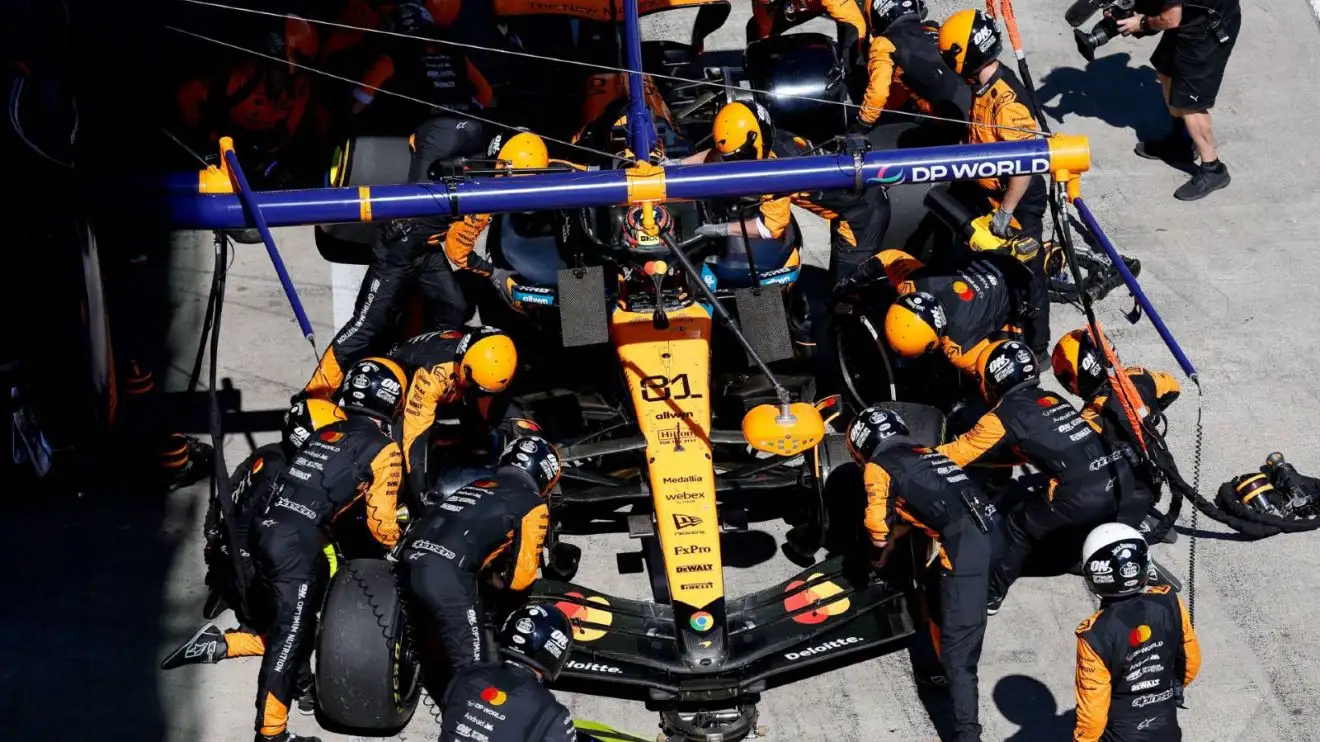
McLaren pit stop
Suffering a double disqualification in Las Vegas when both MCL39’s skid planks suffered excessive wear, McLaren CEO Zak Brown would like to see refuelling return to the sport.
Not that it would’ve definitely prevented McLaren’s double DSQ, but it would open the door to more weight questions, strategies and, ultimately, controversy.
McLaren: But also add a big strategic dimension…
This season four cars; Lewis Hamilton’s Ferrari in China, Nico Hulkenberg’s Sauber in Bahrain, Lando Norris’s McLaren in Las Vegas and also Oscar Piastri’s, were disqualified from grands prix for excessive plank wear.
The regulations state that the thickness of the plank assembly should be 10mm plus or minus 0.2mm when new.
The plank normally wears down during the various sessions, including the grands prix, but it shouldn’t be less than 9mm thick when measured after. That’s done using specialised measuring devices where the FIA assesses the wear at four holes pre-drilled into the plank and skid. Each hole is 50mm in diameter and 10mm deep.
Article 3.5.9 of the 2025 technical regulations states, “The thickness of the plank assembly measured normal to the lower surface must be 10mm ± 0.2mm and must be uniform when new. A minimum thickness of 9mm will be accepted due to wear, and conformity to this provision will be checked at the peripheries of the designated holes.”
Hamilton’s Ferrari failed the test in China, Hulkenberg’s Sauber in Bahrain and both McLarens in Las Vegas.
But on top of that, Charles Leclerc’s Ferrari failed the weight test in China, his SF-25 found to be 1kg under the 800kg minimum weight, with Pierre Gasly’s Alpine also recording the same measurement. They were also disqualified.
McLaren CEO Brown reckons there’s a solution, but an intriguing one that won’t make the teams’ lives easier. In fact, it will make things a whole lot more difficult.
Refuelling.
Formula 1’s season of change: F1 2026 explained
F1 2026 tech analysed: The future of overtaking and biggest car advantage identified
F1 2026 driver line-up: Lewis Hamilton and other drivers already confirmed for 2026
“I think if we got back into refuelling, it would be cool,” the McLaren CEO told talkSPORT, while promoting his book ‘Seven Tenths Of A Second’.
“That would make pit stops, add another dimension to it, but also add a big strategic dimension.
“If you got into refuelling, weight makes such a difference. Do you run heavy at the start and go long? Do you run light to get a better start?
“So it would add a lot of dimensions to the strategy that I think would be fascinating.”
Refuelling would add or subtract kilograms from the car at any given time meaning teams would run lower to the ground, but spend more time in the pits or even two-stop, but have better downforce or run higher from the ground and only one stop, but the downforce would be less
F1 banned refuelling in 2010 due to safety concerns.
It was a huge part of race strategy when it returned to the pit lane in 1994, but as teams pushed the limits in refuelling, despite the use of shut-off valves, there were notable incidents that led to refuelling being banned, again, in 2010.
Although technology had advanced, there were still high-risk moments, such as Felipe Massa’s 2008 Singapore moment when he drove off with the hose still attached.
The FIA banned refuelling in 2010 but in the years since there have been calls for it to return given it adds a whole new dimension to grands prix that tyre changes cannot provide.
McLaren cleaned up the double this season, winning the teams’ trophy in Singapore while Lando Norris beat Max Verstappen to the Drivers’ title at the season finale by two points with Oscar Piastri P3.
Read next: McLaren hoping to be ‘proven correct’ in vital F1 2026 decision


