

Mercedes F1 2026 compression ratio debate nears boiling point ahead of homologation
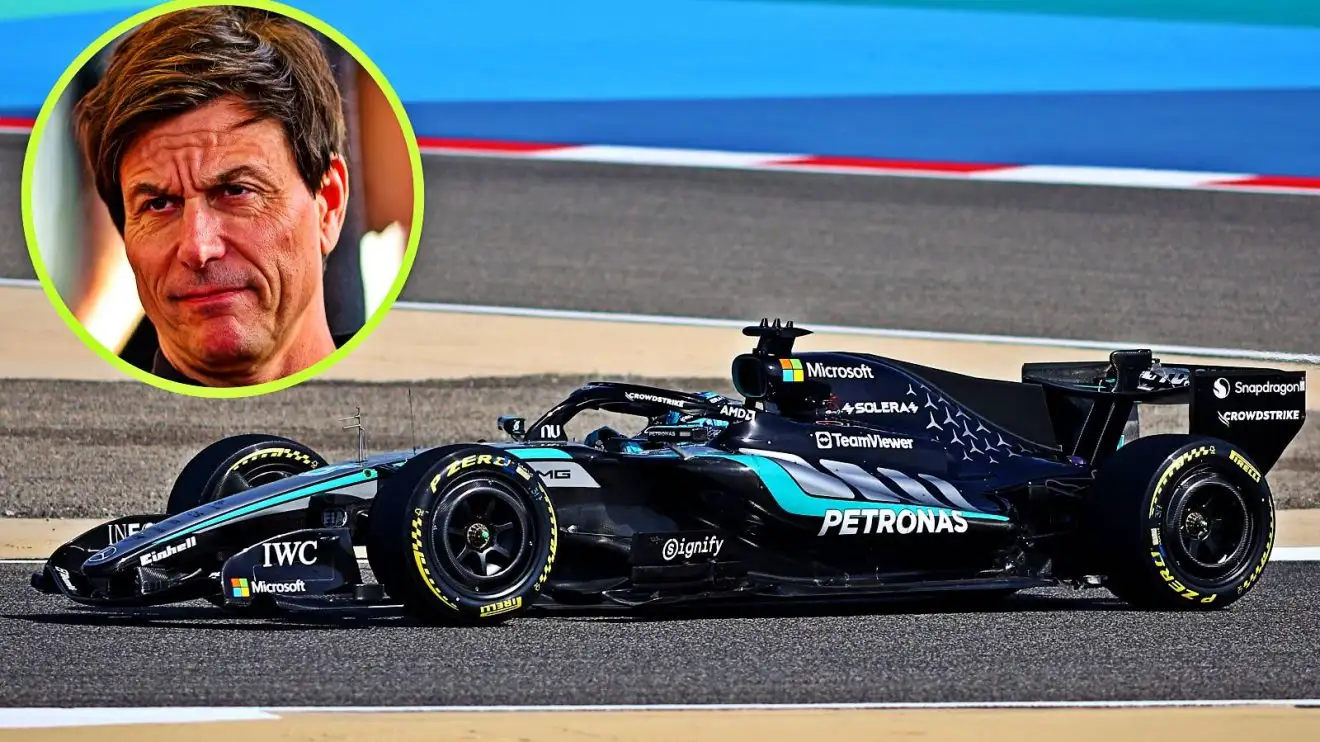
Mercedes could come out on the losing side of a critical vote regarding the engine regulations as other power manufacturers chase a tweak.
A hot-temperature compression ratio test is one solution set to be tabled at an upcoming meeting of the power unit advisory committee.
The matter of compression ratio measurements in the new F1 2026 power units has been a prevailing topic through the winter, with the situation likely to come to a head in the coming weeks as the homologation date for the new units is fast approaching.
What is the power unit compression ratio fuss all about?
Whispers over the winter that Mercedes High-Performance Powertrains, the power unit manufacturer that supplies the factory team as well as customers McLaren, Alpine, and Williams, has exploited a grey area in the technical regulations regarding compression ratios have grown in volume as the F1 2026 season hoves into view.
The homologation date for the new power units is March 1st, with each power unit manufacturer [PUM] required to submit all of its documentation regarding the architecture and construction of the new units to the FIA for final sign-off for the year.
However, early in the winter break, speculation emerged that two power unit manufacturers, Red Bull Powertrains [RBPT] and Mercedes, had exploited a grey area within the technical regulations pertaining to compression ratio measurement.
Article C5.4.3 of those technical regulations states that, “No cylinder of the engine may have a geometric compression ratio higher than 16.0.”
This is a lowering of the ratio from the previous generation of hybrid V6s and the crucial wording of the rule defines when this ratio will be measured.
“The procedure to measure this value will be detailed by each PU Manufacturer and executed at ambient temperature.
“This procedure must be approved by the FIA Technical Department and included in the PU Manufacturer homologation dossier.”
The prevailing hypothesis has been that RBPT and Mercedes had each discovered ways to adhere to the geometric compression ratio of 16.0 at ambient temperatures, but had also unlocked a way to run at a higher ratio at higher temperatures, ie. when in use on track. Depending on who you speak to, the performance advantage this can offer ranges from negligible, to several tenths of a second per lap.
This scenario conforms to the wording of the technical article, but is ambiguous in that it doesn’t explicitly rule out a different interpretation: The regulation states a compression ratio value, but doesn’t outlaw higher ratios under conditions outside of the testing parameters.
It is around this regulation that the PUMs have spent several years building their architectures, and changing these architectures and power unit designs is not the work of a moment.
But, with homologation looming, a series of meetings of the Power Unit Advisory Committee [PUAC], which includes all five PUMs, has been scheduled to meet with the FIA and FOM where the matter of compression ratios and how best to proceed with regards to testing these ratios has been discussed – including whether a change is needed before this season even starts.
Following the first meeting, the FIA confirmed that the occasion had included a discussion on “seeking alignment on the methodology of measurement of compression ratios at hot temperatures”.
A supermajority vote could force engine rule change
Since the initial Barcelona shakedown, it’s understood that the situation has evolved: RBPT – for whatever reason – appears to have moved away from a position of continuing with pursuing its original path and, instead, is said to have joined the remaining three PUMs in seeking the introduction of testing compression ratios at hot temperatures. This leaves Mercedes exposed on its own as a PUM.
Of course, the engineering challenge of creating of such a test is not insignificant and, ahead of the final PUAC meeting, which logically must take place before the homologation shut-off of March 1st, PlanetF1.com has learned that one of the leading scenarios being presented by the PUMs is the details of how such a test can be carried out, with the four non-Mercedes manufacturers collaborating to devise such a test on behalf of the governing body for potential ratification into the rules.
Rules aren’t easily changed in F1 and, with the rulemaking process for power units involving the PUAC rather than the F1 Commission (which is made up of the teams as well as the FIA and FOM, and could have benefitted Mercedes through its customer axis, had it been the relevant body), the only way a change can be made in the short-term is by way of a supermajority vote.
A vote isn’t yet certain to happen, but it is likely at this point, given the impasse that has been reached.
Of the five PUMs, the FIA, and F1, a supermajority would pass if four PUMs, the FIA, and F1 are in agreement on any proposed solution that involves a rule change, meaning that any PUM that is running higher compression ratios above ambient temperatures would be in contravention of the immediately-revised technical regulations.
Of course, Mercedes, as the PUM understood to have exploited the grey area, would be unlikely to be satisfied with this outcome: given its constant communication with the FIA throughout the design process, suddenly finding that its power unit is deemed illegal based on a regulation that did not exist until the final days or weeks before the homologation shut-off.
On Wednesday, the first day of the Bahrain test, James Vowles was at pains to point out that Formula 1 is a meritocracy. With his cars powered by Mercedes, he pointed to the exemplary engineering work that has been performed by Mercedes, and stated his firm belief that the power units are legal.
It is difficult to argue with this position. Creating a power unit that conforms to the letter of the regulations is exactly the type of brilliant engineering that Formula 1 is supposed to reward and, theoretically, could mean that Mercedes starts the new engine cycle with a power unit steps ahead of any rival.
“Obviously, when you design an engine, you’re keeping the FIA very close to the decisions you make and and that’s what we did, and we have had all the assurances that what we did was according to the rule,” Mercedes’ Toto Wolff said later on Wednesday.
“I think all of our competitors got a little bit aggrieved and lobbied the FIA for a long time, and we trust in the governance of the Power Unit Advisory Committee. We’ll see how that goes.”
Faced with the possibility of a team and/or manufacturer such as Mercedes simply steamrollering the field to start the new regulations, if the exploit does prove extremely advantageous, and no quick and easy way for the other power unit manufacturers to close the supposed performance gap – this could lead to a one-sided championship in the first year of the much-vaunted new regulations.
Would late rule change be unfair on Mercedes or any conforming PUM?
But, if a PUM has designed a power unit that conforms to the letter of the regulations as clearly defined, even a supermajority vote to introduce a hot temperature compression ratio test can be viewed as nothing more than a very late moving of the goalposts – likely too late for any affected PUM to be able to make the necessary changes.
There is no palatable resolution to this scenario, as it’s impossible to please everyone. If a supermajority isn’t reached, then mass protests against Mercedes-powered cars are highly likely at the Australian Grand Prix, introducing a raft of hearings, appeals, and uncertainty over results for weeks, if not months, on end.
If a supermajority is reached and a hot ratio test is devised and rolled out, Mercedes could find itself in a scenario in which its engine fails homologation due to a design which only became illegal at the very end of the entire design and construction phase, brought about by a collaborative effort of four other PUMs who have not matched what Mercedes has achieved in its interpretation.
Speculation about legal threats, attributed to Mercedes CEO Ola Kallenius, floated around last week, with said speculation quickly shot down as being without basis when investigated by PlanetF1.com, and Wolff poured cold water on the possibility of exploring legal avenues should it find itself on the losing end of a vote.
“There is no such scenario that we would sue anyone,” he said.
“Formula 1, in my opinion, it’s more essential than ever that you know what the rules are, but engineering ingenuity is always respected and and that’s why we are always going to respect the governance of the sport, and if the governance of the sport decides to change the rules, against or for our position, we just have to get along with it.”
Wolff’s magnaminity is eye-opening as it suggests that there is already a contingency in place, or perhaps the engineering challenge of reverting to a more compliant design is less difficult than externally viewed, given that there appears to be no desire to fight back with all its might on the matter. Or might such a relaxed approach be an affectation to attempt to assuage the four rival manufacturers into believing his words that the ratio trick might only contribute as little as a quoted two to three horsepower?
Regardless of the curious nature of Wolff’s docile acceptance of the situation, it’s difficult to argue that this is fair on Mercedes.
The situation appears quite simple in that the other PUMs have dropped the ball and have banded together to try dragging the errant crab back into the bucket, with the Brixworth-based manufacturer being the one to have spotted a regulation wording that does not clearly define whether engines operating at a higher ratio than 16.0 when not being tested at ambient temperature are against the rules.
Without that definition, Mercedes could yet find itself in the unenviable position of being punished at the end of a process in which it did its homework better than the rest, only to find that jealous rivals can successfully use the fear of a potentially one-sided championship to their advantage.
Read Next: Toto Wolff rules out Mercedes legal action as compression ratio furore set for critical vote


