

Why Toto Wolff believes Red Bull’s first F1 engine sets the benchmark
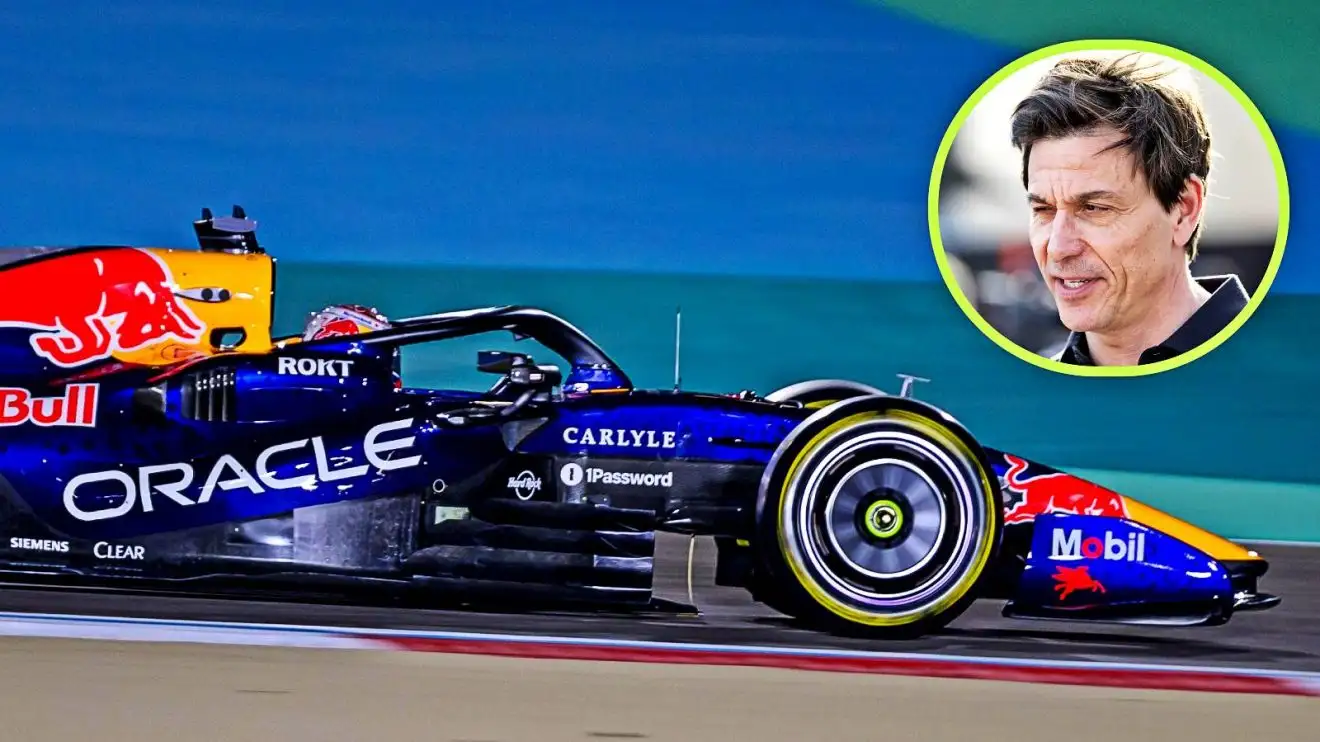
Red Bull's engine project has impressed Toto Wolff, who has declared the team "F1's benchmark".
Red Bull Powertrains’ first F1 engine has caught Toto Wolff’s eye as being the “benchmark” power unit of the five manufacturers.
The Milton Keynes-based manufacturer has arrived on the grid this year with its first-ever F1 engine, and has duly impressed throughout the opening days of testing.
Toto Wolff explains why Red Bull’s new power unit leads F1 field
Want more PlanetF1.com coverage? Add us as a preferred source on Google to your favourites list for news you can trust.
Almost half a decade on from the establishing of the Red Bull Powertrains project, the first unit to hit an F1 track immediately impressed during the Bahrain shakedown a fortnight ago as, on its maiden outing, the power unit performed over 100 laps without issue as Isack Hadjar set the fastest time.
It was an impressive and assured display of pace and reliability from the RBPT unit, with the engine set for submission to the FIA for homologation being the sixth-generation iteration created for the test benches in Milton Keynes.
It’s been a long road for RBPT to get to this point, with Red Bull establishing its own power unit project – a move pushed for and overseen by then-CEO and F1 team boss Christian Horner, who secured former Mercedes man Ben Hodgkinson to become the technical director for the project.
While Horner’s involvement in the project came to an end a few months shy of seeing the engine hit the track for the first time, as he and Red Bull parted ways last summer, the momentum established over the four years of work has allowed Laurent Mekies to slot into Horner’s roles and oversee the delivery of the final product that was slotted into the back of the RB22 for what proved to be an impressive Barcelona shakedown.
Taking on the might of established automotive manufacturers such as Audi, Mercedes, Honda, and Ferrari, RBPT’s project has benefitted greatly from Horner’s securing of US auto giant Ford as a technical partner, expediting the preparations for the F1 2026 debut under the new engine ruleset as the sport moves onto the next-generation hybrid V6 units.
Against the backdrop of lots of noise about compression ratios and grey areas surrounding the topic, Mercedes High-Performance Powertrains [HPP] has been touted as a potential favourite to start the new rules cycle, with the Brixworth-based company supplying the factory Mercedes team, and customers McLaren, Alpine, and Williams.
A Mercedes power unit went quickest on the first day of official pre-season testing in Bahrain as Lando Norris set the pace in his McLaren, but Max Verstappen’s performance in the Red Bull was equally eye-catching.
Circulating with a best time just a tenth off the new World Champions’, Verstappen put in 136 laps all by himself throughout the day, a distance bested only by Williams’ combined efforts to log 145 laps.
With no issues reported by Red Bull, the performance caught the attention of Mercedes’ Toto Wolff, with the Austrian singling out RBPT and the overall Red Bull team as being the benchmark for the grid.
“Well, I was hoping that they were worse than they are,” Wolff told assembled media, including PlanetF1.com, in Bahrain on Wednesday.
“They’ve done a very good job.
“The car, the power unit are the benchmark at the moment, I would say.
“And, obviously, if you have Max in the car, that combination is strong.”
Given the paddock perception that it is Mercedes who is a step ahead, Wolff doubled down on this claim when pressed, saying, “At the moment, I would say so, very much.”
It’s in Red Bull’s apparent understanding of energy harvesting and deployment, an area that could emerge as being one of the main performance differentiators between competitors this year, that Wolff suspects RBPT is a step ahead.
“Look at their energy deployment today,” he said.
“They are able to deploy far more energy on the straights than everybody else.
“I mean, we are speaking a second a lap over consecutive laps.”
This would suggest that Red Bull’s RB22 is generating energy with greater ease than some of its rivals around the Bahrain circuit, allowing it to deploy for a greater percentage of the straights than others who may be running out earlier and thus having to lift and coast greater distances.
“On a single lap, we have seen it before,” Wolff said, “but now we have seen it on 10 consecutive laps with the same straight-line deployment.
“I would say that as of today, on the first official day of testing, which is always with the caveat of that, they’ve done a day to set the benchmark.”
More on the F1 2026 power units
F1 2026 uncovered: How Boost, Overtake, and sustainable fuel change the game
Explained: F1’s complex power unit upgrade system
Appearing to pour cold water on Mercedes’ favourites tag, Wolff denied that the HPP unit is capable of matching what’s being seen from the RBPT, although it’s worth remembering that the learning process for energy management is still very much in its infancy.
When asked if Mercedes can match Red Bull in this area, Wolff bluntly replied: “Today, no.”
Want to be the first to know exclusive information from the F1 paddock? Join our broadcast channel on WhatsApp to get the scoop on the latest developments from our team of accredited journalists.
You can also subscribe to the PlanetF1 YouTube channel for exclusive features, hear from our paddock journalists with stories from the heart of Formula 1 and much more!
Read Next: Mercedes F1 2026 compression ratio debate nears boiling point ahead of homologation


