

Why Monza is no longer the Temple of Speed under F1’s 2026 rules


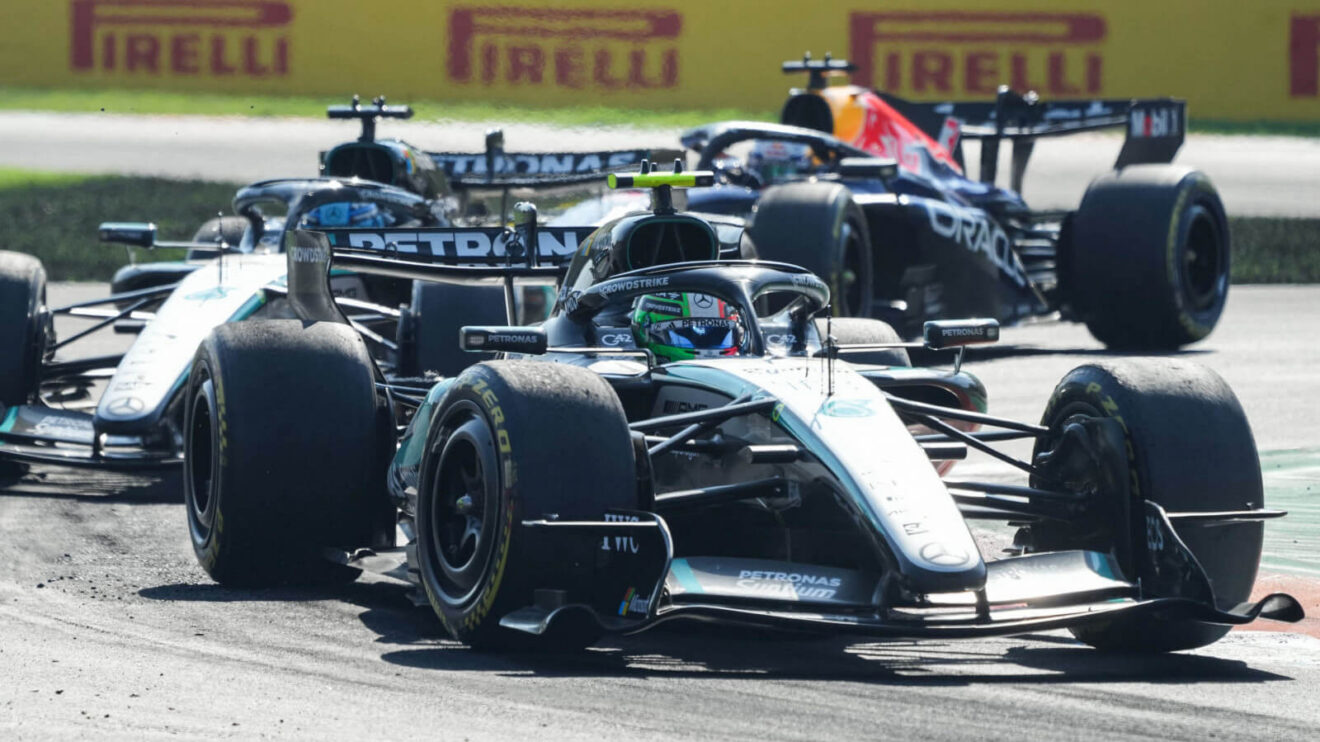
Is Monza still the Temple of Speed?
Monza – traditionally F1’s ultimate speed circuit – has become one of the clearest demonstrations of how radically the 2026 cars have changed.
The skepticism felt ahead of this legendary race proved entirely justified. The data explains why Monza is no longer the Temple of Speed – and why the 2026 rules represent a true paradox.
How the 2026 F1 rules changed Monza’s top speeds
After iconic circuits such as Suzuka, Silverstone and Spa, it was now Monza’s turn to face the harsh reality of the 2026 regulations, forcing us to completely unlearn everything we thought we knew about these venues.
The constant demand for electrical battery charging means drivers are taking iconic corners at entirely different speeds, while long straights have transformed into energy harvesting zones rather than displays of pure power unit output.
Because Monza is a track demanding the highest power unit performance on the calendar, the speed differentials between 2025 and 2026 here are staggering.
Take Max Verstappen, for instance, who took pole position here last year. Comparing his 2025 lap (white) with his best 2026 qualifying run (blue) reveals a startling contrast.
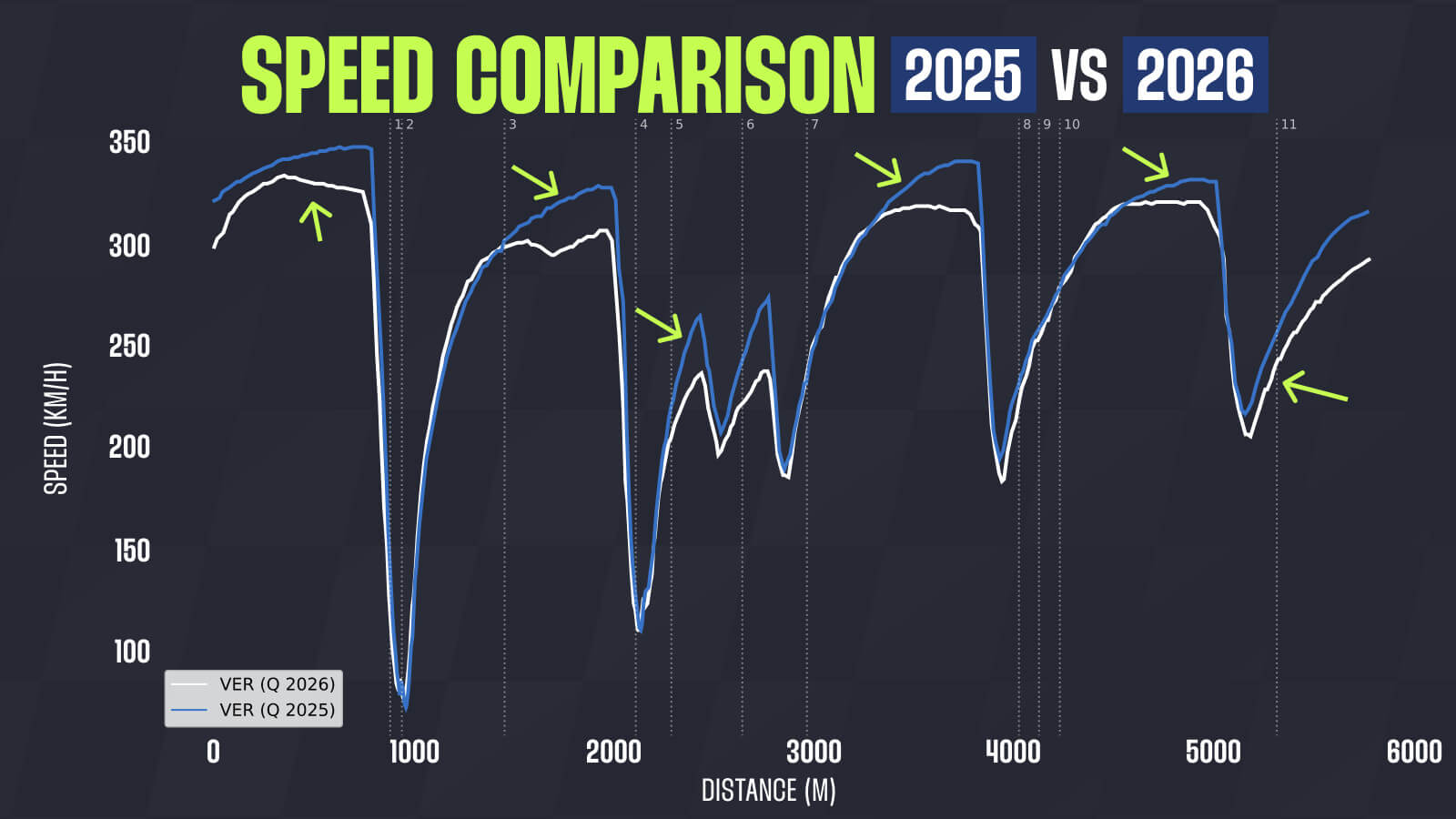
At first glance, the difference is remarkable, whether looking at peak straight-line speeds, the Lesmo section, or the exit of the Parabolica. Although 2026 cars boast superior initial acceleration, the drop in speed on the exit of the final corner is very high.
The highest top speed recorded during this year’s qualifying session was set by Russell at 341 km/h, whereas last year’s benchmark reached 354.7 km/h, set by Hülkenberg (measured during their fastest lap in the session). That represents a deficit of 13.7 km/h.
However, the more concerning issue is what happens once top speed is reached along the straight, which always occurs in the first half of it. At best, speed plateaus until the braking zone; more often than not, it actually begins to drop, which is particularly striking to see in telemetry traces.
But while all of this has been discussed throughout the season, Monza revealed a second type of paradox – perhaps an even stranger one.
Specifically, the Italian GP proved that the longer a circuit’s straights are, the lower its top speeds will be.
Long straights for the ERS system mean that it has be used for a greater distance. In a way, the longer the straight, the earlier harvesting will start, and consequently, the top speed will remain frozen at a lower value.
The data backs this up convincingly.
Comparing race top speeds across all events held so far this season against their 2025 counterparts, Monza recorded the worst deficit – unsurprisingly so – with peak speeds dropping by 14 km/h during the race, mirroring the qualifying picture (falling from 365 km/h down to “just” 351 km/h).
The maximum race speeds referenced here are not speed trap figures. They are generated using a script that does not restrict data to a driver’s or the race’s fastest lap, but simply extracts the peak speed recorded at any moment during the race.
Spa was next on the list, dropping by 7 km/h, while Monaco and Miami also saw minor reductions in top speed.
On every other circuit, however, maximum speeds actually increased, bringing us directly to the core of the paradox.
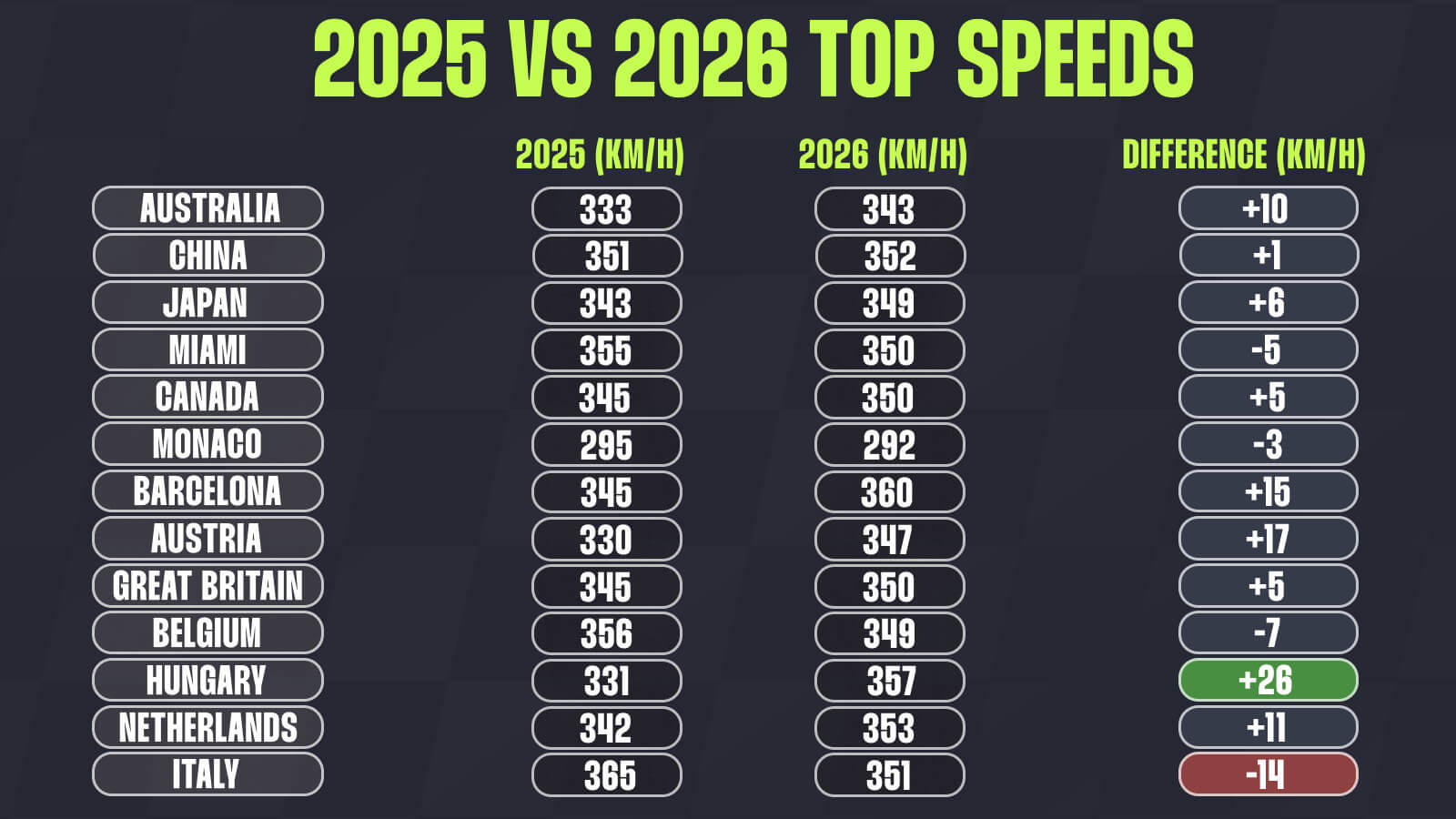
The venues that registered the largest gains in top speed are actually the slowest tracks on the calendar with the shortest straights. Leading this list is the Hungaroring (alongside Monaco the slowest circuit of the year) where peak race speed jumped from 331 km/h in 2025 to 357 km/h this year, a massive increase of 26 km/h.
Next up was the Red Bull Ring with a 15 km/h increase, followed by Barcelona gaining 11 km/h.
All of these circuits are defined by their complex cornering sequences rather than sweeping straights.
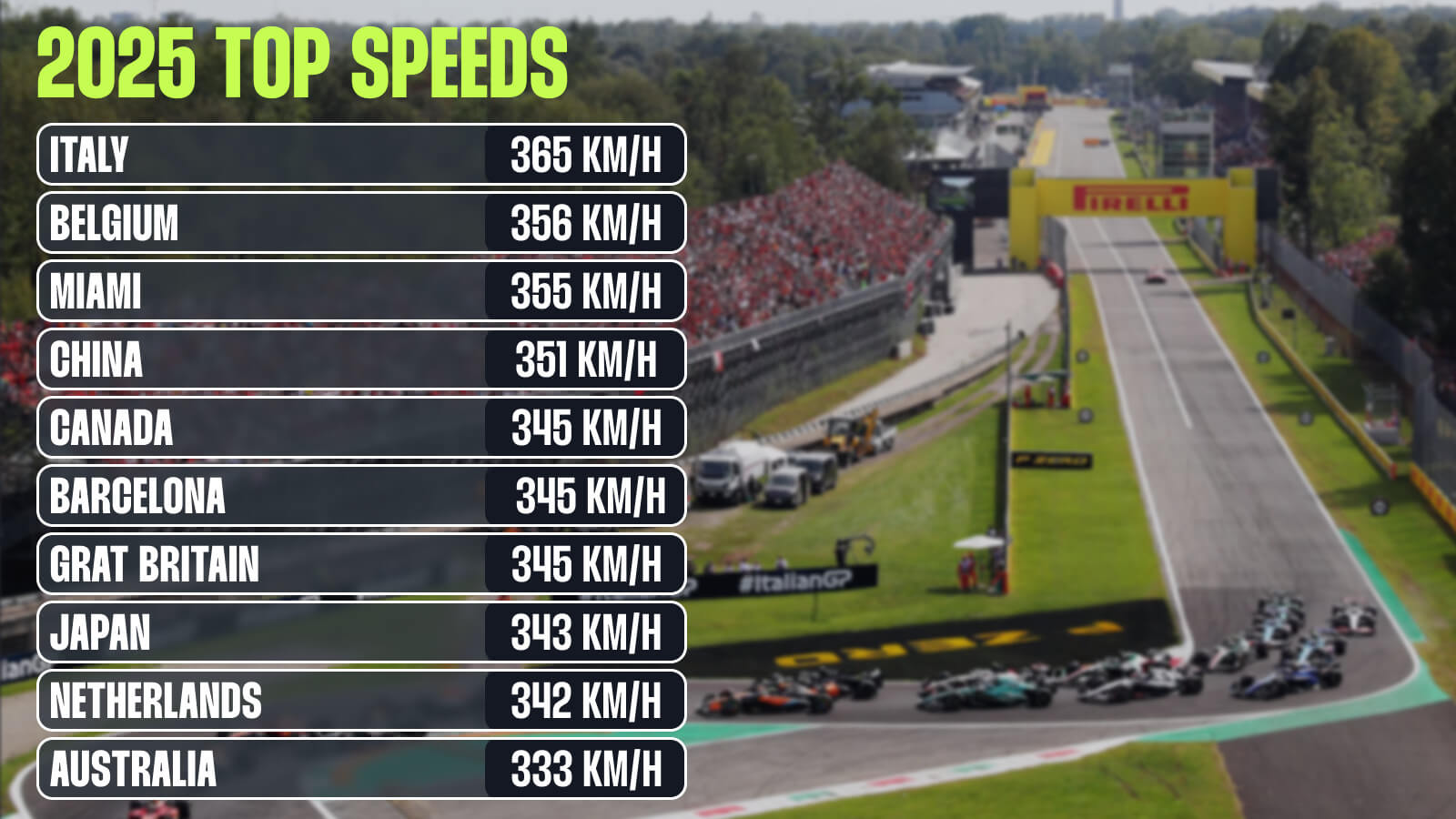
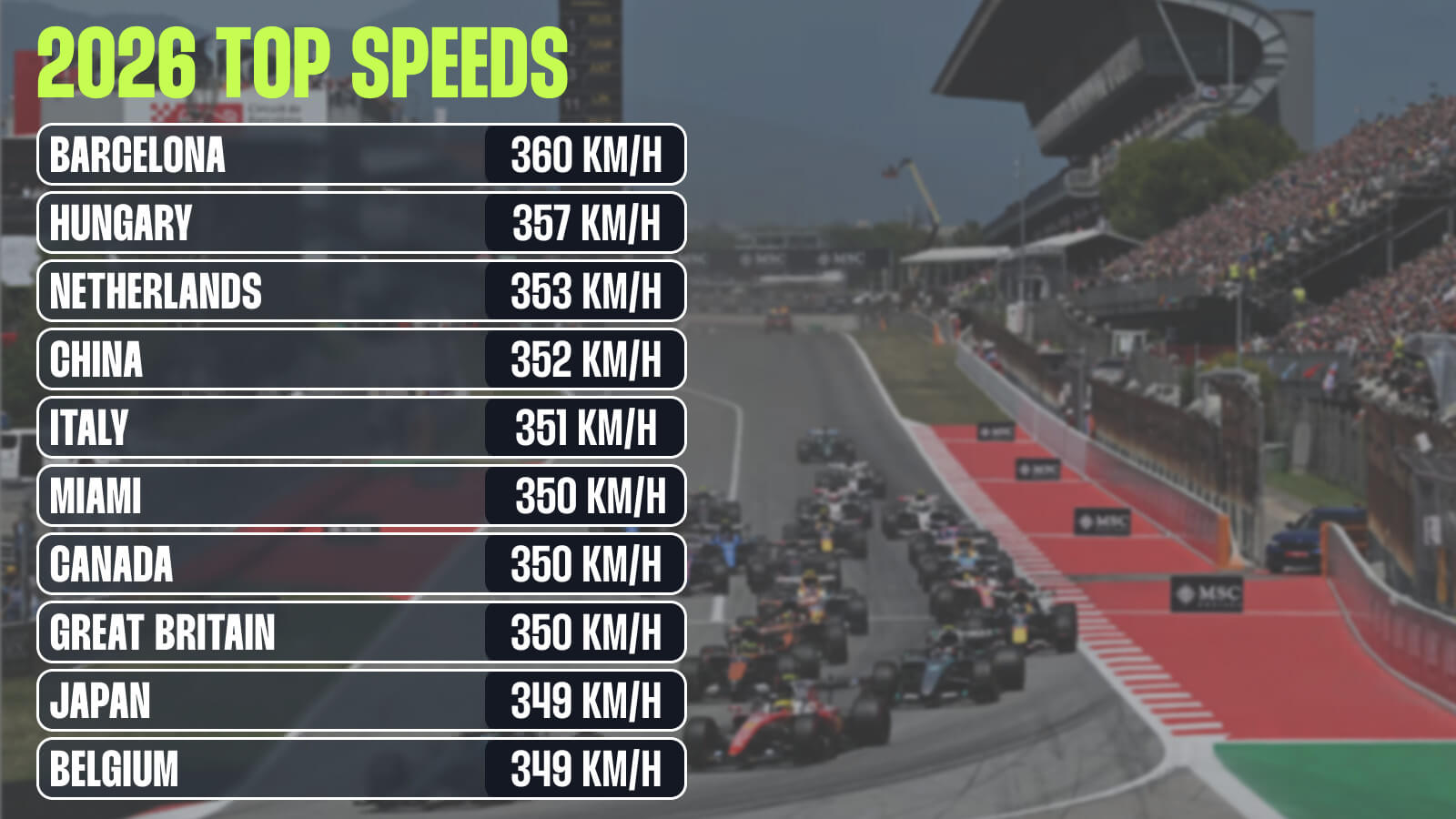
Therefore, it can be stated without exaggeration that Monza is, regrettably, no longer the Temple of Speed. In 2025, among all analyzed events, Monza held the absolute highest top speed by a wide margin (365 km/h), with no other venue coming close.
This year, Monza sits in fifth place in that metric, while Barcelona currently leads the chart at 360 km/h.
This fascinating, peculiar, and somewhat telling statistic perfectly captures the essence of the 2026 car generation. They are so fundamentally different that we must rewire the analytical logic built over decades.
Naturally, the new technical regulations offer many positive aspects, but if a single drawback had to be singled out, it would undoubtedly be this dynamic.
Italian Grand Prix analysis
Italian GP conclusions: Shameless Hamilton playing dangerous game, painful Russell defeat
Italian GP driver ratings: Another costly Leclerc mistake and an Antonelli masterclass
The ‘Temple of Speed’ moniker was earned for very clear reasons.
While it may have temporarily lost some of its traditional clout, the hope remains that in the coming years, true top speeds will return to Monza, right where they belong.
Want to be the first to know exclusive information from the F1 paddock? Join our broadcast channel on WhatsApp to get the scoop on the latest developments from our team of accredited journalists.
You can also subscribe to the PlanetF1 YouTube channel for exclusive features, hear from our paddock journalists with stories from the heart of Formula 1 and much more!
Read Next: Antonelli and Russell telemetry data settles Mercedes Monza strategy debate