
Ferrari telemetry data explains secrets behind epic Australian GP start


Want more PlanetF1.com coverage? Add us as a preferred source on Google to your favourites list for news you can trust
After the first race of the season, PlanetF1.com’s resident data expert Uros Radovanovic has taken a closer look at the start of the Ferraris.
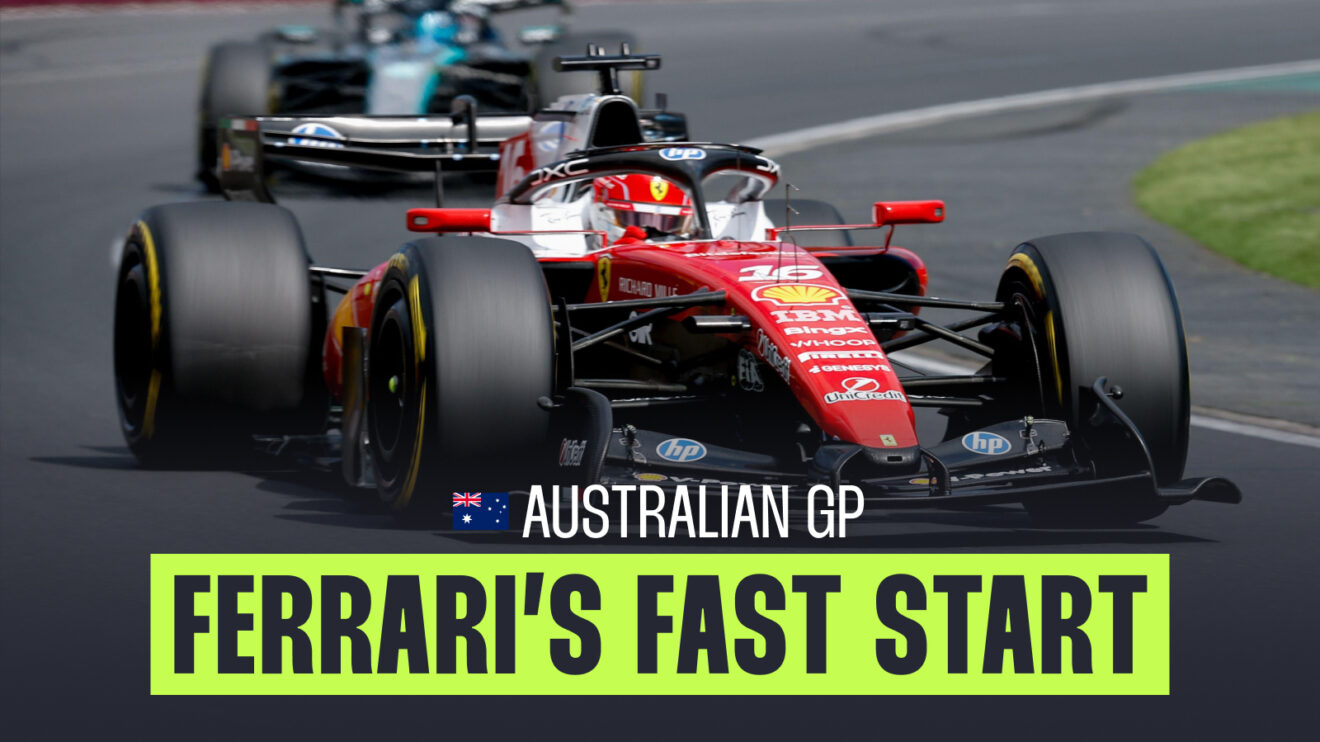
Charles Leclerc and Lewis Hamilton both launched off the line, putting them in contention for the race win at points and it backed a pre-season suspicion that the Scuderia had figured out a way to be superior off the line.
How Ferrari got such a great start to the Australian GP
Want more PlanetF1.com coverage? Add us as a preferred source on Google to your favourites list for news you can trust
A significant portion of the credit for Ferrari’s positive result, and their fight for the win in the early stages of the race, must be attributed to the race start itself.
Even during pre-season testing, there were whispers that Ferrari had engineered a clever way to get off the line better than the rest, but few expected the system to be quite this potent.
Let’s peer behind the telemetry data to understand exactly how Ferrari is achieving these lightning getaways.
A defining characteristic of this new generation of cars is that they require significantly more time in the “high-revving” zone to prepare for a standing start. This was first observed during the Bahrain tests, prompting the FIA to step in and adopt a revised race start procedure.
Under the new rules, drivers are given a blue light signal indicating that the traditional countdown sequence is imminent. This is the cue to switch the car into “high-revving” mode.
Following a qualifying session that didn’t quite deliver the tight battle we expected, Leclerc lined up in fourth, while Lewis Hamilton found himself further back on the seventh row.
For Hamilton, opportunity knocked before the lights even went out. Unfortunately for Oscar Piastri, a pre-race incident forced a DNS, leaving a vacant slot directly ahead of Hamilton and giving the Briton a clear path forward.
However, it was Charles Leclerc who stole the show at the first start of the 2026 season – surging from fourth on the grid to exit Turn 1 in the lead. The graph below illustrates exactly how he pulled it off.
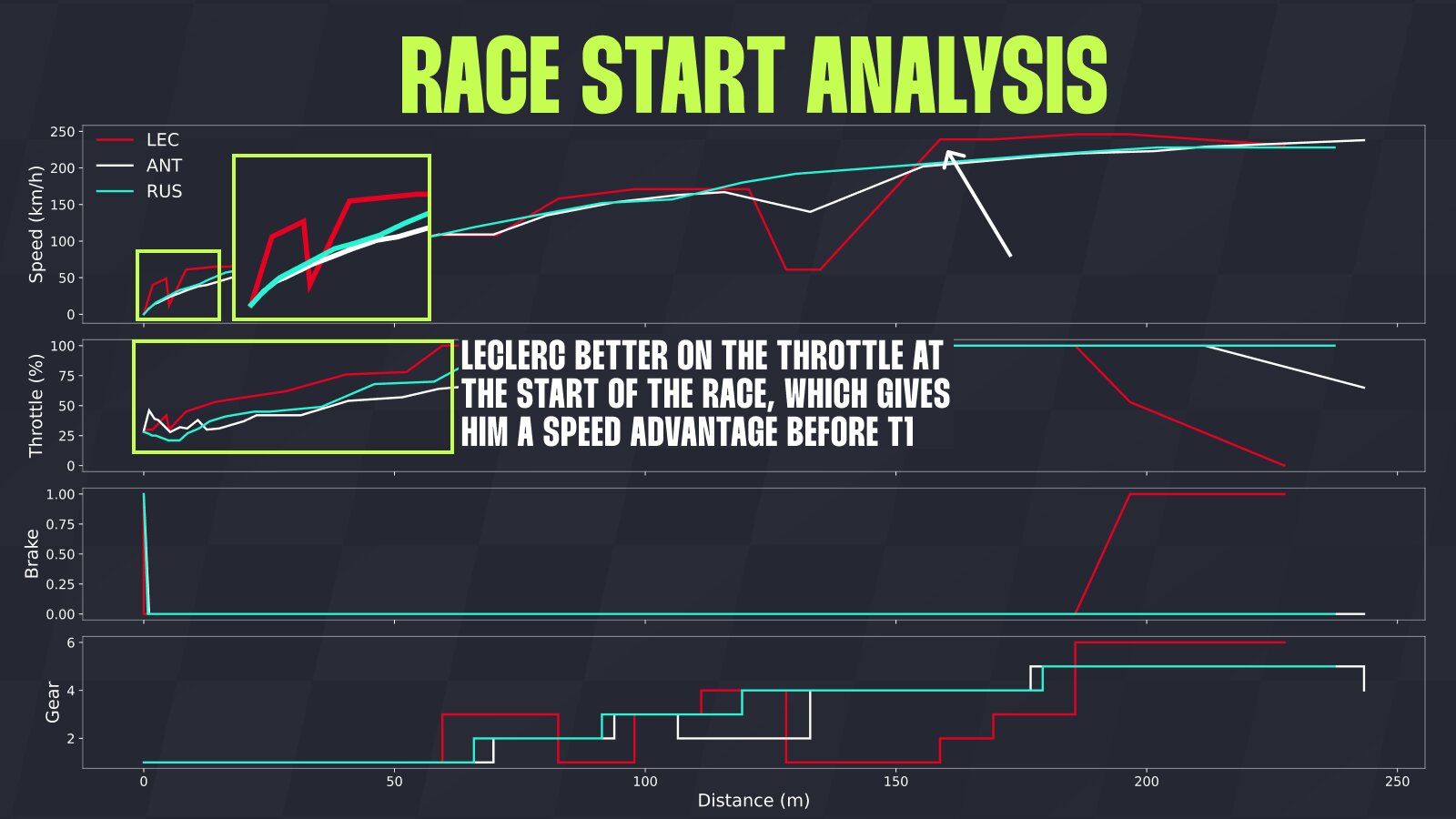
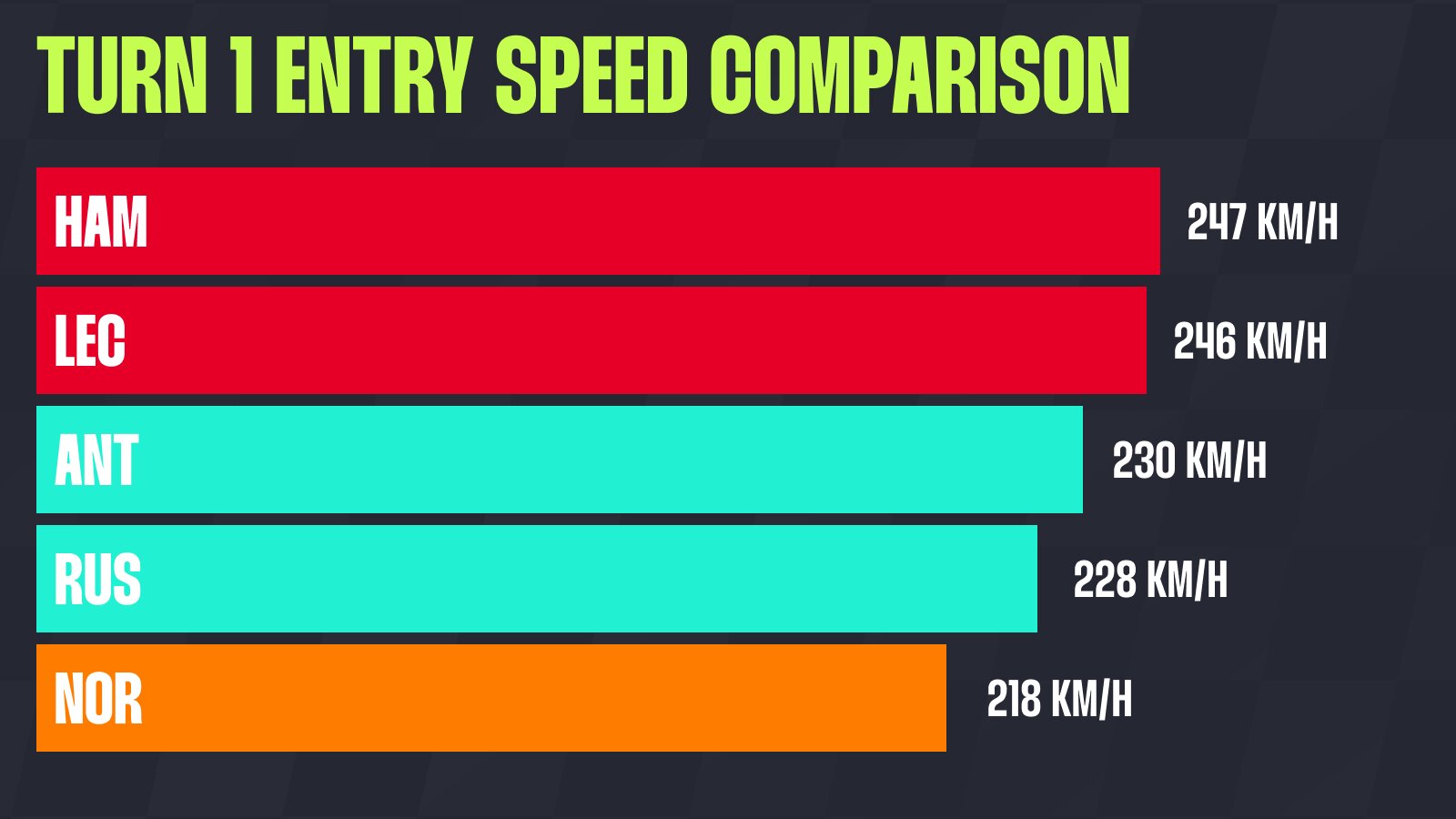
The data shows that Leclerc’s initial velocity was considerably higher than both Russell’s and Antonelli’s. This corresponds with a more aggressive and sustained throttle application throughout the acceleration phase down the straight. This allowed him to arrive at the first corner with nearly a 20km/h speed advantage over Russell which, combined with better position on the track, made snatching the lead look relatively easy.
He was inadvertently assisted by Kimi Antonelli, who started ahead of Leclerc but endured a much more difficult getaway. The telemetry reveals that Antonelli was actually the most aggressive of the three on the throttle. However, this proved to be his undoing, leading to excessive rear-wheel spin.
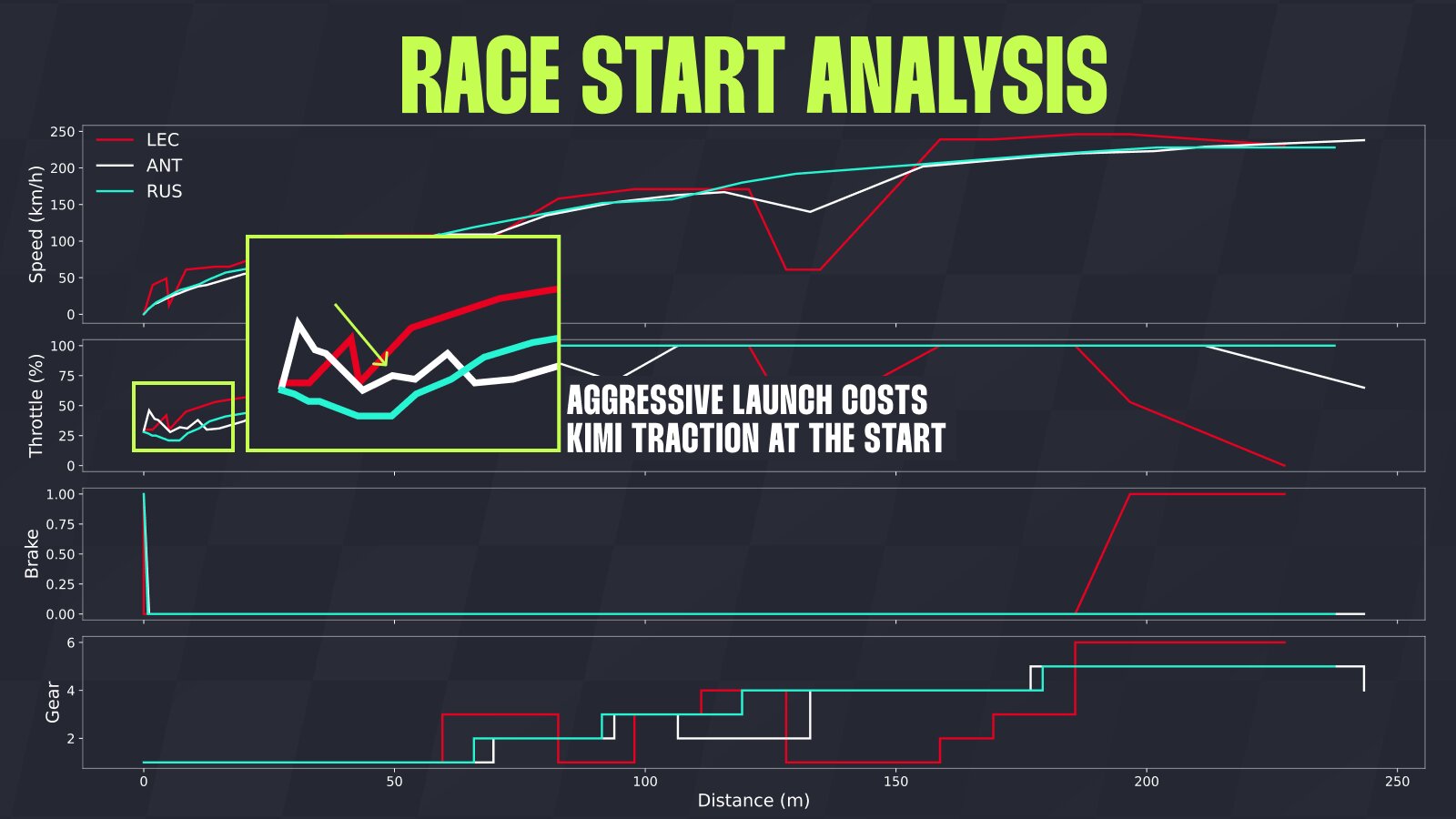
The graph clearly shows Kimi had to lift off to regain grip, costing him precious time and, unfortunately, several positions through the opening complex of corners.
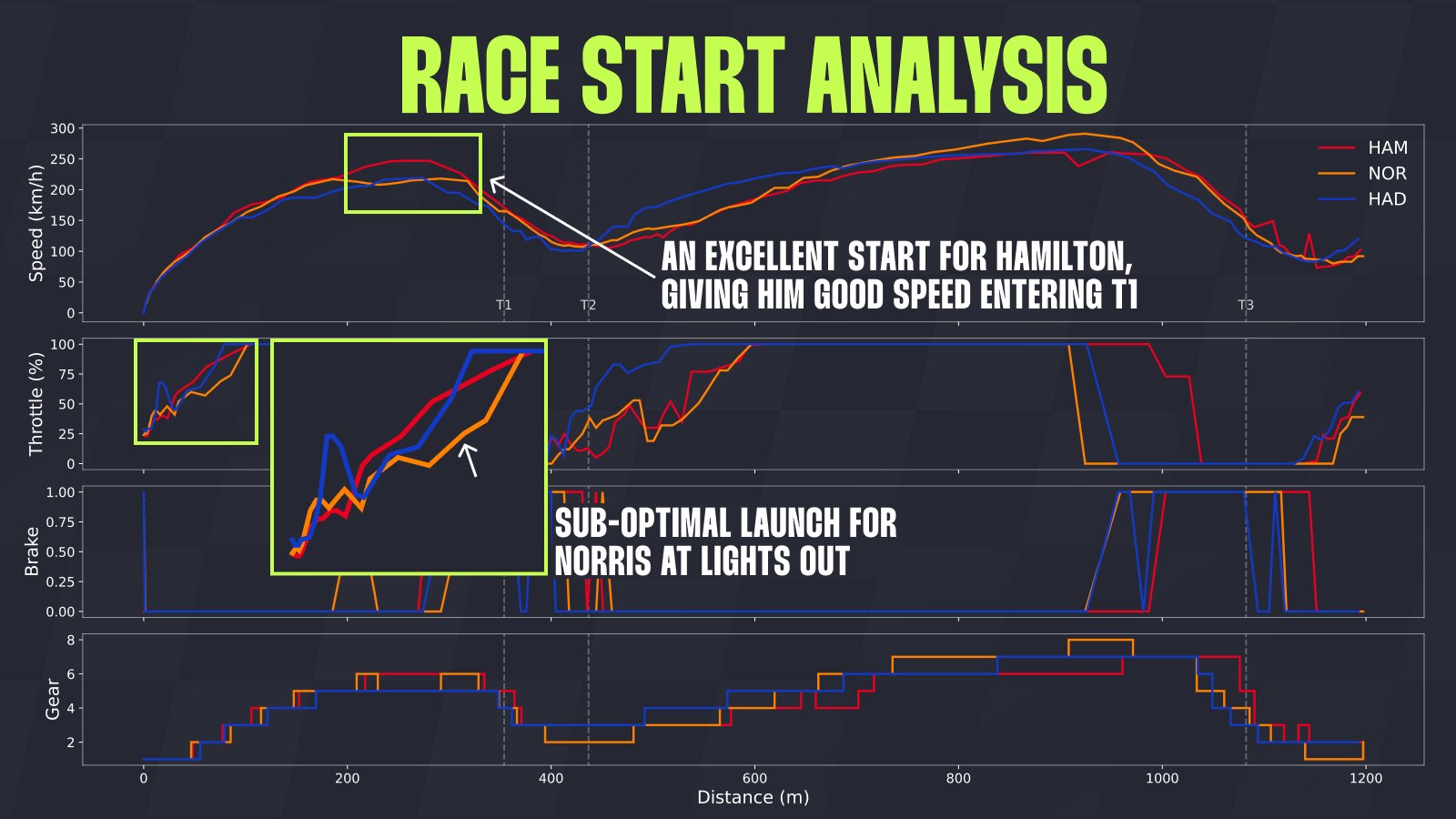
While perhaps not as dominant as Leclerc, Hamilton still made impressive progress at the start. His primary rivals were Lando Norris, who also suffered a sluggish launch, and Hadjar.
By the entry to T1, both Hadjar and Hamilton had cleared the McLaren. The graph below shows the significant speed advantage they held. However, Hamilton ran wide through T1, which cost him momentum and a position to the Red Bull driver.
More on the Australian Grand Prix from PlanetF1.com
* Winners and losers from the 2026 Australian Grand Prix (Albert Park)
* Ferrari strategy call scrutinised as Russell leads Mercedes 1-2 in Australia
* Charles Leclerc says ‘cheeky’ lights-out helped Ferrari lightning start in Melbourne
But the driver who truly demands our attention is the season’s sole rookie, Arvid Lindblad, who appeared seemingly out of nowhere to leapfrog Hamilton.
Lindblad had a clean launch and capitalised on the poor starts of Norris and Antonelli to go wheel-to-wheel with them exiting T1. His masterstroke, however, was “saving” his battery deployment until that specific moment, effectively turning his car into a rocket ship on the run between T2 and T3.
Notice his speed through T2, where he was the slowest compared to Lando and Kimi, only to be demonstrably the fastest through T3.
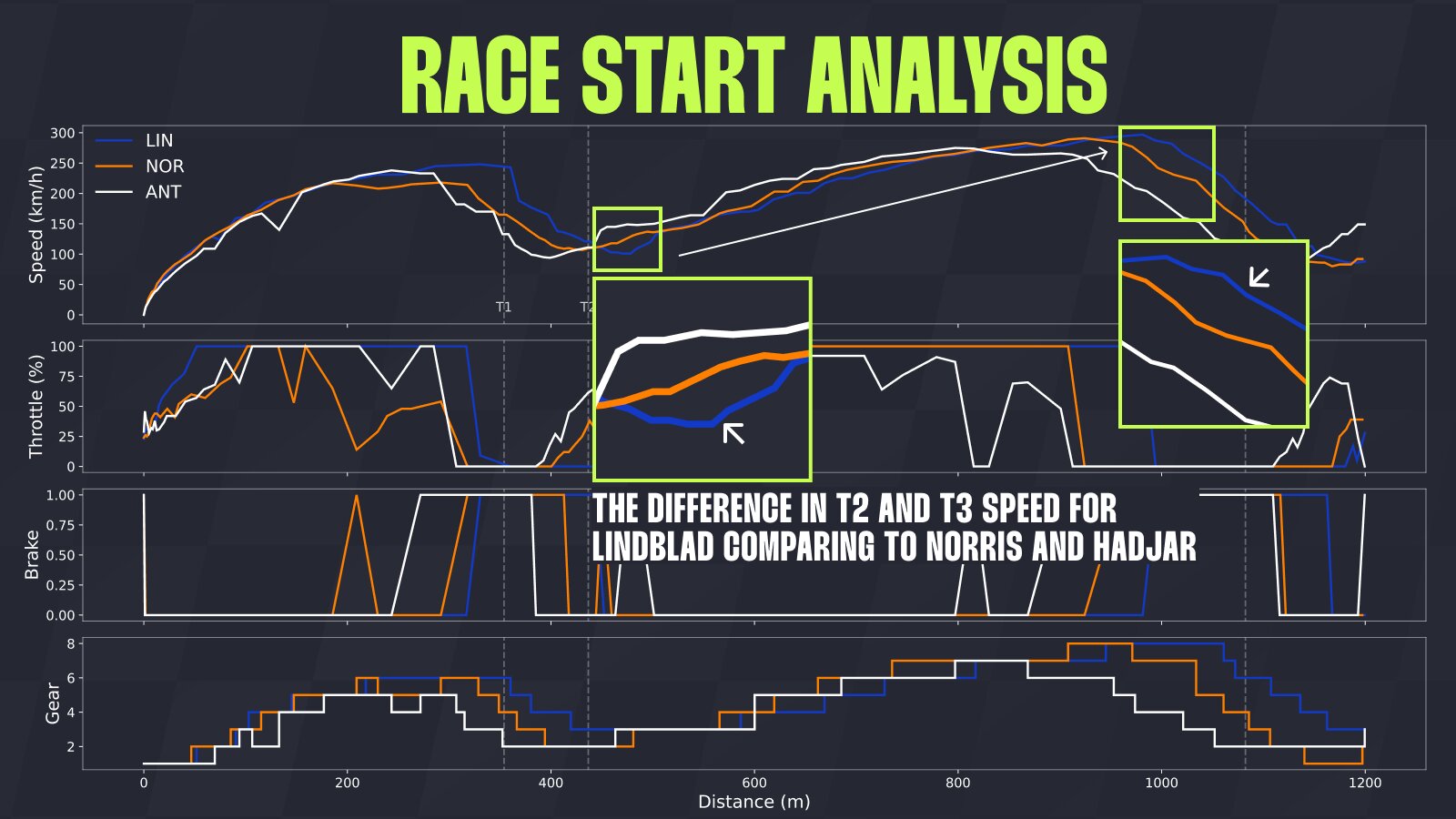
These “games” with electrical energy management are exactly what, in theory, should make Formula 1 more captivating for the fans. For now, we can conclude that the new regulations have given us a completely different start-of-race dynamic. As the season progresses, we suspect teams will find even more creative and entertaining ways to weaponise these new systems.
Read next: Oscar Piastri reveals ‘not insignificant’ factor behind heartbreaking Australian GP crash
Want to be the first to know exclusive information from the F1 paddock? Join our broadcast channel on WhatsApp to get the scoop on the latest developments from our team of accredited journalists.
You can also subscribe to the PlanetF1 YouTube channel for exclusive features, hear from our paddock journalists with stories from the heart of Formula 1 and much more!