
Significant Ferrari loss to Mercedes uncovered in British GP qualifying data


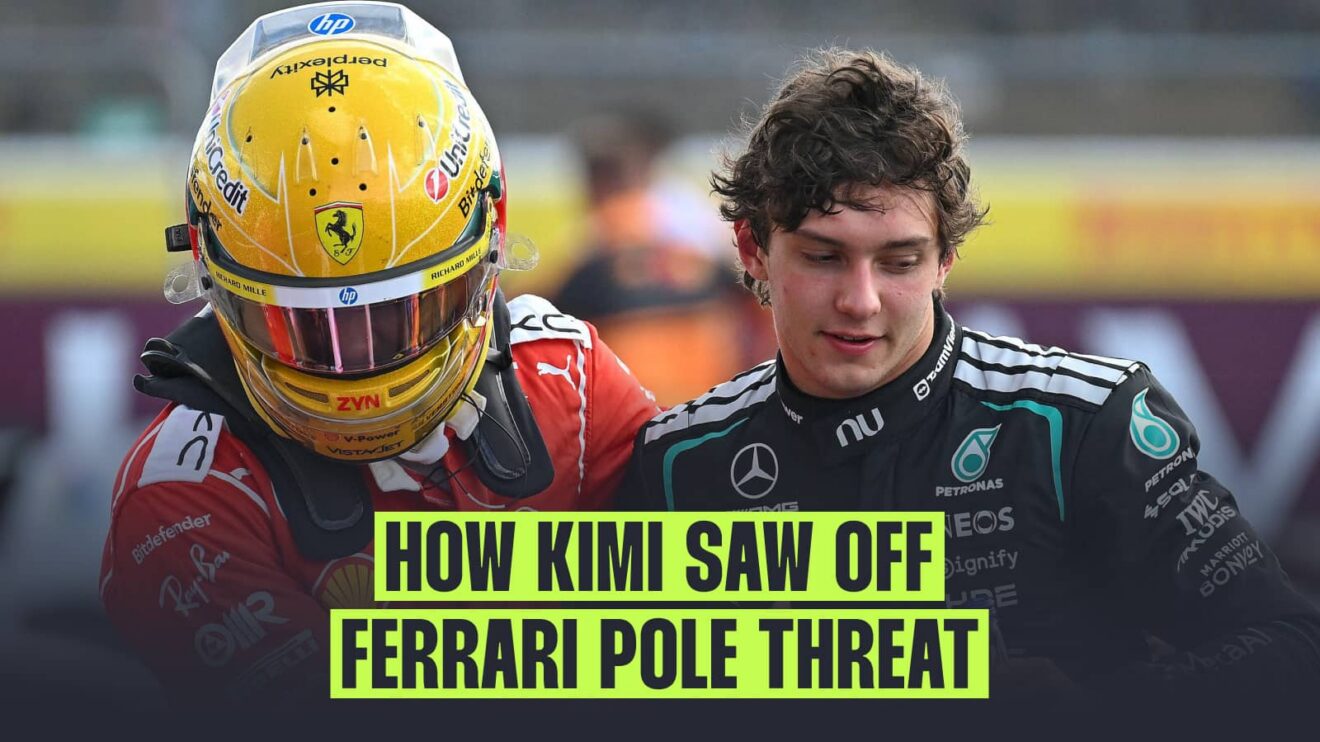
Kimi Antonelli will start the 2025 British Grand Prix from pole position
Following his victory in the Sprint race, Kimi Antonelli continued his Saturday at the British Grand Prix in the best possible way, securing another pole position despite frustrations at the start of his flying lap.
Let’s dive into the telemetry data and see where the Mercedes driver made a change compared to sprint qualifying to beat Ferrari drivers Charles Leclerc and Lewis Hamilton.
How Kimi Antonelli beat Charles Leclerc, Lewis Hamilton to pole position
Want more PlanetF1.com coverage? Add us as a preferred source on Google to your favourites list for news you can trust
This time, Antonelli’s main rivals were the Ferrari drivers, given that his teammate George Russell is not having the cleanest weekend.
Russell was the slower side of the garage throughout the weekend, and after a brief victory over Kimi in Austria, the momentum has swung right back to where it has been since the start of the season.
On the other hand, somewhat unexpectedly, we saw a very fast Ferrari.
The difficulties with maximum straight-line speeds are still there, but they seem to be significantly smaller now. The new power unit appears to function better at the lower altitude in Britain.
However, if we look at the telemetry data, we can see that this small deficit on the straights is exactly what is enough for Mercedes to stay on top.
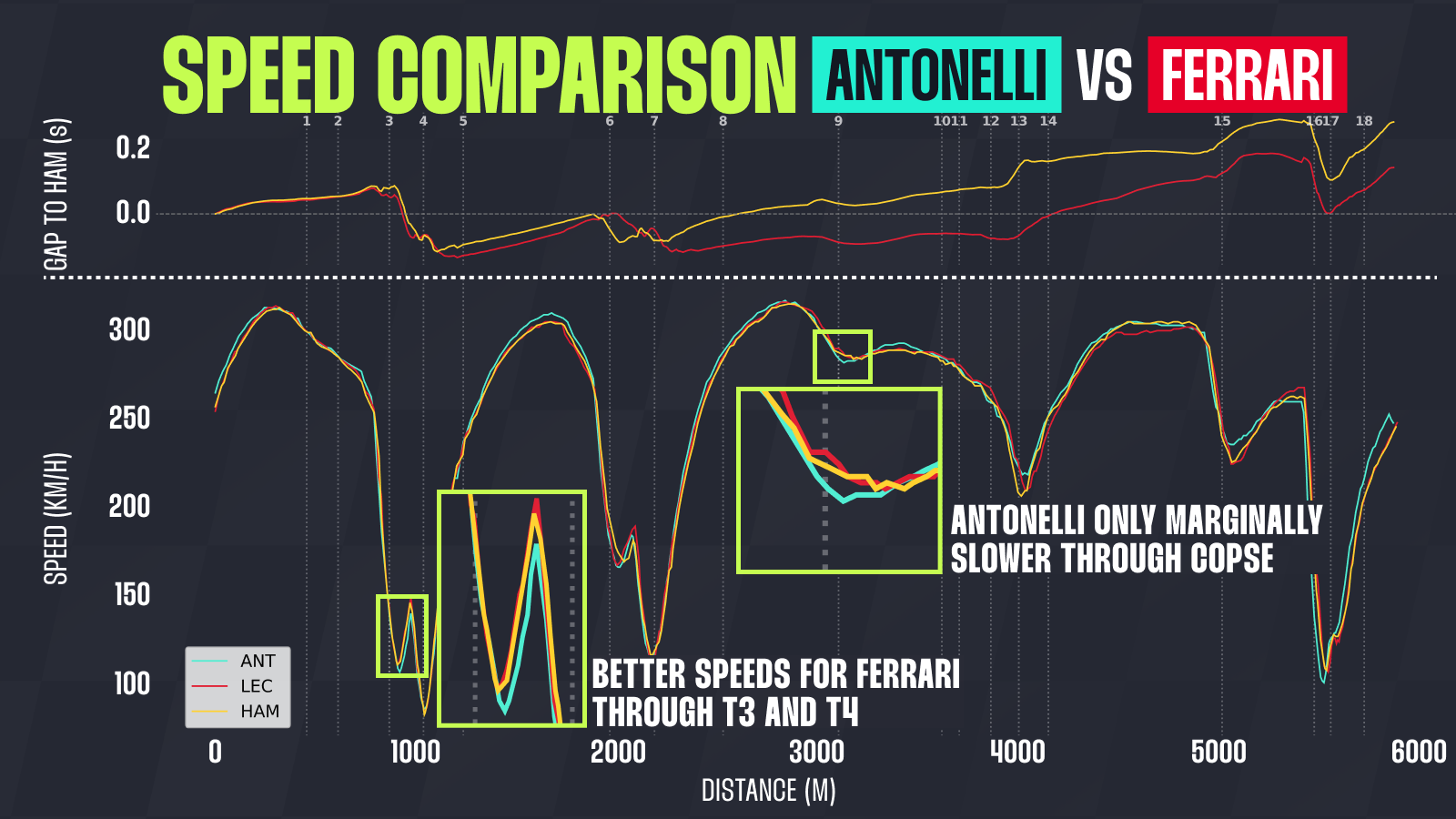
After an initial advantage of just under 0.1 seconds that Antonelli gains with the help of a higher top speed down to the first corner, Ferrari is the one that is significantly faster through Turn 3 and Turn 4.
Mercedes harvests and recharges the battery through these corners to use it in the second part of the lap.
In this section alone, both Hamilton and Leclerc manage to claw back around two tenths and take the ‘lead’ in the fight for pole.
In Leclerc’s case, this advantage remained on his side all the way until entering the third sector of the track.
We have a very similar situation through Brooklands and Luffield; from the graph, we can see how the delta line crosses back over to the side of the Ferrari drivers here, while the moment they hit the straight, it swings back to Kimi’s side.
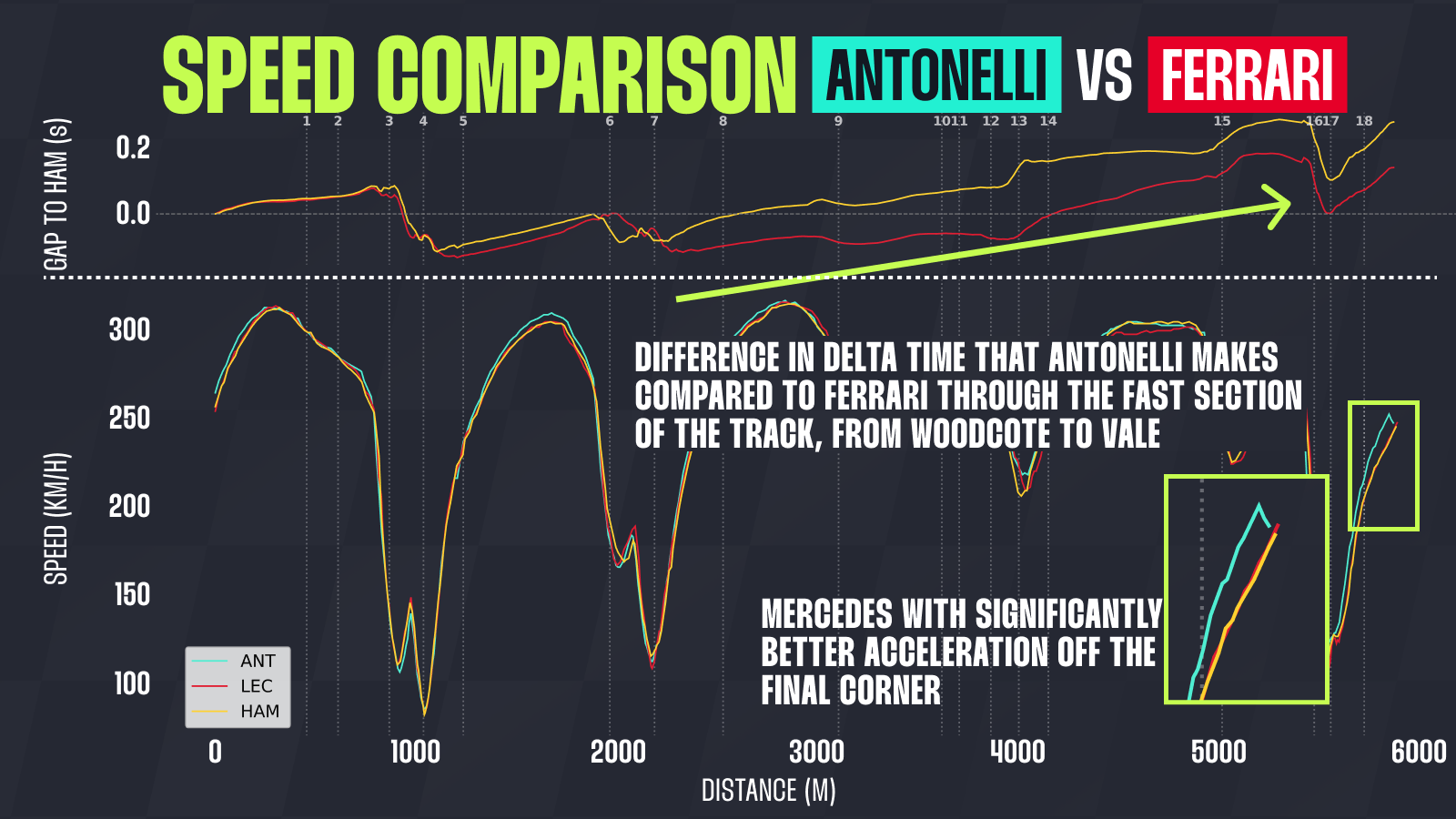
The high-speed sector of the track from Woodcote all the way to Vale is the section where Ferrari simply cannot match Mercedes.
In sprint qualifying, we saw that Hamilton was faster through Copse, which is still the case now, except the difference is much smaller – almost unnoticeable – and brings no real advantage unlike the day before.
An interesting detail is that during SQ, Mercedes did not use 8th gear at all, whereas now Antonelli used it just on the straight from Woodcote to Copse (and only in Q3, which confirms that Mercedes saves their most aggressive strategy for the very end).
It seems that the team made this change by analysing the data, which certainly brought a positive difference.
Already on the approach to Vale, Hamilton was 0.340 seconds behind and Leclerc 0.260 seconds behind, far enough to end any chance of a turnaround.
Through Club, we could again see different deployment strategies, with the Ferrari drivers carrying significantly higher apex speeds, but Antonelli compensated for all of it very easily with incredible acceleration on corner exit.
In the end, Leclerc finished qualifying in P2 with a deficit of 0.175 seconds, while Hamilton was slower by 0.347 seconds, which is definitely a significantly larger gap than expected.
Did Ferrari extract the maximum?
From the perspective of positions gained, absolutely yes.
Being ahead of one of the Mercedes cars is a good result, which gives them more freedom when it comes to team strategy for the main race.
However, from a lap time perspective, the telemetry data reveals that Hamilton could have done better.
After a fantastic lap in sprint qualifying, the seven-time world champion drove below his capabilities.
Namely, Hamilton is the driver with the largest deficit between his real and ideal lap among all the drivers who made it into Q3.
If we put together his best sectors from the session, we get a lap that is 0.174 seconds faster than his actual one, which puts him in P2.
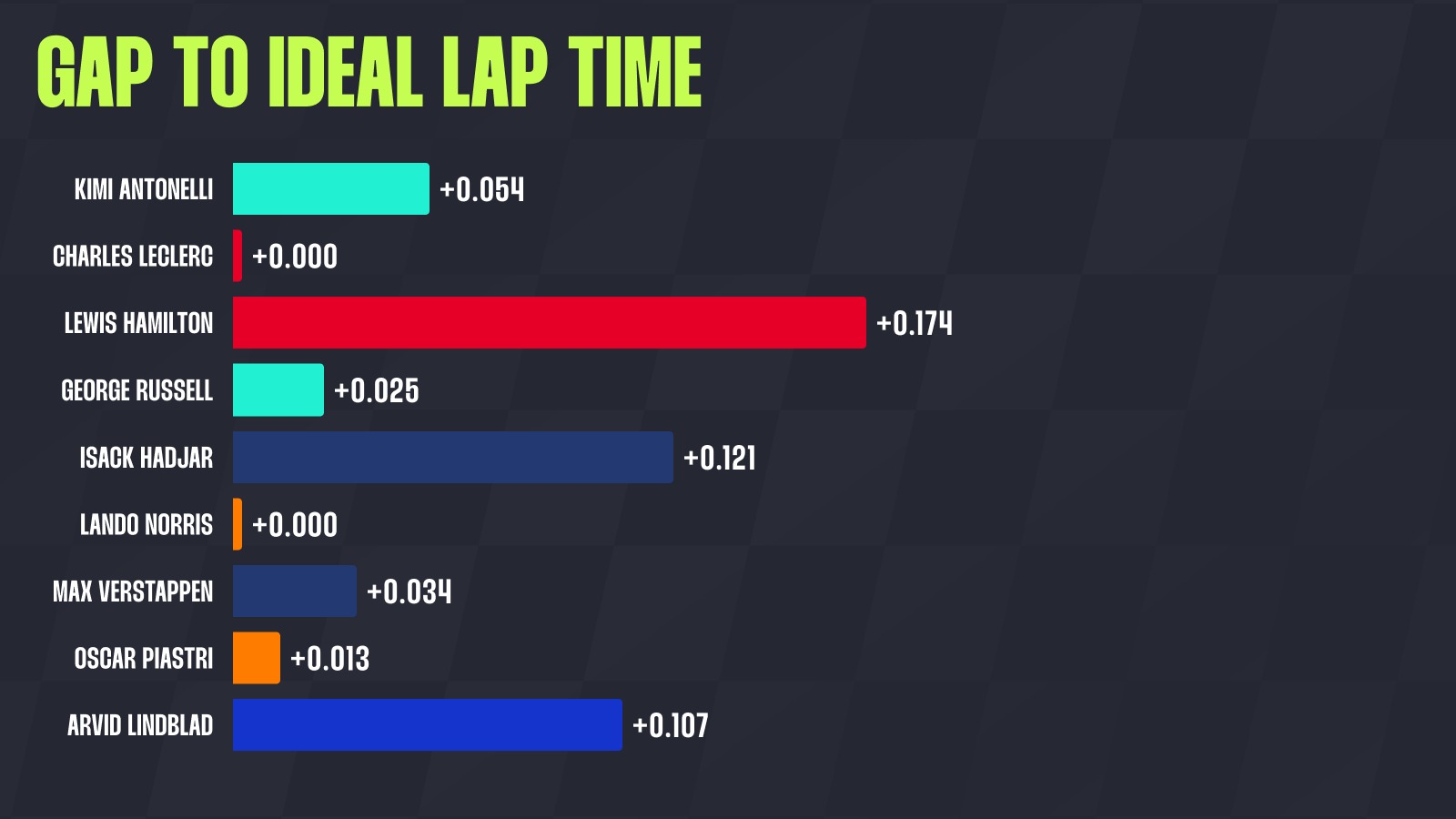
This deficit mostly came from the middle and final sectors, where the Briton had the most room for improvement.
While this lap wouldn’t have put him on pole position, it would have given him the upper hand over his teammate.
Hamilton told PlanetF1.com and other media outlets in the post-race press conference that he was hamstrung by “a problem with the deployment” on his car, which was resolved for the final runs of Q3. He also alluded to inconsistencies with the brakes of the SF-26.
What can we expect from Ferrari in the main race?
The Sprint revealed that Ferrari lags about 1.5 tenths in race pace compared to Mercedes, which is still a large enough gap to fight through.
What currently seems like a realistic battle is with Russell, where Ferrari can use a smart strategy to exploit the fact that both of their cars are next to each other, thereby maintaining their position relative to the Mercedes.
For the team’s perspective, it is very important that Hamilton and Leclerc do not lose time fighting each other.
But considering everything we have seen so far this season, it is likely that we will be see racing between the two of them, which brings additional excitement ahead of the main race at Silverstone.
Want to be the first to know exclusive information from the F1 paddock? Join our broadcast channel on WhatsApp to get the scoop on the latest developments from our team of accredited journalists.
You can also subscribe to the PlanetF1 YouTube channel for exclusive features, hear from our paddock journalists with stories from the heart of Formula 1 and much more!
Read next: George Russell confirms Mercedes investigation over hidden British GP problem